How to honor both roots and flowers in a single preparation — and the principle that lets you build any water formula.
Real medicine is rarely a single plant. You build a formula, and a some times that formula includes both roots that need a long simmer, and leaves and flowers that would be ruined by one. So what do you do when you have burdock and dandelion root that want a decoction, and nettle leaf and peppermint that want a gentle infusion, and you want them all in one cup?
One pot, two needs. This is how you solve it.
 Make it · from Sage
Mullein's House
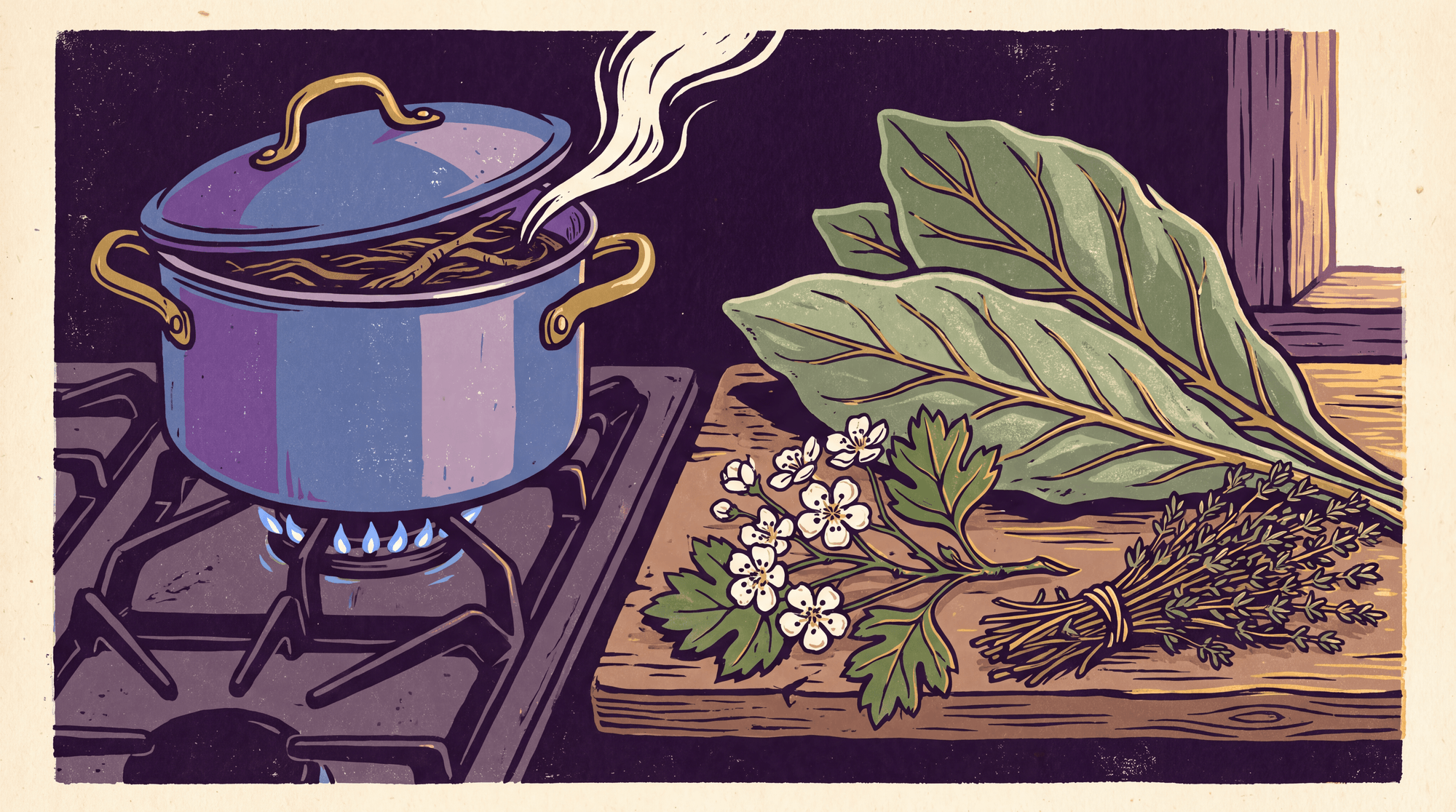
The whole method in one pot: three roots simmered, then mullein, hawthorn, and thyme steeped in off the heat.
Open the recipe →
The Method
We call it a decoction-to-infusion, or a combination extraction. It is simply both methods, in the right order, in the same pot.
Step one. Decoct the hard parts first — the roots, the bark, the berries. Into the water they go, up to a gentle simmer, lid on, cooked the way we learned: twenty, thirty minutes, however long those roots need.
Step two. Take the pot off the heat.
Step three. Add your delicate parts to that hot decoction — the nettle leaf, the peppermint, the rose. Put the lid back on and let them infuse in the heat already held in the water as it cools: ten, fifteen, twenty minutes. The water is plenty hot to steep your leaves and flowers, but it is no longer cooking them. The peppermint’s aromatic oils stay in the pot instead of boiling away. The rose keeps her brightness.
Step four. Strain the whole thing together, press the marc, and you have one finished medicine in which every plant was treated exactly the way she asked to be.
The burdock root got her full simmer. The peppermint got her gentle steep. Nothing was forced, nothing was wasted, and it all came out of a single pot. That is the whole art — you honored the architecture of each plant inside one preparation.
The Principle Underneath
Once you have this, you can build any formula. Hardest, densest, and longest-cooking goes in first. Most delicate, most aromatic, and most heat-shy goes in last. Order your plants by how much heat and time they can take, and you will never ruin a formula again.
There is one more refinement worth knowing. Remember marshmallow — our slippery one, who does not want heat at all? If she belongs in your formula, you do not throw her in at the end of a hot pot. After you’ve strained out everything else and the pot has reached room temperature, put in your marshmallow and give her time that time she needs. Alternatively, you can make the marshmallow separately at the same time the rest is being made… and once your pot has cooled, at that marshmallow infusion.
A Cup to Make
A spring nourishing blend shows the whole method in one pot:
- Decoct burdock root and dandelion root for twenty to thirty minutes.
- Take the pot off the heat and add nettle leaf, peppermint, and rose. Cover and steep fifteen minutes.
- Strain, press, and pour.
The roots reaching down into the dark, the leaves and the flower lifting up bright on top, all of it drawn together in water — that is the way of water in a single cup. The descent and the lift, the earth and the air, meeting in the most ancestral solvent we have.
What Water Teaches
Across these five pieces we have moved from a cup of tea to a whole formula, and the through-line has been water herself: receiver, carrier, the first ingredient. What she asks of us at every step is the same thing.
Water teaches patience. You cannot rush an infusion. You cannot hurry a root into giving up what it spent a season making. The plant sets the pace, and your only work is to pay attention and to wait.
So this is what I hope you carry out of this series: go put a pot of water on. Choose one plant. Meet her the way she asks to be met. And remember that you are doing the oldest, simplest, most powerful thing a healer has ever done.
That is the way of water.