Ashwagandha
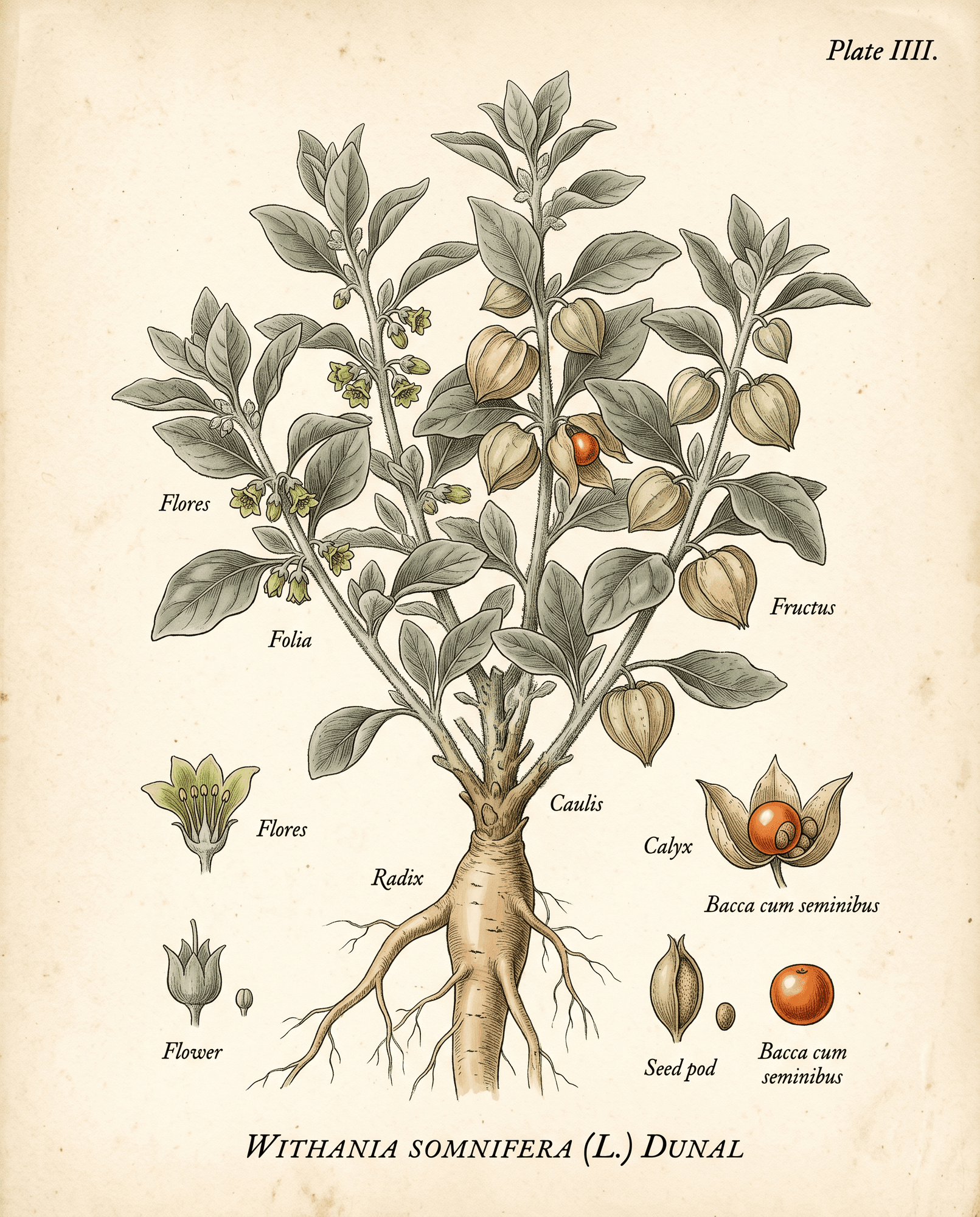
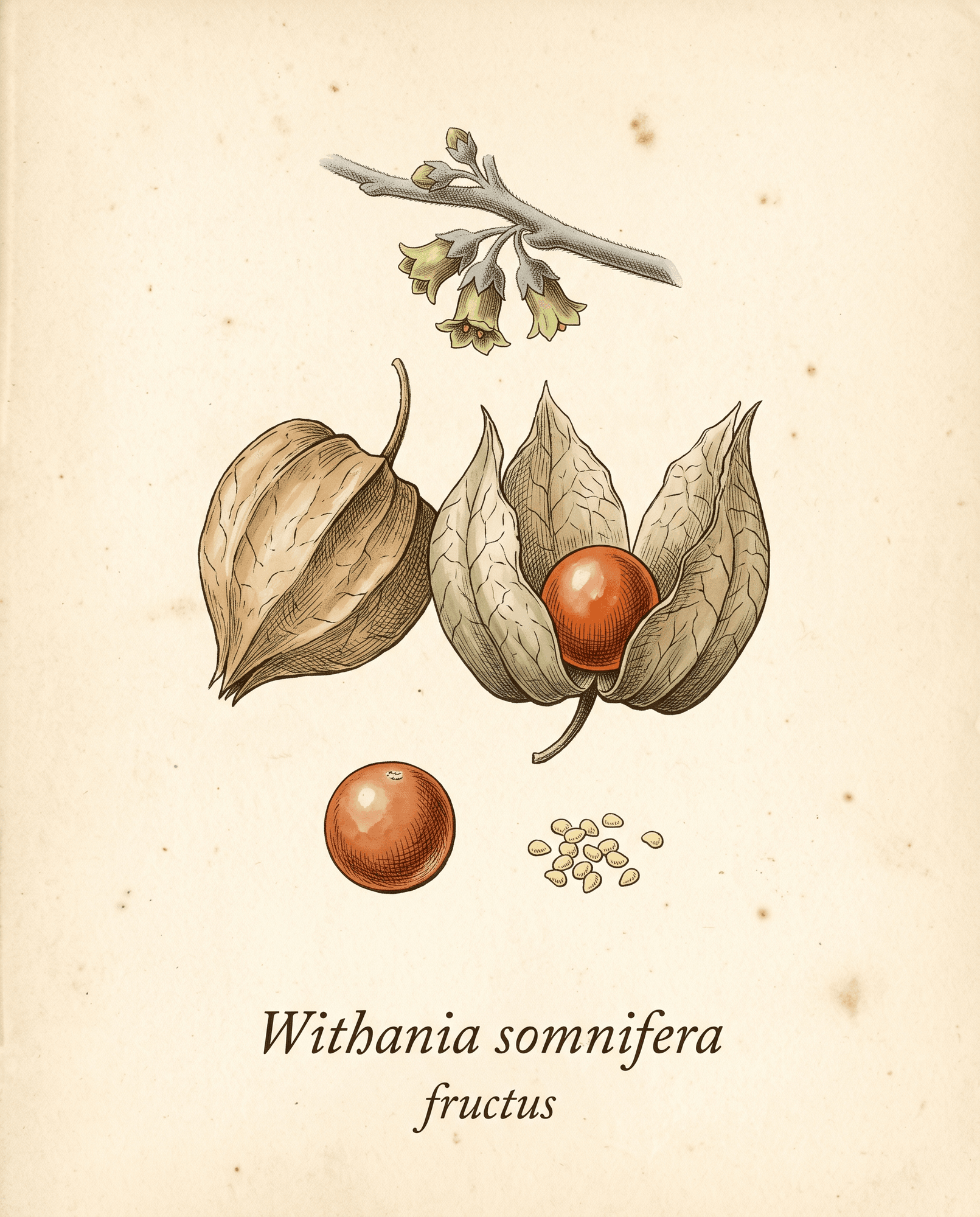
Ashwagandha is the herb for the body that has been running on its last reserve. She is a modest shrub — gray-felted, quiet in her coloring, with small green bells for flowers and red berries she hides inside papery lanterns — and nothing about her above-ground form announces the strength she carries. That strength lives underground, in a pale, fleshy root that smells, when it is fresh, like a horse that has been working all day. Her Sanskrit name says: ashva, horse, and gandha, smell. The old teaching says she gives the one who takes her the endurance of a horse. Her Latin name, somnifera, says the other half: she brings sleep.
Those two names hold her whole medicine. She is strength and she is rest, and she teaches that they were never opposites. She does not give energy the way coffee gives energy, by borrowing against tomorrow. She rebuilds the account. She works on the deepest layer of a person — the marrow, the reserve, the nervous system that has been braced so long it forgot how to let go — and she works slowly, the way roots do. She has walked with people across Africa, Arabia, and the Indian subcontinent for thousands of years, and she has always been medicine for the long recovery: after illness, after childbirth, after grief, after years of carrying more than one body was built to carry.
The shape of her medicine
Ashwagandha moves inward and downward. Where so many stress herbs lift and stimulate, she gathers a scattered system back toward its center and settles it into the ground. She is warming without being fiery, and her quality is heavy and nourishing — the kind of medicine that feeds tissue rather than pushing it. She meets the cold, depleted, wired-and-tired body: the person who is exhausted all day and awake all night, thin in reserve, anxious in the bones, cold in the hands and feet, running on nerves because there is nothing else left to run on.
Her taste is layered. There is sweetness in the root, the building, nourishing sweetness that Ayurveda reads as tonic. There is bitterness, which keeps her from cloying. And there is astringency, a tightening at the edge that helps the body hold what it has been leaking — energy, fluids, attention. Prepared in warm milk, as she has been for millennia, her sweet and moistening nature comes forward and her medicine goes deeper.
As an adaptogen, she helps the body meet stress without tipping into collapse. Her work is normalizing: in the overstimulated, she quiets; in the exhausted, she restores. Modern study has followed her along the axis that runs from the brain to the adrenal glands, finding that she softens the cortisol surge of chronic stress. But the older language says it better — she teaches the body that it is safe enough to stop bracing.
As a nervine, she feeds and tones the nervous system itself. This is not a nervine that numbs. She is restorative, which is why she belongs to the anxious who are also depleted — the frayed, the startled, the overworked, the ones whose anxiety comes from having nothing left in the tank.
Her sedative quality is gentle and cumulative. She is not a knockout herb. Taken in the evening over days and weeks, she helps the body find its way down into sleep and stay there. Her name promises sleep, and she keeps the promise slowly.
As a tonic and trophorestorative, she rebuilds. Ayurveda counts her among the great rasayanas, the rejuvenatives — herbs that restore the tissues, lengthen life, and steady the mind. She is for convalescence, for the long tail of illness, for wasting and weakness, for the elder whose strength is thinning and the young person who has burned through theirs too fast. This is where her nutritive quality matters: the root is starchy and mineral-bearing, a food as much as a medicine, and she was given to the malnourished and the underweight to help them hold flesh.
As an immunomodulant, she brings the immune response toward balance. She helps the depleted body defend itself, and she is studied for her ability to calm immune overreaction as well. That double motion is part of why she asks for care in autoimmune conditions — her direction depends on the terrain.
Her anti-inflammatory and anti-rheumatic threads run through the joints and muscles. The classical texts name her for swelling, gout, and the aching, stiff joints of a cold, dry body, and she appears in medicated oils rubbed into sore limbs. Her antioxidant constituents protect tissue under stress, especially the brain and nerves.
As an aphrodisiac, she restores desire where it has been drained by exhaustion. This is not a stimulant for the libido; it is the return of vitality to a body that finally has enough to spare. She has a long history of supporting fertility and reproductive strength in both men and women.
And her leaf, worked into a paste or an ointment, is a vulnerary — applied across southern Africa to open and septic wounds, abscesses, and inflamed skin. The leaf stays outside the body; the root is the internal medicine.
All of this is one gesture: refilling the well. She is for the body that has been giving from empty.
What lives inside her
Whose medicine she carries
Water (sleep and the deep reserve)
Moon
Taurus
Four of Swords
The Star
Olokun
Olokun lives at the bottom of the ocean, in the dark water where the light does not reach. He holds what is hidden — the riches under the sea, the bones of those lost in crossing, the deep unconscious, the ancestral memory that sits beneath everything a person thinks they know about themselves. His medicine is not the medicine of the surface. It is the medicine of the depths, slow and vast and patient, working in places that are never seen.
Ashwagandha belongs here because she works at the bottom of the person. She does not tend the surface symptom. She goes down to the deepest reserve — what Ayurveda calls ojas, what Chinese medicine calls jing, what the body knows as the marrow and the bone and the last store of vitality that gets drawn on only when everything else is gone. She refills that reservoir the way the ocean refills: invisibly, steadily, by the weight of her presence over time. You do not feel her arrive. You notice, one morning weeks in, that you are standing on solid ground again.
She is also medicine of sleep, and sleep is Olokun’s country. Every night the body goes down into the deep water, and what happens there — the repair, the dreaming, the visits from those who came before — happens out of sight. For people whose sleep has been shallow, broken, or haunted, she opens the way back down. Working with her is an invitation to trust the depths again: to let go of the surface, to sink, and to come back up restored.
Obatala (The Head, Sleep, and the Milk Preparation)
Obatala is the owner of the head, the one who shaped human bodies, the keeper of peace, coolness, and clarity. He is dressed in white. His offerings are white — cotton, shea, coconut, milk — and his medicine settles the mind that will not stop turning.
Ashwagandha’s root is pale inside, and her oldest preparation is white: the root simmered in milk and taken at night. That cup is an Obatala offering to the head. It quiets the restless mind, eases the sleeplessness that comes from thinking too much, and restores the clear, steady intelligence that exhaustion clouds. Ayurveda names her a medhya rasayana, a rejuvenative for the mind — for memory, for focus, for the calm, patient wisdom that is Obatala’s own temperament. She does not sharpen the mind into an edge. She cools it into clarity, and lets it rest.
Ogun (Root, Stamina, and the Strength of the Working Body)
The root is Ogun’s. He is the labor that does not stop, the iron, the forge, the one who clears the path by hand. He is also the one who knows what labor costs — the aching back, the worn joints, the body that has been put to work past its limit.
Ashwagandha carries the strength of the working animal in her very name. She has been given for stamina and endurance, for muscle that has wasted, for joints that ache from use, for the recovery that labor demands and so rarely gets. She builds the body back for work without whipping it, and in that she holds Ogun’s own lesson: that real strength is sustainable, that the blade needs tempering, that the one who works must also be fed and must also lie down. She is medicine for the laborer, and for anyone whose life has been one long shift.
The hands she has passed through
Ashwagandha’s home ground is wide. She grows wild from the Canary Islands and the Mediterranean coast down through the length of Africa to the Cape, across Arabia and the Middle East, and through the Indian subcontinent into Sri Lanka. She is indigenous to southern Africa, and many peoples across her range came to know her independently, each tradition reading her medicine on its own terms.
Across southern Africa, she has deep and varied names: ubuvimbha in isiZulu, ubuvuma in isiXhosa, bofepha in Sesotho, and in Afrikaans geneesblaarbossie — the little medicine-leaf bush — and koorshout, fever-wood. Healers in the Eastern Cape laid her leaves on open sores and abscesses and gave a root infusion for fever. Her leaves were worked into fat or oil to make ointments for septic wounds, inflammation, hemorrhoids, and rheumatism. In the Free State, the berries were roasted in fat and rubbed on the sore udders of cattle. In KwaZulu-Natal, the Free State, and the Eastern Cape she served in reproductive medicine, and across the region her root was known as a calming herb and a sleep herb. In Namibia, her fruit and flowers were carried in charms for lion hunting, and her root was burned to keep lions away from the homestead — a plant that protects the sleeping household.
Further north, the record continues. In Ethiopia, she has been worked with for cough, asthma, eye infections, epilepsy, and against the evil eye and troubling spirits; the Zay people used her for chest pain. In Somalia, her burning smoke was wafted over those whose blood moved too slowly. In Lesotho, leaf, fruit, and root served women’s reproductive health. In Tanzania and in Nigeria’s Lagos State, she was known as an aphrodisiac, and in Nigeria as an herb to bring on a delayed period. In Cape Verde, leaf infusions were drunk to cleanse the blood. Many of these traditions worked with her leaves and berries as much as her root — a broader relationship with the whole plant than the root-centered practice that dominates today.
In India, she became one of the pillars of Ayurveda. Her use is commonly traced back at least three thousand years; the tradition remembers the teacher Punarvasu Atreya instructing students in her use, and his teachings form the foundation of the Charaka Samhita, where she appears among the strength-giving, rejuvenating, and aphrodisiac medicines — for wasting, weakness, and the long recovery after illness. The Sushruta Samhita turned her toward swelling, gout, and medicated oils for aching joints and muscles. Later texts carried her into nerve pain and tremor, and the Bhavaprakasha sums her up as anti-inflammatory, strength-giving, rejuvenating, and good for the mind. Across all of it runs the same cup: the root powder simmered in milk, sweetened, and taken before sleep. In Unani medicine, the Greco-Arabic tradition practiced across South Asia and the Muslim world, she is known as asgandh and held as a tonic for the nerves and the reproductive system.
The Mediterranean record is thinner but old. A plant generally identified as ashwagandha appears in the oldest surviving illustrated copy of Dioscorides’ De Materia Medica, from the 6th century, and European herbals of the 1500s knew her by names that all point at sleep — Solanum soporiferum, the sleep-bringing nightshade. Her family matters to this story. She is kin to henbane, belladonna, tomato, and potato, and the nightshades have always carried a reputation that sits between food, medicine, and the doorway to dreams.
Her Indian name has its own folklore. The smell of the fresh root is the horse, and the gift of the herb is the horse’s power — stamina, strength, virility, the ability to carry a heavy load a long way. She was given to the depleted elder, to the underweight child, to the mother after birth, to the man whose vitality had faltered. In much of her range, her strength was understood as something rebuilt from rest, not wrung out of the body.
In the twentieth century, she crossed into Western herbalism through the new language of the adaptogen — a category born from mid-century research into herbs that help the body withstand stress. She became known in the West as “Indian ginseng,” a name that tells you more about the market than the plant. Today she is among the best-selling herbs in the world, most of it grown as a field crop in the dry country of Rajasthan and Madhya Pradesh, much of it sold as concentrated extracts in capsules. Her popularity has brought new questions about safety, about extracts versus whole root, and about what happens when a medicine of slow restoration is sold as a quick fix for a life that will not slow down. The old way to take her has not changed: in warm milk, at night, over a long season.
She has been fever-wood, horse-smell, sleep-bringer, lion-ward, and the medicine-leaf bush. She has been all of them. She still is.
Where she works in the body
Nervous system. This is her heartland. She is for the nervous system that has been braced too long — the startle response that will not stand down, the anxious hum under everything, the sleep that comes thin or not at all, the mind that races at night and fogs during the day. She calms without dulling and restores without stimulating. Human trials have followed her through stress, anxiety, sleep, memory, and focus, and her old name as a medhya rasayana — a rejuvenative for the mind — speaks to the same thread. She is especially suited to the person whose anxiety and exhaustion are two faces of one depletion.
Endocrine system. She tends the long axis that runs from the brain to the adrenal glands, softening the chronic cortisol pattern of a body that never gets to stand down. She also touches the thyroid. In people with sluggish thyroid function she has been seen to nudge thyroid hormones upward, which makes her useful in the cold, slow, depleted body — and a plant to keep away from an overactive thyroid. Her endocrine work is not a single lever; it is a broader steadying of a system that has been asked to sound the alarm for years.
Reproductive system. For both men and women, she restores reproductive vitality drained by stress and exhaustion. She has a long history in fertility work, and modern study has followed her into improved sperm count and motility, healthier testosterone in men, and eased perimenopausal symptoms in women. Libido returns when the body has energy to spare, and that is her way into desire — not through stimulation, but through replenishment. Across Africa she also served women’s cycles and gynecological health, and her relationship with the womb is one reason she asks for care in pregnancy.
Immune system. She strengthens the immune response of the depleted — the person who catches everything, recovers slowly, and never quite gets back to baseline. Her immunomodulating work leans toward balance rather than simple stimulation, but in autoimmune conditions her direction is not always predictable, and she is best brought in with attention and guidance there.
Musculoskeletal system. She builds muscle and endurance in the wasted and the weak, and she has been studied for strength and recovery in people who train their bodies hard. The classical texts name her for gout, swollen joints, and the cold, aching stiffness of the elder, and she appears in medicated oils for sore muscles and joints. In Ayurveda she nourishes the bone and marrow tissues — the deepest layers of the body’s structure.
How to take her
Harvest calendar
Preparations
Milk decoction (the classical cup): 1 teaspoon (about 3 g) of powdered root simmered in 1 cup of milk — dairy, oat, or coconut — for 5–10 minutes. Add a pinch of cardamom, ginger, or nutmeg if you like. Let it cool to drinking warmth before stirring in honey; Ayurveda teaches that honey should not be heated. Take in the evening, an hour or so before bed. This is her oldest and most trusted preparation, and the fat in the milk carries her medicine deep.
Root powder (churna): 3–6 g daily, divided, stirred into warm water, milk, or ghee with honey. Taken over weeks to months, not days.
Root decoction: 1–2 teaspoons dried, chopped root per cup of water, simmered covered for 15–20 minutes. 1–2 cups daily. Earthier and more bitter than the milk preparation.
Tincture, root: 1:5 dried root in 50% alcohol. Typical dose 2–4 mL, 2–3 times daily. Convenient, though it loses the nourishing quality of the milk and ghee preparations.
Standardized extracts: Human trials have commonly used 250–600 mg of root extract daily, in one or two doses, for eight weeks or more. These are concentrated forms, and the rare cases of liver injury have mostly involved concentrated products. The whole root remains the traditional way to work with her.
Medicated ghee (ashwagandha ghrita): The root cooked into ghee is a classical rejuvenative for depletion, dryness, and the nervous system. Half to one teaspoon taken in warm milk or water.
Confection (lehyam): The root cooked with jaggery or honey, ghee, and warming spices into a thick paste — a building, nourishing preparation for convalescence and the cold months.
Topical, medicated oil: The root decocted into sesame oil, often with other strength-giving herbs, massaged into sore muscles, stiff joints, and the limbs of the weak or elderly. Warm the oil before use.
Topical, leaf: Fresh leaves crushed into a paste or worked into fat or oil, applied to wounds, boils, abscesses, and inflamed skin, as across southern Africa. External use only.
Spiritual & ritual:
- Root kept beneath the pillow or near the bed to guard sleep and invite restorative dreams
- The evening milk cup taken as a quiet offering to the head, with a prayer for rest
- Root placed on altars for Olokun, Obatala, or Ogun when working for restoration after a long depletion
- Root or dried leaf burned to protect the household and turn away the evil eye, as in her Ethiopian and Namibian lineages
When to hold back
Use with caution if:
- You are pregnant. This is where the traditions disagree. Ayurveda has long used her to support and stabilize pregnancy, while some texts warn that high doses can bring on miscarriage, and a few African traditions worked with her leaves and roots for exactly that purpose. Most reports of a miscarriage effect involve the aerial parts rather than the root, and herbal safety authorities have reaffirmed the root’s reproductive safety — yet Denmark banned ashwagandha in 2023 over pregnancy and hormone concerns. Avoid her in pregnancy unless you are working closely with a practitioner experienced in her use.
- You have hyperthyroidism or are taking thyroid medication. She can raise thyroid hormone levels.
- You have an autoimmune condition or take immunosuppressant medication. Her immune-modulating work may push in an unhelpful direction.
- You have liver disease, cirrhosis, or a history of liver injury. Rare cases of cholestatic liver injury — usually with jaundice and itching, arising two to twelve weeks after starting — have been reported, mostly with concentrated extracts. Most resolved once the herb was stopped, but severe cases have occurred in people with existing liver disease. Stop and seek care if jaundice, dark urine, or unusual itching appears.
- You are taking sedatives, sleep medications, benzodiazepines, or anticonvulsants, or drinking alcohol regularly. Her calming effect can add to theirs.
- You are taking medications for blood sugar or blood pressure. Her effects may be additive.
- You have hormone-sensitive prostate cancer. She can raise testosterone.
- You have a known sensitivity to nightshades (tomato, potato, peppers, eggplant).
- You have surgery scheduled. Stop her two weeks before, given her sedative effect.
Topical considerations: Fresh leaf can irritate sensitive skin. Patch test before broader application.
General notes: She is heavy and building, so in a body that is already hot, congested, or full — high fever, acute infection, heavy damp sluggishness, active inflammation with heat — she can add to the burden. Her leaves and berries are kept to external use. She works best in moderate doses over a long season rather than large doses for a short time, and the whole root carries a gentler, more food-like quality than concentrated extracts.
Who walks with her
For the depleted nervous system: Milky oats, skullcap, tulsi, lemon balm, gotu kola.
For deep sleep: Passionflower, chamomile, nutmeg (in tiny amounts in the milk cup), valerian, California poppy.
For the long recovery after illness: Licorice, astragalus, nettle, reishi, shatavari.
For hormonal and reproductive vitality: Shatavari, damiana, saw palmetto, schisandra, maca.
For aching joints and muscles: Ginger, turmeric, frankincense, devil’s claw, the medicated oils of bala.
For the mind and memory: Gotu kola, rosemary, brahmi (water hyssop), tulsi.
In the milk cup: Cardamom, ginger, cinnamon, nutmeg, saffron, a little honey stirred in after cooling.
These allies meet ashwagandha in the places she cannot hold alone. Milky oats rebuild the nerve sheath alongside her; tulsi lifts what she grounds, so the two together steady without sinking. Licorice and shatavari bring moisture and sweetness to her warmth, making her gentler for the person who runs hot. Gotu kola cools and clarifies where she warms and nourishes. Ginger and cardamom carry her into the cold body and help a heavy root digest. In the milk cup, the spices are not decoration — they open the way for a dense medicine to reach the tissues. She is a foundation herb, and foundations are meant to have something built on them.
How to know her
Plant walk: If you can find her growing, find a place where she is tucked among rocks — that is where she likes to be, roots kept cool in the shade of stone while her leaves take the sun. Sit with her. Notice how little she shows above ground, how plain her flowers are, how she hides her fruit. Ask what it would mean to keep your strength the way she does: underground, unannounced, protected.
Evening practice: Make the milk cup by hand rather than swallowing a capsule. Measure the root, warm the milk, stir slowly, and wait while it simmers. Let the preparation itself be the beginning of rest. Take it somewhere quiet, away from screens. Drink it slowly, and when the cup is empty, let that be the signal the day is done.
Ritual of restoration: When you have come through something long — an illness, a grief, a season of caregiving, years of work that took more than it gave — set an intention to rebuild over the course of one moon cycle. Begin at the new moon. Take her each night in milk. Keep a root on your altar with a glass of water for the deep. At the full moon, notice what has returned. At the next new moon, give thanks and decide whether to continue.
Ritual of the sleeping house: For a household troubled by bad sleep, nightmares, or a heavy atmosphere, burn a small piece of dried root on charcoal and carry the smoke through the bedrooms at dusk. Speak a prayer for safe sleep. Place a piece of root beneath each pillow or mattress.
Journal prompts
- Where in my life am I giving from empty?
- What does rest feel like in my body — and when did I last let myself have it all the way down?
- What strength am I keeping hidden, and what is it protecting?
- What do I believe I have to earn before I am allowed to recover?
- What comes to me in the deep places — in sleep, in dream, in the quiet — that I do not hear during the day?
Tarot Spread
A spread for entering into relationship with Ashwagandha as a plant ally:
- Where is my reserve right now — how full is the well?
- What has been draining it that I have not named?
- What is she offering to rebuild?
- What must I allow myself to rest from?
- What strength will return when I do?
Keep a piece of root or a small jar of the powder on your altar with the cards, and a bowl of water beside it. Take the milk cup afterward, and let the answers come in sleep.
The same plant, multiple lenses
In Ayurveda she is known as ashwagandha, and also ajagandha and balada — the giver of strength. Her taste is sweet, bitter, and astringent; her potency (virya) is heating; her post-digestive effect (vipaka) is sweet. She is one of the great rasayanas, and also balya (strength-promoting), vajikarana (aphrodisiac), and medhya (supporting the mind). She nourishes all seven tissues, reaching especially into muscle, bone, marrow and nerve, and reproductive tissue. Her classic vehicles are milk, ghee, and honey.
Vata Dosha — Air & Ether
This is her strongest alignment. Vata in excess shows up as anxiety, insomnia, racing thoughts, dryness, coldness, weight loss, tremor, nerve pain, scattered attention, and depletion — and ashwagandha’s warm, heavy, nourishing, grounding qualities answer nearly every one of them. Taken in warm milk with ghee, she is among the most important herbs for bringing Vata back to earth. For the Vata person who is exhausted, wired, thin, and unable to sleep, she is foundational medicine.
Kapha Dosha — Earth & Water
She also balances Kapha, through her warmth and her bitter and astringent tastes, which keep a heavy root from becoming stagnating. For the Kapha person who is sluggish, low in motivation, and slow to recover, she can restore drive and stamina. Here she is best taken in water or with warming spices rather than in large amounts of milk and ghee, which would add to Kapha’s heaviness.
Pitta Dosha — Fire & Water
Pitta is where she needs care. Her heating potency can aggravate heat, irritability, acidity, inflammation with redness, and skin eruptions when taken in excess or for a long time without balance. For Pitta types who still need her nervous system and rebuilding work, take her in cool or room-temperature milk, with ghee, and pair her with cooling allies — shatavari, licorice, gotu kola, rose. Held this way, she can steady even a fiery constitution.
Ashwagandha is not part of the classical Chinese materia medica, and she has no traditional Chinese name. Practitioners bridging the two traditions have read her through Chinese medical logic, and they do not fully agree. Some read her as balanced in temperature, working in either direction depending on the terrain; others, following Ayurveda and the warmth of the nightshade family, read her as warm. The reading below draws on that bridging work and on her functions as Ayurveda and Western herbalism describe them.
Taste & Temperature: Sweet and slightly bitter. Neutral to warm. Channels Entered: Heart, Kidney, Liver, and Spleen. Functions: Calms the shen and nourishes the heart. Tonifies the kidney and boosts essence. Tonifies qi and strengthens the spleen. Nourishes blood. Gently moves liver qi.
Calming the Shen and Nourishing the Heart
Her most recognizable function in this reading. She settles the spirit that has been disturbed — insomnia, restless sleep, dream-disturbed sleep, anxiety, palpitations, forgetfulness, and agitation — especially where these arise from deficiency rather than excess heat. She calms by nourishing, the way the heart-nourishing herbs do, rather than by heavy sedation.
Tonifying the Kidney and Boosting Essence
She reaches the deepest reserve: exhaustion, aching low back and knees, low libido, infertility, poor sperm quality, premature aging, and the slow decline that follows long overwork. This is where she most resembles the essence tonics — slow-acting, foundational, and meant to be taken over a long season.
Tonifying Qi and Strengthening the Spleen
For fatigue, weakness, poor appetite, muscle wasting, and slow recovery after illness, she builds qi and supports the spleen’s work of turning food into vitality. Her starchy, nourishing root is part of this — she is close to a food.
Nourishing Blood
Her building, sweet nature extends to the blood: pallor, dizziness, dry skin, and the depletion that follows blood loss or childbirth. In this she works alongside the blood tonics rather than in place of them.
Yin/Yang Balance
Ashwagandha is a tonic for deficiency, warming and building, leaning gently toward Yang while nourishing the substance that Yang depends on. She is best for deficient, cold, depleted patterns — the pale, tired, anxious, sleepless body with cold hands and a weak pulse. She is not appropriate for excess patterns — high fever, acute infection, excess heat with a red tongue and rapid pulse, or heavy damp stagnation — where her building nature would add to what the body is already struggling to clear. She is best taken over the long term, in moderate doses, and in formula with herbs that match the pattern.
For going deeper
- Van Wyk, Ben-Erik, van Oudtshoorn, Bosch, & Gericke, Nigel. Medicinal Plants of South Africa. Briza Publications. — for southern African traditional use.
- South African National Biodiversity Institute (SANBI). Withania somnifera entry, PlantZAfrica. — for southern African names, habitat, and herbarium-recorded uses.
- “Critical review of the Withania somnifera (L.) Dunal: ethnobotany, pharmacological efficacy, and commercialization significance in Africa.” 2021. Available through PubMed Central (PMC8529567). — the most thorough gathering of her uses across African countries and peoples.
- Frawley, David & Lad, Vasant. The Yoga of Herbs: An Ayurvedic Guide to Herbal Medicine. Lotus Press.
- Pole, Sebastian. Ayurvedic Medicine: The Principles of Traditional Practice. Singing Dragon.
- Winston, David & Maimes, Steven. Adaptogens: Herbs for Strength, Stamina, and Stress Relief. Healing Arts Press.
- Upton, Roy, ed. Ashwagandha Root: Analytical, Quality Control, and Therapeutic Monograph. American Herbal Pharmacopoeia.
- National Institutes of Health. LiverTox: Ashwagandha entry. — for the current picture of liver safety.
- Elders and practitioners of Ayurveda, Unani, and the healing traditions of southern and eastern Africa. Much of what is known about her lives in practice and oral teaching, close to where she grows.
The Conversation
Questions, noticings, what this is teaching you — leave them here. This same conversation lives in The Circle.