Comfrey
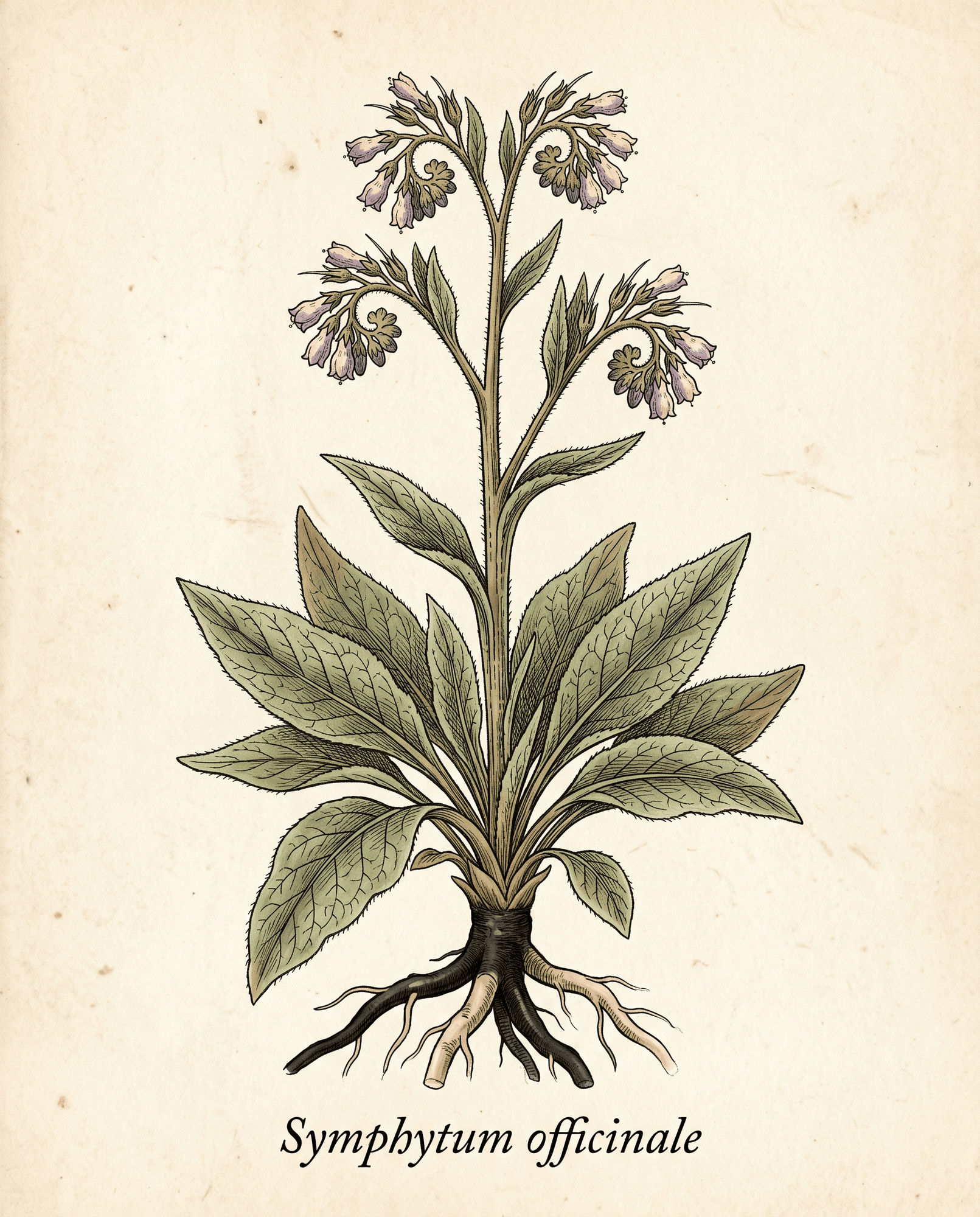
Comfrey is the plant of the mended thing. She grows wide and fast at the wet edges of the world — the ditch, the riverbank, the corner of the garden no one else wanted — and she sends a black root down so deep and so stubborn that a single piece left in the ground becomes a whole plant again. She knows something about coming back from being broken. Her leaves are huge, rough with bristles, heavy with water, and when you bruise one and lay it over a sprained ankle or a bone that has finally been set, she does what her oldest names promise: she knits.
This is hands-on medicine, the kind that lives on the outside of the body. She has been bound onto wrists and backs and knees for as long as people have worked hard enough to hurt themselves — the farmer, the builder, the mother lifting, the elder who fell. She is cool and slippery and patient, and her teaching is about the long, quiet labor of repair. She does not hurry healing. She gives it something to hold on to.
The shape of her medicine
Comfrey’s medicine moves inward and together. Where tissue has been torn apart, she draws the edges back toward each other. Where a joint is hot and swollen, she cools it. Where skin is cracked, chafed, or stretched thin, she softens and moistens. Her sweetness is the sweetness of mucilage — the thick, slippery body of the root and leaf — and her slight astringency gives that softness a spine. She is cooling, moistening, and binding all at once, which is a rare combination: most plants that soothe also slacken, and most that tighten also dry. Comfrey does both jobs without canceling either one.
She is a vulnerary above all else. The allantoin in her root and leaf encourages cells to multiply and fill in what has been lost, which is why she has been used for so long on bruises, sprains, strains, and the slow mending of bone. Laid over an injury, she seems to remind the tissue of its own shape.
As a demulcent and emollient, she coats and softens. Her mucilage holds water against the skin and calms tissue that has been rubbed raw or burned by wind and sun. On dry, cracked heels and hands, she restores suppleness.
Her anti-inflammatory and analgesic actions are where much of her modern reputation lives. Applied to a sprained ankle, a sore back, or an aching knee, she brings down swelling and eases pain. The phenolic acids in her root, rosmarinic acid especially, quiet the inflammatory cascade at the site of injury. She is especially trusted for blunt trauma — the fall, the twist, the knock — where the skin is intact and the damage is underneath.
Her astringent thread comes from tannins. On the surface, as a styptic, she helps slow bleeding and weeping, which is why old wound-healers packed her into cuts and grazes. And as an anti-rheumatic, she has long been laid over gouty joints, arthritic knees, and the stiff, inflamed places that come with age and work.
Together, her actions form a single gesture: binding back together what has come apart. She is for the body that has been broken and asks to be made whole.
What lives inside her
Whose medicine she carries
Water (leaf & mucilage)
The World
The Chariot
Ogun
Ogun is iron and labor. He is the blacksmith at the forge, the one who clears the road with a machete, the worker whose body carries the cost of the work. Comfrey belongs to him because she is the medicine of the working body — the strained back, the crushed finger, the wrenched shoulder, the bone that broke in the field or on the job. She is what gets bound onto the injury so the worker can return to the work. There is no glamour in this. It is the plain, necessary medicine of people who use their hands.
Ogun is also the one who joins metal to metal. At the forge, two pieces of iron are heated, held together, and struck until they become one. That is comfrey’s oldest promise — the bone set and held, the torn edges drawn together, the slow fusing of what was separate. Her black root, driven deep into wet ground and nearly impossible to pull up whole, carries his stubbornness too. You can cut her back to the earth, and she returns. You can dig her out, and every fragment you missed becomes a new plant.
And Ogun clears the road. Comfrey root has long been carried by travelers as a guardian for the journey — tucked into luggage, sewn into a bag, kept on the body until the traveler is safely home. The one who keeps the road open and the one who keeps the traveler whole are the same protection, seen from two sides.
Oya
Oya is the storm that arrives without warning, the wind that snaps the branch, the sudden turn that splits a life into before and after. Every break that comfrey answers began in Oya’s moment — the fall, the slip on the ice, the crash, the instant the body learns it can be broken. Comfrey is the medicine that comes after the storm has passed, when the work of the long repair begins. She does not undo the break. She stands with the body at that threshold and helps it cross back toward wholeness.
Oya also keeps the gates of the cemetery, and her medicine includes decay that turns into life. Comfrey leaves rot faster than almost any other garden plant — cut and steeped in water, they dissolve within weeks into a thick, dark, mineral-rich liquid that gardeners have used for generations to feed their tomatoes, their fruit trees, their whole beds. What dies in comfrey becomes fertility for everything around her. That is Oya’s teaching in plant form: the ending is not the end. What breaks down becomes what builds up.
The hands she has passed through
Comfrey’s names have always told the same story. The genus Symphytum comes from the Greek for to grow together, and nearly every name she has carried across Europe circles back to that one idea. In Latin she was consolida, the one who makes solid. In English she became knitbone and knitback, and comfrey itself descends, by way of French and medieval Latin, from words for joining and strengthening. In German she is Beinwell — bein once meant bone. A plant does not collect that many names for the same gift by accident.
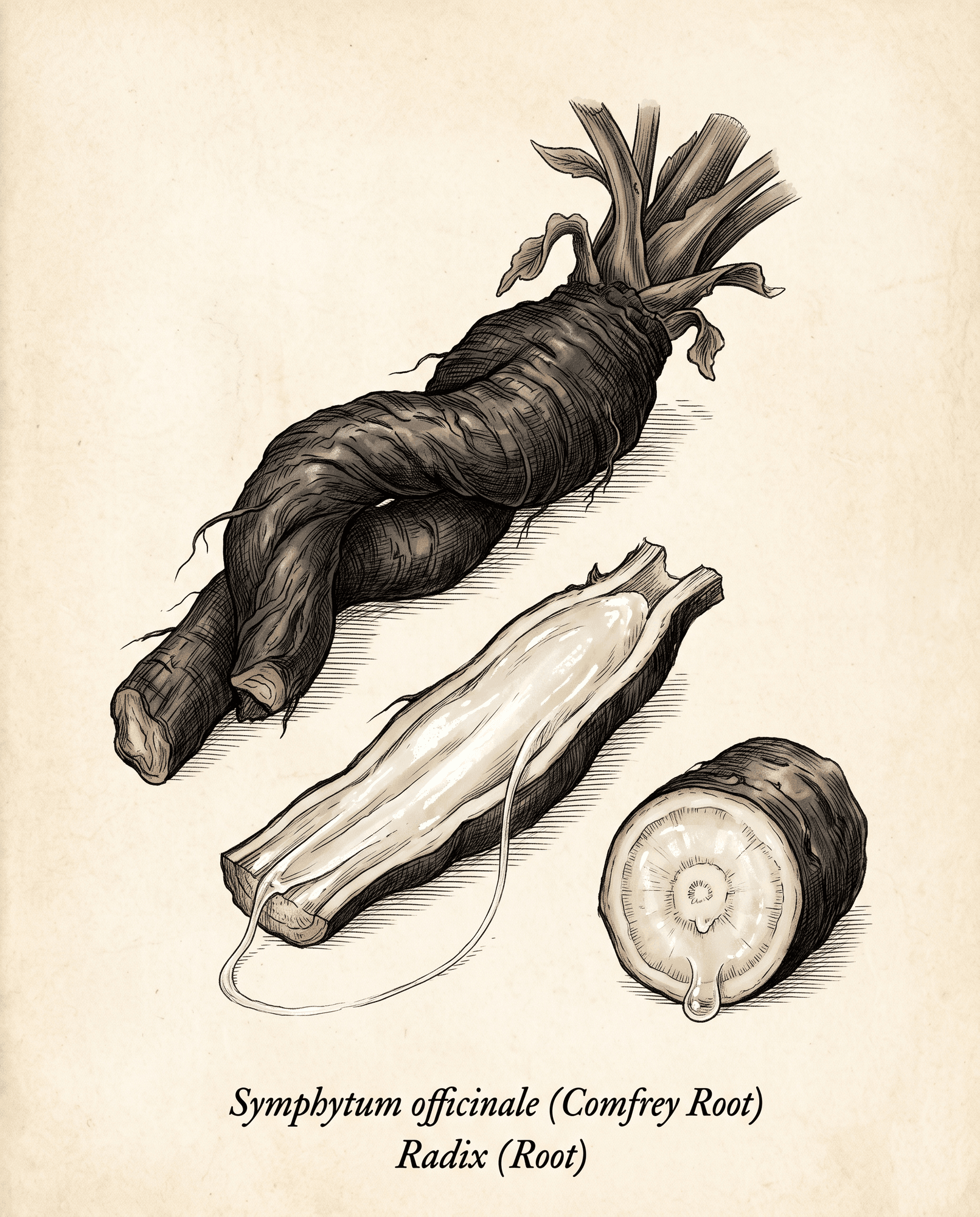
The oldest written descriptions of her come from the Greek physician Dioscorides in the first century, who noted her root — black outside, white and slimy within — and her use for wounds, and from Roman writers who knew her as a joiner of flesh. Through the medieval period she was grown in monastery physic gardens and applied to wounds, fractures, ruptures, and bleeding. Hildegard of Bingen wrote of her. In the Irish book On Wounds, dated to 1352, she is mixed with wheaten meal, honey, and butter and laid on ulcers, and Irish folk healers continued to keep her close as a styptic and bone-setter well into the twentieth century.
There was a well-known proof of her power, repeated in old herbals: boil pieces of meat in a pot with comfrey root, and the pieces would bind back together as if they had never been cut. In the seventeenth century, Nicholas Culpeper placed her under Saturn and the sign of Capricorn — Saturn, who rules the bones, the structure, the root, the slow passage of time. The fresh root, grated and spread on cloth, would set almost like plaster as it dried, and in some places it was used as an early splint around a set bone.
Comfrey crossed the Atlantic with English settlers and spread readily into the moist ground of the eastern woodlands. The Cherokee took her into their own practice, documented using her for sprains and bruises, for dysentery and other digestive troubles, and for gonorrhea — knowledge gathered through their own testing and relationship with a newcomer plant, on their own terms.
In African American conjure, comfrey carries a different but related medicine. Her root is a guardian of travelers: dressed with oil, placed in a red bag, and kept on the body while on the road, she is said to ward off harm from strangers and smooth the way, and to keep the home peaceful and the household faithful while the traveler is away. Her broad green leaves are wrapped around money to draw in more. The same plant that holds a broken body together is asked to hold a journey together, and a household across distance — the binding medicine carried into the spirit.
In the nineteenth century, an English Quaker smallholder named Henry Doubleday became devoted to Russian comfrey, a hybrid of true comfrey and her prickly cousin, and spent the rest of his life promoting her as fodder and food. A century later, the gardener Lawrence D. Hills took up the work, trialing dozens of strains in the village of Bocking in Essex and naming the most productive sterile one Bocking 14. That cultivar now grows at the foot of fruit trees in gardens around the world, cut again and again for mulch and liquid feed. Her deep root draws minerals up from the subsoil — potassium especially — and her leaves give them back to everything planted near her.
The twentieth century also brought her shadow into the light. Comfrey had long been drunk as a tea, swallowed as a tonic, and taken in capsules for ulcers and lung complaints. Her root and young leaves contain pyrrolizidine alkaloids, compounds that the liver converts into substances that damage its smallest veins. The same family of compounds had already been traced, in the 1950s, as the cause of a severe liver disease among Jamaican children and adults who drank bush teas brewed from Crotalaria — a hard lesson learned in Caribbean bodies before it was understood elsewhere. As cases of liver injury linked to comfrey tea and capsules accumulated, country after country restricted her internal use, and in 2001 the U.S. Food and Drug Administration advised that oral comfrey products be removed from the market.
At the same time, her outer medicine was being confirmed. Through the 2000s, a series of trials in Germany found that ointments made from comfrey root eased the pain and swelling of ankle sprains, acute back pain, and arthritic knees — in one ankle study performing as well as a common anti-inflammatory gel. The plant who had been named knitbone for two thousand years was, it turned out, telling the truth about where her medicine belongs: on the body, held against the injury, doing her work from the outside in.
Where she works in the body
Musculoskeletal system — bone, joint, tendon, and muscle. This is comfrey’s heartland. She is one of the great external allies for blunt injury: sprains, strains, bruises, pulled muscles, torn ligaments, sore and overworked backs, and the swelling that follows a fall. Applied as a poultice, compress, oil, or salve over intact skin, she brings down inflammation, eases pain, and supports the slow rebuilding of connective tissue. Once a fracture has been properly set, she has long been laid over the area to support the mending of bone. She is also trusted for the chronic aches of arthritic joints and the hot, swollen pain of gout. Her work here is steady and local — she meets the injury where it lives.
Skin. On the skin, her mucilage and allantoin soften, soothe, and encourage new tissue. She is used for chapped and cracked skin, rough heels and hands, diaper rash and chafing, minor burns, bug bites, and shallow scrapes that are already clean. Her tannins slow the weeping of surface wounds, and her cooling nature calms red, irritated skin. Her one strong caution lives here too: she is so good at closing the surface that she can seal a deep or dirty wound before it has healed from below, trapping infection underneath. She belongs on the shallow wound and the closed injury, not the deep one.
How to take her
Harvest calendar
Preparations
Comfrey’s medicine is practiced on the outside of the body. Apply her to intact skin or to clean, shallow wounds that are already closing, and keep courses short — about 4 to 6 weeks in a year in total is the widely held limit for topical use. Mature leaves carry far fewer of her alkaloids than the root or the young spring leaves, which makes leaf the gentler choice for home preparations.
Fresh leaf poultice: Bruise, chop, or blend a fresh mature leaf with a little water into a green paste. Spread it over the injury, cover with a clean cloth, and leave on for 20–30 minutes. Repeat two or three times a day through the first days of a sprain or bruise.
Fomentation (compress): Make a strong infusion of 2 tablespoons dried leaf per cup of just-boiled water, steeped covered for 20–30 minutes. Soak a cloth in the warm tea, wring it out, and wrap it over the sore area. Rewarm and reapply as it cools.
Infused oil: Use thoroughly dried leaf — the fresh leaf is so watery it can spoil the oil. Fill a jar about halfway with dried leaf, cover completely with olive or another stable oil, and infuse in a warm place for 4–6 weeks, or gently over very low heat for several hours. Strain well. Use as a massage oil for strained muscles and stiff joints.
Salve: Gently warm 1 cup of comfrey-infused oil with about 1 ounce of beeswax until melted. Pour into tins or jars and let set. Excellent for bruises, sore muscles, arthritic hands, and cracked, dry skin. Comfrey salves are often blended with calendula, plantain, St. John’s wort, or arnica oils.
Foot soak or bath: A strong infusion of leaf added to warm water for sore, swollen feet and tired legs.
Root preparations: The root is her most potent part and her most alkaloid-rich. Root-based ointments for sprains and back pain are best sourced from preparations made with alkaloid-reduced extracts rather than made at home.
In the garden: Cut leaves and steep them in a covered bucket of water for 4–6 weeks for a rich liquid feed, diluted before use. Lay leaves as mulch at the base of fruit trees and heavy feeders, or add them to the compost pile to speed its heat.
Spiritual & ritual:
- Root carried in a red bag or tucked into luggage for safe travel and safe return
- Leaves wrapped around money or kept in a wallet to draw steady prosperity
- Root placed on altars dedicated to Ogun for protection of the working body and the road
- Leaves laid over a written intention for mending — a broken relationship, a fractured trust, a self that has come apart
When to hold back
Use with caution if:
- You are considering internal use in any form — tea, tincture, capsule, or fresh leaf eaten. Her pyrrolizidine alkaloids can cause serious, progressive liver damage (hepatic veno-occlusive disease), and harm can build quietly before symptoms appear. Oral products are restricted or banned in the United States, Canada, the United Kingdom, Germany, and Australia.
- You are pregnant or breastfeeding. The alkaloids can cross into the developing child and into breast milk. Topical use is generally avoided at these times, and comfrey should never be used on or near the breast where a nursing infant could ingest it.
- You have liver disease or are taking medications that stress the liver.
- You are taking medications that induce the liver enzyme CYP3A4, which may increase conversion of her alkaloids into their toxic forms.
- You are treating young children. Use small areas and short courses only, and never internally.
Topical considerations:
- Do not apply to deep, dirty, or puncture wounds. She can close the surface before the wound heals from below, sealing in infection and leading to an abscess. Clean and open the wound first, use plantain, yarrow, or calendula in the early stage, and bring in comfrey only once the deeper tissue has begun to heal.
- Do not apply to broken or raw skin over large areas or for long periods; alkaloids absorb more readily through damaged skin.
- Limit use to roughly 4–6 weeks in a year in total, and favor preparations from mature leaf or alkaloid-reduced root extract.
- Make sure a fracture has been properly set before using comfrey to support its mending. She knits quickly, and she will knit a bone in whatever position it is in.
- The bristly leaf hairs can irritate sensitive skin. Blending or straining the leaf, or using oil and salve, avoids this.
General notes: Russian comfrey (S. × uplandicum), including the garden cultivar Bocking 14, contains echimidine, one of the more toxic alkaloids, which true comfrey does not. For medicine, know which comfrey you are growing. Young comfrey leaves resemble foxglove before flowering — a dangerous mix-up. Learn her by her bristly, untoothed leaves and the way the leaf base runs down into a winged stem before you harvest.
Who walks with her
For sprains, strains, and bruises: Arnica (topical, unbroken skin only), St. John’s wort oil, calendula, ginger compress, cayenne (warming liniment for later stages), Solomon’s seal.
For bone and connective tissue (taken inwardly while comfrey works outwardly): Nettle, horsetail, oatstraw, Solomon’s seal.
For skin and surface healing: Calendula, plantain, marshmallow, chickweed, rose.
For wounds, in sequence: Yarrow and plantain first to clean, draw, and stop bleeding; calendula to heal from the inside out; comfrey last, once the wound is shallow and closing.
In the garden: Nettle (a balancing nitrogen-rich partner in liquid feeds), fruit trees, tomatoes, and squash — the heavy feeders who thrive on what her leaves release.
These allies let comfrey do what she does best without asking her to do what she shouldn’t. Because her medicine stays outside the body, nettle, horsetail, and oatstraw carry the inner work — the minerals, the silica, the building blocks of bone — while comfrey holds the injury from without. Solomon’s seal meets her at the tendons and ligaments, restoring flexibility where comfrey restores strength. With plantain, yarrow, and calendula, she becomes part of a sequence rather than a single answer: they open, clean, and heal from below; she closes and binds once it is safe to. And arnica and St. John’s wort meet her in the bruise and the nerve pain that comes with impact. She works best in a community that understands timing.
How to know her
Plant walk: Find comfrey at the wet edge of something — a ditch, a stream bank, the low corner of a garden. Notice how much space she takes, how fast she grows back after cutting, how the base of each leaf runs down the stem like a seam. Run your hand gently along a leaf and feel the bristles. Ask her what it means to take up room, to come back after being cut down, and to hold things together.
Ritual of mending: When something in your life has broken — a relationship, a trust, a sense of yourself — write the name of what was broken on paper. Fold it, and lay a fresh comfrey leaf over it. Place a stone on top. Leave it for nine days, and do not try to fix anything in that time. When the leaf has withered, bury it with the paper in the garden, at the root of something growing. Let what was broken become food for what comes next.
Ritual for the road: Before a journey, dig or purchase a small piece of comfrey root. Hold it and speak where you are going and who is waiting for you to return. Place it in a small red cloth bag with a coin, and carry it on your body or in your luggage until you are home. When you return, lay the root on your altar or at your threshold in thanks.
Seasonal practice: In spring, plant a comfrey crown at the foot of a fruit tree or in the corner of your garden that most needs feeding. Through the summer, cut her back each time she flowers and lay her leaves around the plants that need them. Notice how her generosity is renewable — the more she gives, the more she grows.
Journal prompts
- What in me has been broken, and have I given it time and stillness to knit?
- Where am I rushing a healing that needs to happen from the inside out?
- What have I closed over too quickly, before the deeper wound was ready?
- What is my body carrying from the work I do, and who tends my working body?
- What in my life has decayed that could become fertile ground for something new?
Tarot Spread
A spread for entering into relationship with Comfrey as a plant ally:
- What has been broken that is asking to be mended?
- What is the right timing for this healing?
- What must be cleaned or opened before it can be closed?
- What will hold me together while I heal?
- What will grow from what has broken down?
Keep a dried comfrey leaf or a piece of root on your altar with the cards. Let the answers settle the way she does — slowly, and all the way through.
The same plant, multiple lenses
Comfrey is not part of the classical Ayurvedic pharmacopoeia, but read through Ayurveda’s lens of taste and quality, she is sweet and mildly astringent, cooling, moist, and heavy — a plant that builds and binds. Applied externally, as her medicine is practiced, she calms aggravated Vata and Pitta in the tissues and asks for some care where Kapha is already abundant.
Pitta Dosha — Fire & Water
Comfrey’s cooling nature makes her a natural ally for Pitta conditions on the surface of the body — hot, red, swollen joints, inflamed sprains, gout, minor burns, and irritated, reactive skin. Her mucilage soothes the heat and her astringency gathers tissue that has been inflamed and loosened. For Pitta-type injuries that arrive with heat and swelling, she is foundational external medicine.
Kapha Dosha — Earth & Water
Kapha shares comfrey’s own heavy, moist, cool qualities, and in excess those qualities can add to dampness, stagnation, and boggy swelling. For Kapha-type joints and tissues that are cold, puffy, and slow, pair her with warming, moving allies — ginger compress, cayenne, or mustard in the liniment — so that her binding work is carried by circulation rather than adding to the heaviness.
Vata Dosha — Air & Ether
This is where comfrey’s external medicine shines. Vata governs the bones and joints, and its dry, light, brittle qualities show up as cracking joints, fragile bones, dry and cracked skin, and injuries that are slow to heal. Comfrey’s sweet, moist, heavy, binding nature is the direct counterweight to Vata’s scattering. Comfrey oil massaged warm into dry, aching joints — especially blended with sesame oil, which Ayurveda holds as the great Vata oil — is one of her most fitting uses.
Comfrey does not appear in the classical Chinese materia medica. Practitioners who bring Western plants into Chinese medical thinking read her by her nature and her work: sweet, slightly astringent, cool, and moistening, with an affinity for the tissues Chinese medicine assigns to the Liver (the sinews and tendons) and the Kidneys (the bones).
Taste & Temperature: Sweet and slightly astringent, cool. Channels Entered: Read as Liver and Kidney (through the sinews and bones); Lung and Stomach in historical internal use. Functions: Mends sinews and bones. Invigorates the local flow of blood and reduces swelling from trauma. Clears heat and moistens dryness at the surface. Stops bleeding.
Mending Sinews and Joining Bones
In Chinese trauma medicine — the tradition of die da, the medicine of falls and blows — there is a whole category of herbs devoted to joining bones and mending sinews. Comfrey’s work places her naturally among them. She is applied over fractures once set, over torn ligaments and strained tendons, and over the deep ache of an old injury that never fully healed.
Reducing Swelling and Easing Pain from Trauma
After a fall or blow, blood and fluids stagnate at the site of injury, producing swelling, bruising, and pain. Applied externally, comfrey helps disperse this local stagnation, cooling the heat of fresh trauma and softening the hardness of swelling, so that the blood can move again and the tissue can repair.
Clearing Heat and Moistening Dryness
Her cool, sweet, mucilaginous quality clears heat from inflamed skin and joints and moistens tissue that has become dry, cracked, and brittle — a Yin-nourishing quality expressed at the surface of the body.
Yin/Yang Balance
Comfrey is Yin in nature — cool, moist, heavy, gathering, and still. She is most fitting for injuries with heat and swelling, for dryness and brittleness, and for the slow Yin work of rebuilding structure. She is less fitting on her own for cold, damp, stagnant patterns — cold, puffy joints, old injuries that ache in damp weather — where she should be paired with warming, moving herbs and heat applied with the compress. Her medicine is the stillness that lets the body knit.
For going deeper
- Hills, Lawrence D. Comfrey: Past, Present and Future. Faber & Faber. — the most thorough account of comfrey’s cultivation, agricultural history, and the Bocking trials.
- Wood, Matthew. The Earthwise Herbal: A Complete Guide to Old World Medicinal Plants. North Atlantic Books.
- Culpeper, Nicholas. The Complete Herbal (1653) — available freely through Project Gutenberg.
- Moerman, Daniel E. Native American Ethnobotany. Timber Press. — for documentation of Cherokee use of comfrey.
- yronwode, catherine. Hoodoo Herb and Root Magic: A Materia Magica of African-American Conjure. Lucky Mojo Curio Co.
- Staiger, Christiane. “Comfrey root: from tradition to modern clinical trials.” Wiener Medizinische Wochenschrift (2013). — a review of the topical clinical research.
- European Medicines Agency. Assessment report on Symphytum officinale L., radix. — for constituents, safety limits, and regulatory history.
- Popham, Sajah. The Plant Path podcast, episode on comfrey. — for an energetic and traditional reading of her uses.
- Conversations with elders and bone-setters in your own community. Folk knowledge of comfrey for sprains, breaks, and the working body is often oral and place-based, and worth seeking out where you live.
The Conversation
Questions, noticings, what this is teaching you — leave them here. This same conversation lives in The Circle.