Hawthorn
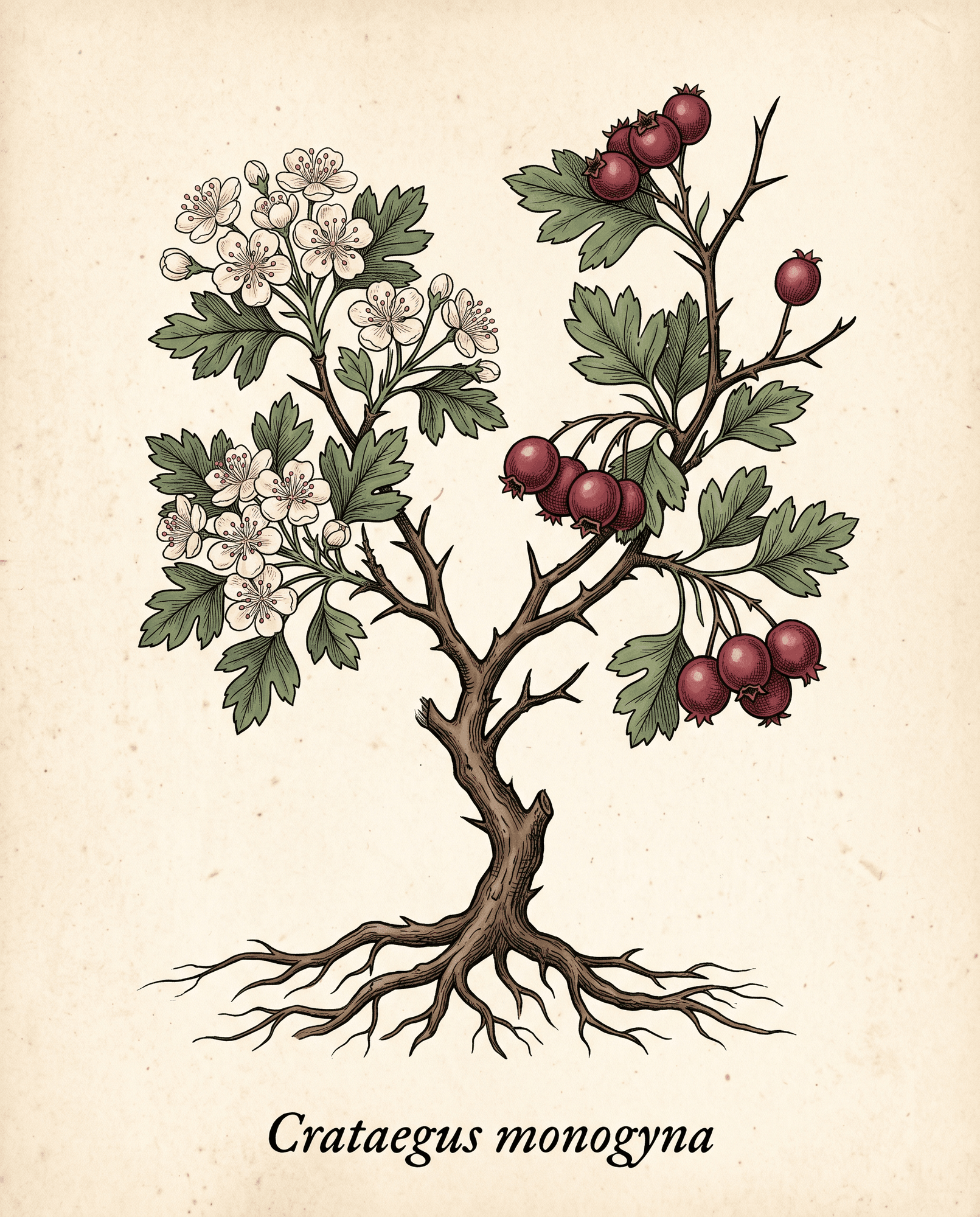
Hawthorn is the keeper of the heart—the muscle that beats and the tender place behind it. She comes cloaked in contradiction, white blossom and long thorn on the same branch, sweetness and defense held together as though they were never opposites at all. This is medicine for those who have loved and lost, who carry their grief high in the chest, who have built the walls around their heart so thick and so long ago that they can no longer find the door. She does not force that door open. She strengthens the heart first, feeds it, steadies its rhythm, and only then—slowly, in her own unhurried time—does she teach it that it is safe to soften again.
She belongs to the rose family, cousin to the flower we most associate with love, and she carries that lineage in her bones. Where Rose speaks of love received and given, Hawthorn speaks of the heart’s own resilience—the plain animal courage it takes to keep beating, to keep protecting what is precious, and to open once more after everything. She is for the depleted and grieving heart, for tissue worn thin by age or sorrow, for a blood pressure that runs high or swings unsteady, for circulation grown sluggish and cold, and above all for the person who has closed the heart in order to keep it safe.
The shape of her medicine
Hawthorn’s medicine moves toward the center. Where many heart herbs push in a single direction—raise or lower, stimulate or sedate—she works as a trophorestorative, which means she rebuilds the tissue itself rather than whipping it or numbing it. She is amphoteric: she brings a pressure that runs too high back down, and steadies a pressure that stutters and swings. This is why she is safe over the long season of healing. She is not a correction applied from outside; she is a feeding from within.
Her temperature is a matter of some disagreement, and that disagreement is worth keeping rather than resolving. In the Chinese tradition her berry is called slightly warm, moving what has gone cold and stagnant; in much of Western practice her flower and leaf are read as gently cooling to the overheated, driven heart. Taken as a whole she sits near neutral, balancing—warming where there is cold stasis, cooling where there is heat, which is simply another face of her amphoteric nature.
Her sourness is the taste of the heart and of gathering—astringent, drawing scattered and slackened tissue back into tone. You can taste it in the berry: tart, a little sweet underneath, faintly puckering. That astringency is not incidental; it is the same gesture she brings to a loosened vessel wall or a heart muscle that has lost its firmness. Her faint sweetness feeds and nourishes what has been spent.
As a cardiotonic and coronary vasodilator, she opens the vessels that feed the heart its own blood, easing the tight, gripping pain of a heart starved of supply. As a normotensive, she meets high pressure by relaxing the vessels rather than forcing the kidneys. As a nervine relaxant, she quiets the anxious, racing quality that so often rides alongside heart complaints—the palpitations of fear, the sleeplessness of grief. As an antioxidant, she protects the delicate lining of the vessels from the slow wear of inflammation and time. And she is slow: this must be said plainly. Hawthorn is not acute medicine but a long companion, and her gifts arrive over weeks and months of steady relationship rather than in a single dose. She rewards the patient.
What lives inside her
Whose medicine she carries
Fire
Mars
Libra
Cancer
The Star
Oshun
Role: Orisha of the sweet waters, love, beauty, the blood, and the joy and sorrow that live together in the heart. Alignment: The emotional heart, love and self-love, the blood and its flow, the grief that lives inside love.
Hawthorn belongs first to Oshun. She is rose-kin, and the rose is Oshun’s own flower—the same five-petaled blossom, the same red fruit, the same thorn set to guard something sweet. Oshun governs the blood and the heart’s whole capacity for love, and Hawthorn is the plant that tends both at once, strengthening the literal blood-pump while softening the heart’s fear. Oshun weeps as easily as she laughs, and she knows what Hawthorn knows: that grief and love are the same water moving in two directions. This is the medicine for the heart that has loved so deeply it has learned to close. Worked with Oshun, Hawthorn restores the sweetness a person has stopped believing they deserve, and teaches the heart that to open is not the same as to be unguarded.
Oya
Role: Orisha of the winds, the storm, the threshold, sudden change, and the transitions of grief and death. Alignment: Boundaries and protection, the gateway between worlds, grief that must move through rather than settle.
The thorn belongs to Oya. Hawthorn is the guardian at the threshold—the tree that stands at the boundary between the living world and the world of the ancestors, blooming at the turning of the season and fruiting at its close, a doorway tree from root to crown. Her thorns are not cruelty; they are the blade Oya carries, the protection set around what is sacred. Where a person’s grief has become a storm that will not pass, or where a heart has been left unguarded and wounded once too often, Oya’s Hawthorn teaches the discipline of the boundary: how to protect the tender heart without sealing it shut, how to let stale grief move the way wind moves stale air. She is the wind at the door and the thorn at the gate, and she does not apologize for either.
The hands she has passed through
Hawthorn has walked with people for as long as there have been hedgerows to walk beside. Pollen records place her in Britain by six thousand years before our era, and across the Celtic and Northern European world she became the most storied of the sacred trees—the fairy tree, the May tree, the guardian of the threshold, revered and feared in equal measure.
In the old Irish Ogham she is Huath, a name tied to fear, to cleansing, and to the fairy realm—a fitting knot of meanings for a tree so paradoxical. She was understood as a doorway, a tree standing at the boundary between the human world and the Otherworld, home to the Sidhe. A lone hawthorn on a hillside was a fairy dwelling, and it was grave misfortune to cut one; roads have been rerouted and building plans abandoned rather than fell a fairy thorn, and the folklore is thick with those who harmed one and paid dearly. She guarded holy wells and sacred springs, and her branches were hung with strips of cloth—clooties—dipped in the sacred water and tied to the tree in petition for healing.
She is, above all, the tree of Beltane, the fire-festival that opens summer. The May Queen was crowned in her blossom; the Maypole was garlanded with her flowers; young people went out before dawn to gather her boughs and wash their faces in the May dew. In this she became the tree of love, marriage, and fertility—in ancient Greece her wood was made into the marriage torch and brides wore crowns of her flowers. Yet her blossom was never brought indoors before May Day, for she belonged to the fairies until the threshold had been properly honored. Love and fear, sweetness and death, protection and bad luck—she has always held both at once. Her flowering marks the door into summer; her berries fall at Samhain, the door into the dark. She is a tree of thresholds through and through.
Her medicine followed her lore. Across medieval Europe she was worked as heart medicine and as protection against lightning and ill-wishing, and Culpeper set her under Mars for her thorns and her guarding virtue while noting her use for the heart. By the time European and later diasporic herbalists turned to her in earnest, she had become what she remains—one of the surest allies for the aging or grieving heart, for high blood pressure, for the tight pain of a starved heart, for palpitations, and for sleep broken by anxiety. In the Chinese tradition she took her own long road, honored for centuries as Shan Zha and recorded in the great herbals, where Li Shizhen described her in the Bencao Gangmu and older texts praised her power to digest heavy food and move stagnant blood.
Where she works in the body
Cardiovascular system. This is her home. Hawthorn is a heart trophorestorative—she rebuilds and feeds the heart muscle over time, strengthening the force of its beat while gently steadying a rhythm that races. She opens the coronary vessels that carry the heart its own blood, which eases the gripping pain of a heart starved of supply, and she meets high or unsteady blood pressure by relaxing the vessels rather than forcing them. Herbalists reach for her in the long care of weak or aging hearts, mild congestive weakness, palpitations, and pressure that runs high. Her work is cumulative and asks for months, not moments.
Digestive system. In her Chinese expression as Shan Zha, Hawthorn is the premier remedy for food that sits and stagnates—especially heavy, greasy, meat-rich meals. Her sourness stirs the digestive fire and breaks down accumulation, easing the bloating, fullness, and heaviness of a belly that has taken on too much. She enters the Spleen and Stomach and clears what clogs them, and this is simply the same dissolving, moving quality she brings to the blood, expressed one level down in the body.
Nervous system. Hawthorn is a quiet nervine, and this is inseparable from her heart work. So many heart complaints ride on fear—the racing pulse of anxiety, the sleeplessness of grief, the chest held tight against feeling. She loosens that held quality, softening the nervous overlay on the heart and making rest possible. She is gentle here, never sedating the spirit, only easing the grip.
Connective tissue. Through her procyanidins, Hawthorn stabilizes collagen—the structural weave that holds vessel walls, skin, and gums in tone. This is subtle, background medicine, but it is real: she strengthens the integrity of the tissues that must hold and contain, quietly, throughout the body.
The emotional & energetic heart. Beneath all of it, Hawthorn is for the heart that has closed—for grief that has hardened into a wall, for the person who has loved and been wounded and decided, somewhere below thought, that it is safer not to feel. She does not tear the wall down. She strengthens the heart until it no longer needs the wall, until the boundary can become a door with a guardian rather than a stone. She is the medicine of boundaried love: the capacity to stay open and stay protected at once.
How to take her
Harvest calendar
Preparations
Tea / infusion: Flower and leaf make a gentle daily tea—1–2 tsp of the dried flowering tops per cup, steeped 10–15 minutes, up to three cups daily over the long term. Decoction: The dense berries give more to a simmer—1–2 tsp dried berries per cup, simmered gently 15–20 minutes. Electuary: For the berries especially, an electuary—dried berry powder folded into raw honey—draws her constituents out slowly and makes a daily heart tonic that is easy to take by the spoonful. Tincture: Berry, leaf, and flower (fresh or dried), typically 2–4 mL three times daily; combining berry with flower-and-leaf captures her fullest medicine. Cordial, oxymel, or vinegar: Her sour, sweet nature makes her a natural in vinegars, oxymels, and brandy cordials—heart medicine that is also a pleasure to drink.
A guiding principle: Hawthorn is a long-relationship plant. Her cardiovascular gifts unfold over weeks and months of steady use, not in a single dose. Combine the berry (fruit) with the flower and leaf (vascular and nervine) to work the whole heart at once.
Spiritual & ritual:
- Heart-anointing oil: Berries or flowers infused into oil and anointed over the heart in work for grief, self-worth, or opening after loss.
- Bath: A strong infusion added to bathwater for emotional restoration and the practice of boundaried love.
- Altar & threshold: Red berries or white blossom kept on the altar or at the door of the home to guard the heart and honor a threshold or transition being passed through.
When to hold back
Use with caution if you:
- Take cardiac or blood-pressure medication—glycosides such as digoxin, beta-blockers, nitrates, or antihypertensives. Because she feeds the force and rhythm of the heartbeat and can lower blood pressure, she may amplify or interact with these. Work with a knowledgeable practitioner and physician; she is not a plant to self-prescribe alongside them.
- Already run low blood pressure, in which case introduce her slowly and watch how you respond.
- Are pregnant—in her blood-moving Shan Zha aspect she carries traditional cautions; use under practitioner guidance.
- Have weak or depleted digestion, as her strong, sour digestive action can be too stirring on an empty stomach or a frail gut in large amounts.
Topical considerations:
- Gentle and well-tolerated in oils and baths; no notable topical concerns. As with any new plant, patch-test infused oils on sensitive skin.
General notes:
- She is remarkably safe with a long record of food-like use, but the heart is not a place for carelessness. Her cautions are almost entirely about interaction with heart medication, not inherent toxicity. Introduce her steadily, give her time, and coordinate care when the heart is already being medically managed.
Who walks with her
Hawthorn is a builder, not a stimulant, and her best partnerships come from her giving the other plants something firm to build upon.
For the heart and circulation: she pairs beautifully with Rose, her rose-family kin, deepening the emotional-heart medicine; with Motherwort, for the anxious, palpitating, grief-heavy heart; with Linden, for gentle vessel-relaxing and calm; and with Tulsi, for a heart worn thin by stress. In the Ayurvedic tradition she is classically joined with Arjuna for cardiovascular strength.
For grief and the nervous heart: Passionflower and Linden soften the anxious overlay, and Lemon Balm lifts a heart pressed down by sorrow, while Rose and Motherwort hold the emotional bowl steady.
For digestion and the moving of stagnant blood (her Shan Zha expression): she works alongside warming, moving digestive herbs to break heavy food stagnation and ease sluggish circulation.
Underneath all of these, one truth holds: Rose and Motherwort meet her at the emotional heart, Linden and Passionflower at the nervous heart, Arjuna at the muscle itself—and Hawthorn holds the center while her allies reach into the edges.
How to know her
Plant walk: Sit with a hawthorn where she grows—the lone tree on the hill, the tree beside the well, the thorned hedge at the boundary of a field. Notice that she is both blossom and thorn, and that neither cancels the other. Ask her what your heart is still protecting, and whether the wall it built so long ago is still needed now.
Seasonal practice: At the turning of a season, or after a loss, gather a few of her berries or blossoms—with permission, and never from a lone fairy thorn without asking first—and keep them at the threshold of your home or on your altar as a marker of the door you are passing through.
Ritual of the guarded heart: Hold a single haw in your palm and feel its firmness and its sourness. Name aloud one place where you have kept a wall when a door with a guardian would serve you better. Let the berry become the medicine of that intention—strong enough to protect, soft enough to open.
Journal prompts
- What has my heart closed around, and what was it protecting me from?
- Where in my life am I keeping a wall when a door with a guardian would serve me better?
- What grief have I been carrying in my chest, and what would it mean to let it finally move?
- Who or what am I still keeping safe behind the thorn?
Tarot Spread
A spread for entering into relationship with Hawthorn as a plant ally:
- What is the true state of my heart right now?
- What wall have I built, and what does it protect?
- What is asking to be let back in?
- How do I keep the boundary while opening the door?
- What does my heart need in order to feel strong enough to soften?
The same plant, multiple lenses
In Ayurveda Hawthorn is most balancing to Vata, and can aggravate Pitta and Kapha when used in excess.
Pitta Dosha — Fire & Water
Pitta, the fire-and-water principle of heat and intensity, can benefit from her cooling touch on an overheated, driven heart, but her slight warmth and her sourness mean she is best balanced with genuinely cooling allies—rose, hibiscus—when Pitta is running hot. On her own she is not primarily a Pitta-reducing herb, and in excess she can add to the fire.
Kapha Dosha — Earth & Water
Kapha, the earth-and-water principle of density and heaviness, asks for care, since her sweet, building nature can add to what is already heavy and damp. Here she is best paired with more moving, warming herbs—and it is her digestive, stagnation-clearing face, the Shan Zha aspect that breaks up accumulation, that is most suited to Kapha.
Vata Dosha — Air & Ether
Vata, the air-and-ether principle of movement, the nervous system, and the racing, scattered quality of anxious thought, is where she shines. Her grounding, steadying, tonifying nature meets Vata-type palpitations, the fluttering anxious heart, and the sleeplessness of an overactive mind. She gathers and settles what Vata scatters, which is the truest expression of her medicine in the doshic language.
Taste & Temperature: Sour, sweet, slightly warm Channels Entered: Spleen, Stomach, Liver Functions: Reduces food stagnation and promotes digestion; invigorates the Blood and dispels stasis
Reducing Food Stagnation and Promoting Digestion
This is Shan Zha’s first and most celebrated action. She reduces the heavy accumulation of meat, fat, and greasy food that overwhelms the Spleen and Stomach, easing the bloating, fullness, belching, and heaviness of food that sits and will not move. Among all the digestive herbs she has the strongest reach into meat and oily stagnation, though she is less suited to grain and starch retention, where sprouted herbs are preferred. In the wheel of the seasons, TCM ties summer to the Heart and the Fire element, and her gentle stirring of digestion and circulation—without overheating—makes her a natural ally for the rich, damp eating of the warm months.
Invigorating Blood and Dispelling Stasis
Her second action moves through the Liver, which governs the smooth flow of Blood, and her sour taste has a natural affinity there. She invigorates Blood circulation and breaks up stasis that has congealed, her slight warmth helping to move what has gone cold and stuck. This is the face of her medicine that addresses stasis showing as menstrual pain, clotting, or the abdominal pain of the postpartum body—and it is the root of her secondary support for the heart and the womb.
Yin/Yang Balance
Shan Zha is a moving, dispersing herb—her nature is to break down, invigorate, and clear rather than to build or hold. She is warming and Yang in her action on stagnation and stuck Blood, and she is at her best where there is excess and accumulation to be moved. For this reason she asks for care in those with weak digestion, a genuinely empty condition, or Spleen deficiency without accumulation, where her strong dispersing action can deplete rather than help. She is a herb of movement, and movement includes knowing when the field is already clear.
For going deeper
- Popham, Sajah. Evolutionary Herbalism — for Hawthorn’s planetary and elemental architecture and her medicine of the heart.
- Wood, Matthew. The Earthwise Herbal (Old World) — for Hawthorn’s Western energetic and clinical portrait.
- Winston, David, & Maimes, Steven. Adaptogens, and Winston’s cardiovascular writings — for Hawthorn as a heart trophorestorative.
- Blamires, Steve. Celtic Tree Mysteries — for the Ogham lore of Huath and the folklore of the fairy thorn.
- Bensky, D., Clavey, S., & Stöger, E. Chinese Herbal Medicine: Materia Medica — for Shan Zha.
- Flower Essence Society (FES) materia on Hawthorn flower essence — for the grieving and armored heart.
Where possible, seek the living lineages that carry this plant—the Celtic and British hedgerow traditions that named her the May tree, and the Chinese herbal tradition that has honored Shan Zha for many centuries—rather than only the clinical literature that came after.
The Conversation
Questions, noticings, what this is teaching you — leave them here. This same conversation lives in The Circle.