Wood Betony
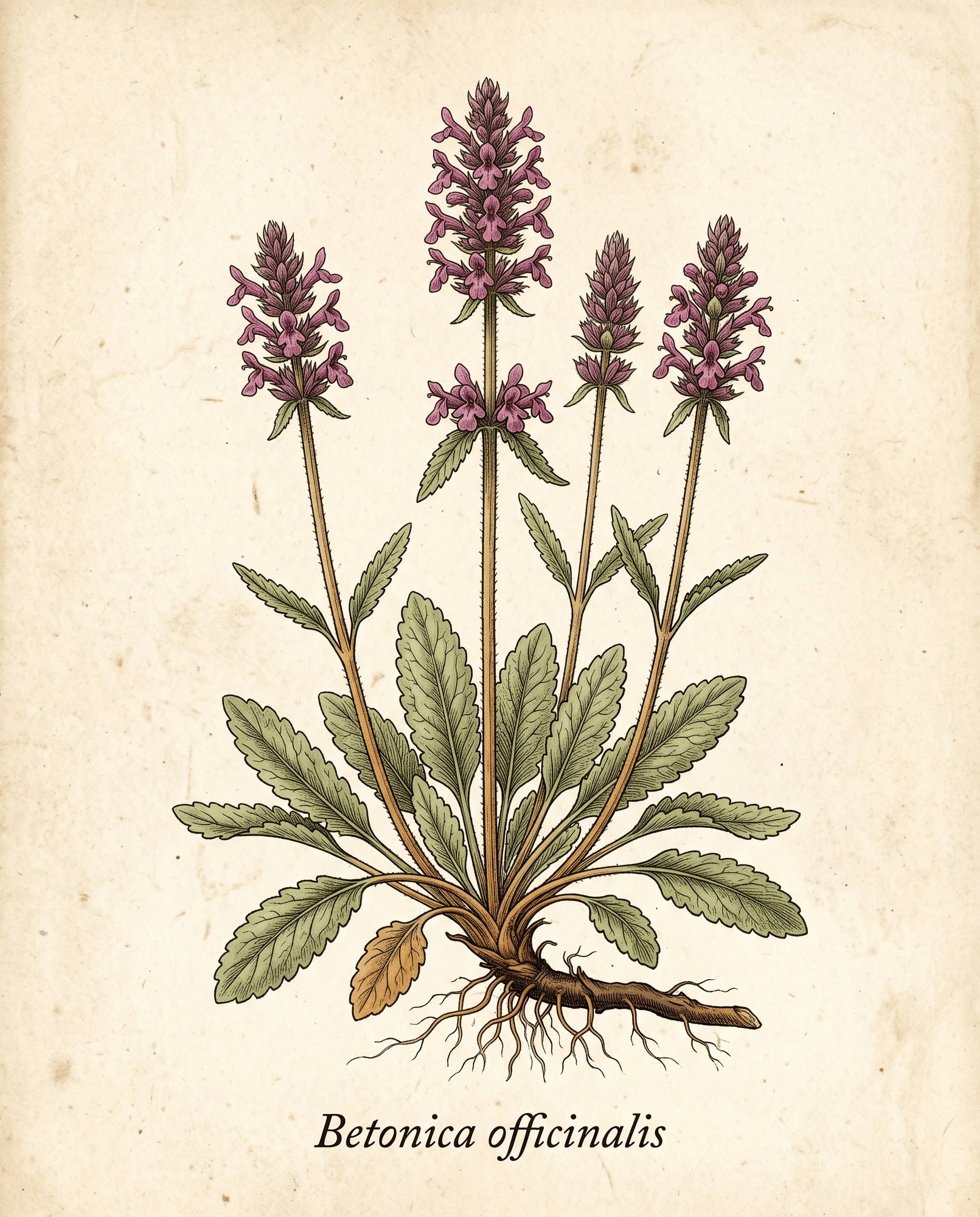
Wood betony is the herb for the one who has gone up and out of herself and cannot find the way back down. She grows low most of the year, a quiet ring of wrinkled leaves pressed close to the ground, and then in high summer she sends up a single square stem with a spike of plum-colored flowers at the top — as if to show exactly the path she offers, from the head down the spine to the earth and back again. She is a mint without much perfume, bitter and drying and steady, and she does not announce herself. Her medicine is the kind you notice by what goes quiet: the headache that loosens, the stomach that unclenches, the mind that stops circling at three in the morning.
For close to two thousand years she was among the most honored plants in the Old World herbals — the remedy of the head, the guardian of the sleeper, the herb planted in churchyards to keep the dead at rest. Then, somewhere in the last century, she slipped out of common practice, so quietly that many herbalists today have never met her. She is worth meeting. She is medicine for the overthinker and the overwhelmed, for the person whose body has become something they live above rather than in, and for anyone who has been visited at night by more than they can carry alone.
The shape of her medicine
Wood betony’s medicine moves downward and inward — from the crown, through the nerves of the face and neck, into the belly, and toward the ground. She gathers what has scattered upward and settles it where it belongs. Her drying, gently astringent nature tones what has gone boggy and loose in the gut, and her relaxing nervine quality unwinds what has gone tight in the head and shoulders. She answers tension above and dampness below, which is a common pairing in bodies that live mostly in their thoughts.
Her temperature is one place the traditions disagree, and the disagreement is worth keeping. Hildegard of Bingen called her warm and dry, and Culpeper prescribed her for headaches “coming of cold.” Many modern herbalists in the Matthew Wood lineage feel her as slightly warming and diffusive — invigorating without being stimulating. Others, Christopher Hobbs among them, read her as cool. The honest answer is that she sits close to neutral and leans whichever way the body needs: warm enough to bring blood and life back to a depleted belly, cool enough to settle a hot, pounding head. Both readings are describing the same plant from different patients.
She is a nervine first. Her work on the nervous system is not sedation so much as reintegration — she brings awareness back into the body. Herbalists who know her well describe her as the remedy for people who are “in their heads,” spacey, ungrounded, disconnected after trauma or after long stretches of purely mental work. She does not dull the mind; she gives it somewhere to land.
As an antispasmodic and analgesic, she eases the gripping kind of pain: the tension headache that starts at the base of the skull and wraps around the temples, the jaw held tight all day, the shoulders up around the ears, the cramping belly. This is where her old reputation as the sovereign herb of the head comes from. She releases the hold rather than masking the pain.
She is bitter, and like every bitter she wakes the digestion from the tongue down — saliva, stomach acid, bile, the whole cascade. Her bitterness is mild, which makes her well suited to the person whose digestion is weak because their nerves are frayed. Her gentle cholagogue action encourages bile flow, and old tradition gave her before heavy meals, especially meat, to help the body meet richness it would otherwise struggle with.
Her astringent tannins tighten and tone. They are why she has long been given for loose bowels, for sore and spongy gums, for an irritated throat, and why she was once laid on wounds to help them knit. As a vulnerary, she belonged in the medieval wound kit, soaked into bandages to help a cut close.
She is a tonic in the old sense — strengthening over time rather than in a single dose. Matthew Wood places the heart of her action at the solar plexus, the great nerve center behind the stomach where the brain and the gut speak to one another. When that center is weak, digestion falters, the tissues are underfed, stress becomes impossible to absorb, and tension climbs into the neck and head. Wood betony meets the problem at its root: she strengthens the belly so the head can let go.
As a diaphoretic, she relaxes the surface of the skin and lets the heat of a fever release outward, particularly when fever comes with a tight, aching head. And as an emmenagogue, she has been used to bring on delayed menses and ease cramping, which is also why she is set aside during pregnancy.
Together, her actions make a single gesture: bringing you back down. She is for the body that has left itself to go live in the attic.
What lives inside her
Whose medicine she carries
Air (the head, the mind, the visions she quiets)
The Hierophant
Four of Swords
Obatala
Obatala is the shaper of heads — the one who molds each person’s ori, the inner head that carries destiny, before they are born. He is cool white cloth, clarity, patience, and the peace that comes when a mind is right with itself. Wood betony has been the herb of the head for as long as people have written about plants. Her old name may even mean “good head,” and whether or not the etymology holds, the tradition does: she was given for every complaint of the head, from headache to madness, from frightful visions to the confusion of the drunk.
She carries Obatala’s medicine in the way she restores composure. Not by forcing calm, but by returning the head to its right relationship with the body — the crown resting on the spine, the spine rooted in the belly, the belly on the ground. When the mind is clear and cool and settled in its own house, discernment becomes possible again. Hildegard prescribed her against madness and false dreams. That is Obatala’s work too: restoring the white, still clarity that lets a person see what is real.
There is a quieter thread here as well. Her folk names — bishopwort, bishop’s wort — tie her to the churchyard and the altar, to vestments and consecrated ground. She was planted where the holy and the human meet. Working with betony in this light is a practice of cleaning the head before prayer, before divination, before any act that asks you to listen clearly.
Elegua
Elegua stands at the crossroads and at the door. Nothing passes between worlds without him; he opens the road and he closes it. In the body, the place where roads meet is the solar plexus — the junction where the head’s thinking meets the belly’s knowing, where the nerves of digestion and the nerves of fear braid together. Wood betony works precisely at that crossing. When the way between head and gut is blocked, everything stalls: food sits, worry loops, the body cannot hear itself. She opens that road again.
Elegua also guards the threshold of the home, and betony has stood guard there for centuries. Pliny recorded the belief that simply having betony in the house protected it from harm. She was carried as an amulet, hung over doorways, and worn about the neck at night. Hers is doorway medicine — the plant set at the edge of things to decide what comes in. To work with her in Elegua’s name is to tend your own thresholds: what you let in at the door, what you let into your body, what you let into your sleep.
Oya
Oya keeps the gates of the cemetery. She is the wind that moves between the living and the dead, the storm that clears the air, the one who escorts spirits across and does not let them linger where they do not belong. Across Europe, wood betony was planted in churchyards so the dead would rest quietly in their graves. The oldest English herbal, written around the year 1000, lists her first remedy as protection against monstrous nocturnal visitors and terrifying visions and dreams.
This is Oya’s medicine carried in a small purple flower. Betony does not banish the dead; she settles them. She draws a clear line between the world of the living and the world of the restless, and she gives the sleeper a place to stand. For anyone who wakes from dreams that feel like visitations, for the grieving who are haunted rather than accompanied, for those working close to ancestors and needing to keep a clean boundary, she has long been the herb under the pillow and on the grave. She guards the gate, and she reminds you that you are on the side of the living.
The hands she has passed through
Wood betony’s story begins with a people. The Roman naturalist Pliny wrote that she took her name from the Vettones, an Iberian people of what is now western Spain and Portugal, who knew her medicine first — vettonica, the Vettones’ herb, softened over the centuries into betonica and then betony. Pliny wrote that she was esteemed above every other plant, and that merely keeping her in the house was believed to protect it from harm. Her range was always wide: she grows wild from the Atlantic coast through Europe and western Asia to the Caucasus, and into the mountains of North Africa.
Her fame peaked in a single remarkable text. A Latin treatise called De herba vettonica, long attributed to Antonius Musa, physician to the emperor Augustus, but now understood to have been written around the fourth century, devotes itself entirely to betony and lists close to fifty conditions she was said to cure. It credits her discovery to Asclepius, the healer-god, or to Chiron, the wise centaur who taught medicine to heroes. The treatise traveled far. Around the year 1000 it was translated into Old English, and the resulting Old English Herbarium opens with betony — the first plant in the book, good for both soul and body. Of its twenty-nine remedies, the first is protection against nocturnal visitors and frightful visions and dreams. The herbal also tells you how to gather her: in August, and without iron.
That instruction says a great deal. Iron was the metal that cut ties with the otherworld, and a plant whose power lay partly in that world had to be taken by hand. The same herbal advises that in winter, when the leaves are gone, the root can be used instead. Medieval people also believed that wild animals knew her worth — that a wounded stag would seek out betony and eat it to heal its own arrow wound.
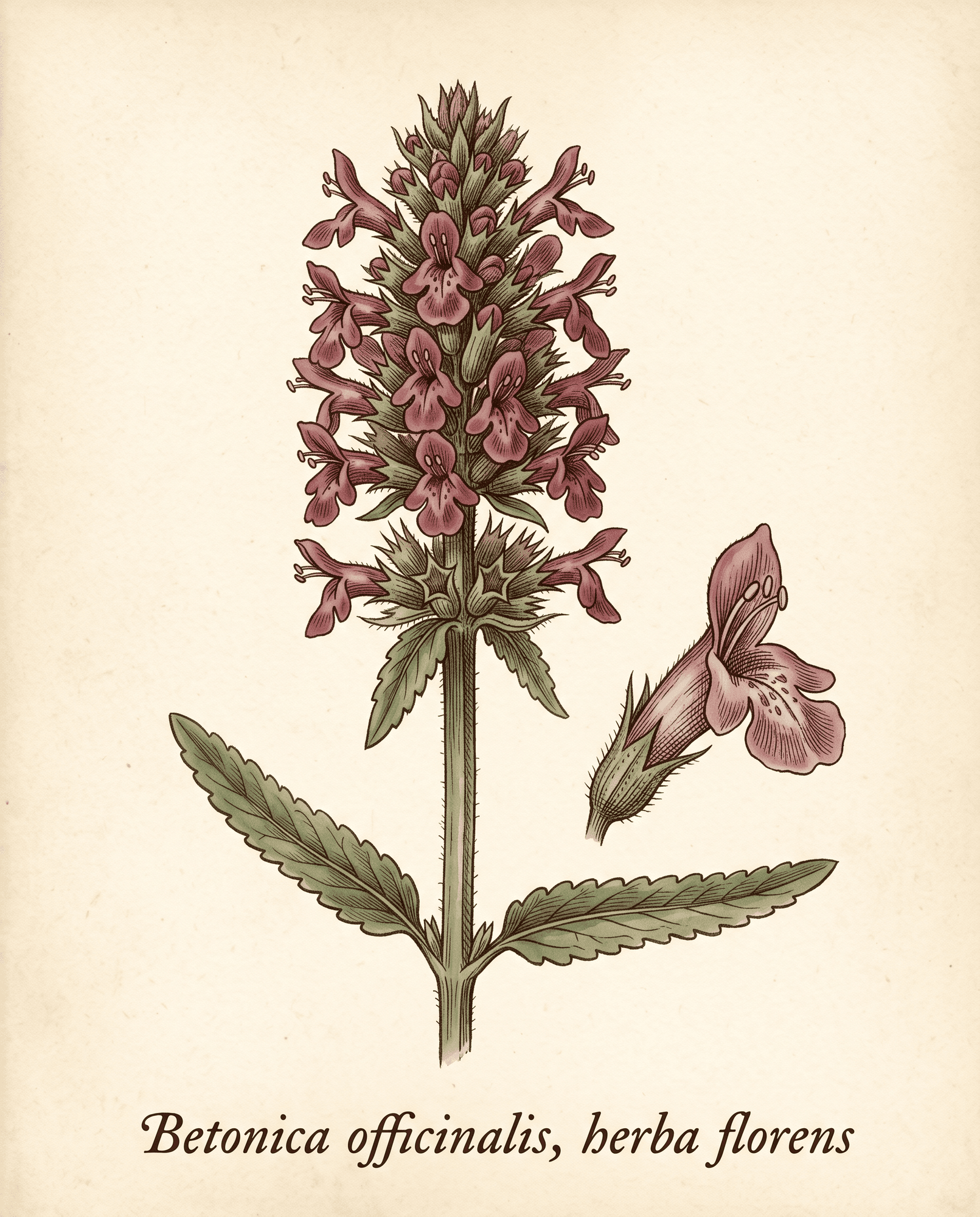
In the twelfth century, Hildegard of Bingen wrote of betony as warm and dry and full of good powers. She prescribed it against madness and against false dreams, instructing that those troubled at night should keep betony with them while they slept. That practice survives in the Hildegard tradition today as small cushions of betony herb tucked beside the pillow. In Wales, a charm against dreaming instructed the sleeper to hang betony leaves around the neck at bedtime. Across Britain and the Continent she was planted in churchyards to keep ghosts from walking.
The proverbs tell how ordinary people felt about her. In Italy they said sell your coat and buy betony. In Spain, the highest compliment for a person of many gifts was that they had as many virtues as betony. The seventeenth-century physician Robert Turner listed some thirty complaints she was known to help and closed with a line he had found in an old manuscript: more than all this has been proved of betony.
Nicholas Culpeper, writing in the 1650s, placed her under Jupiter and the sign of Aries — Jupiter for the liver and the generous, benevolent nature of her medicine, Aries for the head she was known to serve. He recommended her for the falling sickness, for headaches from cold, for clearing the chest, and for opening obstructions of the liver and spleen. Later centuries smoked her for headache, alone or with eyebright and coltsfoot, and ground her dried leaves into snuff; a pinch of the powder brings on fierce sneezing, which was thought to clear the head.
She has a living folk tradition beyond England’s herbals. In Austria, betony tea, compresses, and baths have been used for the respiratory and digestive tracts, the nervous system, the skin, and the womb. Across Serbia, Montenegro, and the Balkans, dried betony leaf tea has been taken for nervous tension, headache, anxiety, skin troubles, and the changes of menopause. Her close cousins carry parallel medicine further east: in Iran and Turkey, related Stachys species are drunk as “mountain tea” for colds, fevers, stomach pain, painful menstruation, and anxiety. In traditional Persian medicine one of these cousins, Stachys lavandulifolia, is classed as hot and dry in temperament, a tonic for the brain and the stomach, and a remedy for headaches that come with phlegm — a description Culpeper would have recognized.
By the twentieth century betony had faded from most herbalists’ practice. Matthew Wood is among the herbalists who brought her back, rooting her medicine in the solar plexus and describing her as the remedy for people who need to come down to earth. His work, and that of herbalists who learned from him, has returned her to modern use for tension headaches, nervous digestion, poor grounding, and the disconnection that follows trauma.
A word about her name. In North America, “wood betony” is also the common name for Pedicularis canadensis and its relatives, the louseworts — native plants of an entirely different family, with their own long history in Indigenous medicine and their own distinct uses as a muscle relaxant. The two are not interchangeable. When you see wood betony in an American herbal or on a dried-herb label, check the Latin name. This monograph is about the Old World plant, Betonica officinalis, sometimes still sold as Stachys officinalis or Stachys betonica. Botanists recently returned her to her own genus, Betonica, after genetic work showed she stands apart from the true hedgenettles.
She has been called a cure for nearly fifty diseases, a guardian of graves, a charm against nightmares, a snuff, a tea, and the herb of the head. Underneath every one of those names is the same gesture: she brings what has wandered back home.
Where she works in the body
Nervous system. This is her heartland. Wood betony is a relaxing, restoring nervine for people whose nervous systems are overextended rather than simply overwound — the student up all night, the caregiver who has not been inside their own body in months, the person who thinks for a living and has forgotten they have feet. She eases the tension headache that rises from the neck and shoulders, the clenched jaw, the scalp that aches, and the circling, racing thought that keeps sleep shallow. Her gift is grounding: she brings attention down out of the head and back into the body, which is often what an exhausted nervous system needs more than sedation. She has a long history with nightmares and disturbed sleep, and she belongs in the formula of anyone who carries the aftermath of trauma as a sense of being slightly outside themselves.
Digestive system. Her work on digestion is inseparable from her work on the nerves. She is for the stomach that shuts down under stress — the knot in the belly, the meal that sits like a stone, the nausea of anxiety, the loose bowels that come with nervous days. Her mild bitterness wakes digestive secretions and bile flow without overstimulating; her tannins tone a gut that has gone loose and boggy; her antispasmodic action eases cramping. Taken before or with a heavy meal, she helps the body meet richness it might otherwise struggle with. As a mouthwash or gargle, her astringency firms tender gums and soothes a raw throat.
The solar plexus — where the head meets the belly. Herbalists in the Matthew Wood lineage treat this as its own territory, and it is where betony’s medicine is most fully hers. The solar plexus is the great web of nerves behind the stomach, the place where we feel dread, where we brace, where we hold what we cannot yet say. When it is weak, digestion is poor, tissues are underfed, stress cannot be absorbed, and tension rises into the neck, the head, and the blood vessels. Betony strengthens this center over time, which is why her effects can reach so far — from the belly to the headache to the restless night.
Musculoskeletal system. Much of the pain betony relieves lives in muscle that cannot let go: the trapezius and neck, the jaw, the scalp, the band of tightness across the brow. Her antispasmodic action helps release that grip from the inside, and she pairs beautifully with topical work — a warm betony compress on the back of the neck, or a betony and lavender bath after a long, braced day.
Reproductive system. Betony has been used for generations to bring on delayed menstruation, ease cramping, and soothe the irritability and headaches that come before a cycle. She is especially suited to the person whose menstrual pain is wound tight with tension and whose premenstrual days bring head pain and a short temper. Her traditional role in expelling afterbirth reflects the same emmenagogue action that sets her aside during pregnancy. Her Persian cousin has been used in Iran for painful menstruation and irregular bleeding, and the two plants share that thread.
Skin. Betony’s tannins made her a wound herb long before she was a headache herb. Medieval healers laid her on cuts and bruises to help them knit, and a strong infusion makes a useful wash for minor wounds, weeping skin, and sore, inflamed patches where gentle astringency helps.
How to take her
Harvest calendar
Preparations
Infusion: 1–2 teaspoons of dried aerial parts (leaf and flowering top) per cup of just-boiled water. Steep covered 10–15 minutes. Drink 1–3 cups daily. Her taste is clean and lightly astringent, close enough to black tea that she has long been used as a caffeine-free substitute. For a gentle daily cup, steep shorter; for headache, steep longer.
Strong infusion: The old English measure is one ounce of dried herb to a pint of just-boiled water, steeped covered until cool, then strained and taken by the wineglassful through the day. A stronger, more astringent brew for tonic work over weeks, and for compresses and washes.
Tincture: Fresh flowering tops 1:2 in 95% alcohol, or dried herb 1:5 in 40–50% alcohol. Typical dose 1–3 mL, up to three times daily. A few drops at the onset of a tension headache, or in water half an hour before a stressful meal, is a common way to work with her.
Old milk decoction for headache: An old English remedy called for a decoction of betony leaves and tops in milk, strained, and taken daily at breakfast for a month or more for stubborn headache. A gentle, nourishing way to take her when the head and the belly both need tending.
Smoke: The dried leaf has long been smoked, alone or with eyebright and coltsfoot, for headache and a crowded head. A little goes a long way.
Compress and bath: A strong infusion soaked into a cloth and laid warm across the back of the neck and shoulders for tension; added to a bath with lavender or chamomile for a body that cannot let go.
Gargle and wash: A strong, cooled infusion as a gargle for a sore throat or tender gums, or as a wash for minor wounds and inflamed skin.
Spiritual & ritual:
- A small pillow or sachet of dried betony beside the bed to guard sleep and quiet troubling dreams
- Leaves carried in a pocket, worn in an amulet, or hung over the doorway for protection of the home
- Planted at the edge of the garden, on a grave, or near an ancestor shrine to settle restless spirits and keep a clean boundary between the living and the dead
- A cup of betony tea before prayer, meditation, or divination to clear and ground the head
- Burned at midsummer as a purifying herb, in keeping with old European practice
When to hold back
Use with caution if:
- You are pregnant. Betony has a long traditional use as an emmenagogue, to bring on menstruation and expel the afterbirth. Avoid internal use during pregnancy.
- You are breastfeeding. There is little information either way; use sparingly or not at all.
- You have low blood pressure or take blood pressure–lowering medications. Her relaxing action may add to their effect.
- You take sedatives or other nervines in significant doses. Additive effects are possible, though betony herself is not strongly sedating.
Topical considerations:
- The powdered herb is a strong sneezing agent and can irritate the nose and eyes. Handle dried, powdered betony gently.
- Tannin-rich washes can be drying on already dry or cracked skin.
General notes:
- The root is emetic and purgative in quantity. Old herbals used it rarely and with care; it is not for tea.
- Maud Grieve recorded that the fresh leaves have a mildly intoxicating effect. Work with the dried herb for internal use.
- Check the Latin name. In North America, “wood betony” is also sold as Pedicularis (lousewort), a different plant with different actions and different cautions. This monograph describes Betonica officinalis / Stachys officinalis only.
- Her drying, astringent quality can aggravate constipation in very dry constitutions with long-term use. Pair her with something moistening if needed.
Who walks with her
For tension headache: Lavender, rosemary, skullcap, lemon balm, chamomile, and a little ginger when the headache comes with cold.
For nervous digestion and the solar plexus: Chamomile, lemon balm, fennel, catnip, and a pinch of ginger or cardamom.
For grounding and the scattered mind: Milky oats, skullcap, tulsi, rosemary, and gotu kola.
For sleep and protection from troubled dreams: Mugwort, lavender, linden, rose, and passionflower.
For menstrual tension and cramping: Cramp bark, motherwort, yarrow, and chamomile.
For a black-tea-style daily blend: Wood betony with a little rosemary, lemon balm, or rose, sweetened with honey.
Betony rarely needs to be the loudest voice in a formula. She works as the thread that ties the head to the belly, which is exactly why she makes everything around her work better. Skullcap and milky oats feed and steady the nerves she relaxes; lemon balm and chamomile carry her into the stomach with sweetness and calm; lavender and rosemary open the head as she settles it down. Mugwort calls dreams and betony guards them, and together they make a pillow for someone who wants to dream deeply but safely. With motherwort she shares the work of the womb and the frightened heart. These allies form a household around her, and she quietly keeps its doors.
How to know her
Plant walk: Look for betony in an old meadow, a hedgebank, or the edge of a woodland clearing in late summer, when her purple spikes rise above the grass. Before you reach for her, notice where you are: how much of you is in your head, how much in your feet. Sit down beside her. Let your eyes rest on the scalloped edge of one leaf. Notice what happens in your breathing and your belly as you look. She teaches by example: her flowers reach up, but she lives close to the ground.
Grounding cup: On a day when you feel scattered, brew a cup of betony and drink it standing barefoot on the earth, or seated with both feet flat on the floor. With each sip, imagine the warmth moving down — past the throat, through the solar plexus, into the belly, down the legs, into the ground. Notice where it catches. Breathe there until it moves.
Ritual for the sleeper: Fill a small cloth pouch with dried betony, gathered by hand if you can. Hold it before bed and name what you want guarded — your dreams, your home, your boundaries with the dead. Place it beside your pillow or under it. In the morning, give thanks. Replace the herb with each new moon, and return the old herb to the earth rather than the trash.
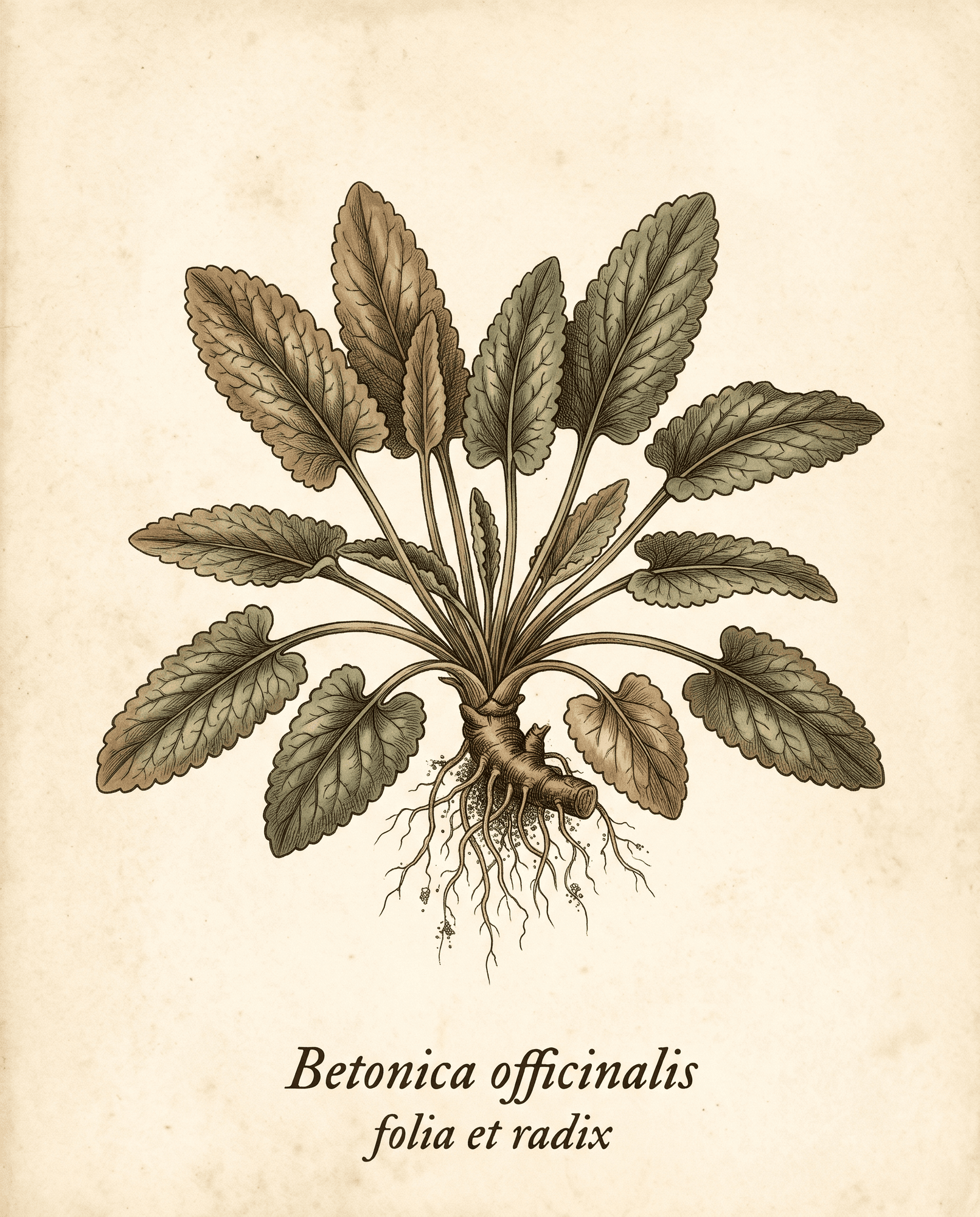
Threshold ritual: Hang a small bundle of dried betony over the main door of your home, or set a bowl of it on the threshold. As you place it, walk the boundary of the house and speak what is welcome and what is not. Renew the bundle each year in August, her old gathering month, and burn the old one with gratitude.
Journal prompts
- Where do I live in my body most days — and where have I stopped visiting?
- What happens in my belly when I am afraid, and what is it trying to tell my head?
- What visits me at night that I have not yet named in daylight?
- Where in my life am I keeping a door open that I want to close, or closing a door I want to open?
- What would it feel like to let my head rest on my body instead of hovering above it?
Tarot Spread
A spread for entering into relationship with Wood Betony as a plant ally:
- Where is my mind right now, and where has it wandered?
- What is my belly holding that my head has not heard?
- What crossroads between the two is asking to be cleared?
- What visits me at night, and what does it need from me?
- How does Betony ask me to come back down to earth?
Keep a sprig of betony or a small bowl of the dried herb near the cards. Let the reading settle into your body before you write it down.
The same plant, multiple lenses
Wood betony is not part of the classical Ayurvedic materia medica, so this reading is drawn from her tastes and qualities rather than from a long Ayurvedic lineage. Her bitter and astringent tastes, her light, drying quality, and her near-neutral temperature place her among the herbs that settle excess Pitta and Kapha. But her real gift reaches toward Vata, and that is where the reading becomes interesting.
Pitta Dosha — Fire & Water
Bitter and astringent are two of the three tastes that reduce Pitta. For Pitta patterns that climb into the head — the hot, pounding headache, the irritability that builds through the day, the anger that tightens the jaw, the sharp acid stomach of the over-driven — betony helps cool and settle. Her near-neutral temperature makes her safe for Pitta in a way stronger warming nervines are not.
Kapha Dosha — Earth & Water
Her drying, toning, astringent action helps clear Kapha’s damp heaviness in the gut — the sluggish digestion, the loose stool, the slow, foggy head after a heavy meal. Her mild bitterness kindles agni without inflaming it. For Kapha types whose stagnation shows up as a dull, heavy head, she offers clarity without agitation.
Vata Dosha — Air & Ether
On taste alone, bitter and astringent aggravate Vata, and her drying quality could tip an already dry constitution further out of balance. And yet the pattern betony is most famous for — the mind lifted up and out of the body, the scattered thought, the nervous stomach, the sleep troubled by dreams and visitors — is a portrait of Vata disturbed, especially prana vata in the head and samana vata at the solar plexus. Her action is grounding even if her tastes are not. For Vata, give her in warm milk, with honey, or alongside moistening, warming allies such as ashwagandha, licorice, cardamom, or milky oats. Held that way, she is one of the clearest herbs for bringing Vata back down to earth.
Wood betony is not part of the classical Chinese materia medica. What follows is an interpretive reading — how a TCM practitioner might understand her through her taste, temperature, and the patterns she has historically addressed.
Taste & Temperature: Bitter, slightly acrid, astringent; neutral to slightly warm. Channels Entered: Liver, Stomach, Heart. Functions: Calms Liver Yang rising to the head and eases headache. Harmonizes the Liver and Stomach. Calms the shen and settles sleep. Astringes and stops loose stool.
Subduing Liver Yang and Easing the Head
Betony’s most famous work maps onto patterns of Liver Yang or Liver Qi rising to the head: tension headaches at the temples and the base of the skull, a tight neck and shoulders, a red face under pressure, irritability that peaks in the afternoon. Her descending movement draws what has risen back down. Where headache comes from cold invading the channels of the head — the pattern Culpeper named — her slight warmth and diffusive quality help it disperse.
Harmonizing the Liver and Stomach
When constrained Liver Qi overacts on the Stomach and Spleen, the result is nervous digestion: a knotted belly, belching, loss of appetite under stress, alternating cramping and loose stool. Betony speaks to both sides at once, releasing the Liver’s grip as she strengthens the middle burner. This is the TCM reading of her solar plexus medicine.
Calming the Shen
The shen, the spirit housed in the Heart, is disturbed by excess thought, fright, and grief. Disturbed shen shows up as restless sleep, vivid or frightening dreams, being easily startled, and a mind that cannot settle. Betony’s long history against nightmares and nocturnal visitations reads naturally here: she anchors the shen and helps it rest in its house at night.
Astringing the Intestines
Her tannins give her a gentle astringing function — useful for loose stool and diarrhea that come with nervousness or with a weak, damp middle burner.
Yin/Yang Balance
Betony is a balancing, near-neutral herb. She is best for mixed patterns where Yang has risen to the head while the middle burner below is weak or damp — the very common picture of a hot, tense head over a cold, uncertain belly. She is not strongly cooling enough for intense heat patterns, nor strongly tonifying enough to rebuild deep Yin or Yang deficiency on her own. For dry, Yin-deficient conditions, she should be paired with moistening herbs to avoid adding dryness. Her nature is that of the mediator: she brings the top and the bottom of the body back into conversation.
For going deeper
- Wood, Matthew. The Book of Herbal Wisdom: Using Plants as Medicines. North Atlantic Books. — his chapter on wood betony and the solar plexus remains the deepest modern treatment of this plant.
- Wood, Matthew. The Earthwise Herbal: A Complete Guide to Old World Medicinal Plants. North Atlantic Books.
- Van Arsdall, Anne. Medieval Herbal Remedies: The Old English Herbarium and Anglo-Saxon Medicine. Routledge. — includes the betony chapter that opens the herbal.
- Hildegard of Bingen. Physica (trans. Priscilla Throop). Healing Arts Press.
- Culpeper, Nicholas. The English Physitian (1652). — available in many editions and through public digital archives.
- Grieve, Maud. A Modern Herbal (1931). — the betony entry gathers much of the English folklore.
- Tobyn, Graeme, Alison Denham, and Margaret Whitelegg. The Western Herbal Tradition: 2000 Years of Medicinal Plant Knowledge. Churchill Livingstone. — traces betony’s medicine from Dioscorides forward.
- Commonwealth Holistic Herbalism (Katja Swift and Ryn Midura). Podcast episodes and materia medica notes on wood betony and on the differences between Betonica and Pedicularis.
- Tomou, E.-M., Barda, C., & Skaltsa, H. “Genus Stachys: A Review of Traditional Uses, Phytochemistry and Bioactivity.” Medicines 7, no. 10 (2020): 63. — includes traditional uses of betony’s cousins across Iran, Turkey, and the Balkans.
- Moerman, Daniel E. Native American Ethnobotany. Timber Press. — for the separate story of Pedicularis, the North American “wood betony.”
- The meadow itself. Betony is declining in the wild in parts of her range as old grasslands are lost. Grow her if you can; she is generous in the garden and the bees love her.
The Conversation
Questions, noticings, what this is teaching you — leave them here. This same conversation lives in The Circle.