There is a kind of knowing that lives in the parts people throw away.
The skin of a banana. The thick green armor of a plantain. In most kitchens, they go directly into the bin. But in the hands of West African soapmakers, in Caribbean herbalism, in the slow accumulated wisdom of people who could not afford to let anything be wasted — the peel was never refuse. It was the point.
Banana and plantain skin powder is not a discovery. It is a remembering.
A Plant That Shows Up Everywhere
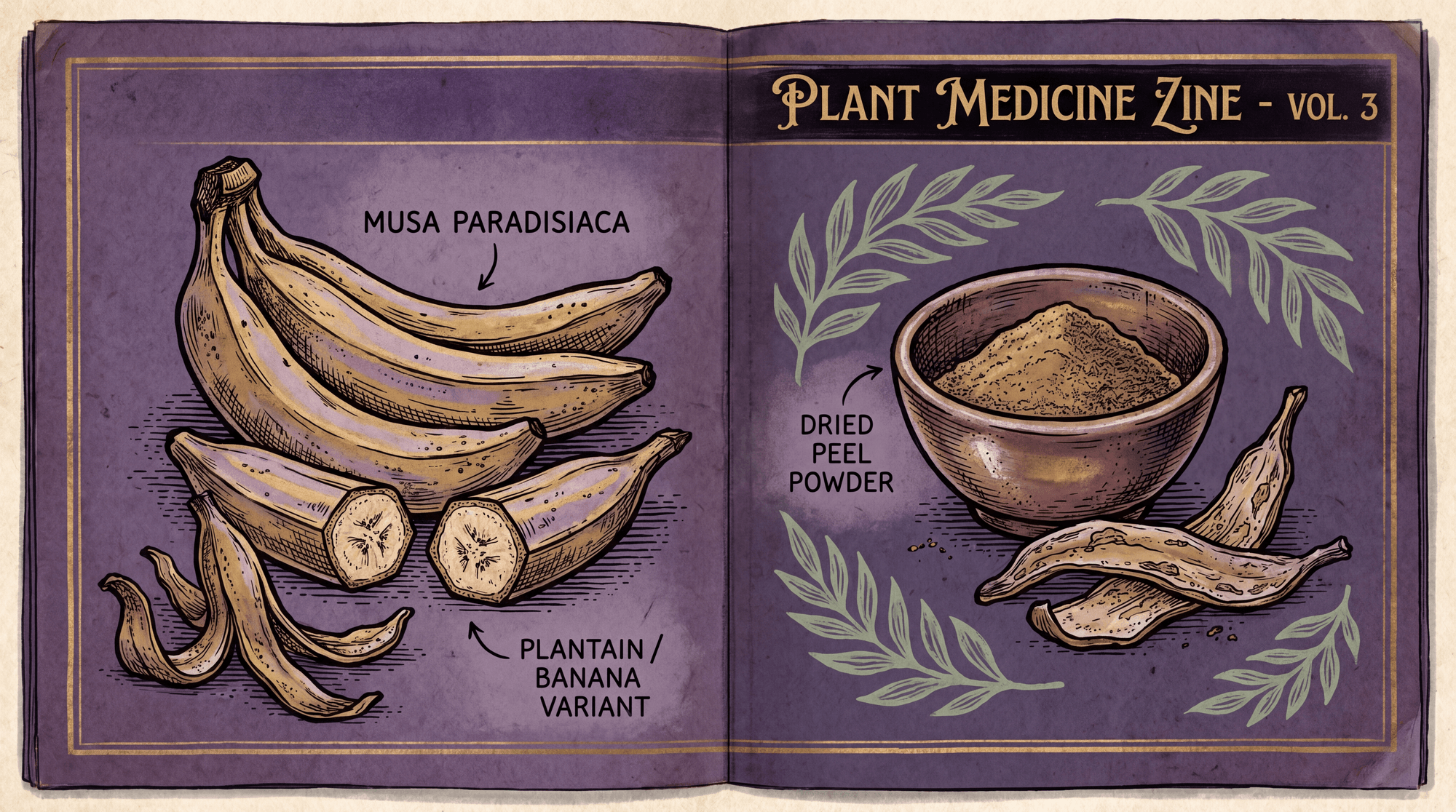
Musa — the genus that holds both the banana (Musa acuminata and its hybrids) and the plantain (Musa × paradisiaca) — did not originate in the tropics of the Western Hemisphere. It came with people. Through trade routes, across the Atlantic, in the hands of those who carried seeds and knowledge across waters they did not choose to cross.
By the time banana and plantain were embedded in the food traditions of the Caribbean, West Africa, and Central America, they had also embedded themselves in the medicine.
The plantain, in particular, has a long place in West African material culture. Its ash — alkaline, mineral-rich, and caustic enough to initiate saponification — is one of the original ingredients in traditional black soap: ose dudu in Yoruba, alata samina in Twi. The skins are not byproduct. They are the chemistry.
The powder we are making here is different from the ash. It is the dried and ground skin — what remains when you remove the moisture and reduce the peel to a fine, workable material. Both have uses. This guide focuses on the powder.
What the Skin Actually Carries
You do not need to know the name of every compound in banana peel to understand that it has something to offer. But it helps to know why this particular thing works the way it does.
Banana and plantain skins are dense with:
Tannins — astringent compounds that contract tissues, tighten pores temporarily, and help regulate oil production. This is why plantain peel has been worked with for oily and acne-prone skin for a long time. It is not balancing skin through chemistry the skin cannot recognize. It is asking the skin to draw back in on itself, in a way the skin already knows how to do.
Lutein — a carotenoid found in high concentrations in plantain skin in particular. Lutein absorbs blue light and supports the skin’s ability to even its own tone over time. This is one of the reasons plantain powder shows up in preparations for hyperpigmentation.
Polyphenols and antioxidants — including quercetin and dopamine (yes, in the plant form — not the neurological kind). These help protect skin cells from oxidative stress and support the skin’s general repair processes.
Potassium and zinc — minerals that the skin uses in barrier function and wound healing. Present in meaningful amounts in the dried, concentrated peel.
Gentle enzymatic action — banana skin contains amylase and other enzymes that, when applied topically, offer a mild chemical exfoliation — loosening dead surface cells without abrasion.
Taken together, this is a skin-care ingredient profile that addresses tone, texture, oiliness, and environmental stress. Not because someone synthesized it that way. Because the plant has been working like this for much longer than any cosmetics lab has existed.
The skin of the plantain and the skin of the person — they are in conversation.
The Black Soap Connection
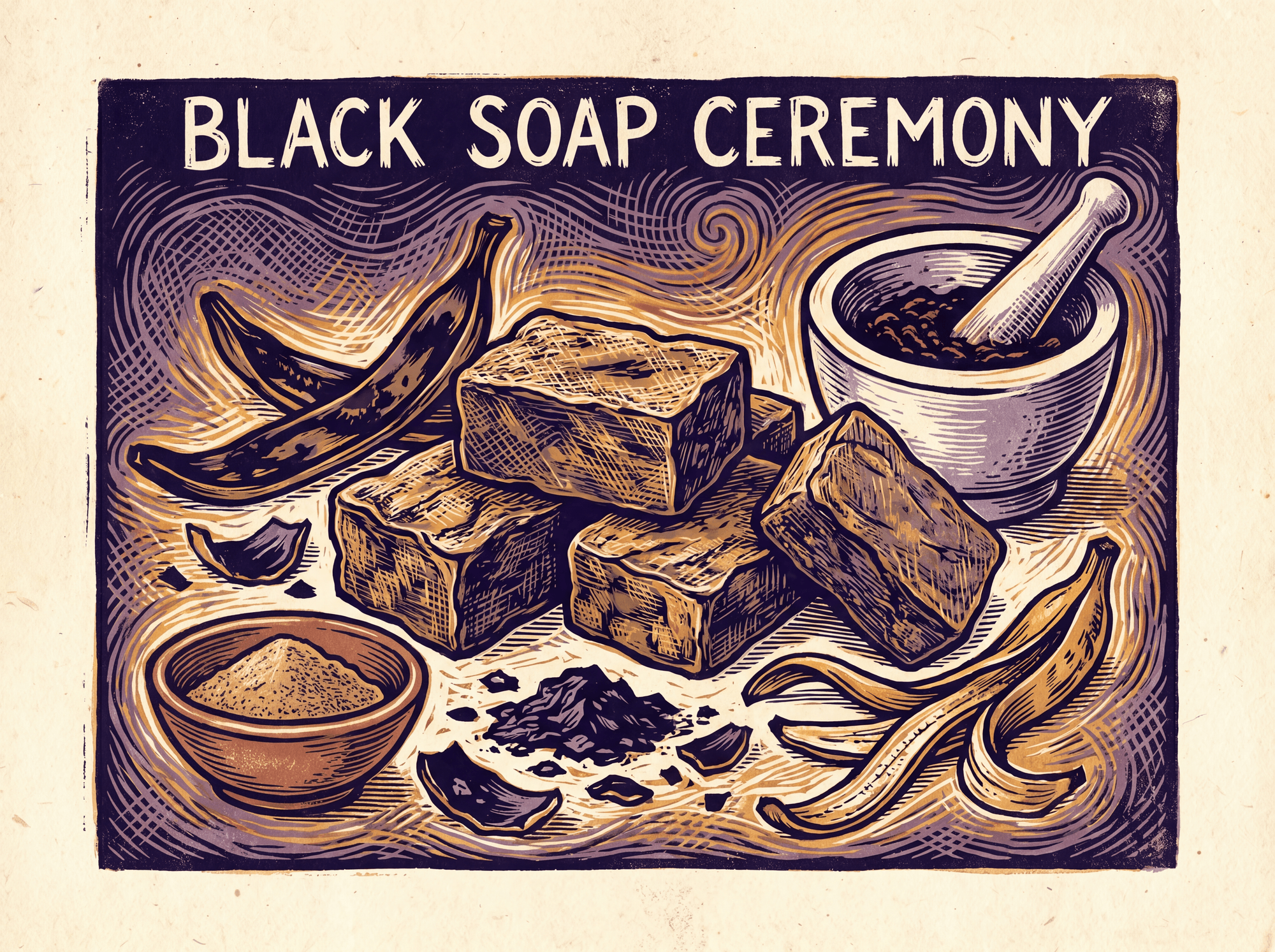
Traditional West African black soap is one of the oldest continuous skin-care traditions in the world. It is also one of the most misunderstood by the market that has come to love it.
Authentic black soap — the kind made in Ghana, Nigeria, Benin, and across the West African coast — begins with ash. Plantain skin ash is one of the most common alkali sources. The skins are sun-dried, then roasted or burned in clay pots. The resulting ash is leached with water to draw out the potassium hydroxide, which is the lye that makes soap possible. This process is not ancient by accident. Plantain grows in abundance in these regions. The math works. The tradition accumulated because it was reliable.
The ash saponifies the oils — shea butter, cocoa pod ash, palm kernel oil — into the dark, soft, crumbled bar we recognize. When made traditionally, nothing is added for effect. Every ingredient is doing something real.
Banana and plantain skin powder — as distinct from the ash — plays a different role in modern black soap formulations. Where the ash does structural work (the chemistry of cleansing), the powder is additive. It is blended into soap bases or worked into finished bars for:
- Its skin-tone-evening lutein content
- Its tannin-driven astringency, which supports the deep-cleansing character black soap is known for
- Its mild enzymatic exfoliation — so that cleansing becomes slightly exfoliating as well
- Its mineral density, which supports skin barrier function
If you are making black soap at home — working from a melt-and-pour base or cold process — banana or plantain skin powder is among the most historically appropriate additives you can reach for. A ratio of 1–2 teaspoons of sifted powder per 100g of soap base is enough to do real work without making the bar gritty.
How to Make Banana and Plantain Skin Powder
This is unhurried work. The powder rewards patience — it wants to be fully dry before it gets near your skin or your soap.
What you need
- Banana peels, plantain peels, or a combination
- A sharp knife
- A baking sheet or clean surface for drying
- A low oven (or reliable sun)
- A spice grinder, high-powered blender, or mortar and pestle
- A fine-mesh sieve
- An airtight jar for storage
Choose your peel
Banana peel produces a finer, smoother powder. It is milder in astringency and has a slightly higher sugar content, which makes it more emollient. Works well in creamy soap, face masks, and body scrubs.
Plantain peel is coarser and more tannin-rich. Its astringency is more pronounced. Better for oily skin preparations, for anyone working with acne or sebaceous congestion, and for black soap specifically. If you are making traditional black soap, plantain is the more historically grounded choice.
You may blend the two. A roughly equal ratio gives you the gentleness of banana and the astringency of plantain.
The process
1. Wash the peels thoroughly. Even if the fruit was organic, wash. Use a vegetable brush and clean water. Residues on the outer skin will concentrate in the powder.
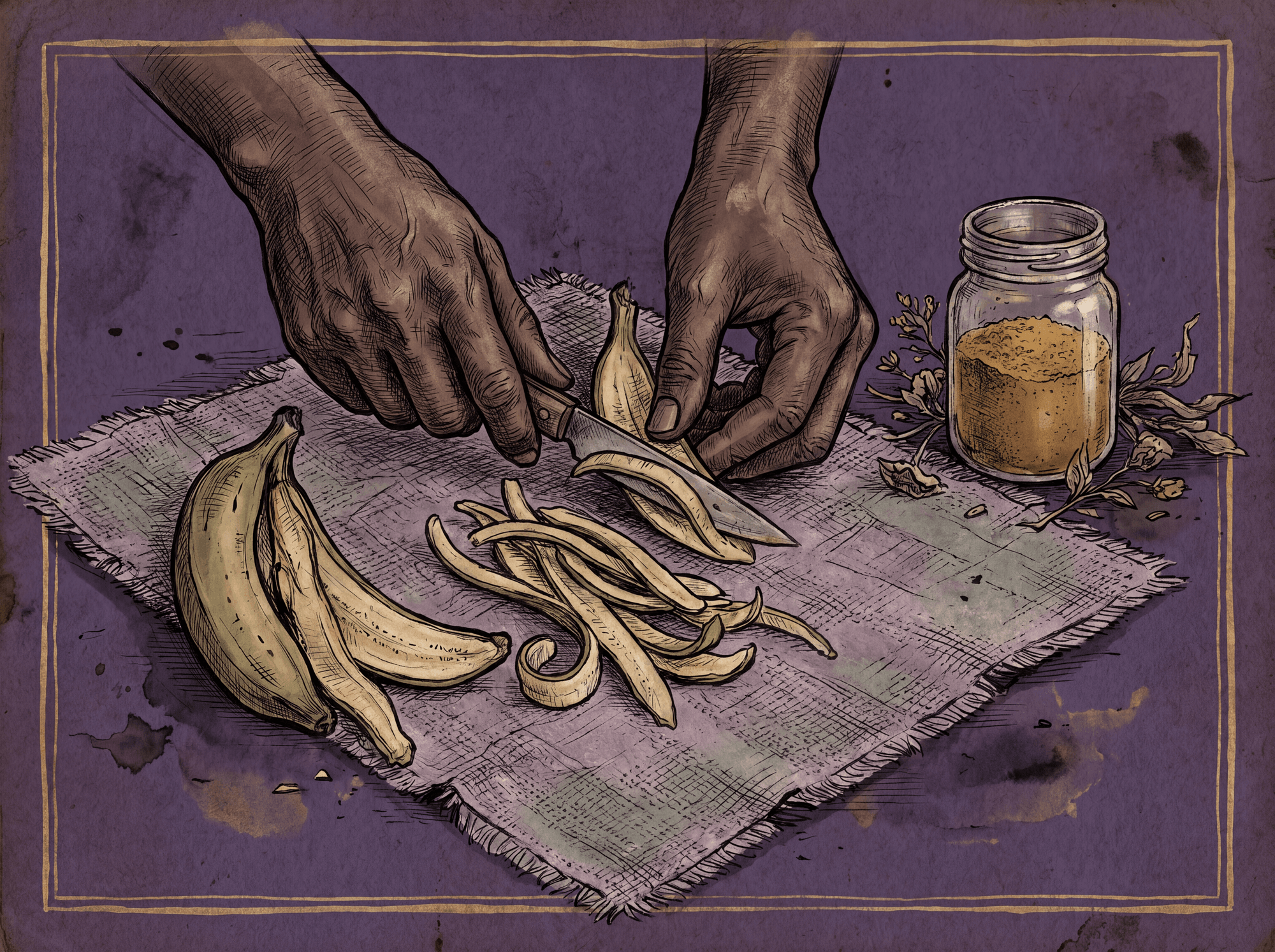
2. Cut the peel into thin strips or small pieces. The thinner the strip, the faster and more evenly it will dry. Aim for strips no thicker than ¼ inch.
3. Dry them completely. You have options here.
Oven method: Spread strips on a parchment-lined baking sheet. Set your oven to the lowest possible temperature — ideally between 150–170°F (65–75°C). Prop the oven door open a crack to allow moisture to escape. Dry for 2–3 hours, checking periodically. The strips are ready when they are brittle, not just dry. They should snap, not bend.
Sun drying: In a reliably warm, dry climate, lay the strips on a clean cloth or screen in full sun. This takes 1–3 days depending on humidity. Bring them inside if there is any chance of overnight moisture.
You are looking for complete desiccation — no softness, no give. Any remaining moisture in the final powder will cause it to clump and, eventually, mold.
4. Grind. Once fully dry, grind in a spice grinder or blender in short pulses. For a finer powder, use the grinder; for a more rustic texture suitable for body scrubs, a mortar works beautifully and gives you more control.
5. Sift. Pass the powder through a fine-mesh sieve. What passes through is your cosmetic-grade powder. What doesn’t — the coarser bits — can go back into the grinder or be reserved for body scrubs where texture is welcome.
6. Store. Transfer to a clean, airtight glass jar. Keep in a cool, dark space. Properly dried and stored powder will hold for six months to a year.
Ways to Work With the Powder
In black soap
Blend sifted powder directly into a melt-and-pour black soap base before it sets. Work it in thoroughly — 1 to 2 teaspoons per 100g. Let the bar cure fully before use.
As a face mask
Mix ½ teaspoon of powder with raw honey and a small amount of aloe vera gel. Apply to clean skin. Leave 10–15 minutes and rinse with warm water. The enzymes soften, the tannins draw back, the honey soothes. Use once a week.
In a body scrub
Combine 2 tablespoons of coarser powder with raw cane sugar, a tablespoon of coconut or jojoba oil, and a few drops of a grounding essential oil (vetiver, frankincense, cedarwood, or sandalwood work well here). Use in the shower on damp skin. This is a full-body exfoliation with the added benefit of the powder’s mineral and antioxidant content.
As a dry powder addition to bath salts
Mix 1–2 tablespoons of fine powder into Epsom or sea salt blends. The powder disperses in the bath water and the skin absorbs what it can. A good addition to any bath blend intended for skin brightening or muscle recovery.
In a soap-free cleansing powder
Blend banana skin powder with kaolin clay, finely ground oat flour, and a small amount of dried chamomile powder. Stored dry, this is activated by wetting a small amount in the palm and applying to skin. Rinse. A gentle daily cleanser that requires no preservative because it holds no water.
A Note on Plantain vs. Banana — When It Matters
Plantain and banana are closely related but they are not the same, and the distinction matters more in some preparations than others.
For skin-tone work and hyperpigmentation, plantain skin powder is the stronger choice. Its lutein concentration is higher. If this is the primary goal, use plantain.
For dryness, dehydration, and sensitive skin, banana is gentler. Its natural sugar content makes it slightly more humectant, and it lacks the pronounced astringency that can tip toward drying for some skin types.
For black soap and deep cleansing preparations, plantain is the historically grounded choice and the more active one.
When you are not sure, use a blend. The two complement each other well, and the combined preparation is broadly useful.
There is something worth sitting with in the fact that one of the most elegant skin-care ingredients available — inexpensive, abundant, historically continuous, and genuinely effective — is the part of the fruit that people routinely discard.
That is not surprising, exactly. It follows a pattern.
The knowledge held in communities that built their wellness traditions around using everything — roots and bark, seed and skin — has often been dismissed or overlooked in the same breath as the communities themselves. What is ordinary in one context becomes novel in another. What was always known gets described as discovered.
The powder knows what it is. It has been doing this work for a long time.
— The Sage