Bay Laurel
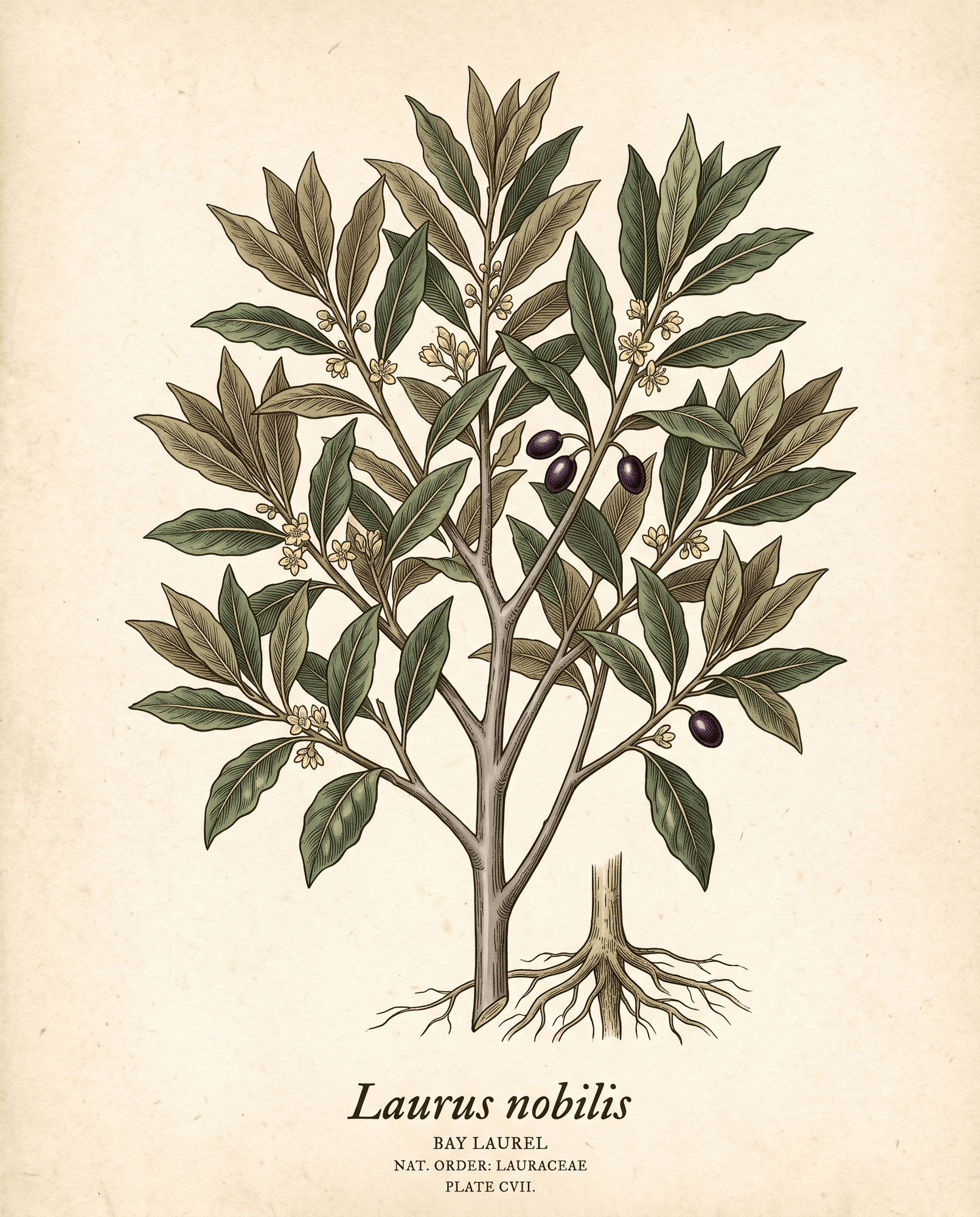
Bay laurel is the evergreen that keeps her word. She has stood in the same kitchens, temples, and doorways for three thousand years without once changing her offer: a leaf, unshowy and stiff, that holds more than it appears to hold. She goes into the pot whole and comes out whole, having given everything and surrendered nothing — a lesson in how to be generous without being consumed. Most people have worked with her a hundred times and never once called it herbalism. That is her way. She is the medicine hiding in plain sight, the sacred tree filed under seasoning.
But bay’s oldest work is not in the pot. She is a tree of the spoken and written word — the leaf the oracle held, the crown the victor wore, the small green page a wish gets written on before it is given to the fire. Wherever people have needed their words to travel — up to spirit, out to the ancestors, forward into a future they were still building — bay has been the carrier. She asks only that you say the thing clearly. Vague prayers get vague answers; bay likes an aim.
The shape of her medicine
Bay’s medicine moves up and out. Where dandelion drains downward and burdock sinks toward the root, bay rises — as aroma from the simmering pot, as steam from the bowl, as smoke from the burning leaf. She is warm and drying, a plant for cold, damp, stagnant conditions: the heavy gut, the congested chest, the stiff joint, the sluggish morning. Her whole gesture is dispersal. She takes what has pooled and settled and sends it moving again.
She is aromatic first. The volatile oils that rise off the leaf are the medicine’s front door — they reach the body through scent and steam before a drop is ever swallowed. This is why a pot of beans with bay in it is already gently medicinal for the household breathing its air.
As a carminative, she is one of the old reliable after-dinner herbs. Her warmth relaxes the smooth muscle of the gut, disperses trapped gas, and eases the heavy, overfull feeling that follows rich food. This is the quiet reason she appears in nearly every long-simmered dish on earth: beans, stews, braises, and broths are exactly the foods that sit heavy, and the cooks who put her in the pot knew what they were doing.
Her bitter thread runs underneath the aroma. The sesquiterpene lactones in the leaf wake the digestive secretions the way all good bitters do — saliva, acid, bile, enzyme — so that the body meets food ready instead of catching up. Bay is a gentler bitter than gentian or dandelion; she stimulates without scouring.
As a diaphoretic, taken hot, she opens the pores and encourages a therapeutic sweat — old fever-tea territory, especially for the chilled, achy, can’t-get-warm stage of a cold. Her antispasmodic warmth eases cramping in the gut and, in the bath or oil, in the muscles.
Topically she turns analgesic and anti-inflammatory. Laurel-infused oil is an old Mediterranean liniment for rheumatic aches, stiff joints, sprains, and overworked muscles — warming the tissue, moving the blood, and quieting the complaint. Her antimicrobial oils earn her a place in steams, gargles, and washes.
And she carries a steady metabolic thread: taken daily as a culinary-dose powder, she helps the body handle sugar and fats with more grace. It is kitchen medicine in the most literal sense — the dose that works is the dose a well-seasoned pot already contains.
One caution belongs in her energetic picture: she is an emmenagogue in medicinal doses, moving blood in the pelvis. Food amounts are fine; concentrated amounts are not for pregnancy.
What lives inside her
Whose medicine she carries
Air (smoke and word)
The Hierophant
Justice
Ochosi
Ochosi is the tracker whose arrow does not miss. He is precision, swift justice, and the discipline of the single clean shot — the hunter who does not spray arrows into the forest but waits, aims, and releases once. Bay belongs to him because bay is a plant of the landed aim. Her crown went to the one whose effort found its mark: the runner who finished, the poet whose lines struck true, the archer of a different kind. To work with bay under Ochosi is to practice the narrowing of intention. One wish per leaf. One word per prayer. Not a paragraph — an arrow.
Ochosi is also the Orisha of rightful outcome, the one called on when justice must find its target through crooked terrain. Bay’s old protective work — the leaf over the door, the wash across the business threshold — carries his signature: not a wall, but a watchfulness. The house dressed with bay is a house whose aim is clean, and what is aimed cleanly tends to arrive.
Orunmila (Divination, the Spoken Word)
Orunmila is the witness of destiny, the wisdom that was present when each soul chose its road, the mouth of Ifá. Bay is his in her oldest office: the oracle’s leaf. For centuries the priestesses at Delphi kept bay at the heart of prophecy — burned, held, kept close — because the tree was understood to open the channel between what is known above and what can be spoken below. The word laureate still means one through whom the gods have spoken well.
In practice, bay serves Orunmila’s work wherever divination happens. She is chewed on in a manner of speaking — a leaf steeped as tea before the cards are pulled, a leaf tucked beneath the pillow when the question is carried into dreams, a leaf burned when the answer needs to travel. She does not give the answer herself. She clears the line so the answer can come through undistorted, and she asks the diviner’s own discipline in return: listen for the one word, and say it out loud even if it is small.
Oya (Smoke, Wind, Transformation)
Oya is the wind that changes the weather, the keeper of the marketplace and the gate of the dead, the one who carries messages where feet cannot follow. Bay meets her in the smoke. The wish written on a bay leaf goes nowhere until it burns — it is Oya’s element that lifts the word off the leaf and takes it where it is addressed. Every bay-burning ritual is, underneath, a small collaboration with the wind.
Oya also governs the sharp, clearing change — the storm that ends the stagnant heat. Bay’s purification work belongs here: the leaf burned to break a heaviness in a room, the wash that sweeps a threshold clean, the sudden fresh air after the smoke settles. She and bay share a temperament: neither is interested in gradual half-measures. When the leaf catches, it catches all at once.
The hands she has passed through
Bay’s recorded story begins in ancient Greece, where the tree and the myth share one name: daphne. The nymph Daphne, fleeing Apollo’s pursuit, called out for rescue and was transformed into the first bay laurel — her freedom preserved in evergreen form. Apollo, the god of prophecy, music, and light, took the tree as his own, and from that claiming came two of bay’s longest offices. At Delphi, the priestess called the Pythia kept bay close as she delivered prophecy — the leaf was burned and held as an instrument of the oracle. And at the Pythian Games held in Apollo’s honor, victors were crowned with wreaths of woven laurel. That crown never left us: poet laureate, Nobel laureate, and baccalaureate all still carry the tree’s name, and every diploma season quietly repeats a rite older than Rome.
Rome took up the laurel as the emblem of triumph and something more — protection. Laurel stood at the emperor’s door, was believed to turn away lightning, and marked the boundary between ordinary and consecrated space. Meanwhile the physicians of the ancient Mediterranean worked with the whole plant: Dioscorides wrote of laurel for the liver, and the leaf and berry moved through Greek, Roman, Arabic, and Persian medicine as a warming remedy for the stomach, the bladder, aching joints, and the chilled body. Through medieval monastery gardens she continued as both medicine and kitchen constant, her leaves laid into stores to keep weevils from the grain — work her volatile oils still perform in pantries today.
A distinction matters here, especially for Caribbean kitchens and apothecaries. The “bay leaf” of many island households — the one distilled into bay rum for fevers, sore muscles, and blessings, the one seasoning the stew pot — is most often West Indian bay, Pimenta racemosa, a different tree entirely, kin to allspice, with a spicier clove-and-cinnamon character. Both trees are true medicine and both have earned their place; they are simply not the same plant, and their strengths differ. This monograph concerns the Mediterranean laurel, Laurus nobilis. If your grandmother’s bay smelled of clove and warm spice, she was likely working with the West Indian tree — a story that deserves its own page.
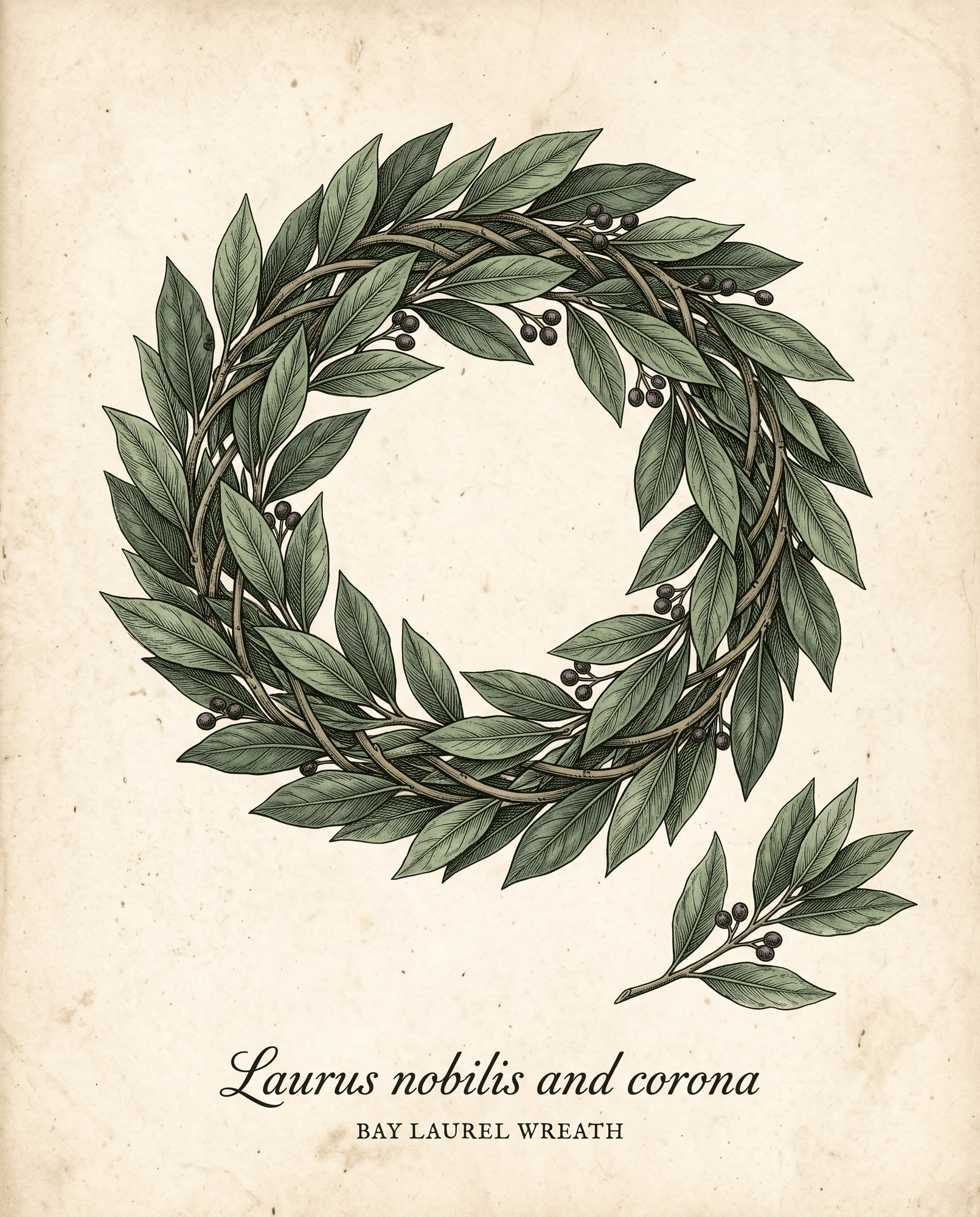
In Hoodoo and rootwork, bay is a cornerstone of petition magic. Wishes and intentions are written directly on the leaf, then burned so the smoke carries the word up, or folded into the wallet so the intention rides alongside the money it is meant to draw. Bay leaves ward the corners of rooms, sit beneath mattresses for protection, simmer into floor washes for the thresholds of homes and businesses, and join charm bags for success and psychic clarity. This is African diasporic technology of the word — the understanding that a written intention, given to fire and smoke, is a prayer with a delivery route. The practice spans the diaspora, from rootworkers’ bay-leaf petitions to the bay in spiritual baths across the Caribbean.
And through all of it, she never left the kitchen. She is in the beans, the stock, the stew, the brine — on every continent, in nearly every cuisine that simmers anything. It may be her deepest teaching: the sacred that stayed ordinary, the temple leaf that chose the soup pot and lost nothing in the move.
Where she works in the body
Digestive system. This is bay’s daily work. Her aromatic oils relax the gut and disperse gas; her bitters wake the secretions that break food down. She is medicine for the heavy meal, the sluggish digestion, the bloating and fullness that follow rich food — which is precisely why tradition placed her in the dishes most likely to cause them. A cup of bay leaf tea after dinner does deliberately what the leaf in the pot does quietly. Her mild astringency also steadies the gut in looseness, an old use for her tea across the Mediterranean.
Metabolic system. Taken as a daily powder in culinary-medicinal amounts — one to three grams, roughly half a teaspoon to a teaspoon and a half — ground bay leaf has meaningfully lowered blood sugar and improved cholesterol patterns in people with type 2 diabetes over a month of use, in modern clinical work. The effect is real enough to respect in both directions: a gift for the body working to steady its sugar, and a reason for anyone on blood sugar medication to involve their care provider before taking bay medicinally, since the two together can drop glucose further than either alone.
Respiratory system. The cineole that dominates her oil is a known friend to the airways — the same compound that makes eucalyptus breathe the way it does. Bay leaf steam opens congested sinuses and chest; her hot tea warms and loosens the tight, chilled stage of a cold; her diaphoretic action supports the fever doing its work. She suits the damp, stuck, phlegmatic cold more than the hot and dry one.
Musculoskeletal system. Laurel oil — the leaf slow-infused in olive oil, or traditionally the berry pressed — is one of the Mediterranean’s oldest liniments. Rubbed into stiff joints, rheumatic aches, sprains, and muscles worked past their limit, she warms the tissue, moves circulation into the complaint, and eases pain. A strong bay decoction added to a hot bath does the same work at the scale of the whole body, and is old medicine for the bone-deep ache of a cold.
Nervous system. Bay’s calm is subtle and comes mostly through the nose. The linalool in her aroma gentles an anxious edge; a cup of her tea in the evening settles without sedating. Her older reputation as a dream herb belongs here too — the leaf under the pillow, the tea before sleep when a question needs to be carried into the night.
Skin. Her antimicrobial and vulnerary threads made her a folk wash for scrapes and blemished skin, and her oil still appears in soaps — most famously the ancient Aleppo soap of laurel and olive. She asks respect in return: the same lactones that do her anti-inflammatory work can sensitize some skins, so anything concentrated gets patch-tested first.
How to take her
Harvest calendar
Preparations
In the pot: The foundational dose. One to three whole leaves in any simmered dish, removed before serving. This is genuine low-dose herbalism practiced daily, and for general digestive and metabolic support it should not be skipped over in favor of fancier preparations.
Leaf infusion (tea): 1–2 dried leaves (torn) or 1 teaspoon crumbled leaf per cup of just-boiled water. Cover and steep 10–15 minutes. 1–2 cups daily; after meals for digestion, in the evening for calm or dream work.
Powder: 1–3 grams of finely ground dried leaf daily (about ½ to 1½ teaspoons), stirred into food, broth, or capsules. This is the metabolic-support dose. Grind fresh in small batches — the aromatics fade in pre-ground powder.
Infused oil: Dried leaves covered in olive oil, infused gently 4–6 weeks (or warm-infused over low heat for several hours), strained. Massage into sore muscles, stiff joints, and rheumatic aches. Patch test first.
Bath: A strong decoction of 6–10 leaves simmered 15 minutes, strained into a hot bath, for body aches, chills, and ritual cleansing.
Steam: 3–5 leaves in a bowl of just-boiled water, towel over the head, slow breaths for 5–10 minutes, for congested sinuses and chest.
Gargle: Cooled leaf infusion for a sore or irritated throat.
Spiritual & ritual:
- A wish or intention written small on a dried leaf and burned in a fire-safe dish, the smoke carrying the word
- A leaf inscribed with an intention and folded into the wallet for steady money and success
- Leaves beneath the pillow to carry a question into dreams; write down what comes in the morning
- A handful of leaves simmered into a floor wash for the thresholds of home and business
- Leaves at the corners of a room, over the door, or on the altar for protection and clear sight
- A small woven wreath or sprig kept on the altar to honor work completed and words kept
When to hold back
Use with caution if:
- You are pregnant or breastfeeding. Culinary amounts are fine; medicinal doses are not, as bay is an emmenagogue in quantity.
- You take blood sugar-lowering medications or insulin. Bay’s glucose-lowering effect can be additive. Involve your provider and monitor closely if adding daily medicinal doses.
- You take sedatives or medications that slow the central nervous system. Medicinal doses of bay may deepen drowsiness.
- You are within two weeks of surgery. Pause medicinal use, as bay can affect blood sugar control around procedures.
- You have a known sensitivity to the laurel family or have reacted to bay-containing products before.
Whole-leaf hazard: The dried leaf stays rigid no matter how long it cooks. Swallowed whole or in large pieces, it can lodge in or scratch the throat and digestive tract. Always remove whole leaves before serving, and strain teas and decoctions well. This is the most common bay injury and it is entirely preventable.
Topical considerations: The essential oil and strong infused oil can cause contact dermatitis in sensitized individuals — the sesquiterpene lactones are known sensitizers. Always dilute the essential oil well, never use it internally, and patch test any concentrated preparation.
Look-alike warning: Several unrelated plants wear the name “laurel” and some are seriously poisonous — cherry laurel (Prunus laurocerasus) and mountain laurel (Kalmia latifolia) among them. Never harvest “bay” from an ornamental hedge without certain identification. Crushed, true bay releases a sharp herbal scent with a clear note of eucalyptus — that’s her cineole. Crushed cherry laurel smells of bitter almond, and that almond scent is the poison announcing itself.
General notes: In food and ordinary tea amounts, bay is safe for nearly everyone and has been for millennia. Respect rises with concentration: the powder dose deserves the medication cautions above, and the essential oil deserves the most care of all.
Who walks with her
For digestion after heavy food: Fennel, ginger, cardamom, thyme, orange peel.
For the congested chest and sinuses: Eucalyptus, thyme, rosemary, peppermint — bay joins them in steams and chest teas.
For sore muscles and joints (in the oil): Rosemary, ginger, cayenne — warming allies that drive circulation into the complaint.
For dream and divination work: Mugwort, chamomile, lavender — bay sharpens the question while they open the dreaming.
For ritual smoke and prosperity work: Cinnamon, frankincense, clove — companions on the charcoal and in the charm bag.
Bay runs with the aromatic kitchen kin — the rosemaries and thymes of the world — plants that, like her, blur the line between seasoning and medicine and are strongest when used daily and casually. In dream work she plays the focusing role: mugwort opens the gates wide, and bay makes sure you walk through them carrying one clear question instead of ten. In the censer she is the messenger among the offerings — frankincense honors, cinnamon sweetens and heats, and bay carries the actual text of the prayer. Give her companions, but let her keep her office: whatever the blend is for, bay is the part that aims it.
How to know her
Plant walk: Find a bay tree — a neighbor’s hedge, a nursery pot, the tree in your own kitchen garden. Crush one leaf gently and breathe it. Then ask her one question — just one — and stay long enough to listen for a single word in return. Not a sentence; a word. Say it out loud when it comes, even if it seems too small to matter. Bay’s oracle has always worked one word at a time.
Ritual of the written wish: Choose one intention — the arrow, not the quiver. Write it small on a dried bay leaf. Hold the leaf and see the intention already landed. Light the leaf in a fire-safe dish and let it burn completely, watching the smoke rise with your word in it. Scatter or bury the ash outside. Do not tell anyone what you wrote until it arrives.
Dream divination: When a question resists the waking mind, write it on a leaf or simply hold the question while placing a few bay leaves beneath your pillow. Sleep on them for three nights, keeping paper beside the bed, and write whatever the mornings bring — images, words, fragments. Read the three mornings together at the end. Burn or bury the leaves with thanks.
Threshold wash: Simmer a handful of bay leaves in a pot of water for fifteen minutes. Strain, cool until comfortable, and wash your front door, doorstep, or the entry of your business from the outside in, praying for what you want to enter and naming what may not. Old rootwork for new premises, slow seasons, and fresh starts.
Journal prompts
- What is the one thing I actually want — the arrow underneath my quiver of wishes?
- What word have I given — to myself, to another, to spirit — that is still waiting to be kept?
- Where in my life am I asking vaguely and receiving vaguely?
- What victory have I already won that I have never let myself be crowned for?
- What stays green in me through every season, no matter the weather?
Tarot Spread
A spread for entering into relationship with Bay Laurel as a plant ally:
- What does Bay see when she looks at my aim?
- What word am I being asked to speak plainly?
- What is ready to be written down and released to the fire?
- What crown have I earned but not yet worn?
- How can I keep my agreements with my own becoming?
Keep a whole dried leaf with the cards while you read. When the spread is finished, you may write one word from the reading on the leaf and burn it, sending the reading’s medicine on its way.
The same plant, multiple lenses
A note on names first: in Indian groceries and much Ayurvedic writing, “bay leaf” usually means tejpatta — Indian bay leaf, Cinnamomum tamala — a cinnamon-family cousin with a different character. The principles below apply Ayurvedic reasoning to Mediterranean bay laurel herself: pungent and bitter in taste, heating in potency, drying in effect.
Pitta Dosha — Fire & Water
Bay’s heat asks moderation here. For Pitta constitutions and hot conditions — acid indigestion, inflammation with redness and heat, the irritable overheated state — her warming, drying nature can aggravate rather than ease. Pitta types do best keeping bay at culinary levels, in cooling company, and reaching for gentler bitters when digestive fire is already high.
Kapha Dosha — Earth & Water
This is bay’s territory. Kapha’s signature imbalances — sluggish digestion, heaviness after meals, mucus and congestion, slow cold metabolism, water retention — are exactly the cold, damp, stagnant patterns her pungent heat disperses. She kindles the digestive fire, dries excess damp, moves the stuck. For Kapha-dominant folks she is an excellent daily kitchen ally.
Vata Dosha — Air & Ether
Bay is warming, which Vata welcomes, and drying, which Vata does not. In moderation — the leaf in a rich, oily, well-cooked meal — she supports Vata digestion beautifully, easing the gas and bloating Vata is prone to. In excess or in dry preparations, her drying quality can aggravate Vata’s own dryness. Keep her in moist, grounding contexts: the stew, the broth, the oil.
Bay laurel is a guest rather than a resident in the Chinese materia medica — known as yue gui ye, she sits at the edges of the tradition rather than among its principal herbs, and the picture below is a working translation of her nature into TCM terms.
Taste & Temperature: Acrid and slightly bitter, warm. Channels Entered: Stomach, Spleen, Lung. Functions: Warms the middle and disperses damp. Moves stagnant qi in the digestion. Opens the Lung and transforms phlegm-damp. Gently calms the shen.
Warming the Middle & Dispersing Damp
Bay addresses the cold-damp middle burner: poor appetite, heaviness after eating, gas and distension, loose digestion from cold. Her acrid warmth dries damp and restores movement to a Spleen bogged down by rich food and cold conditions — the same pattern her kitchen role has always quietly treated.
Moving Stagnant Qi in the Digestion
The overfull, stuck, sighing-after-dinner state is qi stagnation in the middle, and bay’s carminative dispersal is precisely a qi-moving action: she gets the trapped and static circulating again, downward and outward, so the middle can resume its work.
Opening the Lung & Transforming Phlegm-Damp
Through steam and hot tea, her aromatic acridity opens the Lung, disperses wind-cold at the surface through her diaphoretic action, and transforms the thick damp-phlegm of the congested chest — suited to the cold, wet cough rather than the dry, hot one.
Yin/Yang Balance
Bay is Yang in nature — warming, moving, dispersing, rising. She treats patterns of cold, damp, and stagnation, and is not the herb for Yin-deficient heat: the dry cough, the night sweats, the flushed and depleted state. Where there is already heat and dryness, she needs cooling, moistening company or a different ally altogether.
For going deeper
- Grieve, Maud. A Modern Herbal (1931) — the classic “Laurel, Bay” entry; available through Botanical.com.
- Ovid. Metamorphoses, Book I — the story of Daphne and Apollo, the myth at the root of the tree’s name.
- Yronwode, Catherine. Hoodoo Herb and Root Magic. Lucky Mojo. — for bay’s place in rootwork and petition magic.
- Khan, A., Zaman, G., & Anderson, R.A. “Bay Leaves Improve Glucose and Lipid Profile of People with Type 2 Diabetes.” Journal of Clinical Biochemistry and Nutrition (2009) — the clinical work behind the metabolic dose.
- Pursell, JJ. The Herbal Apothecary: 100 Medicinal Herbs and How to Use Them. Timber Press.
- de la Forêt, Rosalee. LearningHerbs — bay laurel plant profile, for a contemporary Western herbalist’s working view.
- Conversations with elders in Caribbean kitchen and healing traditions on bay, bay rum, and the difference between the Mediterranean and West Indian trees. This knowledge is oral and place-based; seek it where you live.
The Conversation
Questions, noticings, what this is teaching you — leave them here. This same conversation lives in The Circle.