Cinnamon
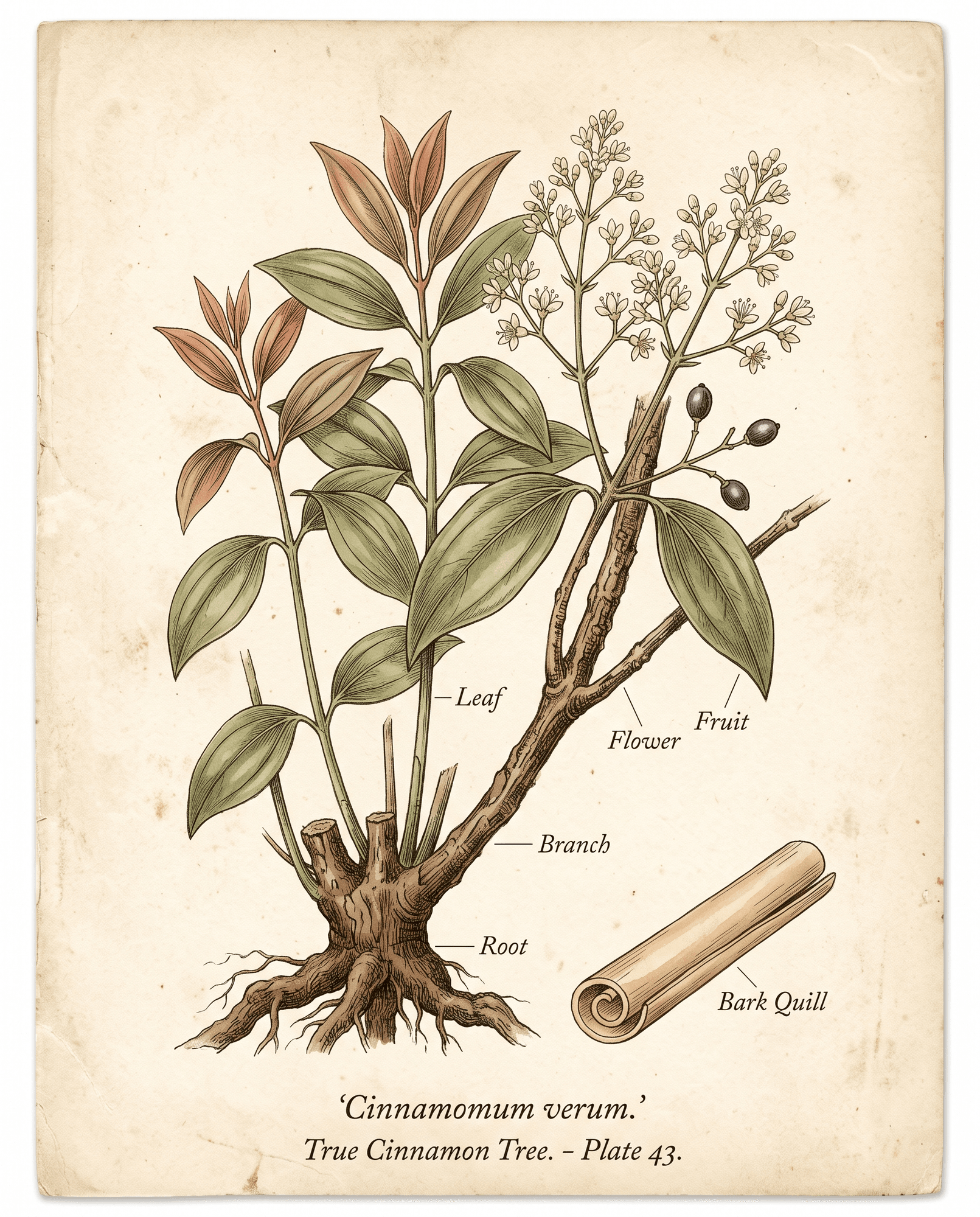
Cinnamon is not the tree’s skin. She is the layer just underneath it — the living tissue where a tree moves its sugars from the leaf, where they are made, to every other part of itself that needs them. Sit with that before anything else. She is the transport layer, the part of the plant whose whole job is carrying sweetness to where it can be used, and that is her work in a body too: she takes warmth to the cold edges, blood to the still places, and sugar out of the bloodstream and into the cells that have stopped hearing it called.
She is also the most traveled plant most of us will ever hold. She grows wild in one small strip of wet forest in southwestern Sri Lanka, and for most of human history the people buying her had no idea where she came from or what the tree looked like. They paid more than the price of gold for her anyway. And yet she is in every kitchen now. There is no household so lean it does not have a little cinnamon. She has been imperial and she has been ordinary, and she has never once stopped being sweet.
The shape of her medicine
Cinnamon’s medicine is heat carried in sweetness. That is what separates her from the other warming spices. Cayenne’s fire flashes outward and disperses; ginger’s fire is bright and pungent at the surface; cinnamon’s fire is banked and low and steady, the coal rather than the flame, and it comes wrapped in a sweetness that lets the body accept warmth it would otherwise refuse. She is hot and drying, pungent and sweet at once, with an astringent finish that tightens as her heat opens. She warms without scattering.
Her direction depends on which part of her you have. The twig moves outward and upward — she goes to the surface, the limbs, the skin, opening the channels toward the periphery. The bark moves inward and downward — she goes to the deepest interior and settles there, and when the body’s fire has floated up and away from its own root, she leads it back down. This is an unusual gesture for a hot herb. Most heat rises. Hers returns.
She is a warming stimulant first; the rest follows. She raises the body’s baseline warmth rather than spiking it — the person who is cold all the time, whose hands and feet never warm, whose digestion has grown slow because there is not enough fire under it, is her person. As a circulatory stimulant she drives blood into vessels that have narrowed with cold, which is why she belongs in the winter cup and in the liniment for the aching knee.
As a carminative and digestive stimulant she is one of the great kitchen medicines. She kindles the digestive fire, moves gas and bloating, eases the cramping that comes from cold in the belly, and quiets nausea. She turns up in nearly every spice blend on earth — chai, garam masala, ras el hanout, mole, café de olla — because she makes heavy food digestible.
Her antispasmodic action reaches the smooth muscle: the gut that has clenched, the airway that has tightened, the uterus that is cramping. This is the mechanism beneath her long-documented relief of menstrual pain, and here the clinical trials and the grandmothers agree without argument.
She is astringent and hemostatic, and this action sits strangely beside her heat. Her tannins tighten lax tissue and slow excessive flow — heavy bleeding, weeping discharge, loose bowels. And yet in Chinese medicine she is also a mover of cold-stuck blood, used for the period that will not come. Both are true. She does not choose between stopping and starting; she restores tone to tissue that has lost it, and tissue with tone bleeds when it should and stops when it should. Where the flow is stuck from cold, she warms it loose. Where it is pouring from slackness, she draws it up.
Her antimicrobial and antifungal reach is broad and well established — cinnamaldehyde is hostile to bacteria, yeasts, and molds, which is why she preserved meat in the world before refrigeration and why she still belongs in the oral rinse, the foot soak, and the winter oxymel.
Her insulin-sensitizing action is the one the modern world came looking for. She does not lower blood sugar by force. Her polyphenols help the insulin receptor stay switched on, so the cell can hear a signal it has been ignoring. The effect is modest and cumulative — most reliable in insulin resistance, prediabetes, and PCOS, and most reliable when she is taken as a daily practice rather than a dose. She is not a replacement for anyone’s medication, and she is at her best where she has always been: stirred into the food, making the meal easier for the body to meet.
Her anti-inflammatory thread runs beneath all of it, damping the signaling that keeps low-grade fire smoldering in joints, gut, and vessel walls. Her diaphoretic action belongs mostly to the twig, opening the pores at the first chill of a cold. Her analgesic work shows up in the cramping uterus, the aching cold joint, and the head that hurts. And her old reputation as an aphrodisiac — shukrala in Sanskrit, a builder of the reproductive tissue — is the same warmth arriving at the pelvis.
Together her actions form one gesture: warmth returned to the places it left. She is for the body that has gone cold at its edges, cold in its belly, cold in its center, or cold at the root.
What lives inside her
Whose medicine she carries
Air (the volatile oil, the scent that travels ahead of her)
Earth (the tree, the wood)
Venus
Taurus
The Sun
The Magician
Oshun
Oshun is sweetness with power in it. She rules honey and gold and the moving river, the ovaries and the cycle they govern, and the whole difficult art of attraction — the drawing of what is wanted rather than the seizing of it. Cinnamon is her spice, and not for pleasantness. Sweetness is the mechanism of her medicine. She does not force warmth into a body; she makes warmth desirable — the reason a bitter medicine goes down, the reason a cold person will drink the cup, the reason a plain pot becomes something people gather for. That is Oshun’s own way of working: what cannot be taken by force can be drawn by sweetness.
The correspondence runs deeper than metaphor, into the body’s literal relationship with sugar. Cinnamon’s most studied gift is that she helps the cell hear insulin again — she restores the body’s ability to receive sweetness and put it to use instead of letting it circulate, unclaimed, doing damage. Anyone who has had abundance move past them without landing knows that gesture from the inside. And her reproductive work sits in Oshun’s own chamber: the painful cycle eased, the heavy flow drawn up, the cold womb warmed, the tangled insulin-and-hormone knot of PCOS slowly loosened. Few plants meet the ovary and the blood sugar in the same gesture.
She is also, across the whole of the diaspora, the money plant. Sprinkled in the wallet, dressed on the candle, worked into the powders and the mojo bags, blown across the threshold on the first of the month with a request spoken out loud. This is Oshun’s domain and Oshun’s terms — abundance that is asked for sweetly, prosperity that arrives because it was welcomed rather than demanded. Working with cinnamon in her name is a practice in wanting out loud, without apology, and in making yourself a place worth arriving at.
Shango
Shango’s fire in cinnamon is not the flash. That belongs to the pepper. His fire here is the coal at the bottom of the banked hearth — the heat that has been kept, that does not go out overnight, that is still there in the morning to build from. Cinnamon bark is the most deeply warming medicine in most traditions that use her, and her warmth goes to the two places his fire lives: the heart and the root. She tonifies the heart’s own warmth, she stokes the fire at the base of the spine where vitality and generative force are held, and she meets the exhaustion that is not tiredness but cold — the body that has run out of fuel rather than out of sleep.
Her most striking gesture belongs entirely to him. When the body’s fire has floated up and away from its own base — heat in the face and the head while the low back and the feet are cold, a false burning above and a real emptiness below — cinnamon bark is the medicine that brings the fire back down and roots it where it belongs. In a very small dose, deliberately, she leads it home. Heat that has left its source looks like strength. It is a body flaring at the top because it is failing at the bottom. Shango’s discipline is the keeping of the fire rather than the size of it, and cinnamon carries that — she returns flame to the hearth instead of adding to it.
The hands she has passed through
Cinnamon’s story begins in a narrow band of wet lowland forest in southwestern Sri Lanka, where she is endemic and where the Sinhala people have known her as kurundu for as long as there is memory of the island. Everything else in her history is what happened to a plant that grew in only one small place and turned out to be worth more than gold everywhere else.
She was already in Egypt by around 2000 BCE, carried up the Red Sea by traders who never once said where she came from. Egyptians used her in embalming and in perfume; Ramesses III is recorded making enormous offerings of her. She is named in the Hebrew Bible among the ingredients of the holy anointing oil of Exodus, blended with myrrh, cassia, and olive oil to consecrate the tabernacle, the priesthood, and the kings — and again in Proverbs, where a lover perfumes her bed with cinnamon and myrrh. Sacred and sensual in the same book. In Rome she was tribute and funeral incense; Nero is said to have burned the city’s entire annual supply at the funeral of his wife.
The Arab and Phoenician traders who controlled her routes protected their monopoly with story. They told buyers that cinnamon was gathered from the nests of enormous birds who built with the sticks on unreachable cliffs, and that the traders lured them down with slabs of meat too heavy for the nests to bear. Herodotus wrote it down around 430 BCE as fact. Pliny called it what it was — a tale invented to justify the price — but the story outlived him by more than a thousand years. The longest-running commercial fiction in recorded history was built to hide a small island, and it worked.
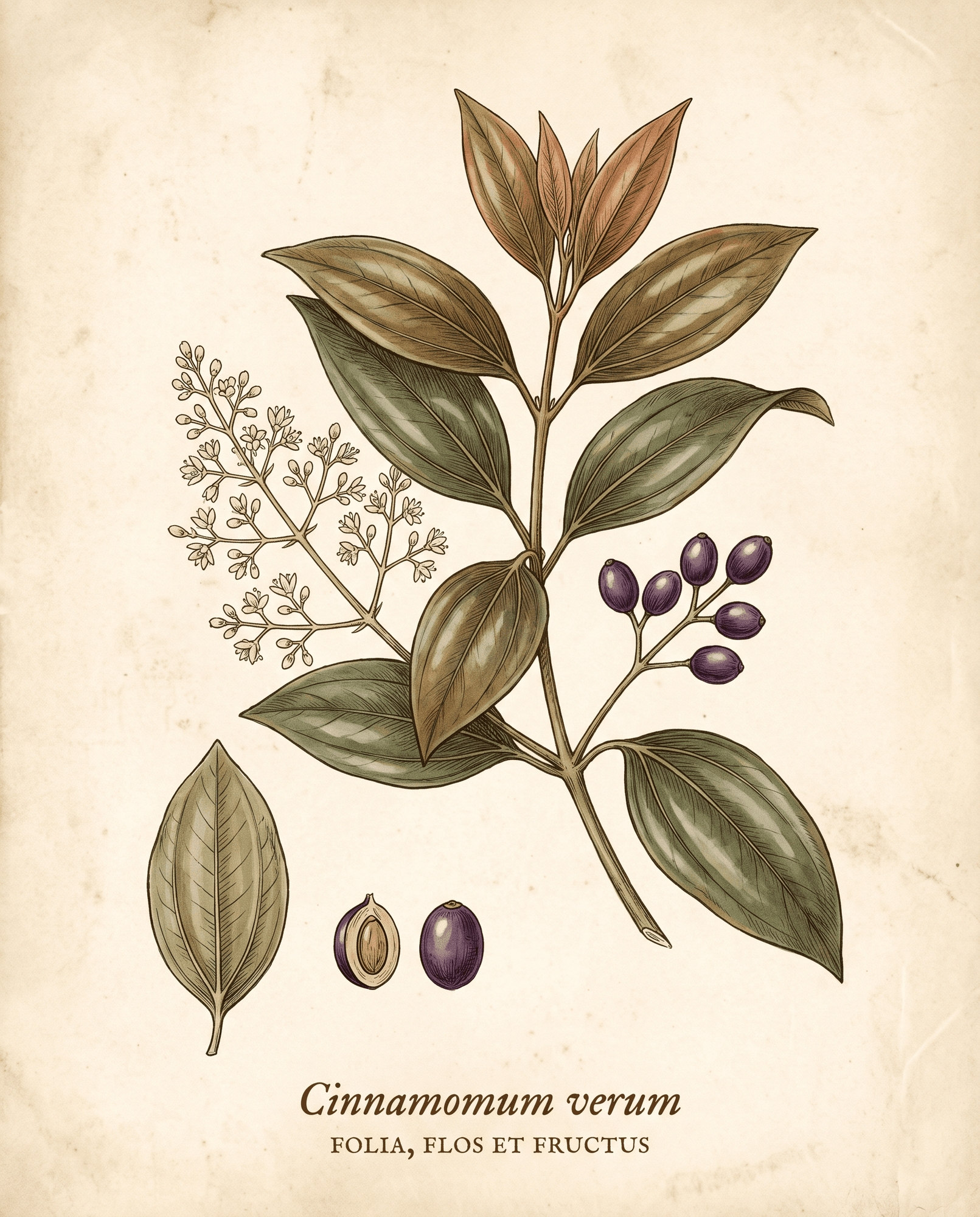
The lie held until 1505, when the Portuguese landed in Sri Lanka, understood what they had found, and built forts to hold the coast. What followed is the part of her history that most spice-cabinet writing skips. The peeling of cinnamon is skilled work — scraping the outer bark, loosening the inner layer with a brass rod, drawing it off in unbroken strips, rolling it into quills before it stiffens — and that skill belonged to the Salagama, a Sinhalese caste who had traditionally delivered quills to the Kandyan kings as a labor levy. The Portuguese took that levy and made it a machine, conscripting boys as young as twelve and raising quotas by age. When the Dutch East India Company displaced them in the mid-1600s, demand multiplied and so did the brutality: mutilation, chains, branding, and whipping for missed quotas, with anyone who could stand and walk pressed into peeling. When Salagama families tried to marry out of the obligation, the Dutch passed law to make it hereditary regardless. The peelers were not passive in this. They organized, struck, and walked off into the Kandyan highlands where the company could not follow, and the VOC was repeatedly forced to negotiate them back. One Sri Lankan historian called them the island’s first proletarian caste. The British took the coast in 1796 and kept both the monopoly and the compulsory service for another generation. What ended it was not conscience but arithmetic. Dutch smugglers had carried cinnamon plants out to Java in the 1820s — and carried Salagama peelers along with them to work the new plantations — cheap cassia was steadily replacing true cinnamon in European kitchens, and the price collapsed. The reforms of 1833 abolished compulsory service and sold off the government’s cinnamon lands, and within a decade coffee had taken the island’s attention entirely. The peelers were released at the moment their labor stopped being worth coercing. Every quill in every jar came off a tree by hand, and for three centuries those hands were not free.
In China, she is one of the oldest herbs in the written record, appearing in the Shen Nong Ben Cao Jing among the superior class of medicines — the ones held safe for long use and said to lengthen life. Chinese medicine draws a line most Western cooks never learn: Rou Gui is the bark, hot and heavy and inward, the great warmer of the deep interior; Gui Zhi is the twig, warm and light and outward, for the surface and the limbs. Same tree, two different medicines, and they are not substituted for each other. She anchors formulas that have been in continuous use since the Han dynasty.
In Ayurveda she is Twak or Dalchini, and she belongs to two of the classical spice groups — trijata, the three aromatics with cardamom and tejpatta, and chaturjata, the four with nagkeshara added. These groups appear across the formulary as the warming, digestive, aromatic backbone of countless preparations. She is in sitopaladi churna, the everyday remedy for cough and cold that sits in Indian medicine cabinets the way honey and lemon sit in others.
In Mexico and across Latin America she is canela, and she is not a garnish — she is structural. Mexico is the largest single buyer of Ceylon cinnamon in the world, so much so that one of Sri Lanka’s official export grades is named “Mexican.” She is the backbone of café de olla, champurrado, atole, arroz con leche, horchata, and the deep spice of mole. Where cassia dominates the American spice aisle, true cinnamon has been the ordinary daily standard in Mexican kitchens for centuries.
And across the African diaspora, she carries both her kitchen life and her spiritual one. She is in the sweet potato pie, the bread pudding, the tea cakes, the rice pudding, the stewed apples — the warm-spice signature of Black Southern baking, which is also a signature of who had access to what and made it beautiful anyway. In hoodoo and rootwork she is one of the primary money-drawing herbs: sprinkled in the wallet, dressed onto green candles, mixed into prosperity powders and mojo bags, added to floor washes and Florida water. The most widely practiced of her rituals is also the simplest — a palmful of cinnamon blown inward through the front door on the first of the month, with the ask spoken aloud, welcoming abundance across the threshold for the cycle ahead. She is worked for love and for speed as well, and the elders who teach her are clear that she is not gentle: used carelessly she stirs more than she settles.
Wherever she has gone, and she has gone everywhere, she has done the same two things. She has made ordinary food into something worth gathering for. And she has been asked, over and over, to bring something good across a threshold.
Where she works in the body
Digestive system. This is cinnamon’s daily work and her most universal one. She kindles digestive fire, stimulates the secretion and movement that a cold, sluggish gut has stopped producing on its own, and relieves the gas, bloating, and cramping that come from cold and stagnation in the belly. Her antispasmodic action quiets the clenching; her astringency firms loose stool; her antimicrobial reach addresses the fungal and bacterial overgrowth that so often sits underneath chronic bloating. She is the spice that makes rich, heavy, and cold-natured foods digestible, which is why nearly every traditional cuisine put her in the pot alongside them. Her caution is the mirror image of her gift: where the gut is already hot — active reflux, gastritis, ulceration — she adds to the fire.
Cardiovascular system. She warms and moves the blood. She drives circulation into vessels that have narrowed with cold, which is her answer to hands and feet that never warm, to chilblains, to the person who cannot get warm from the inside. Her effect on lipids and on the oxidative stress that stiffens vessel walls is modest but real and cumulative, and in Chinese medicine she is a direct tonic to the heart’s own warmth — used where the pulse is weak and the chest is cold rather than where it is racing. She is warming heart medicine, appropriate to cold and deficient patterns and inappropriate to hot and excess ones.
Endocrine and metabolic system. Her insulin-sensitizing action belongs here, and it is useful when understood correctly. She helps the insulin receptor remain active so cells can take up glucose that would otherwise stay circulating, and she slows the formation of the sugar-damaged proteins that drive much of the long-term harm of high blood sugar. The clinical picture is consistent though not dramatic: modest improvements in fasting glucose and insulin sensitivity, most reliable in insulin resistance, prediabetes, and PCOS, and dependent on daily use over months rather than a single heroic dose. In PCOS in particular she has been studied for both the metabolic and the menstrual side of the condition, which is unusual — most herbs address one or the other. She belongs alongside medical management, not instead of it.
Reproductive system. She warms the womb and eases what cold and stagnation have made painful. Her strongest and best-supported use here is menstrual cramping, where her antispasmodic and analgesic actions meaningfully reduce pain, and where the tradition and the trials say the same thing. For heavy bleeding she works as an astringent, drawing up tissue that has gone slack; for the period held back by cold she works as a warmer, loosening what has stopped. In the Ayurvedic reading she is shukrala, a builder of reproductive tissue and vitality, and her old reputation as an aphrodisiac is this warmth arriving at the pelvis. Because she moves blood and warms the uterus, medicinal doses are not for pregnancy.
Respiratory system. The twig especially belongs to the first cold hours of an illness — the chill, the ache, the stiff neck, the sense of something settling in at the surface. She opens the pores, encourages a sweat, and helps the body push out what has just arrived rather than letting it descend. For the wet, cold, phlegmy cough she warms and dries, and her antimicrobial action supports the tissue directly. She is wrong medicine for a hot, dry, barking cough with a red throat, where she will only harden what is already parched.
Musculoskeletal system. Cold, damp, aching joints that hurt worse in wet weather and better with heat are her territory. She warms and opens the channels, moves the blood into stiff tissue, and relieves the pain that comes from cold obstruction rather than from inflammation and heat. She works internally in warming formulas and externally in liniments and infused oils, where her rubefacient warmth brings blood to the surface of a cold, stiff, unwilling joint.
Immune system. Her antimicrobial and antifungal breadth is her contribution here, and it is broad enough to matter — against bacteria, yeasts, and molds, internally in the gut and topically on skin, nail, and mucous membrane. Combined with her diaphoretic warmth at the onset of a cold and her general support of a body that runs too cold to mount a good response, she is a reliable winter ally. She is defense by warmth, not by force.
How to take her
Harvest calendar
Preparations
Bark decoction: 1–2 teaspoons of broken quill per cup of water, simmered gently 10–15 minutes, covered. Covering matters — her medicine is volatile and will leave with the steam. Drink 1–3 cups daily. For blood sugar work, a daily cup of Ceylon rather than an occasional strong one.
Bark in Chinese formula (Rou Gui): 1–4.5 grams, added at the very end of a decoction or taken as powder, because long boiling drives off the volatile oil that carries her action. For leading floating fire back to its source, the traditional dose is startlingly small — a tenth of a gram to half a gram.
Twig decoction (Gui Zhi): 3–9 grams, simmered as part of a formula. This is the preparation for the surface, the limbs, and the first stage of a cold with chills.
Tincture: 1:5 dry in 60–70% alcohol — she is resinous and volatile, and needs the higher proof. Typical dose 1–3 mL, up to three times daily.
Powder: ½ to 1 teaspoon (roughly 1–3 grams) daily, stirred into food, taken in honey, or capsuled. This is the form most of the blood sugar research used. Use Ceylon for anything daily.
Infused honey: Broken quills submerged in raw honey for two to four weeks. One of her most pleasant preparations and one of her most fitting — heat held in sweetness, taken by the spoonful through the cold season or stirred into hot water for a sore throat.
Oxymel and fire cider: She takes readily to vinegar and honey and belongs in the winter preparations alongside ginger, garlic, and hot pepper.
Milk decoction: Simmered in milk or a plant milk with a little ghee or coconut oil — the classical Ayurvedic method, which buffers her dryness and carries her deeper into the tissues. This is how to give her to a Vata constitution without aggravating.
Food: Her oldest and safest form, and the one with the longest track record for the metabolic work. Chai, café de olla, mole, rice pudding, stewed fruit, oatmeal, the pot of beans. Daily food is the dose that has actually fed and warmed people for four thousand years.
Topical infused oil: Quills gently warmed in sesame or coconut oil, strained, and used on cold stiff joints and cold hands and feet. Test a small area first.
Essential oil: Topical only, and heavily diluted — 0.5% or less for the bark oil. It is a strong dermal sensitizer and will burn mucous membranes. It does not belong in a diffuser around children or pets, in the bath undispersed, or in the mouth without clinical training.
Spiritual & ritual:
- A palmful blown inward through the front door on the first of the month, with the ask spoken aloud, to welcome abundance across the threshold for the cycle ahead
- Ground and sprinkled in the wallet, the register, or the corners of a shop before it opens
- Dressed onto candles and worked into powders, floor washes, and mojo bags for prosperity, love, and speed
- A pinch added to any working that has been sitting too long and needs heat under it
- Quills placed on altars for Oshun with honey, or for Shango
- Simmered on the stove with orange peel and clove, to make a house smell like somewhere people want to be
When to hold back
Use with caution if:
- You are pregnant. Cinnamon warms and moves the blood and has a long reputation as an emmenagogue. Culinary amounts in food are generally considered fine; medicinal doses, concentrated extracts, and the essential oil are not.
- You are using cassia rather than Ceylon, daily or long-term. Cassia’s coumarin content can exceed the tolerable daily intake at a single teaspoon for a smaller adult, and coumarin is hepatotoxic with sustained exposure. For any regular use, buy true Ceylon — pale tan, papery, many thin layers rolled together, and it crumbles under a finger.
- You have liver disease, are a heavy drinker, or take liver-metabolized medications. Avoid cassia entirely and keep even Ceylon to reasonable amounts.
- You take anticoagulant or antiplatelet medication. She moves blood, and the coumarin question compounds the caution.
- You take antidiabetic medication or insulin. Her effects are additive and blood sugar can drop lower than intended. Monitor, and work with your prescriber rather than around them.
- You have active reflux, gastritis, or peptic ulcers. She is hot and will aggravate a gut that is already burning.
- You run hot — a Pitta-predominant constitution, or the Chinese picture of yin deficiency with heat: night sweats, flushing, a red tongue with little coat, a dry burning restlessness. She adds fire where there is already too much.
- You have bleeding from heat rather than from slackness — bright red, hot, rapid. Her warmth is wrong there even though her astringency seems right.
- You are approaching surgery. Stop medicinal doses one to two weeks beforehand.
Topical considerations: The essential oil is among the more aggressive dermal sensitizers in common use. Never apply it undiluted, never to mucous membranes or broken skin, and patch-test even at low dilution. Repeated exposure can sensitize a person who tolerated it fine at first. Powdered bark held against the skin or the gums — a folk practice for toothache — can cause a chemical burn and mouth ulceration. Whole-bark infused oils are far gentler and are the better vehicle for nearly everything topical.
General notes: As food, across the world and across four thousand years, she is remarkably safe. As concentrated medicine she asks for a light hand and a clear reason. She is not a plant to take heroically. Take her daily, in small amounts, over a long time — which is also how she works best.
Who walks with her
For blood sugar and metabolic terrain: Fenugreek, gymnema, holy basil, bitter melon, burdock.
For warming digestion: Ginger, cardamom, black pepper, fennel, clove, tulsi.
For circulation and the heart: Hawthorn, ginger, cayenne, garlic, prickly ash.
For the painful or heavy cycle: Ginger, cramp bark, motherwort, yarrow, raspberry leaf, vitex.
For the first hours of a cold: Ginger, yarrow, elderflower, thyme, garlic.
For cold, damp, aching joints: Ginger, turmeric, prickly ash, black pepper.
For prosperity and threshold work: Basil, bay, allspice, five-finger grass, patchouli.
What cinnamon brings to a plant community is palatability with power behind it. She is one of the few herbs that improves the taste of a formula without weakening it, which means she can carry harder medicines into a body that would otherwise refuse them — the bitter blood sugar herbs especially, which people abandon because they cannot stand the cup. With ginger she doubles the warmth, ginger holding the bright surface heat while cinnamon banks the deep coal beneath it. With hawthorn she rounds out heart medicine, hawthorn steadying the muscle while cinnamon warms the blood that serves it. With fenugreek and gymnema she completes a metabolic formula that people will keep drinking. She rarely needs to be the largest part of anything. She needs to be present, in a small steady amount, over a long enough time to matter.
How to know her
Plant walk: Most of us will never meet her growing, so meet her where she lives in your life — the spice cabinet, the grocery aisle, the market bin. Buy one quill of true Ceylon and one stick of cassia and put them side by side. The Ceylon is pale tan, soft, made of many thin sheets rolled one inside the other; it will crumble between your fingers. The cassia is reddish, thick, hard, a single woody curl. Smell each. Break each. Understand that these have been sold to you as the same thing your whole life — learning to tell apart what commerce has flattened into one word is the whole of the walk.
Kitchen practice: Make something slow with her. Café de olla, chai simmered from whole spices rather than a bag, rice pudding, a pot of stewed apples. Let the house fill with the smell before you taste anything. Notice that people come into the kitchen. That is the medicine working before it is even drunk — she gathers, and gathering is half of what warmth is for.
Ritual of the threshold: On the first of a month, or the first day of anything, stand outside your own front door with a small palmful of ground cinnamon. Say what you want for the season ahead in ordinary language, no poetry. Blow the cinnamon inward through the open door. Leave it a while before you sweep. This is old, widely practiced, and it asks only two things of you: that you say the want out loud, and that you address it to your own doorway.
Ritual of return: For when you have been running hot at the top and cold at the bottom — burning through the days, all fire in the head and the mouth, nothing left in the low back or the feet. Make a small cup: a short piece of bark simmered briefly in milk with a little fat, not strong, not much. Sit somewhere low to the ground and drink it slowly, and put your attention below your navel while you do. This is the plant’s most particular gesture — she is the one that takes a fire which has floated up and away and walks it back down to its own hearth. Ask her for that.
Journal prompts
- Where in my life have I gone cold, and did I notice it happening?
- What sweetness has been circulating past me without ever landing — and what would it take for me to be able to receive it?
- Where am I burning at the top while the bottom of me is empty?
- What do I want this season, said out loud, with no softening?
- What have I been taught to call one thing that is really two? Where else in my life has commerce flattened a difference that matters?
- What in me needs warmth before it will move, rather than pressure?
Tarot Spread
A spread for entering into relationship with Cinnamon as a plant ally:
- Where has my fire left its source?
- What is she offering to warm that I have written off as permanently cold?
- What am I being invited to ask for?
- What is standing at my threshold, waiting to be welcomed in?
- Where do I need to stop forcing and start sweetening?
- What does she want me to know about the cost of what I take for granted?
Keep a quill of cinnamon on the altar with the cards, and a small dish of honey beside it. Break the quill before you begin so the scent is in the room while you read.
The same plant, multiple lenses
Cinnamon is Twak or Dalchini, and she is one of the tradition’s central warming aromatics — a member of both trijata and chaturjata, the classical spice groups that form the digestive backbone of countless formulas. Her energetics are pungent, bitter, and sweet in taste (katu, tikta, madhura rasa); light, dry, and penetrating in quality (laghu, ruksha, teekshna guna); hot in potency (ushna virya); and pungent in post-digestive effect (katu vipaka). She is a deepana and pachana herb — she kindles digestive fire and burns undigested residue — and she is named shukrala, a builder of reproductive tissue, and varnya, a supporter of complexion.
There is a genuine disagreement inside the tradition. Most contemporary sources classify her as kapha-vata shamaka — reducing Kapha and Vata, increasing Pitta by virtue of her heat. But the Bhavaprakasha describes her as balancing Vata and Pitta both, on the strength of her sweet and slightly bitter tastes. The resolution is in the dose and the vehicle: taken as a small amount of sweet aromatic in a fatty carrier she is far gentler on Pitta than her heat alone would suggest; taken as concentrated dry powder in quantity she aggravates Pitta exactly as the modern reading predicts.
Pitta Dosha — Fire & Water
Care is needed here. Her hot potency and pungent post-digestive effect increase Pitta, and in a Pitta-predominant person or a Pitta-aggravated season she can drive acid, inflammation, skin heat, and irritability. That said, she is gentler than the other hot spices because of her sweetness — a small amount in a sweet, cooling, or fatty base is often well tolerated where ginger or pepper would not be. For active Pitta conditions, use sparingly or not at all, and never as dry powder in quantity.
Kapha Dosha — Earth & Water
Kapha is her clearest indication. Kapha’s cold, heavy, damp, slow, congested nature is what her light, dry, penetrating heat disperses. She cuts through mucus and phlegm, kindles a metabolism that has stalled, moves the heaviness that settles in the chest and the gut, and addresses the sluggish sugar handling that so often accompanies a Kapha imbalance. For cold, damp, stagnant Kapha patterns she is well-matched daily medicine.
Vata Dosha — Air & Ether
Cinnamon’s warmth does reduce Vata’s cold — she is a reliable answer to cold hands and feet, cramping, gas, and the cold weak digestion of a Vata imbalance. But her dryness is the caution, because Vata is already dry, and her penetrating quality can be scattering to a constitution that is already too mobile. Give her to Vata the classical way: simmered in milk with ghee or another good fat, sweetened, taken warm. The vehicle does the work of holding her heat without letting her dryness aggravate.
Chinese medicine draws the distinction that matters most about this plant: the bark and the twig are two separate medicines, and they are not interchangeable.
Taste & Temperature: Rou Gui (bark) — acrid and sweet, hot. Gui Zhi (twig) — acrid and sweet, warm. Channels Entered: Rou Gui — Kidney, Spleen, Heart, and Liver. Gui Zhi — Heart, Lung, and Bladder. Functions: Warms the fire and assists Yang. Leads floating fire back to its source. Disperses Cold and relieves pain. Warms and unblocks the channels and vessels. Encourages the generation of Qi and Blood. Releases the exterior and assists Qi transformation.
Warming the Fire & Assisting Yang
Rou Gui is among the very hottest herbs in the materia medica and the principal one for supplementing Kidney Yang and the Ming Men fire — the “life gate,” the deep generative warmth at the base of the body that everything else draws on. Her picture is unmistakable: aversion to cold, cold limbs, a weak and cold low back and knees, frequent pale urination, loose stool, low libido, a body that has run out of fuel. She warms the Spleen and Heart alongside the Kidney, which is why she appears in formulas for cold, painful digestion and for Heart Yang deficiency with a cold chest.
Leading the Fire Back to Its Source
This is her signature and her strangest gift — a hot, descending herb used for false heat above with true cold below. The picture is a flushed face, a dry mouth, a sore throat or toothache worse at night, together with a cold low back, cold feet, and a weak deep pulse. The fire has floated up because there is nothing left to hold it down. Rou Gui, in a very small dose, guides it back to the Kidney where it belongs. The dose here is a fraction of the usual — this is a gesture of direction, not of force.
Dispersing Cold & Relieving Pain
Where Cold has lodged in the body and stopped things, she moves it: cold abdominal and epigastric pain, cold painful obstruction in the joints and low back, the deep ache that eases with heat and worsens with damp weather. She enters the blood level, which is why she also addresses Cold in the Blood causing amenorrhea and painful periods, and the yin-type sores and ulcers that ooze clear fluid and will not close.
Warming & Unblocking the Channels
Gui Zhi carries this function outward. The twig is warm rather than hot, light rather than heavy, and moves upward and outward to the surface and the limbs. She releases the exterior in wind-cold invasion — the chill, the stiff neck, the ache at the very start of an illness — warms the channels of the arms and legs, calms upward-surging Qi, and assists the Bladder’s Qi transformation and fluid metabolism. She is the twig in Gui Zhi Tang, one of the oldest and most-used formulas in the tradition.
Encouraging the Generation of Qi & Blood
Added in small amounts to Qi and Blood tonics, Rou Gui warms them and helps the body build from what they supply. Warmth is a precondition for generation — a cold body cannot make blood well, no matter how good the tonic — so she often appears as a small auxiliary in formulas whose main work is nourishing rather than warming.
Yin/Yang Balance
Cinnamon is strongly Yang — warming, generating, and in the bark’s case unusually, descending. She is medicine for Cold and Yang-deficient patterns: the cold body, the failing digestive fire, the deep chill in the low back, the blood stopped by cold. She is expressly not for Yin deficiency with heat effulgent, for bleeding due to heat in the blood, or for pregnancy. In classical practice she is rarely used alone and rarely decocted long — she is added at the end, in a small amount, to warm and direct a formula whose other herbs are doing the bulk of the work.
For going deeper
- Bensky, Dan, Clavey, Steven & Stöger, Erich. Chinese Herbal Medicine: Materia Medica (3rd edition). Eastland Press. (See the entries for Rou Gui and Gui Zhi — the bark/twig distinction is where this plant opens up.)
- Chen, John K. & Chen, Tina T. Chinese Medical Herbology and Pharmacology. Art of Medicine Press.
- Frawley, David & Lad, Vasant. The Yoga of Herbs: An Ayurvedic Guide to Herbal Medicine. Lotus Press.
- Bhavaprakasha Nighantu — the classical Ayurvedic source for Twak and Darusita, worth reading with a commentary that addresses the Pitta question directly.
- Wood, Matthew. The Earthwise Herbal: A Complete Guide to Old World Medicinal Plants. North Atlantic Books.
- Turner, Jack. Spice: The History of a Temptation. Vintage. — for the long arc of cinnamon’s trade, mythology, and the appetite that drove empires after her.
- Yronwode, Catherine. Hoodoo Herb and Root Magic: A Materia Magica of African-American Conjure. Lucky Mojo Curio Co. — for cinnamon’s place among the money-drawing and quickening herbs.
- Lee, Michele Elizabeth. Working the Roots: Over 400 Years of Traditional African American Healing. Wadastick Publishers.
- Sri Lankan sources on the cinnamon peelers and the Salagama caste — the labor history of this plant is documented on the island in ways the European spice histories do not carry. Look for Sinhala-language and Sri Lankan scholarship rather than Western trade histories, which tend to narrate the monopoly from the deck of the ship.
- The German Federal Institute for Risk Assessment (BfR) and EFSA assessments of coumarin in cassia — the clearest public documentation of the Ceylon/cassia safety distinction.
- Conversations with Mexican, Caribbean, and Black Southern cooks about canela and the warm-spice tradition. She lives in kitchens more than in clinics, and the kitchen knowledge is older.
The Conversation
Questions, noticings, what this is teaching you — leave them here. This same conversation lives in The Circle.