Chicory
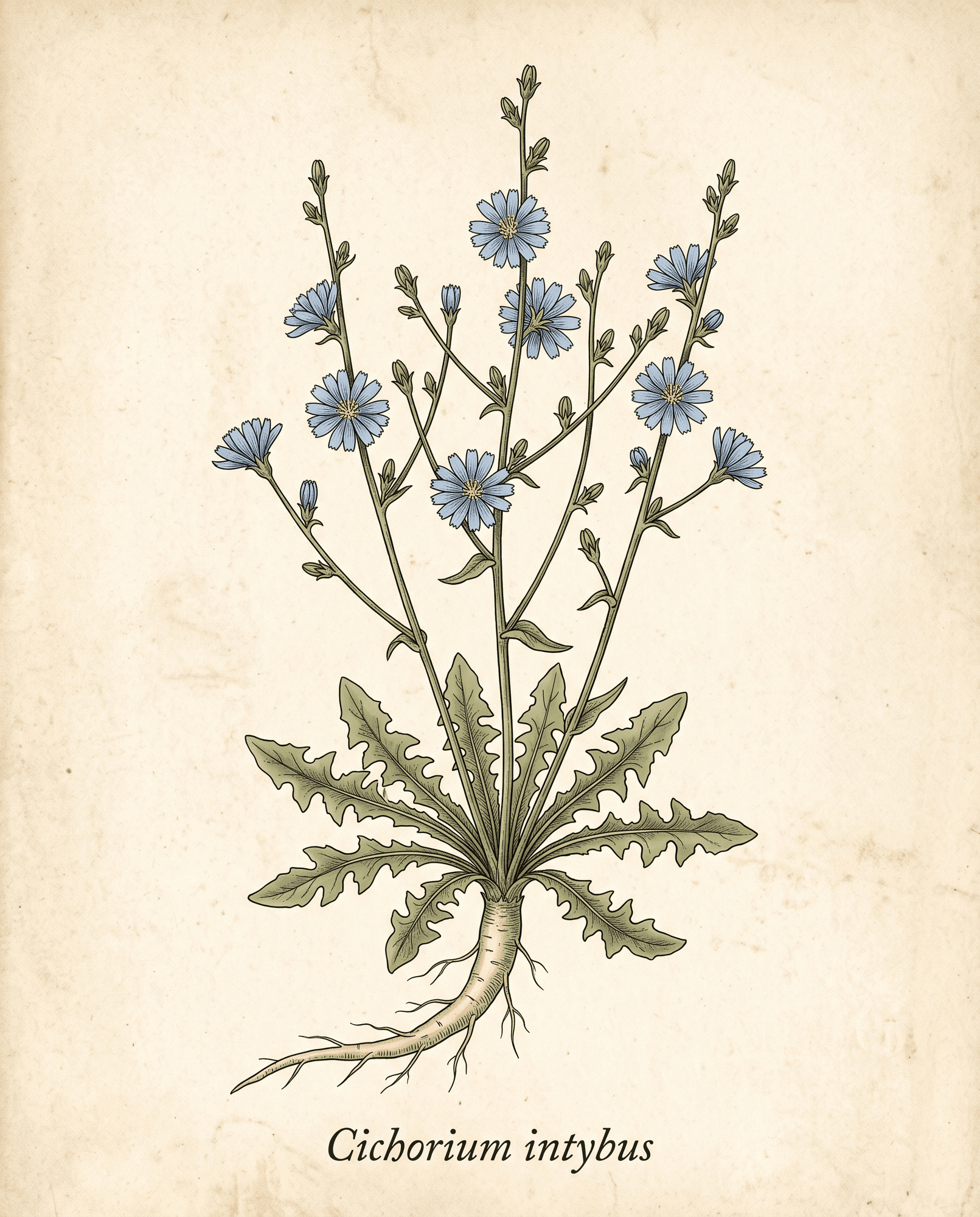
You have seen her even if you never learned her name. She is the one growing out of the crack in the sidewalk, along the median, at the edge of the parking lot and the abandoned field — stiff-stemmed, ragged, and crowned each morning with a flower the exact blue of the sky before full heat. Those flowers close by noon and open again the next day, whether or not anyone is watching, in soil nobody else wanted, and she has been keeping that schedule for a very long time.
Chicory is bitter medicine for the liver and the gut, and she is also a story about sustenance — about what people learn to make when the shelves go bare. Her roasted root has carried families through war, blockade, and depression, stretched into the coffee cup when coffee could not be had, and across all of that history she has been teaching one thing, which is that the bitter can feed you. She is for sluggish digestion and a flat appetite, for the heavy fullness after rich food, for a liver that has run hot and congested, for the damp heaviness of fluid that will not move — and for the spirit that has stopped believing a lean season has anything in it to eat.
The shape of her medicine
Chicory’s medicine moves downward and out. Where heat has gathered high in the body — the irritable, frustrated liver, the hot and reactive gut, the bitter or sticky taste that sits in the mouth by afternoon — she draws it down and carries it out through the bile and the urine. She is cooling and drying, which makes her a plant for damp heat: the sluggish, congested, overheated patterns that show up as fullness after meals, a flushed and short temper, skin that reacts, and a body that feels waterlogged and slow. Her direction is unhurried, and it is the direction of a drain rather than a purge — she lowers the level of what has pooled, day after day, instead of emptying the vessel all at once.
She is bitter first, and the bitterness is where her medicine begins. The moment she touches the tongue, the whole digestive tract is put on notice — saliva rises, the stomach readies its acids, the pancreas prepares its enzymes, and the liver and gallbladder begin to move bile. Herbalists call this the bitter reflex, and chicory is one of its most dependable workhorses. What she calls up is the body’s own digestive intelligence, awake before a single bite is swallowed, with nothing added from outside.
As a cholagogue, she stimulates the liver to make bile and the gallbladder to release it, and bile is the current on which so much depends: it emulsifies fats, carries spent hormones and lipid-soluble waste out through the bowel, and keeps the stool moving. When that current slows, everything downstream sours — digestion turns heavy, the skin breaks out, the mood curdles. Chicory keeps the gate open. Her hepatic work goes deeper than the gate, though. Her bitter constituents protect liver tissue under strain and support the organ’s slow rebuilding of its own capacity to process and discern. She is for the liver that has been asked to carry too much for too long.
As an alterative, she works on the terrain of the body rather than the symptom — the cumulative state of the blood, the lymph, and the organs of elimination. You notice this kind of medicine months in: a digestion that has settled, a calmer skin, a temper that no longer boils by three in the afternoon. Her diuretic action is mild and pairs naturally with the liver work: what the liver hands off, the kidneys carry out, and she clears the stagnant fluid and damp heaviness that settle in a hot, sluggish system. As an aperient, she encourages the bowels gently, through bile and fiber rather than irritation.
Her anti-inflammatory and antioxidant threads run through every system she touches, cooling reactive tissue and quieting the chronic low fire that overheated livers tend to keep burning. And she is stomatic — a rare quality in a cooling bitter. Where many of the great liver bitters are hard on the stomach, chicory strengthens it, which is why she can be taken daily, as food, for a long season without wearing the digestion down.
Taken together, her work has one shape: she clears the way so the body can feed itself. She is for the body that has been running hot and eating poorly and holding on, and for the constitution that needs a gentle, cooling clearing. Because she is cooling and drying, she can over-chill or over-dry a body that is already cold and depleted, so read the terrain first, and hold her with warmth when the terrain asks for it.
What lives inside her
Whose medicine she carries
Water (bile and the clearing current)
Air (flower)
Sun
Virgo
The Star
Orisha Oko
Orisha Oko keeps the farm and the tilled earth. He governs the fertility of the soil, the labor of cultivation, and the sustenance that labor brings home to the community. His ground is the place where the wild bush meets the worked field — and chicory lives exactly there, half wild weed and half cultivated crop, rooted in disturbed and roadside soil that has been turned, broken, and left. She is his plant in the most literal way: a deep taproot that draws nourishment from poor ground and turns it into food, into the roasted root that has fed people through war and want, into bitter greens that wake the body in spring.
Her medicine is sustenance made from what is already at hand. Oko’s teaching is the long, honest, unglamorous work of tending — the seed put in, the field kept, the harvest brought home without spectacle — and chicory keeps the same measure: the daily drainage that keeps a body fed and clear, the cup poured every morning, the root dug every fall. To work with her in his name is to practice feeding yourself and your people from the ground you stand on rather than the ground you wish you had. Offerings of the roasted root, shared in a cup, are a fitting way to bring her to his field, especially in seasons of scarcity or when the work ahead asks for endurance more than inspiration.
Oya
Oya is the wind that follows the storm. She rules sudden change, the marketplace, and the gate the ancestors pass through — and she is the one who sweeps the field of dead wood so that something new can grow. Chicory carries a very particular piece of her. She is a plant of the aftermath: of ground that has been torn up, of soil turned over by construction and neglect, of the verge after the road has been cut. You will rarely find her in a settled garden; she comes up where something has been disturbed, and she makes medicine there.
The story she is best known for is a marketplace story. When blockade cut a port city off from its coffee, the tradition that grew in the wake of that upheaval was built at street stands, by vendors who turned scarcity into a thing the whole city now claims. That is Oya’s signature — the storm that seems only to take, and the new order that rises in the market after it passes. And in the body, her alterative work is Oya’s sweeping: bile and fluid moved down and out, the stagnant cleared, the old drained so the current can run again. Even the roadside folklore that credits her with opening locked doors belongs here — the plant that removes what stands in the way. The second cup, the one poured for the ones at the gate, is poured on her threshold.
The hands she has passed through
Chicory has walked beside people for thousands of years. She appears in the plant records of ancient Egypt, and the Greek and Roman physicians ate her bitter leaves as a cleansing spring food and worked her root for the liver and the blood. Across European folk tradition she led a double life: humble pot-herb and field weed on one side, and on the other a plant wrapped in quiet magic. Her sky-blue flowers, which open with the morning sun and close by midday, gathered legends of faithfulness and watching — the old story of a maiden left waiting at the roadside for a love who never returned, turned at last into the blue flower that keeps its vigil there still. Other traditions held that chicory, gathered in silence with the right tools on the right day, could open locked doors or make the bearer unseen: a plant credited with removing whatever stands in the way.
In Traditional Chinese Medicine, where she is known as ju ju, she came into the pharmacopoeia by way of the Uyghur medical tradition of the far west, which has long worked her for the liver and the gallbladder — for jaundice, for damp heat, for the fullness and bitter mouth of a congested liver. In Ayurveda and Unani medicine she is kasni, a cooling bitter for the liver and the blood, valued for the same hot, congested patterns and for her gentleness on the stomach.
But her most enduring story on this side of the water is a story of scarcity and resourcefulness. The roasted root has long been the people’s coffee — caffeine-free, cheap, and grown from common ground — reached for in every season when real coffee was hard to come by: through the blockades of the Napoleonic wars, through the American Civil War, through the Great Depression. When Union naval blockades sealed the port of New Orleans and the coffee ships stopped coming, the city stretched its dwindling supply with locally grown, roasted chicory root, and when the blockade lifted and the ships returned, the habit stayed.
What grew from that necessity was something deeper than a workaround. New Orleans coffee culture was built on the labor and ingenuity of Black women — street vendors like Rose Nicaud, remembered as the one who lit the city’s coffee-stand tradition — and it carried the braided inheritance of French, African, and Caribbean hands. The chicory café au lait that still pours at the old French Market stands is a diasporic creation: bitter root and dark coffee softened with hot milk, bitterness met with sweetness, plenty made out of a shortage. To drink it is to taste a tradition that turned blockade and scarcity into something a whole city now claims as its own, and that is her truest folklore: the lived, ancestral practice of opening a way where none was given, which outlasts any charm for opening locks.
Where she works in the body
Hepatic system & gallbladder. Her medicine lives here. Her bitters stimulate the liver to make bile and the gallbladder to release it, keeping the current moving that carries fats, spent hormones, and lipid-soluble waste out of the body. When the liver runs hot and congested — irritability that builds across the day, a bitter or sticky mouth, headaches settling behind the eyes, nausea after rich food, skin that flares — she cools and decongests. Her sesquiterpene lactones lend real protection to liver tissue under strain, and her work is cumulative: she rebuilds capacity rather than forcing function, which is why she belongs in the long liver formulas rather than the quick ones.
Digestive system. Her bitterness is her opening move. Taken before meals, she wakes the whole tract through the bitter reflex — saliva, stomach acid, digestive enzymes, bile — so that food is met by a body that is ready for it. She sharpens a flat appetite, eases the heavy fullness and sluggishness that follow rich or fatty meals, and gently encourages the bowels. Unlike most cooling bitters, she strengthens the stomach rather than wearing on it, which lets her serve as daily food-medicine for the digestion that has gone slow, dull, and damp.
Urinary system. As a mild diuretic she moves stagnant fluid and helps clear the damp heaviness that settles in a hot, sluggish system. Her water-moving is gentler than dandelion leaf’s — a lower, slower drainage that partners her liver work, so that what the liver hands off the kidneys can carry out — and it is why she has long been reached for in the swollen, waterlogged patterns of a congested liver.
Metabolic system. Through the inulin in her root she feeds the beneficial flora of the gut, and a well-fed microbiome touches digestion, immunity, and mood alike. The same inulin, with her phenolic acids, gives her a long traditional and modern role in steadying blood sugar. These are slow gifts, earned by a daily cup over a season rather than by any single dose.
How to take her
Harvest calendar
Preparations
Roasted root decoction (chicory “coffee”): Her signature preparation. Chopped dried root roasted at 250–300°F until deep brown and fragrant, then simmered — 1–2 teaspoons per cup of water, 10–15 minutes. Roasting mellows the bitter inulin into something rounder and faintly sweet. Drink alone, blend with coffee, or finish with warm milk in the café au lait tradition. A daily cup as liver and digestive tonic, and as communion.
Raw root decoction: 1–2 teaspoons of dried, chopped root per cup of water. Simmer 10–15 minutes. Taken warm before meals to wake digestion, or through the day as a cooling liver support. Sharper and more bitter than the roasted root, with more of the medicine and less of the comfort.
Tincture, root: 1:5 dry in 25–40% alcohol, or fresh 1:2 in 50% alcohol. Typical dose 2–4 mL, up to three times daily, shortly before meals when the aim is bile flow and digestive fire. Let the bitterness land on the tongue — it is part of the medicine. Do not mask it entirely.
Leaf, as food: Young basal leaves eaten raw or lightly cooked as a cooling, cleansing spring green, in the lineage of endive and radicchio. Food-as-medicine for keeping the liver and digestion tended without ceremony.
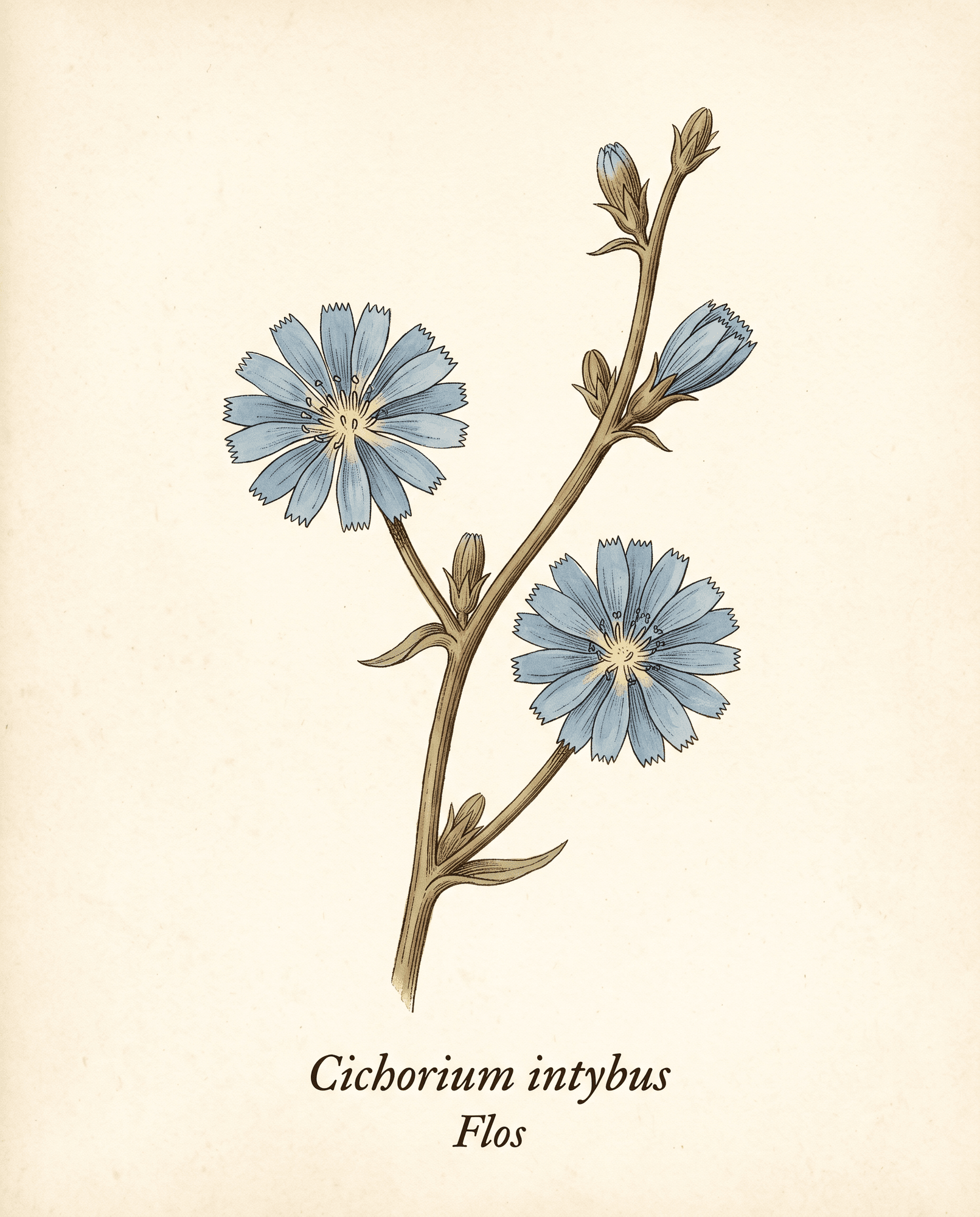
Flower: The blue flowers are edible and largely worked for their spirit — laid on altars, or made into a flower essence for hope, faithfulness, and keeping watch through lean times.
Spiritual & ritual:
- The roasted root shared in two cups, one poured for the ancestors who fed their families through scarcity
- Root offered to Orisha Oko’s ground when the season asks for endurance
- The blue flower placed at the gate or the altar for the ones who have passed, and for whatever needs clearing
- Sitting with the open flower at first light, as a practice of keeping faith with the morning
When to hold back
Use with caution if:
- You have bile duct obstruction or active gallstones. She stimulates bile flow, and moving bile against an obstruction can cause harm. Diagnosed gallstones do not always rule her out, but require professional guidance.
- You have a known allergy to the Asteraceae family (ragweed, daisies, chrysanthemums, marigolds). Cross-reactivity is possible.
- You are pregnant. Older sources list chicory, in large medicinal doses, among the uterine-stimulating plants. Culinary amounts and the roasted-root cup are generally regarded as fine; concentrated medicinal doses are best avoided without guidance.
- You have a sensitive or fermentable-fiber-reactive gut. The same inulin that feeds healthy flora can cause gas, bloating, or loose stools in sensitive bodies. Start low and build.
- You are taking antidiabetic medications. Her mild blood sugar–lowering effect may be additive.
Topical considerations: The fresh plant’s milky sap can cause contact dermatitis in those sensitive to the daisy family. Patch test before handling in quantity.
General notes: Food-grade and very safe in culinary and coffee-cup amounts across the lifespan. Her cooling, drying, draining nature can deepen cold and dryness in a constitution already running empty; for those bodies, hold her with warming, building companions or choose a different plant.
Who walks with her
For the liver, gallbladder, and bile: Dandelion root, burdock root, yellow dock, milk thistle, artichoke leaf.
For digestion and appetite: Gentian, fennel, ginger, orange peel, cardamom.
For cooling the blood and clearing skin heat: Calendula, cleavers, nettle, red clover.
For water balance alongside the liver work: Nettle leaf, corn silk, parsley.
As a roasted morning cup: Roasted dandelion root, roasted burdock, rooibos, ashwagandha, carob — warmed with ginger, cinnamon, and cardamom, and pointed at the liver with turmeric and a little black pepper.
These allies share her downward, clearing direction while balancing what she cannot balance alone. With dandelion she is doubled — two bitter taproots, two teachers of slow liver medicine — and burdock takes the work into the lymph and the blood. Gentian deepens the bitter where a sluggish digestion needs more waking, while the warming aromatics keep her from over-chilling and make a sharp, cooling formula something a body will take day after day. Ashwagandha steadies what she clears; rooibos gives her body in the cup. She is a plant of the community rather than the solo, and she does her best work in a formula that holds her coolness with warmth and her draining with something that builds.
How to know her
Plant walk: Look for chicory where nothing was planted — the cracked curb, the gravel lot, the worn median, the margin of a field after the machinery has passed. Go in the morning, while the flowers are open. Notice the ground she chose and what it has been through. Sit with what she is making from soil that was torn up and abandoned, and what that has to teach about feeding yourself from where you are.
Seasonal practice: Meet her three times across the year. In early spring, gather a few young leaves from the basal rosette and eat them — the bitter is gentle then, and it wakes a winter-heavy body. In summer, sit with the flower at first light and watch it close by noon. In fall, once the flowers are spent and the leaves have died back, dig the root, and do it from clean ground — a field or a garden rather than the roadside itself, because a taproot pulls up what the road leaves behind. Chop it, dry it, and roast it low and slow until it is dark and fragrant. The whole plant, from sidewalk to cup, becomes yours.
The shared cup: Brew the roasted root and pour two cups — one for you, one for the ancestors, and especially for those who fed their families through hard seasons and made do until making do became a tradition. Drink in their company, slowly, without a screen. Let the bitterness be a remembering. The plant has no older use than this, and it needs no altar beyond the table.
Ritual of clearing: When bitterness has gone stagnant in you — an old resentment, a grief that has stopped moving, a season that will not end — make a strong decoction of the raw root. Drink it before the morning meal, on the tongue, without sweetening. Let it be as bitter as it is. As it moves through you, imagine it doing in the spirit what it does in the body: draining what has pooled, opening what has closed, clearing the road. Do this for a week of mornings.
Journal prompts
- Where am I being asked to feed others, or myself, from depleted ground?
- What have I learned to make out of scarcity, and what did that teach me about my own resourcefulness?
- Where do I keep showing up, the way the flower opens each morning by an empty road?
- Where in my life has bitterness gone stagnant, and what would it mean to let it move and clear?
- Whose cup am I still pouring, and who poured it before me?
Tarot Spread
A spread for entering into relationship with Chicory as a plant ally:
- What do you want to teach me about thriving where I was planted?
- Where am I reaching for sweetness when the bitter is the medicine?
- What am I being asked to keep faith with, daily?
- What can I make to feed myself from what this season has left me?
- What do the ones at the gate offer me in the second cup?
Keep a piece of the roasted root, or a cup of the brew, beside the cards. Sit long enough for the answers to settle.
The same plant, multiple lenses
In Ayurvedic and Unani traditions she is kasni, a cooling bitter for the liver and the blood. Her taste is tikta (bitter), her energy sheeta (cooling), and she is light and drying in quality — a plant that reduces excess, and most of all the excess of fire.
Pitta Dosha — Fire & Water
Her clearest alignment is with Pitta. Where fire has built in the liver and the blood — heat, irritability, inflammatory skin, a hot and reactive gut, sharp headaches, the short temper of a congested liver — she cools and drains the excess and supports the liver in clearing it. She pacifies the Pitta that has run too hot for too long, and because she is kind to the stomach she can do so for a whole season without wearing the digestion down.
Kapha Dosha — Earth & Water
Kapha benefits in measured use. Her bitterness and dryness cut through damp, heavy stagnation and the accumulation of ama — the residue of food not fully digested — and she gently kindles a sluggish digestion without adding heat. For the heavy, slow, waterlogged constitution she is a fitting ongoing ally, particularly as the roasted root, which carries a little warmth of its own.
Vata Dosha — Air & Ether
Vata is where she asks for care. Cooling, drying, and draining, she can aggravate Vata’s inherent dryness and cold if used heavily or alone. For Vata-dominant bodies that still need her liver or digestive support, hold her with moistening, warming, grounding companions — ginger, cardamom, cinnamon, ashwagandha, warm milk — and keep the dose modest. In the café au lait she is already balanced this way, which is part of why that cup has held for so long.
In Chinese medicine she is ju ju (菊苣), entered into the pharmacopoeia through the Uyghur tradition and classified among the herbs that clear the liver.
Taste & Temperature: Bitter, cool. Channels Entered: Liver, Gallbladder, and Stomach. Functions: Clears the Liver and drains damp-heat. Strengthens the Gallbladder and Stomach and smooths digestion. Promotes urination and reduces swelling.
Clearing the Liver & Draining Damp-Heat
Her primary pattern is damp-heat in the Liver and Gallbladder — the picture of a bitter or sticky taste in the mouth, poor appetite, fullness and heaviness under the ribs and in the belly, nausea after rich food, and in its deeper expression jaundice, where damp heat causes bile to overflow. She drains that damp heat downward and outward, clearing heat while moving stagnant fluid. Compared with the great bitter-cold liver herbs such as gentian root (long dan cao), she is gentler and only mildly cold, suited to the milder and more chronic forms of the pattern rather than its acute fire.
Strengthening the Gallbladder & Stomach
What sets her apart from most liver-clearing bitters, which tend to injure the Stomach with long use, is that ju ju strengthens the Gallbladder and Stomach even as she clears, smoothing digestion and easing the distension and heaviness of a middle burner weighed down by damp. It is the reason she can be taken as food, daily, across a season — a clearing herb that does not cost the digestion its strength.
Promoting Urination & Reducing Swelling
She facilitates urination and reduces the edema and heaviness that accompany damp-heat in the lower burner. Her water-moving is gentler than the strong diuretics of the materia medica; it works alongside her liver-clearing so that what the Liver releases has a way out.
Yin/Yang Balance
Ju ju is Yin in nature — cooling, descending, draining — a clearer of excess heat and damp. She is for patterns of excess, not deficiency, and is most at home where damp-heat has settled into the Liver and Gallbladder and the Stomach needs support alongside the clearing. She should be used with discernment where the Spleen and Stomach are cold and weak — pale tongue, loose stool from cold, cold extremities — lest she deepen the cold, and in those patterns she wants warming companions such as ginger and cinnamon.
For going deeper
- Wood, Matthew. The Earthwise Herbal: A Complete Guide to Old World Medicinal Plants. North Atlantic Books. — for the Western and energetic picture of chicory alongside her relatives.
- Herbal Reality. Chicory (Cichorium intybus) monograph. — a thorough clinical and energetic overview.
- Me & Qi TCM herb database. Ju Ju (Chicory). — for the Chinese medicine actions, channels, and pattern indications, and the Uyghur lineage of her use.
- Peer-reviewed phytochemical and pharmacological reviews of Cichorium intybus — for the inulin, sesquiterpene lactone, and liver-protective research.
- Smithsonian Magazine and the New Orleans Historical archive on chicory coffee — for the diasporic and New Orleans foodways lineage, including the Black women vendors who shaped the city’s coffee tradition.
- Twitty, Michael W. The Cooking Gene: A Journey Through African American Culinary History in the Old South. Amistad. — for the wider frame of what enslaved and free Black people made from scarce ground.
- Conversations with elders and cooks who kept chicory coffee through lean seasons. This record is oral and place-based, and worth seeking out where you live — it holds what the books do not.
The Conversation
Questions, noticings, what this is teaching you — leave them here. This same conversation lives in The Circle.