Dandelion
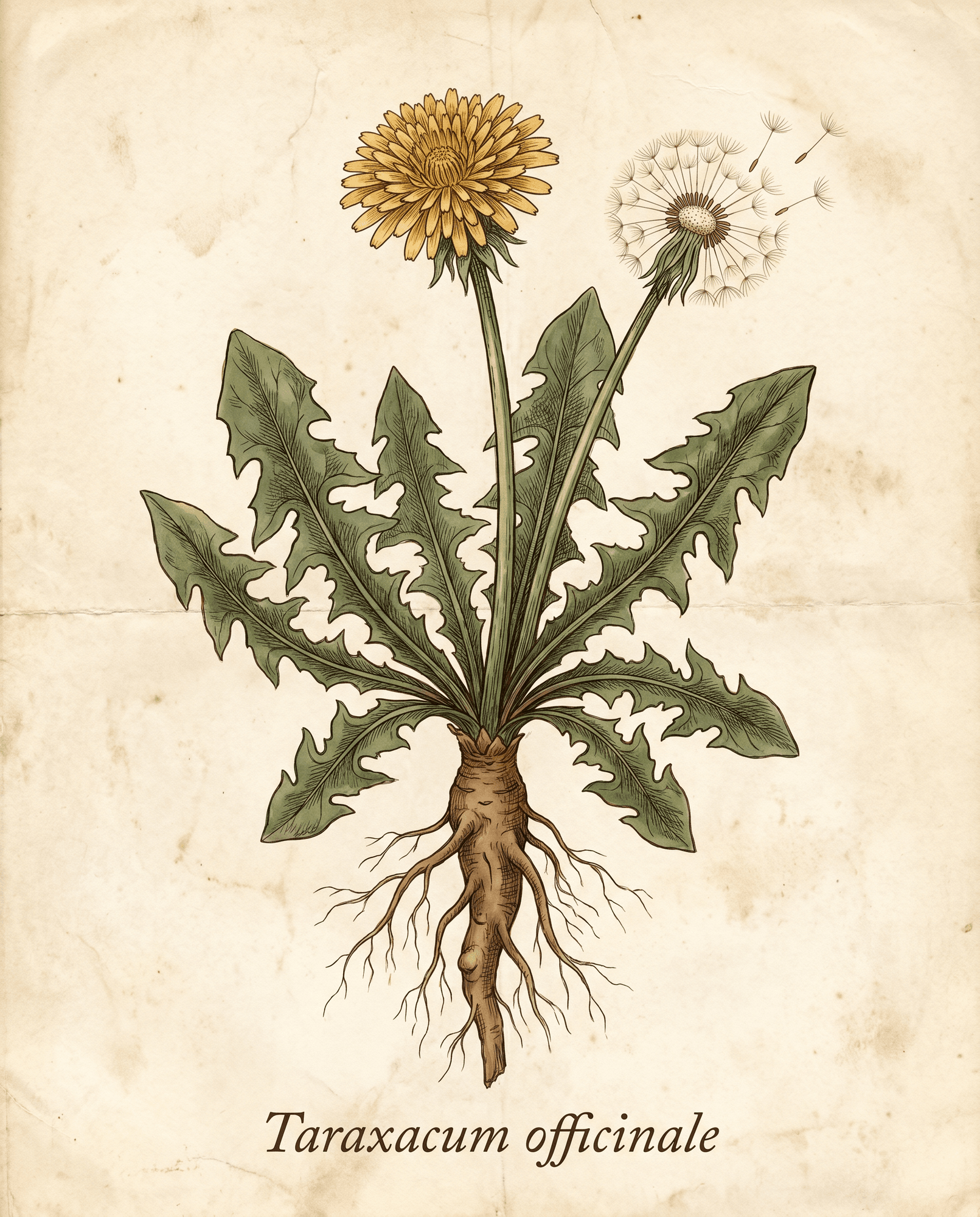
Dandelion is the herb that refuses to be hidden. She breaks through concrete, claims the disturbed ground, blooms where she wasn’t planted, and offers her medicine before you’ve even thought to ask. Every part of her teaches: the deep taproot mining minerals from packed earth, the bitter green leaves that wake the liver, the golden flower that follows the sun and closes at night, the seedhead that scatters intention on the wind.
This is humble medicine — the kind that has fed people in lean seasons, cleansed bodies after long winters, and traveled across oceans tucked into the seams of memory. Dandelion does not ask for ceremony. She is already woven into daily life: in the messes of greens, the spring tonic, the wish blown into the wind. She is medicine for the liver and the lymph, the kidneys and the blood, and for anyone who has been told they are weeds while they were quietly holding the soil together.
The shape of her medicine
Dandelion’s medicine moves downward and outward. She draws stagnation toward the exits — through the bowels, the kidneys, the lymph, the skin. Her cooling nature meets heat where it has settled into tissues: the irritated liver, the inflamed joints, the hot rashes that bloom across the chest and arms. Her drying quality clears damp — the kind of waterlogged sluggishness that creeps into joints, lymph nodes, and cycles that have grown heavy and stagnant.
She is bitter first, and that bitterness is where her medicine begins. The bitter taste on the tongue triggers the cephalic phase of digestion: salivation, bile flow, gastric secretion, peristalsis. The whole digestive tract wakes up before food has even reached the stomach. This is what makes her a true bitter tonic — she doesn’t add stimulation, she restores the body’s own digestive intelligence.
As a cholagogue and choleretic, she encourages the liver to make bile and the gallbladder to release it. Bile is how the body carries fats, fat-soluble toxins, and excess hormones out through the bowel. When bile flow is sluggish, the system grows stagnant — skin breakouts, hormonal heaviness, irritability after rich meals, slow digestion. Dandelion root opens that gate.
Her hepatic action is steady and trophorestorative. She doesn’t whip the liver into action; she nourishes it. Over time, she helps the organ rebuild its capacity to process, detoxify, and discern what stays and what leaves. This is why she shows up in formulas for chronic skin conditions, hormone imbalance, and post-illness recovery.
As an alterative, she shifts the deep terrain of the body — the slow, cumulative state of the blood, lymph, and connective tissue. This is patient medicine. You don’t feel it dramatically; you notice it months in, when the eczema has softened, the digestion has steadied, the inflammation has quieted.
The leaf moves more strongly into the kidneys and bladder. She is a powerful diuretic, and uniquely, she does not deplete potassium the way pharmaceutical diuretics often do, because the leaf itself is mineral-dense — returning what it draws. She helps clear edema, water retention, and the heavy fullness that comes when fluids stop moving.
Her lymphatic action is gentle but real. She supports drainage especially through the deeper layers of the body, where so much lymphatic stagnation actually originates. And her anti-inflammatory thread runs through every system she touches, cooling reactive tissue and quieting chronic low-grade fire.
Together, her actions form a single gesture: clearing the channels. She is for the body that has held too much for too long.
What lives inside her
Whose medicine she carries
Air (seed)
Fire (flower)
Sun
Leo
The Wheel of Fortune
The Hermit
Erinle
Erinle moves between worlds. He is the river that runs through the forest, the healer who is also a hunter, the one who tends the body’s filtering channels — the liver, the kidneys, the lymph, the skin. Dandelion belongs to him because she does the same work: she draws from deep earth and offers her medicine to the body’s clearing systems. She is one of the great alteratives — the herbs that shift the inner terrain through patience and repetition.
Erinle’s medicine is also about abundance from unexpected places. He rules the wealth that grows where it has been seeded, not where it has been demanded. Dandelion embodies this completely. She is everywhere. She does not require permission, irrigation, or status. She is rich in minerals because she goes deep, rich in food because she does not refuse to feed, rich in medicine because she does not withhold. Working with dandelion in Erinle’s name is to learn the practice of generosity that does not need to be witnessed.
Ogun (Root)
The root is Ogun’s. The dandelion’s taproot can drive a foot or more into compacted soil, breaking through where other plants cannot. This is iron medicine — patient, persistent, downward. Harvesting dandelion root is itself an act of Ogun: the digging fork, the bent back, the labor of pulling something whole from the ground without snapping its tail.
In the body, the root carries Ogun’s signature too. It supports the clearing of what the body carries home from the fight. The liver is where the labor of struggle is finally processed and set down — the long work of metabolizing everything a body endures to keep going. Dandelion root meets that work, the way Ogun meets any labor: without flinching, without hurry, until it is done.
Babalu Aye
Babalu Aye governs the conditions that do not yield to fast medicine — the eczema, the psoriasis, the chronic fatigue, the slow autoimmune inflammation. He is the Orisha of the skin and the sore, of infectious and chronic disease, and of everything the body wears on its surface that the world would rather not look at. But his domain is not only the illness. It is the one who carries it. Babalu Aye walks with the sick, the marginalized, the quarantined, the cast-out — the bodies that have been set outside the gate. He is the medicine of those who have been left at the edge of the village and told to stay there.
Dandelion belongs to him in more than her chronic-terrain work. She is the plant the world calls a weed while she feeds and heals everything around her — pulled up, poisoned, mowed down, named a nuisance, and still returning, still offering. She knows what it is to be cast out and to be medicine anyway. That is Babalu Aye’s own teaching: that the one who has been marked as unclean, as too much trouble, as better left outside, is so often the one holding the deepest medicine. Dandelion carries that dignity in her body. She does not wait to be welcomed before she does her work.
Dandelion’s alterative action is exactly the kind of patient, terrain-shifting work his medicine requires. She does not promise quick relief. She promises that if you sit with her over weeks and months, the body will remember how to clear itself again. She is one of the herbs that walks the long road with him — and with everyone the long road belongs to.
The hands she has passed through
Dandelion’s story is older than her common name. The earliest written records of her medicine come from 10th- and 11th-century Arabic and Persian physicians — al-Dīnawarī and Ibn Sīnā among them — who documented her use for liver complaints, jaundice, and digestive heat. The genus name Taraxacum itself is widely believed to derive from the Persian talkh chakok or the Arabic tarakhshaqūq, meaning “bitter herb” or “remedy for inflammation.”
In Traditional Chinese Medicine, where she is known as pu gong ying, dandelion has been used for at least a thousand years to clear heat and resolve toxicity. She is classically applied to hot, red, swollen conditions: mastitis (especially the inflamed, plugged-duct kind), boils, abscesses, sore throats, and damp-heat lodged in the liver or breast. The whole plant — root, leaf, and flower — is used, often mashed fresh and applied as a poultice over a hot lump or swollen breast.
Across medieval Europe, dandelion moved from monastic gardens into folk hands. Monks tended her in physic gardens; village women gathered her at the edges of fields. She was understood as a spring tonic — one of the bitter greens eaten after the long, heavy winter to clear the blood, wake the liver, and restore the body’s appetite for life. The French name pissenlit — “wet the bed” — is a frank acknowledgment of her diuretic strength.
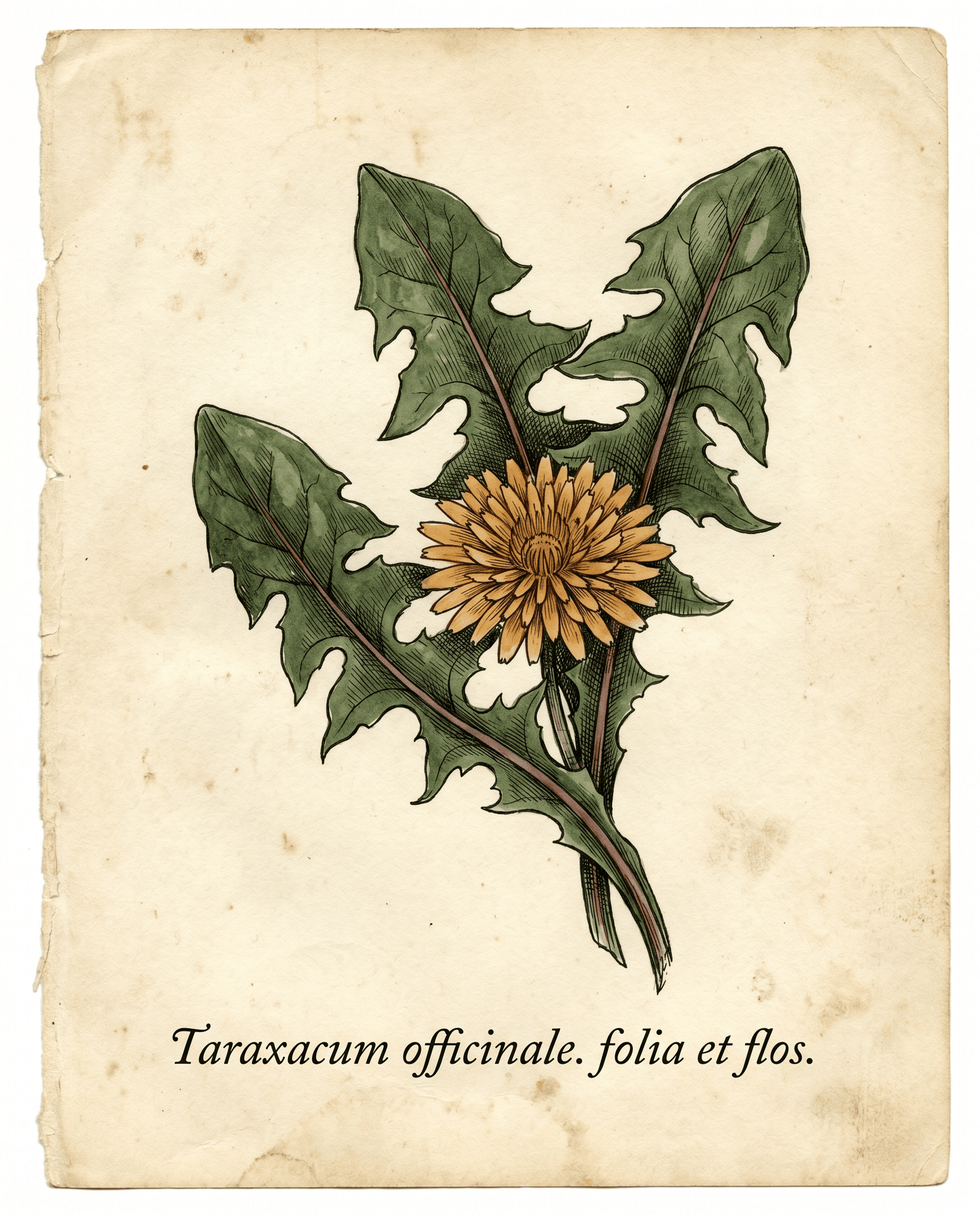
When dandelion crossed the Atlantic with European settlers, she did not stay in their gardens. She spread, and many Indigenous nations of North America — among them the Ojibwe, Iroquois, Mohegan, Cherokee, and Diné — took her into their own healing practices, often for digestive complaints, kidney conditions, and skin troubles. This was not passive absorption. Dandelion arrived as part of the same colonial disruption that displaced Native peoples from their lands and their native plant relations, and Indigenous herbalists met that newcomer with discernment — testing her, learning her, and deciding, on their own terms, to work with her. Her adoption was so thorough that some traditions came to hold her as a familiar, woven into local plant lore as if she had always been there. That familiarity was earned through relationship, not granted by accident.
In African American foodways, dandelion greens belong to the broader tradition of messes of greens — the cooking of bitter and pungent leaves that draws on West African foodways adapted to whatever grew in the new soil. Dandelion, poke, dock, mustard, turnip, and collard moved together through Southern kitchens as both nourishment and medicine, particularly in spring, when the body asked for clearing after the heaviness of winter foods. For enslaved people, this knowledge lived in the kitchen gardens and the foraged edges — the small plots tended after the day’s forced labor was done, and the ditches, field margins, and woods where medicine could be gathered outside the plantation economy. These were sites of survival and of quiet sovereignty: a place to grow and gather what one’s own body and family needed, on ground the master did not fully control. The greens carried what the soil carried — minerals, bitterness, and the memory of how to use what is at hand. They also carried the knowledge of how to keep a people alive and tended when the surrounding world offered nothing.
In European folk magic, the seedhead became a tool of divination. Children blew the seeds to count the hours, to send wishes, to predict love. The yellow flower was associated with the Sun and with Saint John’s Day at midsummer. That timing mattered: the Feast of Saint John falls near the summer solstice, the year’s solar peak, and herbs gathered in that window — St. John’s wort most famously, but dandelion among them — were believed to hold the sun’s strength at its fullest. To gather a golden, sun-following flower at the sun’s own height was to catch that solar power in the plant. The dandelion was understood to carry protective and resilient qualities — fitting for an herb that survives mowing, trampling, and herbicide, and returns wearing the color of the sun.
The Eclectic physicians of the late 19th century used the root extensively for liver and gallbladder conditions, jaundice, and chronic skin disorders. Today she sits in nearly every herbalist’s foundational toolkit — for the liver, for the kidneys, for the lymph, for the woman with cyclical breast tenderness, for the child with eczema, for the body that has stopped clearing what it has carried.
She has been called a weed, a tonic, a coffee, a wine, a wish, a cure for warts, and a remedy for inflammation. She has been all of them. She still is.
Where she works in the body
Hepatic system & gallbladder. This is dandelion’s heartland. The bitter constituents of the root activate bile production in the liver and bile release from the gallbladder — the central mechanism by which the body processes fats, hormones, and lipid-soluble waste. She is one of the foundational herbs for sluggish liver patterns: morning grogginess, nausea after rich food, irritability that builds across the day, hormonal acne along the jaw, premenstrual breast tenderness, and the slow heavy feeling of a system that is not clearing efficiently. Her work is steady and cumulative; she rebuilds capacity rather than forcing function.
Urinary system. The leaf moves the kidneys. She is one of the most reliable plant diuretics — strong enough to address edema, water retention, and fluid-driven blood pressure, gentle enough to be used regularly. Unlike most pharmaceutical diuretics, dandelion leaf does not deplete potassium because she is herself one of the most potassium-rich plants known. She returns minerals as she clears water. This makes her especially appropriate for cyclical water retention, mild hypertension, and the puffy, heavy fullness of a body holding too much fluid.
Lymphatic system. Her lymphatic action is subtler than herbs like cleavers or red root, but real. She supports drainage through the deeper layers — the liver and the gut — which is where much lymphatic stagnation actually originates. For chronic swollen nodes, breast lymph congestion, and the foggy, heavy feeling of lymphatic stagnation, she works well in formula with cleavers, calendula, or burdock.
Skin. Dandelion does not work on the skin directly so much as she works on the systems that keep the skin clear. Most chronic skin conditions — eczema, psoriasis, hormonal acne, chronic itching — reflect the body’s struggle to clear waste through its primary channels. When liver, kidney, gut, and lymph are stagnant, the skin takes over the clearing work. Dandelion supports the deeper channels so the skin can return to its proper role of boundary rather than overflow valve.
Digestive system. Her bitterness opens the entire digestive tract. She supports stomach acid production, peristalsis, bile flow, and pancreatic secretion. For sluggish digestion, bloating after meals, slow bowel transit, and the inability to properly digest fats, she is foundational. The root’s inulin content also feeds beneficial gut flora, supporting the microbiome’s role in digestion, immunity, and mood.
Endocrine and metabolic system. Through her support of liver detoxification, dandelion plays an important role in hormone balance — particularly the clearing of excess estrogens through bile. She is often included in formulas for estrogen dominance, cyclical breast tenderness, hormonal acne, and PCOS. The inulin in her root also has a modest blood sugar-stabilizing effect through its prebiotic action and its role in slowing carbohydrate absorption.
Cardiovascular system. Through her potassium content, her diuretic action, and her support of liver-mediated cholesterol metabolism, she contributes gently but meaningfully to cardiovascular health. She is included in many traditional formulas for mild hypertension and supports the body’s overall fluid balance, which is foundational to cardiovascular function.
How to take her
Harvest calendar
Preparations
Root decoction: 1–2 teaspoons of dried, chopped root per cup of water. Simmer 15–20 minutes. Drink 1–3 cups daily. Best harvested in fall when inulin content is highest.
Roasted root decoction (dandelion “coffee”): Roast dried root pieces at 250–300°F until deep brown and fragrant. Decoct as above. Roasting transforms the bitter inulin into milder, sweeter, more grounding compounds. Often blended with chicory and roasted barley.
Leaf infusion: 1–2 teaspoons dried leaf per cup of just-boiled water. Steep 10–15 minutes, covered. Drink 1–3 cups daily, especially in the first half of the day for diuretic action.
Tincture, root: 1:5 dry in 25–40% alcohol, or fresh 1:2 in 50% alcohol. Typical dose 2–5 mL, 3 times daily. Excellent in liver and digestive formulas.
Tincture, leaf: 1:5 dry in 25% alcohol, or fresh 1:2 in 40% alcohol. Typical dose 2–5 mL, 3 times daily for diuretic and mineral support.
Vinegar: Pack fresh leaves into a jar, cover with raw apple cider vinegar, infuse 4–6 weeks. Use as a daily mineral tonic, salad dressing base, or stirred into water with honey.
Food: Spring leaves eaten raw in salads or wilted as greens (the tender young leaves before flowering are mildest). Roots roasted as coffee substitute. Flowers fried as fritters, infused in honey, made into wine, or steeped in oil for topical use.
Topical, latex: The fresh white sap from the stem applied directly to warts, corns, and certain skin growths, daily for several weeks.
Topical, infused oil: Flowers slow-infused in olive or jojoba oil for 4–6 weeks, used in salves for sore muscles, joint stiffness, and dry skin.
Spiritual & ritual:
- Seedheads blown into the wind to carry intention or release what no longer serves
- Roots placed on altars dedicated to Erinle, Ogun, or Babalu Aye for healing work
- Flowers gathered at noon and dried for solar abundance work
- Bitter greens shared in ancestral meals as remembrance medicine
When to hold back
Use with caution if:
- You have bile duct obstruction or active gallstones. Dandelion stimulates bile flow and could worsen an obstruction. Diagnosed gallstones do not always rule her out, but require professional guidance.
- You have a known allergy to the Asteraceae family (ragweed, daisies, chrysanthemums, marigolds). Cross-reactivity is possible.
- You are taking pharmaceutical diuretics. Additive effects can lead to electrolyte imbalance.
- You are taking lithium. Diuretic action can affect lithium clearance and blood levels.
- You are taking antidiabetic medications. Her mild blood sugar–lowering effects may be additive.
- You are taking potassium-sparing diuretics or ACE inhibitors. Her high potassium content combined with these drugs can elevate potassium to risky levels.
- You have chronic kidney disease with restricted potassium intake. Leaf in particular is potassium-dense.
Topical considerations: The fresh latex (white sap) can cause contact dermatitis in sensitive individuals. Patch test before broader application.
General notes: Generally considered very safe in food and medicinal doses across the lifespan. Long-term, very high doses without warming or grounding companion herbs can be drying or aggravating to Vata constitutions.
Who walks with her
For liver and digestion: Burdock root, yellow dock root, milk thistle, artichoke leaf, chicory root, gentian, fennel.
For kidneys and water balance: Nettle leaf, cleavers, parsley, corn silk, horsetail.
For lymph and skin: Burdock, cleavers, calendula, red clover, violet leaf.
For blood building (especially when iron-rich liver work is needed): Yellow dock, nettle, alfalfa.
For hormonal balance through liver clearing: Burdock, vitex, red raspberry leaf, schisandra.
As a roasted coffee blend: Chicory root, roasted barley, carob, dandelion root — sometimes finished with cardamom or cinnamon.
These allies share dandelion’s commitment to clearing the deep channels. Burdock takes her work into the lymph and the blood; nettle returns minerals as dandelion clears water; cleavers softens lymphatic congestion she cannot reach alone; yellow dock partners her in iron-building blood work. With chicory she is doubled — both bitter taproots, both Erinle-aligned, both teachers of patient liver medicine. The alterative herbs are a community, not soloists. Dandelion shines best when she is allowed to do her work in formula, slowly, over weeks and seasons.
How to know her
Plant walk: Find a dandelion growing somewhere she was not planted — a sidewalk crack, a parking lot edge, a neglected lot. Sit with her. Notice what soil she is working with, what conditions she is tolerating, what she is offering anyway. Ask what she has to teach about generosity, persistence, and the medicine that survives.
Seasonal practice: Harvest dandelion three times across the year — leaf in early spring before flowering when she is most tender, flower at the height of her bloom, root in fall when the energy returns to the ground. Each harvest carries a different medicine. Notice which one your body asks for in each season.
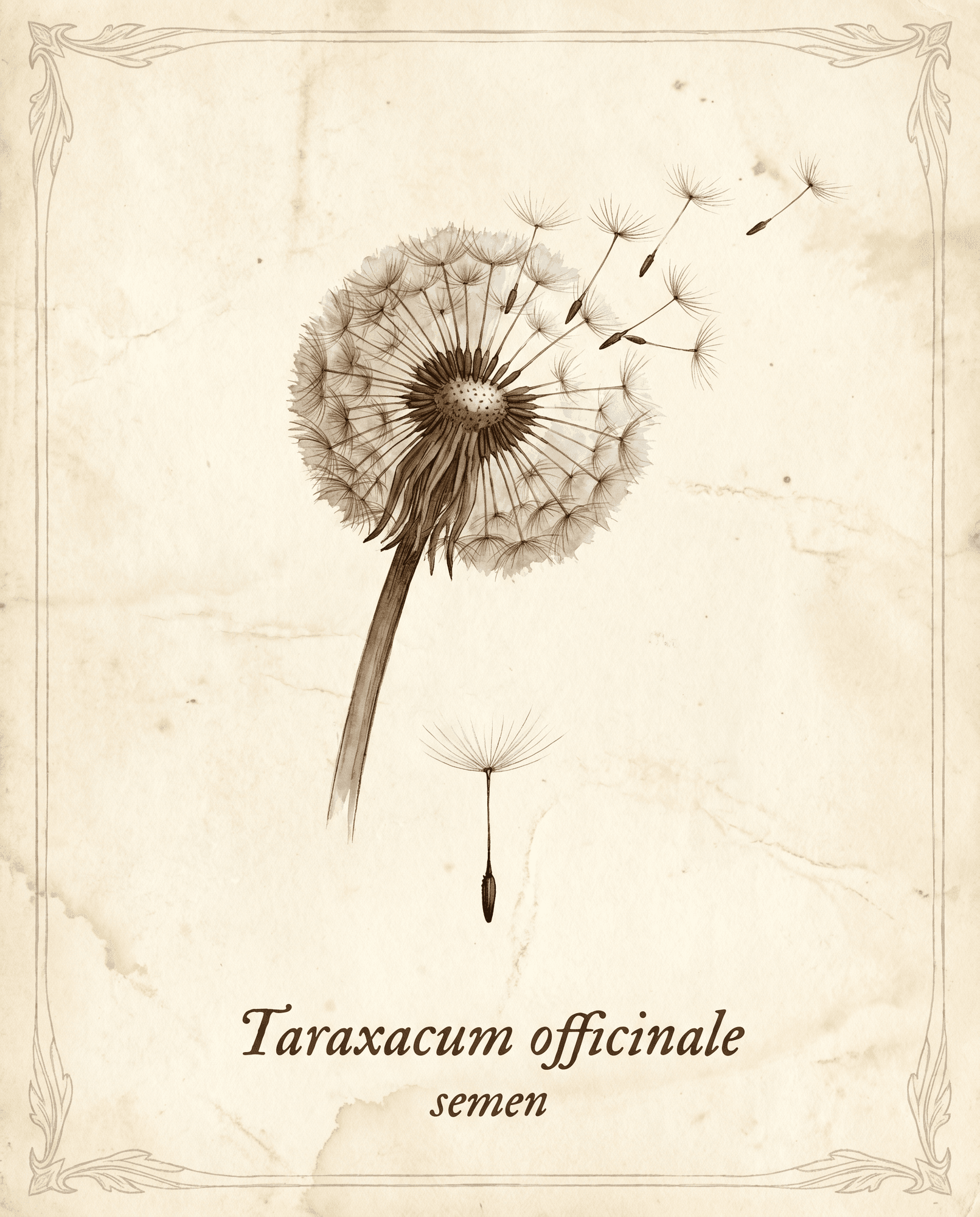
Ritual of release: When you have something to let go of — a grief, a story, an old version of yourself — go to a dandelion seedhead. Hold it gently. Speak the release. Blow the seeds and let them go where they will. Trust the wind to carry what you no longer need to hold.
Ritual of clearing: Make a strong decoction of dandelion root, let it cool, and add it to a bath. Sit in it for as long as feels right. As you rise, imagine what has been holding in your tissues releasing into the water. Let it drain.
Journal prompts
- Where in my body am I being asked to clear what I’ve been holding?
- What does it mean to do quiet, persistent work in disturbed ground?
- What “weeds” in my life — practices, people, parts of myself — am I being invited to recognize as medicine?
- Where am I performing scarcity in a place where I am actually abundant?
- What does it ask of me to receive medicine from something the world calls common?
Tarot Spread
A spread for entering into relationship with Dandelion as a plant ally:
- How does Dandelion see me right now?
- What is she offering me that I have not yet received?
- What part of her medicine asks for my participation, not just my consumption?
- What is she asking me to release into her keeping?
- What does she want me to know about the soil I am growing in?
Keep a sprig of dandelion or a vial of root tincture on your altar with the cards. Sit long enough for the answers to settle.
The same plant, multiple lenses
Dandelion’s bitter, slightly sweet, cool, and drying nature places her clearly in the camp of herbs that reduce excess — particularly excess Pitta and excess Kapha.
Pitta Dosha — Fire & Water
This is dandelion’s strongest dosha alignment. Pitta-type imbalances — heat in the liver, inflammatory skin conditions, irritability, hot anger, hormonal acne, gallbladder agitation, and burning digestive heat — all respond well to her cooling, clearing action. She drains heat downward through the bowels, urine, and lymph rather than suppressing it. For Pitta types prone to liver heat or inflammatory skin patterns, she is foundational medicine.
Kapha Dosha — Earth & Water
Kapha imbalances often show up as stagnation, water retention, heaviness, sluggish digestion, and slow lymphatic flow — exactly where dandelion’s drying, moving action is most useful. The bitter taste itself is one of the great reducers of Kapha, and dandelion’s diuretic action helps clear the dampness Kapha holds in tissues and joints. She is an appropriate ongoing ally for Kapha-dominant constitutions.
Vata Dosha — Air & Ether
Vata is where dandelion needs balancing. Her cool, dry, downward-moving qualities can aggravate Vata’s inherent dryness, coldness, and tendency toward depletion if used long-term in isolation. For Vata-dominant folks who still need her liver or lymph support, pair her with warming, moistening, grounding allies — ginger, cardamom, ashwagandha, marshmallow, licorice, sesame oil. She becomes safe and useful in Vata constitutions when her bitterness is held by warmth and her dryness is buffered by demulcents.
In TCM, dandelion is known as pu gong ying and has been classified for centuries.
Taste & Temperature: Bitter and sweet, cold. Channels Entered: Liver and Stomach. Functions: Clears heat and resolves toxicity. Dispels nodules and reduces swelling. Promotes urination. Clears damp-heat.
Clearing Heat & Resolving Toxicity
Pu gong ying is a primary herb for hot, red, swollen, and toxic conditions — boils, abscesses, sores, hot mastitis with plugged ducts, sore throat, conjunctivitis, and inflammatory skin eruptions. She is often used both internally as decoction and externally as fresh poultice. Her heat-clearing action is especially trusted for the upper jiao (chest and head) and for heat lodged in the liver and breast tissue.
Dispelling Lumps & Reducing Swelling
She is one of the classical herbs for dispersing swollen nodules, especially mastitis with red, hot, painful breast lumps, swollen lymph glands, and certain hot abscesses. This action depends on her ability to move stagnant heat and damp out of tissues that have grown swollen and hardened.
Promoting Urination & Clearing Damp-Heat
Her diuretic function in TCM is understood as clearing damp-heat in the lower jiao — painful or burning urination, certain types of vaginal heat, and damp-heat in the liver-gallbladder complex (jaundice, hepatic inflammation). She moves heat downward and out through the urinary passage.
Yin/Yang Balance
Dandelion is Yin in nature, an excess-Yang clearer — cooling, descending, and clearing. She is best for conditions of excess heat and excess damp. She is not appropriate for cold, deficient patterns — pale tongue, weak digestion, cold extremities, loose stool from cold — without significant warming companions. In TCM she is rarely used alone for long durations, but combined with allies like jin yin hua (honeysuckle), huang qin (skullcap), or fu ling (poria) depending on the pattern.
For going deeper
- Wood, Matthew. The Earthwise Herbal: A Complete Guide to Old World Medicinal Plants. North Atlantic Books.
- Bensky, Dan, Clavey, Steven, & Stöger, Erich. Chinese Herbal Medicine: Materia Medica (3rd edition). Eastland Press. (See entry on pu gong ying.)
- Frawley, David & Lad, Vasant. The Yoga of Herbs: An Ayurvedic Guide to Herbal Medicine. Lotus Press.
- Felter, Harvey Wickes & Lloyd, John Uri. King’s American Dispensatory (1898) — for Eclectic-era clinical use, available through Henriette’s Herbal.
- Moerman, Daniel E. Native American Ethnobotany. Timber Press. — for documentation of Indigenous adoption of dandelion across many nations.
- Pursell, JJ. The Herbal Apothecary: 100 Medicinal Herbs and How to Use Them. Timber Press.
- The Herbarium / Herbal Academy. Dandelion monograph.
- Conversations with elders in African American, African, and Caribbean food traditions on greens and spring tonics. These are oral and place-based, and worth seeking out where you live — they hold knowledge that is not always written down.
The Conversation
Questions, noticings, what this is teaching you — leave them here. This same conversation lives in The Circle.