Red Clover
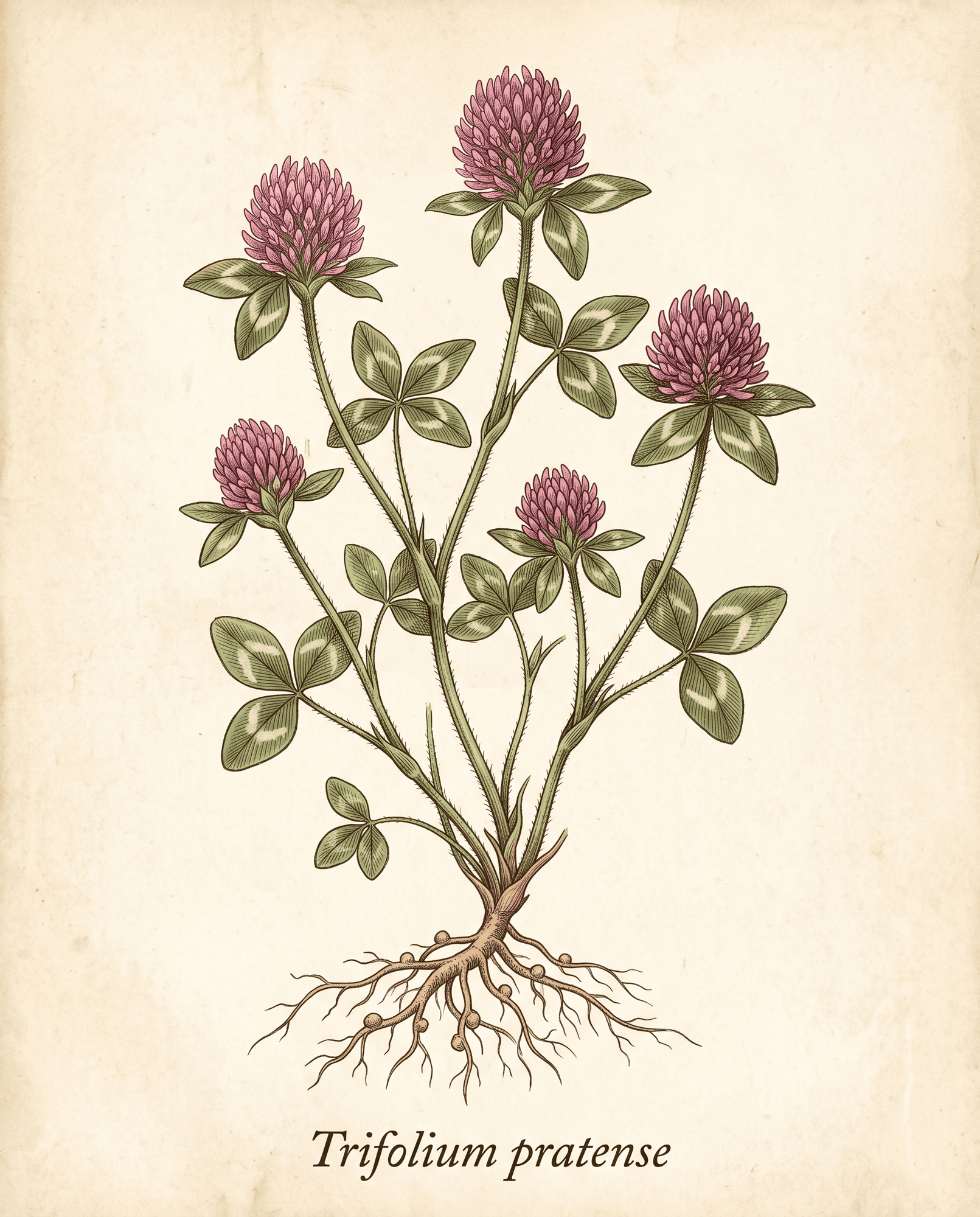
Red clover is the sweetness in the field. She grows wherever there is a little dirt — the meadow, the roadside, the neglected pasture, the crack at the edge of the lot — and she offers her medicine the way she offers the nectar at the base of each tiny flower: freely, to anyone who stops long enough to receive it. Children have always known her. Pull a single floret from the rose-pink globe and taste the drop of sweetness at its base, weave the blossoms into a crown, lie down in a field full of her in the long light of summer. She is one of the first plants many of us ever met, and she has been quietly tending our blood the whole time.
Her medicine is the gentlest kind of blood work there is. She simply cleans the blood — slowly, sweetly, without drama, working through the lymph and the liver to clear what the body has accumulated and carried too long. The old herbalists called her a blood purifier, an alterative, and meant something precise by it: a plant that changes the quality of the blood over weeks and seasons by helping the body take out its own trash. She teaches that cleansing does not have to be fierce. Sometimes the deepest clearing is the work of a sweet flower in a summer field, taken patiently, over time.
The shape of her medicine
Red clover’s medicine moves outward through the moving channels — not a sharp outward drive but a slow, sweet dispersal through the lymph and the fluids. She is cool, sweet, and moistening, which is unusual for a clearing herb: most alteratives are bitter and drying, but red clover does her clearing gently, nourishing as she goes. She does not strip or scour. She softens, moves, and carries away.
Her alterative action is her heart, and it is worth being precise about what the word means. An alterative changes the deep terrain of the body — the slow, cumulative quality of the blood, lymph, and connective tissue — by supporting the body’s own channels of elimination. Red clover does this through several gentle doors at once: her flavonoids and phenolic acids support the liver’s clearing enzymes, her coumarins improve the fluidity of the blood so it moves and delivers more freely, and her isoflavones and other constituents move the lymph. What the tradition called “bad blood” — the congested, sluggish, waste-burdened inner state that surfaces as chronic skin trouble, swollen glands, and low-grade inflammation — is exactly what she is for.
Her lymphatic action is the specific mechanism beneath the alterative reputation, and it is her signature. The lymph is the body’s quiet drainage system, and when it grows thick and slow, waste backs up in the tissues. Red clover thins the lymph and gets it moving, carrying cellular debris and inflammatory metabolites away from the tissues and toward the liver for final processing. She has a particular affinity for the glands of the neck and head — the swollen, congested nodes — and for the deep lymphatic stagnation that so much chronic illness grows out of.
Her nutritive gift runs alongside all of this and sets her apart from harsher clearing herbs. She is mineral-rich — calcium, magnesium, potassium, chromium, iron — and taken as a long overnight infusion she is a genuine nourishing tonic, feeding the body while she cleans it. This is why she is safe and appropriate for children, for the depleted, and for the long-term work that a drying bitter alterative could not sustain.
Her phytoestrogenic action comes from her isoflavones, which bind weakly to the body’s estrogen receptors. This makes her a gentle ally in the cyclical and menopausal transitions of the feminine body — a subtle hormonal support rather than a forceful one — and it is also part of her cardiovascular and bone-tending reputation. Her anti-inflammatory, expectorant, and antispasmodic threads round out the picture: she quiets inflammation through her flavonoids, moves and soothes a stuck cough through her moistening lymphatic action, and eases spasm gently. Together her actions form a single gesture: cleaning the blood softly, and feeding it while she cleans. She is for the body that has carried too much for too long and needs it cleared gently, kindly, without force.
What lives inside her
Whose medicine she carries
Water
Mercury
Libra
Temperance
The Empress
Erinle
Erinle tends the body’s filtering channels — the liver, the kidneys, the lymph — and he is the healer who works through patience and repetition, drawing from deep places and offering his medicine to the clearing systems. Red clover is his in the lymph most of all. She is one of the great lymphatic movers, and the lymph is Erinle’s own territory: the quiet, hidden river that carries the body’s waste toward the places it can be processed and released. Where a fiercer herb would force the channels, red clover coaxes them — thinning the lymph, easing it into motion, letting the body clear itself at its own sweet pace.
There is more of Erinle in her than the mechanism. He rules abundance that grows in humble and unexpected places, wealth that arrives where it was not demanded, and red clover is abundance itself — she grows everywhere, gives her nectar to every bee and every child, fixes nitrogen and enriches the very soil she stands in, asking nothing. She is rich because she is generous, and generous because she is rich; the two are the same in her. To work with her in the clearing of the blood is to learn Erinle’s own lesson: that the deepest medicine is often the most common, and that the plant giving her sweetness away at the edge of the road may be the one quietly keeping you well.
Oshun
Oshun is sweetness, the flower, the honey, and the cyclical medicine of the feminine body. Red clover belongs to her in the blossom — that rose-pink globe full of nectar, the flower children make into crowns, the sweetness offered freely. Oshun teaches that sweetness is not frivolous but medicinal, that beauty and pleasure are healing forces, and red clover carries that teaching in her body: she is an alterative you can love, a clearing medicine that tastes of the summer field, a remedy disguised as a wildflower.
And she carries Oshun’s blood-work in the specific sense. Her phytoestrogens make her a gentle ally to the cyclical and menopausal body, easing the feminine transitions without force — the kind of soft, self-tending medicine Oshun governs. She is a plant for the tender-hearted and for the one learning her own worth, a sweetness that says: you are allowed to be cared for gently, you do not have to be scoured to be made clean.
Babalu Aye
Babalu Aye governs the conditions that do not yield to fast medicine — the chronic skin troubles, the eczema and psoriasis, the long slow terrain-shifting work of the body that has been struggling to clear itself for years. Red clover belongs to him wherever the skin is speaking for the deeper channels. Her oldest and most trusted use is exactly this: the clearing of chronic skin conditions by moving the lymph and supporting the liver, so the skin no longer has to carry the clearing work alone. The old herbalists reached for her first for the child with eczema and the stubborn adult rash, and they were right to.
This is patient medicine, and Babalu Aye’s medicine is always patient. She does not promise to clear the skin overnight; she promises that if you work with her over weeks and months, the deeper terrain will shift and the skin will follow. She walks the long road with him — and with everyone whose healing is slow, whose body wears its struggle on the surface, whose clearing cannot be rushed. That she does this so gently, so sweetly, is her particular grace: she is the kind medicine for the long hard road.
The hands she has passed through
Red clover carries a double history — sacred symbol above ground, blood medicine below — and both threads run back a very long way.
Her trefoil, the three-part leaf, made her holy to nearly every people who counted holiness in threes. The Celts and Druids held the three-leafed clover sacred and counted her among the herbs that warded off evil spirits; the rarer four-leaf was elevated to a charm of protection and luck. The Greeks and Romans associated the trefoil with their triad goddesses. When Christianity came to Ireland, the shamrock — red clover was one of the several plants named as the true shamrock, championed by the old herbalist John Gerard — was folded into the teaching of the Trinity, but the reverence for the three-in-one was already ancient by then. To carry clover was to carry protection; to find her four-leaved was to be touched by luck. She has been a plant of blessing and warding across the whole of her European homeland.
Her medicine was known just as long. Across European folk herbalism she was the blood purifier — the alterative reached for in spring and in chronic illness to clear “bad blood,” taken for skin eruptions, swollen glands, stubborn coughs, and the slow congested conditions that would not resolve. She was gentle enough to be the children’s alterative, the one given to the child whose skin would not clear, and nourishing enough to be taken long-term as a tonic. The blossoms were eaten, chewed for their sweetness, dried for winter tea, and simmered into the syrups and washes of the household medicine chest.
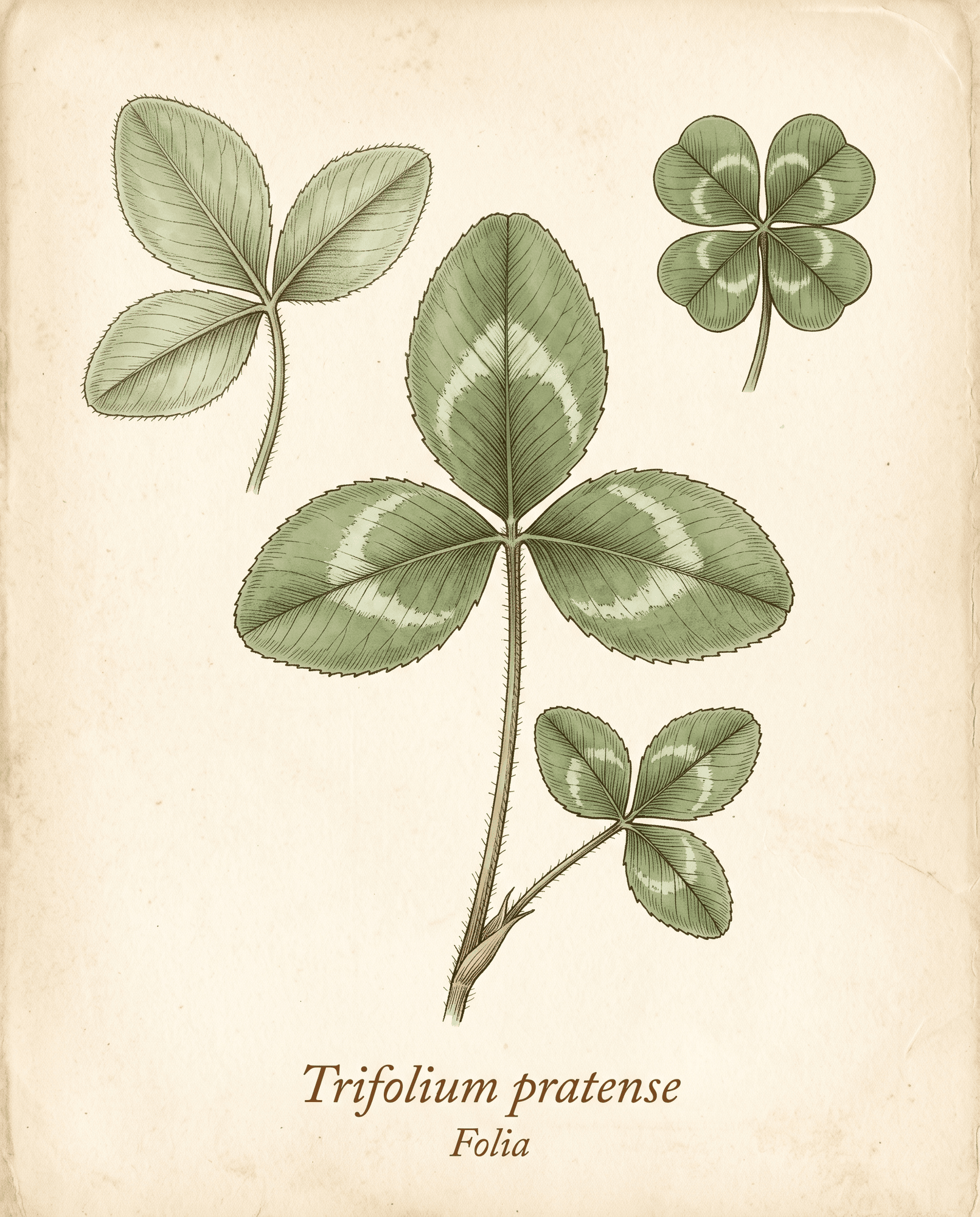
That knowledge crossed the Atlantic and took root in North American folk medicine, where she became one of the most widely used blood purifiers on the continent — a staple of the Eclectic physicians’ practice and of the folk traditions that grew alongside it. She entered the great alterative formulas of nineteenth- and twentieth-century American herbalism, paired with burdock, yellow dock, and dandelion for chronic skin and blood conditions. Jethro Kloss praised her in Back to Eden; she appeared in the famous folk cancer formulas of the era, held (with more hope than proof) as a plant that could change the deep terrain of a struggling body. Herbalists still reach for her first among the gentle alteratives, and modern study has begun to explain what the tradition knew — that her isoflavones move the lymph, support the liver, and tend the blood, clearing metabolic waste slowly and steadily, exactly as the old blood-purifier language always claimed.
Through all of it she has kept her sweetness and her accessibility. She is not a rare or a difficult plant. She grows in the pasture and the roadside, blooms all summer, and gives her medicine to anyone who gathers her — a wildflower that has been quietly cleaning the blood of ordinary people for as long as ordinary people have walked through summer fields.
Where she works in the body
Lymphatic system. This is red clover’s heartland and her clearest medicine. She is one of the foremost gentle lymphatic tonics — she thins the lymph and moves it, carrying cellular debris and inflammatory waste away from the tissues and toward the liver for processing. She has a particular affinity for the glands of the neck and head, for swollen and congested nodes, and for the deep lymphatic stagnation beneath chronic conditions. Because the lymph and the liver are so intimately linked — a backed-up liver thickens the lymph, and thick lymph burdens the whole system — her lymphatic work and her alterative work are one gesture. She is for the body whose drainage has grown slow.
Skin. Her oldest and most trusted application. Most chronic skin conditions — eczema, psoriasis, stubborn rashes, chronic itching — reflect the body’s struggle to clear waste through its deeper channels; when the lymph and liver are congested, the skin takes over the clearing and rebels. Red clover supports the deeper channels so the skin can return to being a boundary rather than an overflow valve. She works from the inside as a lymphatic and alterative, and topically as an anti-inflammatory wash to soothe the irritated surface. This is patient work — weeks and months, not days — but it addresses the root rather than the symptom.
Respiratory system. Her moistening, gently expectorant, and antispasmodic qualities make her a soft ally for the lungs, particularly for dry, spasmodic, or lingering coughs. The tradition reached for her in whooping cough and irritable coughs, often combined with more strongly moistening herbs. She soothes and moves without harshness — a gentle respiratory medicine suited to children and to sensitive constitutions.
Endocrine system. Her isoflavones bind weakly to estrogen receptors, making her a gentle phytoestrogenic support through the cyclical and menopausal transitions of the feminine body. She is a subtle hormonal ally rather than a forceful one — appropriate for easing the menopausal passage and for gentle cyclical support — and this same isoflavone activity is part of her value for bone and cardiovascular health in later life. This is also the source of her main caution: where estrogen should not be encouraged, she is not the right plant.
Cardiovascular system. Through her isoflavones, her mild blood-thinning coumarins, and her antioxidant flavonoids, red clover offers gentle support to the vessels and the blood. She has been studied for improving arterial flexibility — the capacity of the vessel walls to expand and contract with each pulse — and for supporting a healthy lipid balance, and her mild anticoagulant quality improves the fluidity and delivery of the blood. Hers is the gentlest register of blood work — the sweetener and cleaner — soft enough for anyone to begin with.
How to take her
Harvest calendar
Preparations
Overnight infusion (nourishing tonic): A generous handful (roughly 1 ounce by weight) of dried blossoms in a quart jar, filled with just-boiled water, capped, and steeped 4–8 hours or overnight. This long steep draws out both her minerals and her medicine, making the deeply nourishing tonic infusion in the tradition of the mineral-rich herbs. Drink through the day.
Standard tea: 1–3 teaspoons of dried blossoms per cup, steeped 10–15 minutes. A pleasant, mild daily tea; drink 1–3 cups.
Tincture: 1:5 in 40% alcohol, typical dose 2–4 mL up to three times daily. Convenient for the alterative and lymphatic work in formula.
Topical wash or compress: A strong infusion, cooled, applied to irritated, inflamed, or itchy skin — the external partner to her internal skin work.
Infused honey or syrup: The blossoms infused in honey or simmered into syrup, carrying her sweetness and her gentle respiratory medicine — an easy and pleasant form, well suited to children.
Food: The fresh blossoms eaten in salads or nibbled in the field for their sweetness; dried blossoms added to herbal blends.
Spiritual & ritual:
- Blossoms woven into crowns or garlands for blessing, celebration, and gentle protection
- Carried or placed for luck and warding (the trefoil charm)
- Added to cleansing baths for a soft, sweet clearing of what the body and spirit have accumulated
- Offered on altars dedicated to Erinle, Oshun, or Babalu Aye
- Used in gentle self-worth and self-tending work, especially for the tender-hearted
When to hold back
Use with caution if:
- You take anticoagulant or antiplatelet medication. Her coumarins add a mild blood-thinning effect that can be additive. Gentle as she is, the effect is real and worth respecting.
- You are approaching surgery. Stop red clover a week or two before, for the same mild bleeding-risk reason.
- You have an estrogen-sensitive condition — estrogen-positive breast or uterine cancer, endometriosis, or a history of these. Her phytoestrogenic isoflavones may not be appropriate; work with a practitioner.
- You are pregnant. Traditionally avoided in pregnancy because of the hormonal and mild blood-thinning activity. (She is, by contrast, sometimes used in the postpartum and nursing period as a nourishing tonic — but confirm with a practitioner.)
- You take hormonal medications (hormone therapy, tamoxifen, hormonal contraception). Her phytoestrogens could theoretically interact; raise it with your prescriber.
Topical considerations: Very well tolerated; patch test as with any botanical.
General notes: One of the gentlest and safest herbs in the materia medica, a classic children’s alterative and a nourishing daily tonic. The cautions all trace to two mild activities — her blood-thinning coumarins and her estrogenic isoflavones — and outside those specific situations she is remarkably safe across the lifespan.
Who walks with her
For the blood and the lymph (the alterative community): Dandelion, burdock, yellow dock, cleavers, nettle. These are the gentle blood-cleaners, and they work as a community rather than as soloists. Cleavers deepens the lymphatic movement; burdock takes the clearing into the deeper blood and skin; dandelion and yellow dock bring the liver and the iron-building; nettle mineralizes and nourishes. Red clover is often the sweet, gentle anchor of a chronic-skin formula built from these.
For chronic skin: Burdock, calendula, violet leaf, cleavers. The alterative-and-lymphatic herbs for the skin that speaks for the deeper channels — red clover and violet especially bring a cooling, moistening softness to the work.
For the respiratory system: Mullein, marshmallow, violet, thyme. Her gentle expectorant medicine deepens in the company of the moistening lung herbs for dry, spasmodic coughs.
For the feminine transitions: Nettle, oatstraw, raspberry leaf, sage (for menopause). The nourishing, mineralizing, gently hormonal herbs keep good company with her isoflavone support.
These allies share red clover’s patience and gentleness. She is a plant that works best in a chronic-skin or blood formula, taken over weeks and seasons — the alteratives are a community, and she is happiest among them, adding her sweetness and her lymphatic movement to their combined slow work.
How to know her
Plant walk: Find her in a summer field in full bloom, thick with bees. Sit down in the middle of her. Pull a single floret from a flower head and taste the drop of sweetness at its base, the way you did or would have as a child. Notice that she grows where she was not planted, that she feeds every bee in the field, that she enriches the very soil she stands in. Ask her what it means to clean gently, to give freely, to be common and abundant at once.
The clover crown: Weave the blossoms into a crown or a chain, slowly, the way it has always been done. Let the making be the medicine — a return to the child who lay in fields, a small act of blessing yourself with sweetness. Wear it, or lay it on your altar.
Ritual of gentle clearing: When you need to clear something — a grief, a residue, an accumulation the body or spirit has carried too long — but you are too tender to be scoured, make a strong infusion of red clover and add it to a warm bath. Sit in it. Let the clearing be soft this time. Not everything that needs to leave must be forced out; some things dissolve gently in sweet water.
Journal prompts
- Where am I trying to scour myself clean when what I actually need is gentleness?
- What have I carried too long that could be cleared slowly, sweetly, without force?
- Where in my life am I abundant and generous at once — giving freely because I have enough?
- What sweetness am I allowed to receive? What would it mean to be tended kindly rather than harshly?
- What is the “bad blood” I’ve been holding — the old residue, the accumulated grievance — and am I ready to let the slow work of clearing it begin?
Tarot Spread
A spread for entering into relationship with Red Clover as a plant ally:
- What have I been carrying that she wants to help me clear?
- Where am I being asked to be gentle with myself instead of harsh?
- What sweetness is she offering that I have not let myself receive?
- What is the slow, patient work she is inviting me into?
- What abundance is already growing at the edges of my life, waiting for me to notice?
Keep a few dried blossoms or a clover crown on your altar with the cards. Let her sweetness soften the reading.
The same plant, multiple lenses
Red clover is a European and Western-Asian plant rather than a classical Ayurvedic herb, so she has no ancient Sanskrit lineage — but her qualities read clearly through the doshic lens. She is sweet (madhura) and slightly astringent (kashaya) in taste, cool (shita) in potency, and moistening — a gentle, nourishing, cooling profile.
Pitta Dosha — Fire & Water
Red clover suits Pitta well. Her sweet, cool, moistening nature soothes Pitta’s heat and inflammation, and her use for hot, inflamed, eruptive skin conditions is precisely Pitta-clearing work. For the fiery, inflammatory constitution with heat surfacing in the blood and skin, she is a gentle and appropriate cooling alterative.
Kapha Dosha — Earth & Water
Kapha is where red clover asks for a little care. Her sweet and moistening qualities could, in excess, feed Kapha’s heaviness and damp — but her lymphatic, moving, dispersing action works in the opposite direction, actively clearing the congestion and stagnation that Kapha holds. On balance she is usable for Kapha, especially in the lymphatic and skin work, but she is best paired there with more pungent or drying movers rather than used alone in large sweet infusions.
Vata Dosha — Air & Ether
Red clover is gentle and nourishing enough to suit Vata reasonably well. Her moistening, mineral-rich, sweet quality counters Vata’s dryness and depletion, and her gentleness makes her safe for the sensitive, easily-aggravated Vata constitution — unlike the harsh, drying, bitter alteratives that can leave Vata more depleted. As a nourishing tonic infusion she is genuinely supportive for a dry, thin, run-down Vata body.
Red clover is not a classical Chinese herb — she has no traditional pin-yin name in the materia medica — but her actions translate readily into TCM’s framework, and reading her this way honors the pattern-logic even where the lineage is Western.
Taste & Temperature: Sweet, slightly salty, cool. Channels (by function): Lung, Liver, and the body’s fluid pathways. Functions: Moves and clears the fluids (lymph); cools and clears heat from the blood; nourishes; gently transforms phlegm and stops cough.
Clearing Heat & Cooling the Blood
Her cool, sweet nature clears heat from the blood — the underlying heat that surfaces as red, inflamed, eruptive skin. In TCM terms her alterative work reads as cooling blood-heat and clearing the toxicity that manifests on the surface, the pattern behind so many chronic skin conditions.
Moving the Fluids & Transforming Congestion
Her lymphatic action reads as moving and transforming the body’s congested fluids — dispersing the phlegm-damp accumulations that gather as swollen glands and nodules. This is her signature: she gets the stuck fluids moving so the body can clear what has pooled in the tissues.
Nourishing & Moistening the Lung
Her sweet, moistening, gently expectorant quality moistens the Lung and eases dry, spasmodic cough — a soft, yin-supporting respiratory action rather than a forceful dispersing one.
Yin/Yang Balance
Red clover is Yin in nature — cooling, moistening, nourishing, and gently dispersing. She suits heat patterns, blood-heat, and fluid congestion with an underlying need for nourishment, and she is gentle enough for the depleted and the young. She is less suited to cold, damp-deficient patterns without warming companions. Hers is a deeply yin-nourishing medicine — the kind that feeds the body while it clears.
For going deeper
- Wood, Matthew. The Book of Herbal Wisdom: Using Plants as Medicines. North Atlantic Books. (For his teaching on red clover as the consummate alterative.)
- Weed, Susun S. Healing Wise and New Menopausal Years the Wise Woman Way. Ash Tree Publishing — for the nourishing-infusion tradition and the feminine transitions.
- Bruton-Seal, Julie & Seal, Matthew. Backyard Medicine: Harvest and Make Your Own Herbal Remedies. Skyhorse.
- Hoffmann, David. Medical Herbalism: The Science and Practice of Herbal Medicine. Healing Arts Press.
- Kloss, Jethro. Back to Eden — for the historical American folk use, read with a modern eye.
- Grieve, Maud. A Modern Herbal — for the older European folk record and the trefoil folklore.
- The place-based knowledge of red clover held in European and North American folk traditions, where she has been the gentle blood-purifier of ordinary households for generations.
The Conversation
Questions, noticings, what this is teaching you — leave them here. This same conversation lives in The Circle.