Verbascum thapsus
Mullein is the one standing alone in the open ground, taller than everything near her, a single straight stalk rising from a rosette of leaves so soft they feel like flannel in your hand. By fall her flowers are spent and the stalk has gone brown and dry. She leaves it standing anyway, all winter, long after the rest of the field has fallen down.
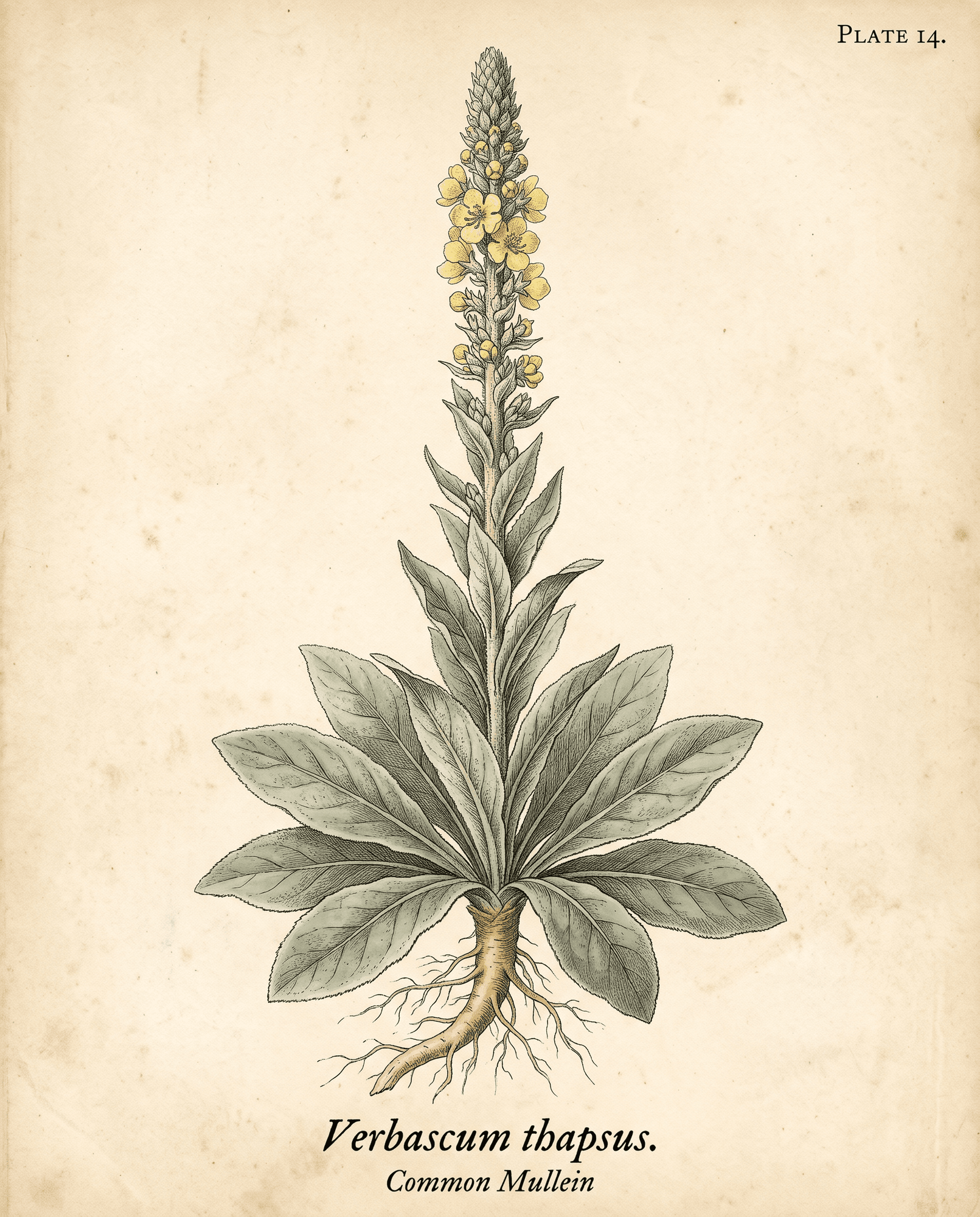
She is the lung plant of three continents. Greek and Roman physicians wrote of her for the chest, Unani healers call her ban tambaku, and when she crossed the ocean, Navajo, Cherokee, Creek, and Mohegan healers each came to her on their own for the cough. She grows where the ground has been opened and left — road cuts, burned slopes, gravel lots — and her seed can wait a hundred years in the soil for that opening to come. People dipped her dry stalks in tallow and carried them as torches, which is how she came to be called hag’s taper and candlewick plant. She has been light in the dark for a very long time.
Two Years, One Plant
Mullein lives her life in two parts. In her first year she stays low, a wide gray-green star of felted leaves pressed to the ground, while her taproot gathers everything she will need. In her second year she sends it all upward at once: a stalk that can reach past your head, lit along its length with small sulfur-yellow flowers that open a few at a time all summer. Then she seeds, dries, and stands. The leaf is her everyday medicine, the flower is for the ear, and the root, dug before she bolts, holds a year of stored strength.
Her Medicine Is Breath
Where elder keeps the door against the cold, mullein is for what comes after. She is cool, moist, and descending. Her leaves give up a soothing mucilage that coats a throat gone raw and a chest scraped by coughing, while her saponins loosen what has gotten stuck so the lungs can bring it up. Most cough herbs either soothe or clear. She does both, which is why she suits the dry, tickling cough that won’t quit and the long, rattling tail of an illness that has already broken. Her flower, steeped in oil, eases the throbbing ear. Her root strengthens the bladder and, for many herbalists, the back. She is gentle enough for children and elders and steady enough to take for a whole wet season.
A Practice for the Season
For one week, end each day with mullein. Steep a heaping teaspoon of dried leaf in a cup of just-boiled water, covered, for fifteen minutes, then pour it through a cloth or a paper coffee filter. Her leaves are covered in fine hairs that scratch the throat, and a metal strainer alone lets them through. Before you drink, hold the cup under your face and breathe the steam slowly. Notice where your breath stops short, and where it eases. If you’re coming out the other side of a cold, the pot that rebuilds the chest is Mullein’s House, elsewhere in this issue.
A Plant Walk, Wherever You Live
Go looking now, while the field is bare. Look for the standing stalks in open, sunny, disturbed ground — the road cut, the logging road, the burn, the gravel lot, the edge of a field — straight and brown and crowded at the top with dry seed capsules. Then look low around them. The new first-year rosettes are often right there, green under the frost, big soft leaves you’ll know the moment you touch one. Stand between the two, the one who has given everything and stands anyway, and the one gathering strength for next year. If you’d like to gather leaves, do it away from the roadside, because she takes up whatever is in the soil. If she doesn’t grow near you, find her in the bulk jars of an herb shop, or in the tea aisle, where she is in nearly every blend made for the lungs.
She stands in the frozen field all winter so you can find your way. Breathe out. She will hold the light until you can.
— The Sage
Go deeper. The full Mullein monograph lives in the Materia Medica library — her energetics and the rare pairing of moistening and clearing, the torch and the cemetery gate, her lineages among Indigenous nations, Unani healers, and the Eclectic physicians, the truth about mullein and graveyard dirt, her Ayurvedic and Chinese readings, methods and dosages for leaf, flower, and root, and a tarot spread for entering into relationship with her as an ally. It’s included with Herb-Curious membership, along with the whole library.