Mullein
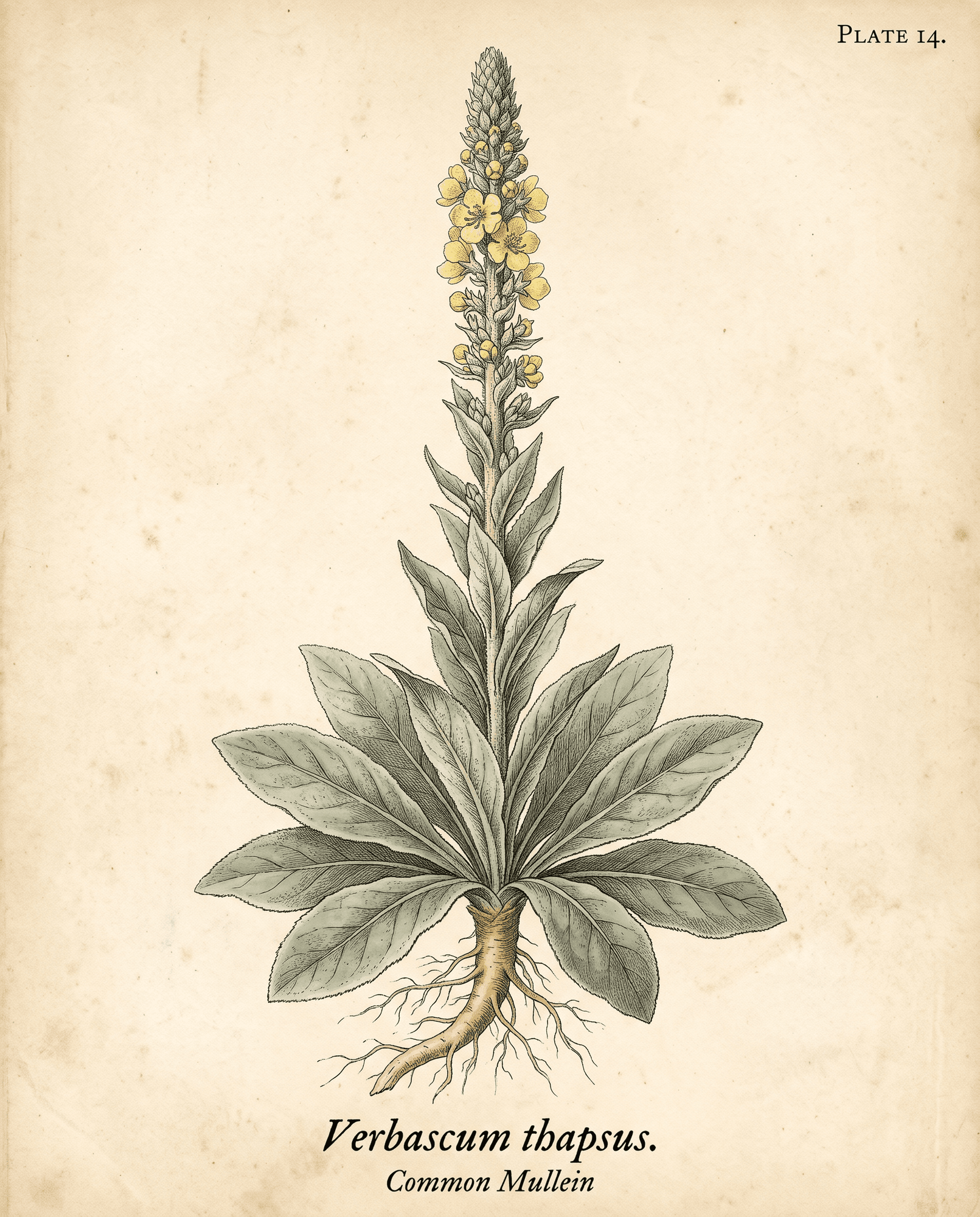
Mullein is the one standing alone in the open ground, taller than everything around her, a single straight stalk rising out of a rosette of leaves so soft they feel like flannel against your palm. In her first year she keeps low, a wide gray-green star of felted leaves pressed close to the soil while her taproot gathers everything she will need. In her second year she sends it all upward at once — a stalk that can reach past your head, lit along its length with small sulfur-yellow flowers that open a few at a time, all summer long, as if the plant were a candle burning slowly from the bottom up.
Her medicine is breath. She has been the lung plant across three continents for as long as anyone has written plants down, the one reached for when the cough has gone dry and raw, when the chest feels scraped, when the body has been through a long illness and is trying to remember how to breathe all the way in. But she is also the plant of the long road and the dark season. Her stalk stands through the whole winter after the rest of the field has fallen, and people once dipped it in fat and carried it as a torch. She is medicine for getting through, and she lights the way while you do.
The shape of her medicine
Mullein is cool, moist, and descending. She meets heat and dryness where they have settled into the membranes — the throat that burns, the bronchi that rasp, the cough that keeps coming without bringing anything up — and she softens them, coats them, and turns the breath back downward where it belongs. She holds two qualities most plants keep apart: she moistens, and she helps the body clear. That pairing is the heart of her medicine.
As a demulcent, her leaves and flowers release mucilage into water — long soothing polysaccharides that lay a protective film over irritated tissue. This is why she is so trusted for the dry, tickling, hacking cough, the laryngitis, the throat left raw by a long illness or by smoke. She does not force anything. She gives the tissue a chance to stop reacting.
As an expectorant, her saponins loosen and thin mucus that has grown thick and stuck, so the lungs can bring it up with less work. Most expectorants dry the tissue as they clear it. Mullein clears while she moistens, which is why she suits both the dry cough and the deep, stuck cough that has worn the chest out.
She is anti-tussive and antispasmodic — she quiets the reflexive, spasmodic cough that has outlived its purpose, the one that keeps a person awake at night and leaves the ribs aching. She does this not by suppressing the cough but by easing the irritation and the tension that drive it. She is a pectoral in the old sense of the word: a plant for the whole chest, its membranes and its rhythm, rebuilding strength in the lungs over weeks.
Her anti-inflammatory thread runs through every part of her. The iridoids and verbascoside she carries quiet inflamed tissue wherever she touches it, and the flower carries that most clearly, which is why the flower oil eases the hot, throbbing ear.
Outwardly she is emollient and vulnerary. The fresh leaf, warmed and laid on the skin, softens and soothes; poultices of her leaf have long been laid over bruises, sprains, swollen glands, and slow wounds. Her mild tannins give her an astringent edge that tightens and tones, so her softness never becomes slack.
The flower oil is analgesic in the ear and around it, easing pain while its lymphatic action helps drain the swollen glands along the jaw and neck.
The root moves differently from the leaf. It is a tonic to the bladder, strengthening the muscle that holds and lets go, and a gentle diuretic. Herbalists have also turned to it for the spine and the joints, for the structures that hold us upright. Root, leaf, and flower are three expressions of one gesture: she helps the body hold its shape and let its breath move freely.
What lives inside her
Whose medicine she carries
Fire (stalk and torch)
Earth (root)
Aquarius
Death
The Star
Oya
Oya is the wind. She is breath moving through the body and storm moving across the land, the force that clears what is stagnant and carries what must change. She stands at the gates of the cemetery, keeper of the threshold between the living and the dead, and she carries a torch into the dark. Mullein belongs to her in all of these.
Her medicine is breath first. The lungs are where the wind lives in the body, where every change begins with an inhale, and mullein is the great lung plant — the one who clears what has settled heavy in the chest so the wind can move through again. She is especially medicine for the breath after a storm: the cough that lingers after the fever has broken, the grief that sits in the chest after a death, the shallow breathing of someone who has been holding on too hard for too long.
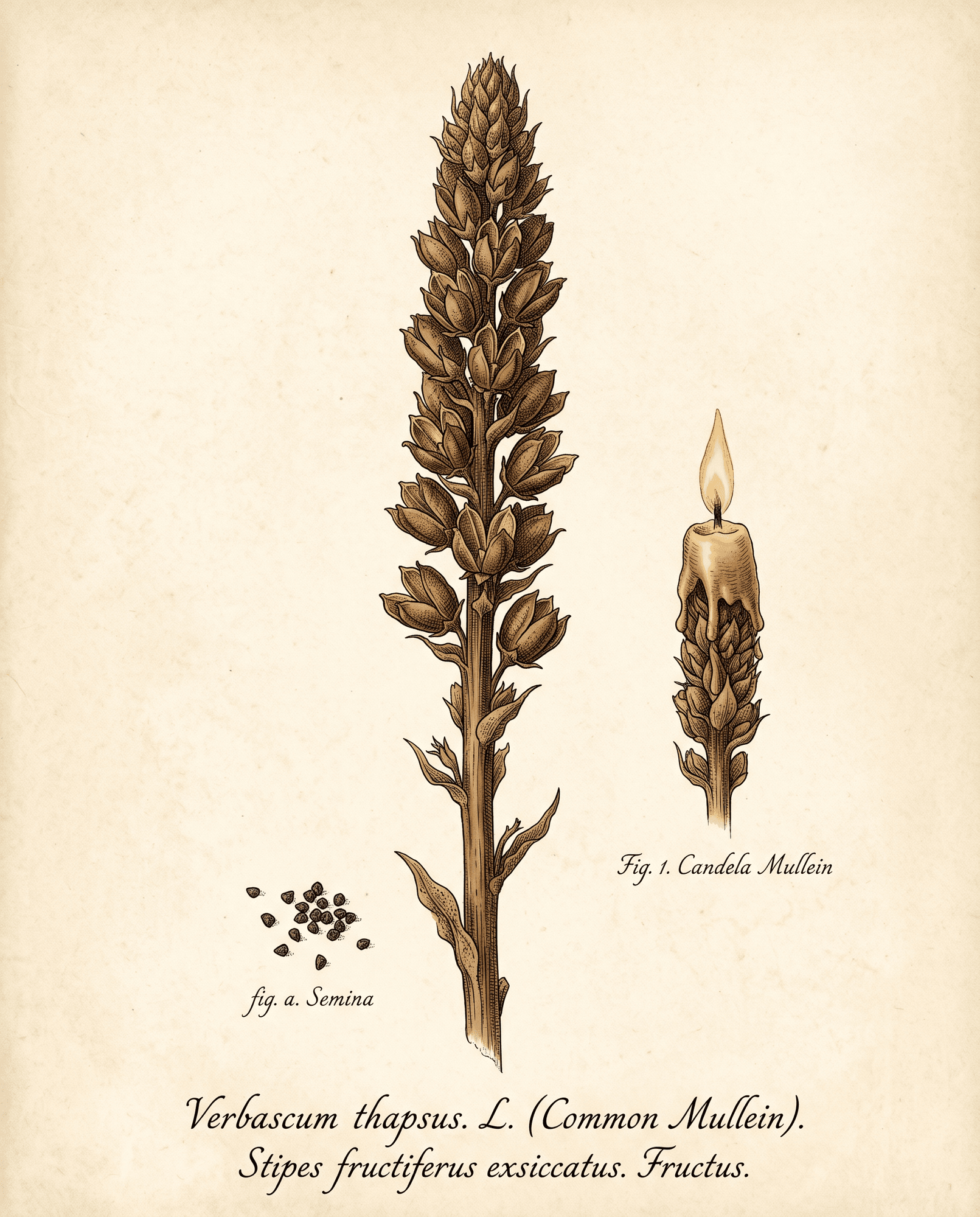
She is also the torch. Her stalk stands in the open field through every storm of winter, dry and upright, and people have gathered it on the darkest nights, dipped it in tallow or wax, and carried it as light on the road. To work with mullein here is to carry light through a passage — a death, an ending, a transformation that cannot be stopped, only walked through. She does not make the passage easier by making it smaller. She makes it possible to see.
Babalu Aye
Babalu Aye walks with the sick. He is the Orisha of the long illness and the slow recovery, of the bodies set outside the village gate, of everything the world would rather not look at. He limps, and his medicine is for the ones who carry their illness in their bones and on their skin for a long time. Mullein belongs to him through the long road.
For generations she was the plant reached for in consumption, the wasting lung disease that set people apart, and she has always been medicine for the convalescent — not the crisis, but the weeks and months after, when the body has spent everything and must rebuild. One of her oldest names is beggar’s blanket. Her leaves are soft enough and large enough to wrap a body in, and she grows freely in the poorest ground, available to anyone who needs her and asks nothing back.
The root carries his medicine too. Herbalists have turned to mullein root for the spine and the bones, for the body that has been knocked out of alignment and needs to find its way back into its own shape. That is Babalu Aye’s work: the patient return of a body to itself, step by uneven step.
The hands she has passed through
The genus name Verbascum is thought to come from the Latin barbascum, from barba, “beard,” for the hairs that cover every part of her, and the old English name mullein is often traced to the Latin mollis, “soft.” Her species name thapsus may point to Thapsos in Sicily. Wherever the names came from, they all describe her body: soft, bearded, felted, unmistakable.
Across the Mediterranean and western Asia, where she is native, she was a lung plant from the beginning. Greek and Roman physicians wrote of her for coughs and chest complaints, and her leaves and flowers were brewed into teas, steeped into wine, and burned so the smoke could be breathed for congested lungs. In Persian and Indian Unani medicine, she is known as ban tambaku, “wild tobacco,” for the resemblance of her broad leaves, and is used for cough, asthma, bronchitis, and skin ulcers. Across Spain and Latin America she is gordolobo, used broadly for coughs, aches, and pains.
In European folk life, she was a plant of light. Her stalks were dipped in tallow and carried as torches, and the soft down of her leaves was twisted into lamp and candle wicks — hence candlewick plant, torches, and hag’s taper. The hag in that name is often traced to the Anglo-Saxon word for hedge, so the hedge taper was simply the candle that grew along the hedgerows. Over time the name drifted toward the witch, and the plant came to be known for protection: against wild animals, against nightmares, against what walks the road at night. Her leaves lined boots against the cold and wrapped wounds and sore joints.
When she crossed the Atlantic, Indigenous nations of North America took her into their own medicine quickly and on their own terms. Many independently came to her for the lungs. The Navajo smoked her leaves mixed with tobacco to ease coughing. Creek healers decocted the root for coughs. The Mohegan steeped her leaves in molasses for a cough syrup, and the Cherokee made a similar syrup with honey or brown sugar. The Catawba mixed her young flowers with plum root into a cough syrup. The Cherokee also laid her leaves on cuts and swollen glands, the Abenaki strung pieces of her root as a teething necklace for infants, and the Iroquois used her for colds. As with so many plants that arrived with colonization, this was not passive adoption. It was discernment: healers met a newcomer, tested her, and decided where she belonged.
In African American conjure, mullein appears in a story worth knowing. Many modern books repeat that “graveyard dirt” is an old code name for powdered mullein, and that she can stand in for it. Practitioners and historians of hoodoo have traced that idea to herb-supply catalogs from around the Second World War, not to the tradition itself. Graveyard dirt is exactly what its name says: earth gathered from a grave, with payment and permission, carrying the presence of a particular ancestor. Nothing replaces it. What mullein offers is her own: protection, the torch, the breath, the light carried to the cemetery gate. She does not need to be anything else.
The Eclectic physicians of nineteenth-century America relied on her as a demulcent for the chest, a diuretic, and a mild nervine that helped sleep come. Their flower oil for earache, catarrhal deafness, and painful swellings is still the remedy most people know her by. Modern herbalists have extended the root’s use to the bladder and the spine, carrying a tradition forward rather than inventing one.
And she keeps her own records. Her seed can lie in the ground for a century, waiting for the soil to be opened. In a seed-burial experiment begun at Michigan State in 1879, mullein seed was still germinating more than a hundred years later. She is a plant that remembers.
Where she works in the body
Respiratory. This is her heartland. Mullein is one of the foundational lung plants: she coats and soothes the irritated membranes of the throat, trachea, and bronchi, loosens mucus that has grown thick and stuck, and quiets the spasmodic cough that keeps going long after it has done its work. She is especially suited to the dry, hot, raw cough — the tickle that won’t stop, the bark of laryngitis, the burning throat — and to the long tail of a respiratory illness, when the infection has passed but the chest still rattles, aches, and tires easily. She is gentle enough for children and elders and for long courses through a whole wet season.
Ears & throat. The flower oil is her best-known medicine. Warmed and dropped into the ear, it eases the throbbing pain of an earache, and rubbed along the outside of the ear, under the jaw, and down the neck, it helps the swollen glands there begin to drain. It is often combined with garlic-infused oil. Her leaf tea, gargled or sipped warm, soothes the raw throat and the strained voice.
Urinary. The root is the part for the bladder. Herbalists use it as a tonic for the muscle at the base of the bladder that holds and lets go, turning to it for the leaking and urgency that come after childbirth, in menopause, with an enlarged prostate, or in children who wet the bed. She is a gentle diuretic that does not irritate the kidneys, so she can be taken for months.
Musculoskeletal. Mullein root has become a modern herbalist’s remedy for the back and the spine — for a slipped disc, a muscle spasm that won’t release, a body that keeps falling out of alignment, nerve pain running down a leg. Some herbalists describe her as easing fluid back into dry joints and the spaces around them so the body can settle back into place, and some use her alongside bone-setting work after a fracture. The fresh leaf, warmed, has long been laid over sprains, bruises, and aching joints.
Lymphatic. Through the flower oil and leaf poultices, she helps move congestion out of swollen glands, especially around the ears, jaw, throat, and armpits. This is gentle, local work rather than deep drainage, and it pairs well with her anti-inflammatory and pain-easing gifts.
Skin. Outwardly she is soft medicine: the warmed leaf as a poultice for bruises, sore joints, and slow wounds; the flower oil for chafed or inflamed skin and for hemorrhoids. Her emollient and astringent qualities together soothe and tone at once.
How to take her
Harvest calendar
Preparations
Leaf infusion: 1–2 teaspoons of dried leaf per cup of just-boiled water. Cover and steep 15 minutes, then strain through a fine cloth or a paper coffee filter — not a metal strainer alone — to catch the hairs. Drink 2–3 cups daily through a cough or a long recovery. Honey makes it a syrup-like cup for night coughs.
Leaf syrup: Make a strong infusion (double the leaf), strain through cloth, and stir in an equal amount of honey. Keeps in the refrigerator for several weeks. 1 teaspoon to 1 tablespoon as needed for cough.
Leaf tincture: 1:5 dried leaf in 40% alcohol, or fresh 1:2 in 60% alcohol. 2–4 mL, 3 times daily.
Flower oil: Fill a small jar loosely with fresh flowers, gathered once the dew has dried, cover completely with olive oil, and leave in a warm spot for 2–3 weeks. Strain through cloth and press well. Some makers wilt the flowers for a few hours first so less water goes into the oil. For earache, warm the bottle in a cup of hot water to body temperature and place 2–3 drops in the ear, then rub a little oil around the outside of the ear and down the neck. Often combined with garlic oil.
Root decoction: 1 teaspoon of dried, chopped root per cup of water, simmered 15–20 minutes. 1–2 cups daily.
Root tincture: Fresh root 1:2 in 60% alcohol, or dried 1:5 in 40% alcohol. 1–3 mL, 2–3 times daily for the bladder and the back. Many herbalists find small doses enough.
Steam: A handful of leaves in a bowl of steaming water, head covered with a towel, breathing slowly for 5–10 minutes, for a congested chest and sinuses.
Smoke: The dried leaf has a long history as a smoke for the lungs, alone or in blends. If smoke is your tradition, use it sparingly and with intention, as an occasional medicine rather than a habit.
Poultice: Fresh leaf, warmed in hot water or over steam, laid on bruises, sprains, aching joints, swollen glands, or a tight chest.
Spiritual & ritual:
- The dried winter stalk, dipped in beeswax or tallow, burned as a torch or taper for night walks, vigils, and ancestor work at the threshold of the year
- The leaf burned as a clearing smoke to lift heavy air from a room after illness, conflict, or grief
- Leaves carried or placed in the shoes for protection on the road
- Flowers placed on the altar for the beloved dead, or a candle set on a bed of dried leaves
- A sprig of the stalk kept by the door through the winter as a watchful presence
When to hold back
Use with caution if:
- You are preparing any tea, syrup, or tincture from leaf or flower. Always strain through fine cloth or a paper filter. The fine branched hairs irritate the throat and can bring on the very cough you are trying to ease.
- You are using ear oil. Do not put oil in an ear where the eardrum may be perforated, where there is any discharge, or where ear tubes are in place.
- You are pregnant or nursing. Leaf tea in ordinary amounts has a long record of use, but there is little formal study. Keep long courses and root preparations for another season.
Topical considerations:
- The hairs can cause contact dermatitis in sensitive skin. Handle fresh leaves with care and patch-test a poultice first.
General notes:
- The seed is not taken internally. It is very high in saponins and was once used to stun fish. Some sources also report rotenone in the seed, though this is disputed. Keep seed out of leaf and flower preparations.
- She readily takes up what is in the soil. Harvest away from roadsides, rail lines, and contaminated ground, which are exactly the places she likes to grow.
- Generally considered among the gentlest of herbs, suitable for children and elders in appropriate amounts.
Who walks with her
For the dry, raw, hot cough: Marshmallow root, licorice, plantain leaf, slippery elm, violet leaf.
For the deep, stuck, wet cough: Elecampane root, thyme, horehound, hyssop, pleurisy root.
For rebuilding the lungs after illness: Elecampane, astragalus, licorice, hawthorn, thyme. This is the formula in Mullein’s House.
For colds and fevers: Elderflower, yarrow, peppermint.
For the ear: Garlic oil, St. John’s wort oil, calendula oil.
For the bladder: Corn silk, horsetail, plantain.
For the spine, bones, and joints: Comfrey, Solomon’s seal, horsetail.
Her allies tend to fall on either side of her. With marshmallow and licorice, her moistening is deepened for the driest, most irritated throats. With elecampane and thyme, her clearing is warmed and quickened for the cough that has settled deep and cold. She is the center that holds the two together: soft enough to soothe, steady enough to clear. In a formula she is rarely the loudest plant, but she is often the reason the formula can be taken for weeks without wearing the body down.
How to know her
Plant walk: Go looking in winter, when everything else has fallen. Find the standing stalks in the open ground — road cuts, burned slopes, gravel lots, the edge of the field. Near them, low to the ground, you may find this year’s first-year rosettes, still green under the frost. Stand between the two: the one who has given everything and stands anyway, and the one gathering strength for next year.
Seasonal practice: Work with her across her two years. In the first fall, gather leaves from the rosette and dig a root or two. Over the winter, drink the tea through the cold season. In the second summer, gather flowers each morning for oil. In the second winter, collect the standing stalks for tapers. To know her fully, you have to stay with her for the whole life she lives.
Ritual of light: On the longest night of the year, or on the night you remember a particular ancestor, take a dry mullein stalk, dip the top in melted beeswax, and let it cool. Light it outdoors over bare earth or in a safe holder, and speak the names of those who walked the long road before you. Let the taper burn as long as it will. You are lighting the way for them, and they are lighting it for you.
Ritual of breath: When grief or fear has settled in your chest, make a cup of mullein tea and hold it under your face before drinking. Breathe the steam slowly. On each exhale, let a little of what you are holding go out with the breath. Drink the tea slowly when it has cooled. Let her soften what has hardened.
Journal prompts
- Where in my life am I being asked to stand tall in open ground, without shelter?
- What have I been gathering quietly, below the surface, that is nearly ready to rise?
- What breath have I been holding? What would happen if I let it out?
- Who lit the way for me through a dark passage? How do I honor that light now?
- What in me has outlived its season and is still standing? Is it time to let it become a torch?
Tarot Spread
A spread for entering into relationship with Mullein as a plant ally:
- Where am I holding my breath right now?
- What is Mullein offering to soften in me?
- What passage am I walking through, and what does she show me on the road?
- What am I gathering underground for a season that has not yet come?
- Whose light do I carry, and how do I carry it forward?
Lay a leaf or a piece of the dry stalk beside the cards, and let a candle burn while you sit with them.
The same plant, multiple lenses
Mullein is not part of the classical Ayurvedic texts. She is known in the Unani tradition and in Himalayan folk medicine as ban tambaku, and practitioners who read her through Ayurveda’s lens work from her qualities: sweet in her mucilage, slightly bitter and astringent, cooling, softening, and gently heavy.
Pitta Dosha — Fire & Water
Mullein soothes Pitta well. Her cooling, moistening nature is suited to the hot, inflamed, burning patterns of the throat and lungs — the red sore throat, the dry hot cough, inflammation in the ear, irritated skin. She cools without depleting, which makes her a steady ally for Pitta types prone to heat in the chest and head.
Kapha Dosha — Earth & Water
Kapha asks for care with her. Her expectorant action helps Kapha clear thick, stuck congestion from the chest, but her demulcent, moistening quality can add to Kapha’s heaviness when taken alone over long periods. For Kapha patterns — the wet, heavy, cold, congested chest — pair her with warming, drying, pungent allies such as ginger, thyme, elecampane, or black pepper.
Vata Dosha — Air & Ether
Mullein is especially kind to Vata. Vata imbalances in the lungs show up as the dry, ticklish, spasmodic cough, a hoarse voice, shallow breath, anxiety held in the chest — exactly the patterns her moistening, soothing, antispasmodic nature meets. For Vata’s tendency to coldness, take her warm and pair her with a little ginger, licorice, or honey.
Mullein is not part of the classical Chinese materia medica. Herbalists who translate Western plants into Chinese medicine terms read her this way, by her taste, temperature, and the patterns she meets.
Taste & Temperature: Sweet and slightly bitter, cool. Channels Entered: Lung, with the root also reaching the Bladder. Functions: Moistens the Lung and stops cough. Transforms phlegm. Directs Lung qi downward. Clears damp-heat from the lower burner (root).
Moistening the Lung and Stopping Cough
Her primary function is to moisten Lung dryness and relieve the dry cough that follows heat or dryness damaging the Lung — little or no phlegm, a dry throat, a hoarse voice, a cough that worsens at night. Her sweetness nourishes the fluids the Lung has lost.
Transforming Phlegm
What makes her unusual is that she also helps transform and clear phlegm. Most phlegm-transforming herbs are warm and drying, and most Lung-moistening herbs do not address phlegm at all. Mullein does both, so she suits patterns of phlegm-heat and dryness mixed together — the sticky, hard-to-raise mucus in a chest that is also dry and irritated.
Directing Lung Qi Downward
The Lung’s natural movement is to descend. When its qi rebels upward, the result is cough and wheezing. Mullein’s descending nature helps restore that downward flow, calming the cough and easing the breath.
Clearing Damp-Heat from the Lower Burner
The root’s use for the bladder can be read as clearing damp-heat from the lower burner while protecting the yin fluids, easing urinary weakness, leaking, and discomfort without drying the body further.
Yin/Yang Balance
Mullein is cool and moistening, a Yin-supporting herb. She is best for patterns of dryness and heat in the Lung and for the depleted fluids that follow a long illness. She is less suited, alone, to patterns of cold, damp, and heavy phlegm — the pale, wet, white-phlegm cough with cold hands and a weak appetite — where she needs warming, drying companions to keep her from adding to the dampness.
For going deeper
- Moerman, Daniel E. Native American Ethnobotany. Timber Press. (Entries on Verbascum thapsus across many nations.)
- Wood, Matthew. The Earthwise Herbal: A Complete Guide to Old World Medicinal Plants. North Atlantic Books.
- de la Forêt, Rosalee. Alchemy of Herbs and Wild Remedies (with Emily Han). Hay House.
- Yronwode, Catherine. Hoodoo Herb and Root Magic. Lucky Mojo Curio Company. (On mullein and the graveyard-dirt question.)
- Felter, Harvey Wickes, and John Uri Lloyd. King’s American Dispensatory. (Eclectic entry on Verbascum.)
- Gupta, A., Atkinson, A. N., Pandey, A. K., & Bishayee, A. “Health-promoting and disease-mitigating potential of Verbascum thapsus L. (common mullein): A review.” Phytotherapy Research 36(4), 2022.
- Alipieva, K., et al. Review of the iridoids, phenylethanoids, and pharmacology of the genus Verbascum. Phytochemistry Reviews 13: 417–444, 2014.
The Conversation
Questions, noticings, what this is teaching you — leave them here. This same conversation lives in The Circle.