Abelmoschus esculentus
Okra is the pod that softens the way through, and her slip is the whole of her gift. It is what thickens the pot so a little feeds many, what coats a raw throat and soothes a burning stomach, what eases a bowel that has gone dry and stubborn. As the furnace comes on and the air indoors turns parched, she is the plant that brings the moisture back.
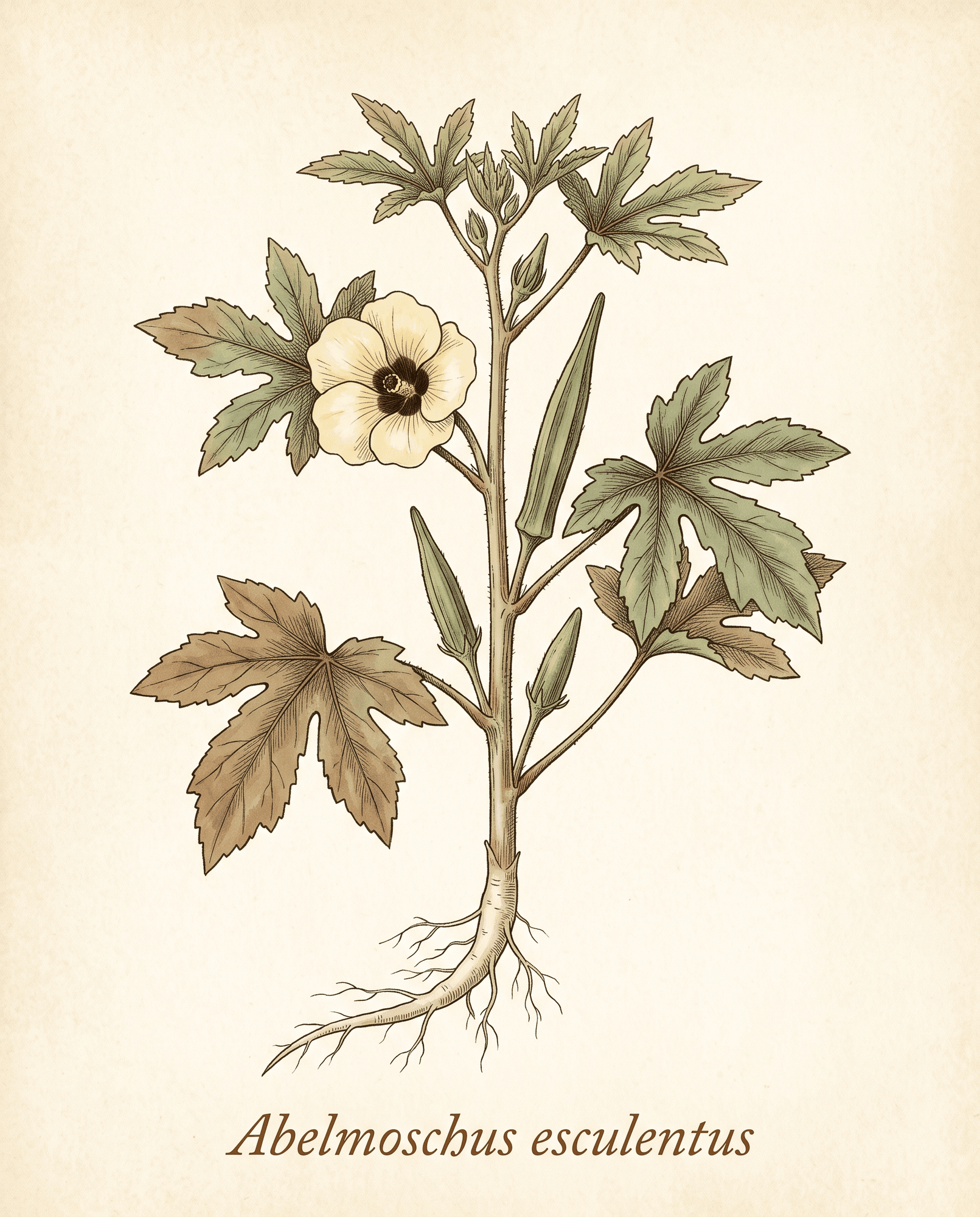
She is one of the plants the diaspora carried in its body. Her English name is Igbo, from ọ́kụ̀rụ̀, and her other name, gumbo, comes from the Bantu kingombo. Both words survived the crossing, and so did she. The memory held across the diaspora tells of African women braiding seed into their hair before the ships, okra and rice and black-eyed peas, so their children would have something to plant on the other side. She came up in Bahia and Barbados, in Port of Spain and New Orleans, and she is still in the pot there: callaloo, cou-cou, caruru, gumbo, okra soup. To cook her is to keep a promise someone made a long time ago that this, at least, would not be lost.
Pod and Seed
Okra hands over her medicine on her own schedule. At the height of summer she gives a new pod nearly every day, and the more faithfully you pick, the more she gives. That daily harvest is her teaching: a little medicine, every day. Leave a pod on the stalk and she takes it as her signal to slow down. It hardens, dries, and by fall splits along its five seams to let the seed go. The young pod is her medicine. The seed is her continuity, saved and passed hand to hand and planted again.
Her Medicine Is Softening
Where elderberry stands guard, okra softens. She is sweet, cool, and wet, and her mucilage swells in water into a gentle gel that coats whatever it touches. She soothes the raw throat, the irritated stomach, the hot and sluggish bowel, and she moves downward as she goes, easing things through without pushing them. Eaten steadily over weeks, her fiber and slip also slow the rush of sugar into the blood after a meal and carry cholesterol out through the gut. Her medicine builds the way her harvest does, a little at a time. And cooking does not destroy that slip. Heat draws it out of the pod and into the soup, and the medicine goes right into the bowl with it.
A Practice for the Season
For one week, begin the morning with okra water. It is the simplest medicine she offers, and you make it while you sleep. Notice what happens across the week in your throat, your stomach, and the ease of your mornings.
Okra water
- 3 or 4 fresh young okra pods
- 8 to 12 ounces of cool water
- A clean jar with a lid
Slice the pods lengthwise or into rounds so more of the inside meets the water. Drop them in the jar, cover with the cool water, lid it, and set it in the refrigerator overnight. In the morning, strain and drink the water slowly. It will be silky and a little thick, and that is the medicine. Make a fresh jar each night.
Every day: One glass each morning, before food. Eat her in the pot too, as often as you can.
For the body that runs cold: Okra is cooling. If your belly runs cold or your digestion is slow, cook her with ginger, garlic, cumin, or pepper the way her home kitchens always have, and lean on the pot more than the cold glass.
Okra water slows how quickly the body takes in anything swallowed alongside it, so keep it two hours apart from any medication.
A Plant Walk, Wherever You Live
Okra wants heat and long warm nights, so unless you live where summer runs hot, you may never see her growing. If you can, find a garden in the last weeks before frost and look for the tall stalks with broad, rough, deeply lobed leaves, the last pale-yellow flowers open for a single morning around their dark maroon hearts, and the dry pods left standing to split and give up their seed. Wear long sleeves; her hairs prickle. If she doesn’t grow near you, walk the markets. Go to the West African, Caribbean, South Asian, Middle Eastern, and Latin grocers and find her in the bins and the freezer case, and in West African shops, dried and ground into powder for draw soup. Read the labels as you go: bhindi, bamia, ochro, gombo, quiabo. Notice how many names she carries, and how many tables have kept her.
She crossed the water braided in our grandmothers’ hair. She is what holds the pot together, and what lets you through.
— The Sage
Go deeper. The full Okra monograph lives in the Materia Medica library — her energetics and pharmacology, her crossing from the Ethiopian highlands to West Africa and the Americas, her place in Oshun’s birthing medicine, her Ayurvedic and Chinese readings, methods and dosages for pod, seed, leaf, and root, and a tarot spread for entering into relationship with her as an ally. It’s included with Herb-Curious membership, along with the whole library.