Okra
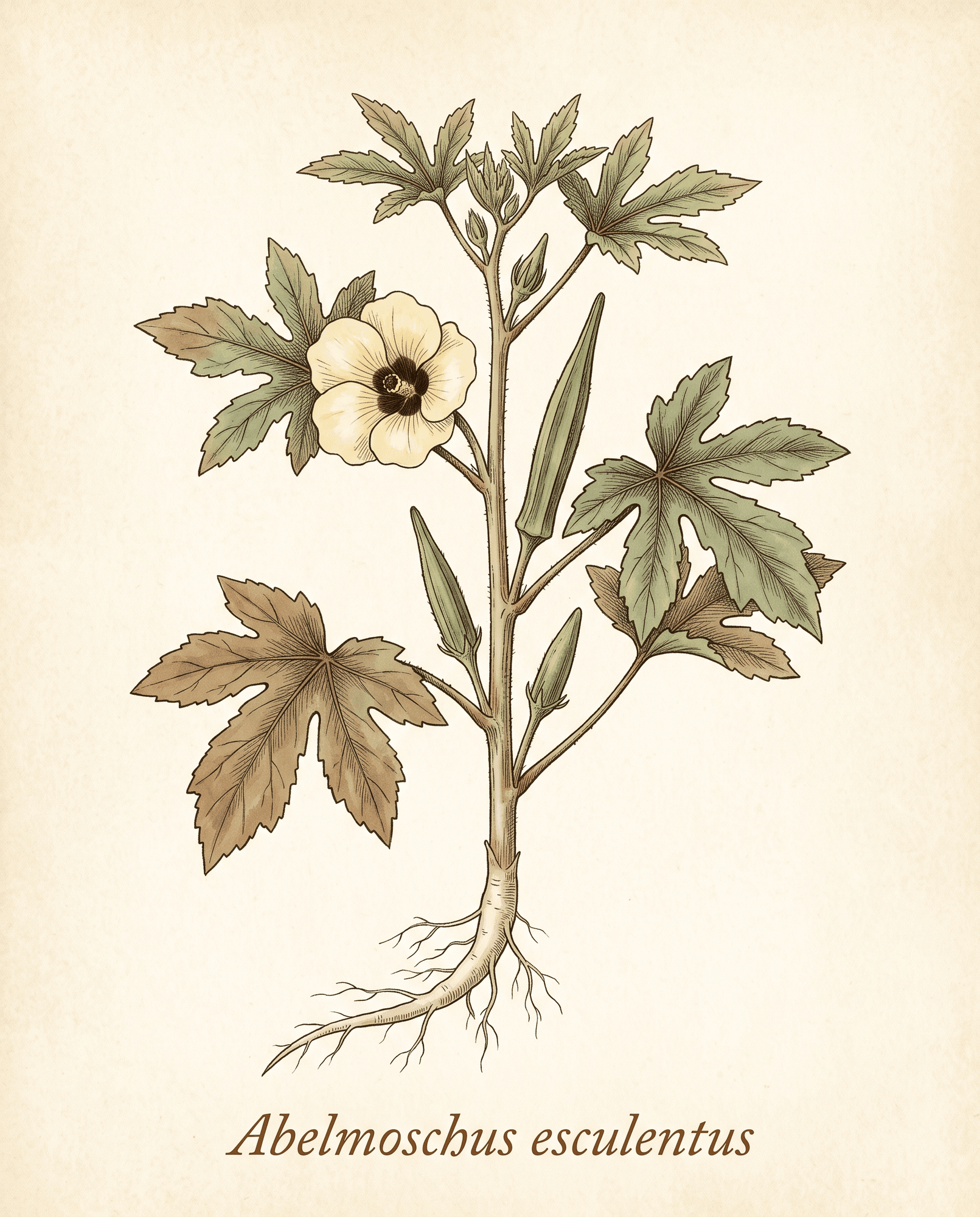
Okra is the medicine of the slip, and that slip is the whole of her gift. It is what thickens the pot so a little feeds a great many. It is what coats a raw throat, soothes a burning gut, and softens a bowel that has grown dry and stubborn. It is what lets things move that have forgotten how to move. Where the body has become parched, hard, or stuck, she arrives cool and wet and patient, and reminds the body that softness is its own kind of strength.
She is also one of the plants the diaspora carried in its body. Her English name is Igbo, from ọ́kụ̀rụ̀. Her other American name, gumbo, is Bantu, from kingombo. Both words crossed the Atlantic in the mouths of captured people, and both survived, which tells you something about how tightly they were held. She went into the pot in Bahia and Barbados, in Port of Spain and New Orleans, in Havana and the Carolina Lowcountry, and she is still there, holding the soup together, holding the people together, remembering on their behalf what the soil they came from tasted like. To cook her is to keep a promise someone made a long time ago that this, at least, would not be lost.
The shape of her medicine
Okra’s medicine moves downward and inward, moistening as it goes. She is sweet and bland, cool in temperature, and heavy with mucilage — the slick, water-holding polysaccharide that runs through her pod, her root, her leaf, and her seed. Where heat and dryness have settled together, she meets both at once: she cools what burns and wets what has cracked. Her direction is descending. She coats the throat on the way down, settles the stomach, softens the stool, and carries the whole of the digestive tract toward ease.
Her demulcent action is the root of everything else she does. Mucilage swells in water into a protective gel, and when it meets inflamed mucous membrane — a raw throat, an irritated stomach lining, a hot and spasming bowel — it lays down a soothing film between the tissue and whatever is aggravating it. This is the same medicine the mallow family has always offered, the work of her sisters marshmallow and hibiscus, and okra carries it in a form you can eat by the bowlful. Her mucilage does something more specific in the stomach as well: it discourages the bacteria behind many ulcers and much gastritis from clinging to the stomach wall, which is part of why West African and Asian traditions have long fed the young pods to people with burning, ulcerated stomachs.
As an emollient she brings that same softening to the outside of the body. The cooled gel from her pods and leaves, laid on dry, itchy, or inflamed skin, calms and moistens it, and the same gel combed through hair gives slip and soft definition to curls that would otherwise break.
Her laxative action is gentle and bulk-forming. Her fiber draws water into the stool and her mucilage lubricates the passage, so the bowel moves without being driven. She does not stimulate; she eases. This makes her right for the dry, hard, stuck constipation of a body that has run too hot or too depleted, and wrong for the person whose bowels are already loose.
Her nutritive gift is generous. The young pod carries vitamin C, vitamin K, folate, calcium, magnesium, and potassium; the seed is rich in protein and oil; the leaf, in the places where it is eaten, is a mineral-rich green. She has fed people through famine, war, and blockade, and the body recognizes her as food first.
Her diuretic action is mild and soothing rather than forceful. A decoction of the young pods has long been given for burning, painful, scanty urination, where her cooling mucilage calms irritated urinary passages as it gently increases flow.
Her anti-inflammatory and antioxidant threads run through all of this. Her flavonoids, concentrated in seed and pod, quiet low-grade inflammatory fire and protect tissue from oxidative wear. And underneath her actions runs a metabolic medicine that is now well documented: her mucilage and fiber slow the absorption of sugar from a meal, bind bile acids and the cholesterol that travels with them, and carry both out through the bowel. Over weeks of regular eating she steadies blood sugar and shifts the lipid balance of the blood in a gentler direction.
Together her actions form one gesture: softening the way through. She is for the body that has grown dry, hot, and hard — in the throat, the gut, the blood sugar, the skin — and needs not to be pushed but to be eased.
What lives inside her
Whose medicine she carries
Fire (summer heat)
Air (opened pod, scattered seed)
Venus
Taurus
Temperance
Death
Oshun
Oshun is the sweet river, the honey, the gold, and the yellow — the Orisha of beauty, of pleasure taken as medicine, of fertility and the womb and the long mystery of bringing life through. Okra belongs to her first through the slip. Oshun’s medicine is the medicine of moisture and flow, the river that softens the stone by staying with it, and okra is the plant that makes that softness edible. Where life has gone dry — the throat, the gut, the skin, the spirit worn brittle with effort — okra brings back the wet, the yielding, the sweet. Her flower, which opens for a single morning in pale butter yellow around a dark and secret heart, is Oshun’s own color worn for one day and then let go.
And okra carries Oshun’s birthing medicine. Among the Bini, the Igbo, the Urhobo, and the Isoko, okra has been given to ease childbearing and labor, and the same knowledge traveled through the American South and the Caribbean, where women still eat okra through the last weeks of pregnancy so the baby will slide through when it is time. In the Yoruba town of Igbo-Ora, the soup made from the leaf is counted among the foods credited for the town’s famous abundance of twins — the twins whom many lineages place in Oshun’s care. In Bahia, the okra stew called caruru is cooked each September in honor of the twin saints and the children they stand for. Fertility, the womb, the passage of the child, the joy of a full house: these are Oshun’s, and okra has been at the table for all of them. Working with okra under her is the practice of letting softness be a strength, and of trusting that what is slippery is not weak but ready.
The hands she has passed through
Okra’s earliest home is most likely the Ethiopian highlands and the lands along the upper Nile, where she still grows in many local varieties and where peoples like the Berta of western Ethiopia eat nearly every part of her — pod, leaf, flower, bud, and seed. From there she traveled north and west in very old times. She was established in Egypt by the early thirteenth century, when an Andalusian botanist visiting in 1216 described the locals eating her tender young pods cooked with meal, and from Arabia she moved around the Mediterranean, where her Arabic name, bamia, still holds across North Africa, the Levant, the Balkans, and Turkey. She reached India later, after the turn of the common era, and became bhindi, so thoroughly woven into the kitchen that many people assume she was born there.
In West Africa, okra became a pillar of the pot. She is ọ́kụ̀rụ̀ to the Igbo and ilá to the Yoruba, cooked fresh or dried and powdered into the draw soups whose long, silky strands are the whole point — the sauces that stretch a little meat and fish across a full table and slide a ball of pounded yam down with ease. Her leaves are a green in their own right. Her medicine lived alongside her nourishment: the crushed fruit and leaf mucilage given for childbearing and labor, the young pods for burning stomachs and hot bellies, the leaf soup in Igbo-Ora and its twins. In Yoruba religious life, and in the Lukumí and Candomblé traditions that carried it across the ocean, okra is a sacred food. Amalá with okra is offered to Shango in Cuba, and in Brazil the okra-and-palm-oil stew called amalá is laid out for Xangô on a tray standing with upright pods.
She crossed the Atlantic with the transatlantic slave trade. Her presence in Brazil is recorded by 1658, in Suriname by 1686, and she reached the American South in the early eighteenth century. She came as seed carried by people who had nothing else to carry. The memory held across the diaspora tells how African women, facing the ships, braided seed into their hair: rice and okra, black-eyed peas, maize, whatever would keep. They tucked it close to the scalp under tight plaits where no one would think to search, so their children would have something to plant on the other side. Maroon women in Suriname still know the braiding that hides a handful of seed in plain sight, and they still tell of the foremothers who carried their crops to freedom that way. Whether every seed came by braid or by the scraps of the ship’s provisions, the story keeps the truth that matters: the enslaved brought their food across the water on purpose, by their own wit, against everything done to stop them. She was first grown to feed the enslaved, in provision grounds and kitchen gardens tended after the forced day’s labor was done. Every name she gathered in the Americas traces back to Africa. Her English name is Igbo. Her other name, gumbo, comes from the Bantu kingombo, which became quimbombó in Cuba, quiabo in Brazil, gombo in French Louisiana, and gumbo in English — so that in early Louisiana the word meant the plant and the soup at once. Enslaved people in Louisiana cooked her with rice in a dish they called ya-ya, one of the ancestors of the gumbo that would later carry her name, and in time she took the thickening role that Choctaw filé had played in the pot.
Across the Caribbean, she became ochro and settled into the dishes that hold the islands’ memory. In Trinidad she is stewed with dasheen bush, coconut milk, and pepper into callaloo, the Sunday pot swizzled smooth, and in Barbados she is stirred into cornmeal for cou-cou, the national dish served with flying fish. That cornmeal-and-okra pairing echoes the amalá offered to Shango, the same marriage of grain and slip made sacred in one place and daily in another. In Bahia, caruru is cooked every September for the twin saints Cosme and Damião, and families feed the neighborhood’s children from the pot. A nineteenth-century physician in Jamaica wrote about dosing his poisoned patients with a thick infusion of ochro to protect the stomach lining, a remedy he almost certainly learned from the enslaved Africans around him, who were using her for the stomach long before he arrived.
In the American South, okra gave one more gift during the Civil War. When the blockade cut off coffee, Southern newspapers in 1861 and 1863 urged families to parch and grind okra seed as a substitute, and the roasted seed made a dark, nutty, caffeine-free brew that many found better than any other wartime replacement. In Black Southern foodways she stayed constant through all of it — fried in cornmeal, stewed with tomatoes, folded into succotash and gumbo and pots of field peas, and given to women in the last weeks of pregnancy to make the birth easy.
She has been mocked for her texture in more than one century and more than one country, and she has outlasted the mockery every time. In recent years she has come back into the light through the diaspora itself — Black women in West Africa, the Caribbean, and the United States sharing okra water for the gut and for birth, okra gel for natural hair, the old pot recipes from their grandmothers — taking back, in public, what was always theirs.
Where she works in the body
Digestive system. This is okra’s heartland. Her mucilage coats and soothes the whole length of the digestive tract, from a raw, sore throat down through an irritated, burning stomach to a dry, sluggish bowel. She calms gastritis and the heat of an inflamed stomach lining, and her mucilage specifically discourages ulcer-causing bacteria from clinging to the stomach wall. Her fiber and slip add bulk and water to the stool and ease it through without stimulation. Her fiber also feeds beneficial gut flora. She is foundational for the dry, hot, irritated gut, and she does this work as food, gently enough to be eaten daily.
Metabolic system. Okra’s influence on blood sugar is among her best-documented medicines. Her mucilage and soluble fiber slow the movement of sugar from the gut into the blood, softening the spike after a meal, and over regular use she supports steadier blood sugar in prediabetic and diabetic patterns. Her flavonoids, especially from the seed, add their own support to that steadiness. She appears in Ayurvedic formulas for prameha, the sweet-urine disorders, and in modern kitchens as a daily food for people working to bring their blood sugar home.
Cardiovascular system. Her mucilage binds bile acids in the gut and carries them out, along with the cholesterol they hold, so the liver must draw more cholesterol from the blood to make new bile. Over weeks of regular eating this gently lowers LDL and triglycerides. Her antioxidant flavonoids protect the vessel walls, and her potassium and magnesium support a healthy rhythm and pressure. She is not a heart remedy in the way hawthorn is; she is a quiet daily ally for the blood’s lipid balance, working from the gut outward.
Urinary system. A decoction of the young pods, or the cool mucilaginous water they release when soaked, has long been given for hot, burning, scanty, painful urination. She soothes irritated urinary passages much as marshmallow root does, increasing flow mildly while laying a cooling film over inflamed tissue.
Respiratory system. Okra’s syrup and fresh-pod mucilage have long been taken for sore throats and for the dry, tickling, unproductive cough that comes from a parched upper airway. She coats and moistens the throat, quiets the irritation that drives the cough, and suits the dry, hot respiratory pattern rather than the wet, congested one.
Skin. Inside and out, okra moistens and cools the skin. Taken as food, her vitamin C and antioxidants support the skin from within. Applied as a cooled gel or a poultice of the leaves, she soothes dry, itchy, inflamed skin, and a paste of the seed has been used on itching lesions. In the natural hair community her boiled pod gel has become a beloved conditioner and curl definer, giving slip and moisture without heaviness.
Reproductive system. Okra’s oldest reproductive medicine is her role in pregnancy and birth. Across West Africa, the American South, and the Caribbean she has been eaten through the last weeks of pregnancy, and her leaf and fruit mucilage given to ease childbearing and labor. Her folate makes her a nourishing food for the whole of pregnancy, and her moistening, softening nature carries over into a traditional reputation for easing dryness in the reproductive tissues. She is honored as fertility food in the places where she is most at home.
How to take her
Harvest calendar
Preparations
As food: Her first and best form, and she sets the rhythm herself. At the height of summer a pod is ready nearly every day, and the more faithfully you pick, the more she gives. Let a pod stay on the stalk to grow hard and set seed, and she takes it as her signal to slow down. She asks for a daily harvest, and in return she offers a daily medicine, which is exactly how her medicine works best: steadily, a little at a time, over weeks. Eat her young, sliced and stewed, simmered into soups and gumbos, sautéed hot and fast with spices, roasted, or fried. Cooking does not destroy her mucilage. Heat draws it out of the pod and into the pot, which is why she thickens the soup, and the medicine goes right into the bowl with it. Several servings a week carry her metabolic and digestive medicine, and a little every day is better still.
Okra water (cold infusion): Slice three or four fresh young pods lengthwise and soak them overnight in 8–12 ounces of cool water. In the morning, strain and drink the thickened water. A daily soothing drink for the gut, the throat, and blood sugar support.
Pod decoction: A handful of chopped young pods simmered 15–20 minutes in two cups of water. Drink warm or cool, 1–2 cups daily, for burning urination, sore throat, and an irritated stomach.
Syrup: Simmer chopped pods in water until thick, strain, and sweeten with honey. Take by the spoonful for sore throat and dry cough.
Powder: Dried, powdered pod, 3–6 grams (about 1–2 teaspoons) stirred into warm water once or twice daily. Let it stand a few minutes to thicken before drinking.
Root cold infusion: Like marshmallow, the root is rich in mucilage and gives it up best to cool water. Soak chopped root in cool water for several hours, strain, and drink for an irritated gut or urinary tract.
Roasted seed “coffee”: Parch dried seeds in a dry pan until deep brown and fragrant, grind, and brew like coffee. Nutty, warming, and caffeine-free.
Topical gel: Simmer sliced pods in water until thick, strain, and cool. Use as a face mask for dry or inflamed skin, as a soothing wash for itching, or as a leave-in gel for curly and coily hair. Keep refrigerated and use within a week.
Leaf poultice: Fresh leaves bruised or briefly steamed and laid over dry, hot, or inflamed skin.
Spiritual & ritual:
- Okra water drunk or poured at a threshold to ease a passage — birth, a move, a transition of any kind
- Okra cooked into the shared pot as remembrance of the ancestors who carried her seed across the water
- Fresh pods and the yellow flower placed on altars for Oshun in fertility, sweetness, and birth work
- Dried pods and seed saved and planted as an act of continuity
When to hold back
Use with caution if:
- You form calcium-oxalate kidney stones. Okra is moderate in oxalates. Eating her in ordinary amounts alongside calcium-rich foods is generally fine; large daily amounts of okra water or powder deserve moderation.
- You take metformin or other medications that need steady absorption. Her fiber and mucilage can slow the absorption of drugs taken at the same time, and metformin in particular has been shown to be affected. Separate okra water, powder, or a large okra meal from medication by at least two hours.
- You take blood sugar–lowering medication. Her blood sugar–steadying effect is real and additive; watch for lows when adding her in concentrated form.
- You take warfarin. Okra carries meaningful vitamin K. Eating her steadily is fine; sudden large changes in how much you eat can shift clotting time.
- You have irritable bowel syndrome or a sensitive gut. Her fermentable carbohydrates can cause gas and bloating in some people; start small.
- You already have loose stools or diarrhea from cold and weakness. Her cool, moistening, laxative nature can aggravate it.
Topical considerations: The fine hairs on the pods and leaves can irritate the skin when harvesting; wear gloves or long sleeves in the garden. Patch test the gel before broader use on the face.
General notes: Food-safe across the lifespan, including in pregnancy, where she is a traditional and nourishing food. Her medicine is gentle and cumulative, built on regular eating rather than heroic doses. For cold, damp constitutions, cook her with warming spices.
Who walks with her
For the gut and the mucous membranes: Marshmallow root, slippery elm, plantain leaf, licorice root. These are her fellow demulcents, and together they make a deeply soothing formula for gastritis, reflux, and an irritated bowel. Okra brings food and fiber; marshmallow and slippery elm bring concentrated mucilage; plantain adds wound-healing tone to raw tissue; licorice sweetens and calms.
For blood sugar and the metabolic body: Fenugreek, cinnamon, moringa. Fenugreek is another mucilaginous seed that slows sugar absorption; cinnamon warms and steadies; moringa nourishes. With okra they make a gentle daily metabolic support that lives as easily in the kitchen as in the apothecary.
For the urinary passages: Corn silk, marshmallow root, plantain. Cooling, soothing, and gently diuretic, these calm burning and irritated urination alongside her.
For the throat and dry cough: Licorice, marshmallow, honey. The classic soothing syrup, with okra as its edible base.
As kitchen companions: Ginger, garlic, cumin, turmeric, mustard seed, hot pepper, thyme. These are her diaspora and Ayurvedic cooking partners, and they do real work — warming and moving her cool, heavy nature so she is easier to digest and suits a wider range of bodies.
As a sister: Hibiscus. Two mallows out of Africa, both carried across the ocean, both cooling — hibiscus tends the blood and the pressure; okra tends the gut and the sugar. Together on the table they cover a great deal of the heart and metabolic medicine the diaspora most needs.
These allies share okra’s gift of softening and easing. The demulcents deepen her mucilage medicine; the metabolic allies extend her work on blood sugar and lipids; the warming spices supply the heat and movement she lacks. She is an easy and forgiving plant in formula, and even easier in the pot, where she has always worked best in company.
How to know her
Plant walk: Find okra growing in a garden at the height of summer, early in the morning. Look for the flower that has just opened — pale yellow around its dark heart — and know it will close by afternoon and never open again. Stand with her a while. Notice the pods rising straight up from the leaf axils, the roughness of the leaf, the heat she needs to thrive. Ask her what she has to teach about softness that is strong, and about beauty that does not need to last to matter.
The shared pot: Make a pot that needs her — gumbo, callaloo, caruru, okra soup, a stew of okra and tomatoes. As you cut her open and the slip runs from the knife, remember that this is the same gesture made in Lagos and Bahia and Port of Spain and New Orleans, by people who carried her seed in their memory when they could carry nothing else. Say the names of your ancestors into the steam. Feed as many people as the pot will hold.
Ritual of easing passage: When you are standing at a threshold — a birth, a move, an ending, a beginning you are afraid of — make okra water the night before. In the morning, strain it and drink most of it slowly, asking her to ease your way through. Pour the last of it across the doorway you will walk through, and step over it.
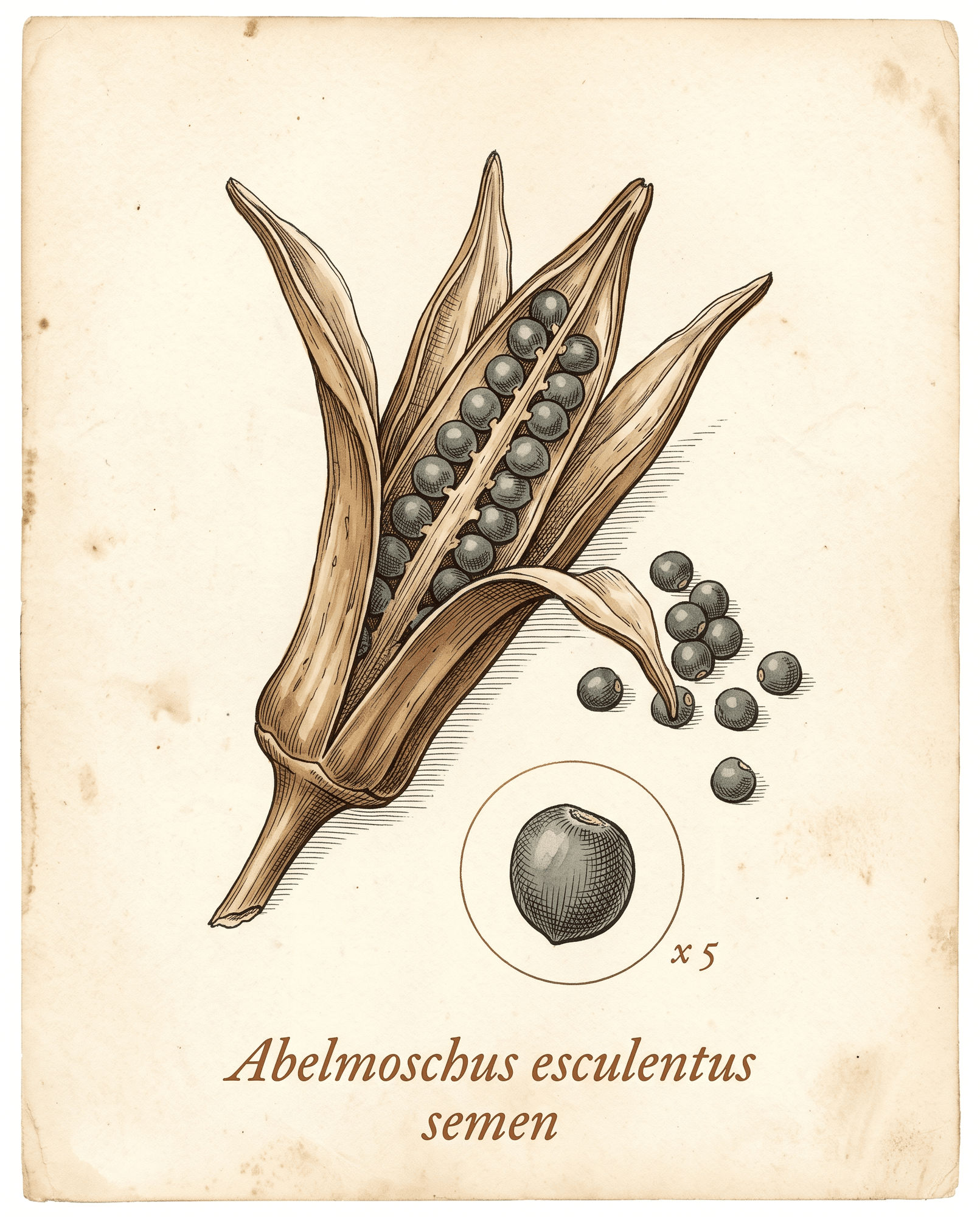
Saving the seed: Leave a few pods on the plant at the end of the season and let them dry until they split. Gather the seeds, hold them in your palm, and remember that this is how she crossed the water. Keep some to plant next year and give some away. Continuity is a practice.
Journal prompts
- Where in my body or my life have I grown dry, hard, or stuck, and what would it feel like to be softened rather than forced?
- What have I been told is too much about me — too soft, too slippery, too strange — that is actually what holds things together?
- What passage am I standing at the edge of, and what would help me move through it?
- What did my ancestors carry across a crossing they did not choose? What of theirs am I still cooking, still saving, still planting?
- Who could I feed from my pot?
Tarot Spread
A spread for entering into relationship with Okra as a plant ally:
- Where in me has life grown dry and hard?
- What softness is she offering me?
- What passage is she helping me through?
- What seed from my lineage is she asking me to save?
- Who is she asking me to feed?
Keep a fresh pod or a small bowl of saved seed on your altar with the cards. If you can, lay out the spread in the morning, while her flower is open.
The same plant, multiple lenses
In Ayurveda, okra is bhindi, from the Sanskrit bhindaka, and she is understood first as food — one of the vegetables of the kitchen rather than a potent single herb. Her taste (rasa) is sweet (madhura), with some readings adding a faint astringency or bitterness; her potency (virya) is cooling (shita); her post-digestive effect (vipaka) is sweet. Her qualities (gunas) are heavy, unctuous, and slimy (guru, snigdha, picchila), and that sliminess is the defining character of her medicine.
Pitta Dosha — Fire & Water
Okra is a clear Pitta soother. Her sweet taste, cool potency, and wet, coating mucilage meet Pitta’s heat where it lives — in the hot, acidic, irritated stomach, the burning urine, the inflamed skin, the scratchy throat. She cools and coats without depleting. For the Pitta constitution or the Pitta pattern of heat and inflammation in the gut, she is a gentle daily food medicine.
Kapha Dosha — Earth & Water
Kapha is where okra asks for care. She shares Kapha’s own heavy, cool, moist, and slimy qualities, and too much of her, eaten plain or raw, can add to Kapha’s congestion, sluggishness, and heaviness. Ayurvedic cooks answer this the traditional way: cooking her hot and dry with mustard seed, cumin, ajwain, turmeric, and asafoetida, so the spices cut her heaviness and kindle digestion. Prepared that way, she suits Kapha bodies too, and her blood sugar medicine makes her worth the effort for the Kapha pattern of sluggish metabolism.
Vata Dosha — Air & Ether
Vata is dry, rough, light, and cold, and okra’s unctuous, heavy, moistening nature is exactly what dry Vata tissue asks for. She lubricates a dry, constipated bowel, moistens a dry throat and skin, and grounds the light, scattered quality of Vata with her weight. Her one mismatch is temperature: her cool potency asks to be balanced with warm cooking and warming spices. Served warm and well spiced, she is a nourishing Vata food.
In Chinese, okra is qiu kui, the “autumn mallow,” and she entered Chinese kitchens and food therapy far more recently than the classical herbs. She is not part of the classical materia medica, but she is read today through its lens, and that reading is consistent. Her cousin Abelmoschus manihot, whose flower is called huang shu kui hua, carries a longer medicinal record, especially for damp-heat in the Kidney.
Taste & Temperature: Sweet, cold. Channels Entered: Primarily the Liver, with clear action on the Stomach and Large Intestine. Functions: Clears heat and cools the blood; moistens the Intestines and moves the stool; generates fluids and benefits the throat; promotes urination and clears damp-heat from the lower burner.
Clearing Heat & Cooling the Blood
Qiu kui’s cold, sweet nature clears heat, particularly heat that has settled into the Liver and the blood and shows as irritability, flushed skin, and a body that runs hot. She is classed in modern food therapy among the foods that regulate the blood, a gentle heat-clearer for long-standing low heat rather than acute high fever.
Moistening the Intestines
This is her clearest function. Like the seeds and nuts that TCM uses to lubricate the bowel, okra moistens the Large Intestine and eases dry, hard stool, especially constipation from heat or depleted fluids. She moves the bowel by wetting it, not by purging.
Generating Fluids & Benefiting the Throat
Her sweet, mucilaginous nature generates fluids and moistens dryness in the upper body — the dry throat, the parched mouth, the dry and tickling cough. Fresh-pod juice and syrup have long been used this way.
Promoting Urination & Clearing Damp-Heat
Okra cools and soothes the lower burner, easing hot, painful, scanty urination by clearing damp-heat downward and out. Her manihot cousin is still used for chronic damp-heat in the Kidney, and the two share this cooling, draining direction.
Yin/Yang Balance
Okra is Yin in nature — cold, moistening, descending, and nourishing of fluids. She is medicine for heat with dryness: the hot, parched throat, the burning stomach, the dry and stuck bowel, the thirsty body with blood sugar that runs too high. She is not suited to cold, deficient Spleen patterns — loose stools, poor appetite, a cold belly, fatigue after eating — unless she is cooked with warming spices and ginger, which is precisely how her home traditions have always prepared her.
For going deeper
- Smith, Chris. The Whole Okra: A Seed to Stem Celebration. Chelsea Green Publishing. — a loving, whole-plant tribute to okra: her history and lore, growing and seed saving, and recipes for every part of her, from pod and leaf to flower and seed.
- Carney, Judith A. & Rosomoff, Richard Nicholas. In the Shadow of Slavery: Africa’s Botanical Legacy in the Atlantic World. University of California Press. — for how okra and the other African food plants crossed the ocean and took root in the Americas.
- Twitty, Michael W. The Cooking Gene: A Journey Through African American Culinary History in the Old South. Amistad. — for okra in Black Southern foodways and memory.
- Harris, Jessica B. High on the Hog: A Culinary Journey from Africa to America. Bloomsbury. — for the long road of the African pot through the diaspora.
- Frawley, David & Lad, Vasant. The Yoga of Herbs: An Ayurvedic Guide to Herbal Medicine. Lotus Press.
- “An Overview of the Current Scientific Evidence on the Biological Properties of Abelmoschus esculentus (L.) Moench (Okra).” Foods (2025). — a thorough recent review of her constituents and studied actions.
- The ethnobotanical literature on West African okra and its traditional uses among the Bini, Igbo, Urhobo, Isoko, and Yoruba peoples of Nigeria.
- Oral traditions of okra soup, callaloo, cou-cou, caruru, gumbo, and amalá — held in families, kitchens, and religious houses across West Africa and the diaspora. Learn the pot from the elders who make it; the medicine and the memory travel together.
The Conversation
Questions, noticings, what this is teaching you — leave them here. This same conversation lives in The Circle.