I never knew okra growing up. Never knew what it looked like, where it came from. Never knew it was my favorite thing.
As a child, I remember my friends complaining about eating spinach. And I thought, how could you not like spinach? It’s delicious. Then I had their spinach, boiled and limp, flavorless… likely from a can. I understood why they had to have a whole cartoon, Popeye, just to convince them to eat it. So, it wasn’t about the spinach after all… it was about the okra. It was about my grandmother’s Callaloo served with CooCoo and fish… sometimes shark, but more often salmon as she became acclimated to life here in Seattle… where salmon is everything. My grandmother, Dudu darling, taught me so many things growing up. So many of her Trinidadian ways, as I was constantly in her shadow. But for some reason, she never taught me how to make Callaloo.
So, it wasn’t about the spinach after all… it was about the okra.
Later, my cousin Greg would make it for Christmas… until my aunt declared that two large family feasts that close together (Thanksgiving and Christmas) was too much cooking. So we started having Christmas catered by Guapos, which was Guatemalan… and didn’t have Callaloo.
My dad’s family was from Savanna… South Carolina Sea Islands… Gullah and Cherokee. So I know okra was there too… my Nana must have made it for me on one of her visits out or one of our visits to her. But, I don’t remember her food — with her at such a great distance. She never made the migration West with us. Even when two strokes had her wheelchair-bound. Because even then she could still get on the bus to Atlantic City from South Bronx, and that was what gave her life. Maybe my dad’s older sister, Bess, maybe she used to cook it back when everyone took turns cooking Sunday dinner… until Dudu took over… making the deal that she would cook if everyone just came to her house.
All I know is that later, when my dad took over cooking after I left for college, he made his okra with tomatoes (Native American nightshade)… and when I tasted it, I knew I had had it before. And it tasted like home.
Then, I moved away… and okra was out of my life for a long time.
Meet okra as a plant ally in Plant Ally: Okra, elsewhere in this issue.
I became an herbalist over 12 years ago. Woke up one morning and just decided, instead of chemistry, my eldest should have their homeschool science class for the fall in herbalism. I found a class online and we started learning together. I was hooked. So many healers in my family had gone into the medical field, nurses, doctors. But that was never for me. Without even knowing, I was craving for the natural healings of Mother Earth… and these classes were helping me find that missing piece. Well, sort of. It was getting close to what was missing… but it was like that canned spinach… limp… nutritious, perhaps, but tasteless — a white washed tradition void of its roots. Through these classes, I was taught about marshmallow root. When the teacher demonstrated the mucilaginous qualities of the plant, it made me think of okra. But of course, marshmallow is an herb and okra is a food. So I carried on with marshmallow, infusing in cold water with linden for flavor. This I drank often to help to add moisture to my body… and especially to my lungs when I suffered through the dry spasms of asthma. Always and only this way, marshmallow was too delicate to be heated, I was taught.
About a year later, I came to be connected with Sade Musa. She was offering her first foray into an online class she called “Roots of Resistance”. Sade offered two new perspectives in her teachings. First, she not only gave the history of the herb, but she combined it with the history of the people. “Plants move with the people.” And of course, her second perspective was 100% on the African Diaspora.
She taught us the history of the plants my grandparents had given me — Chamomile, Calendula, Garlic, Tamarind, Hibiscus… etc. etc. etc. And then… And then came Okra. Okra, like Hibiscus, was part of the Mallow family. Abelmoschus esculentus, Malvaceae… Okra.
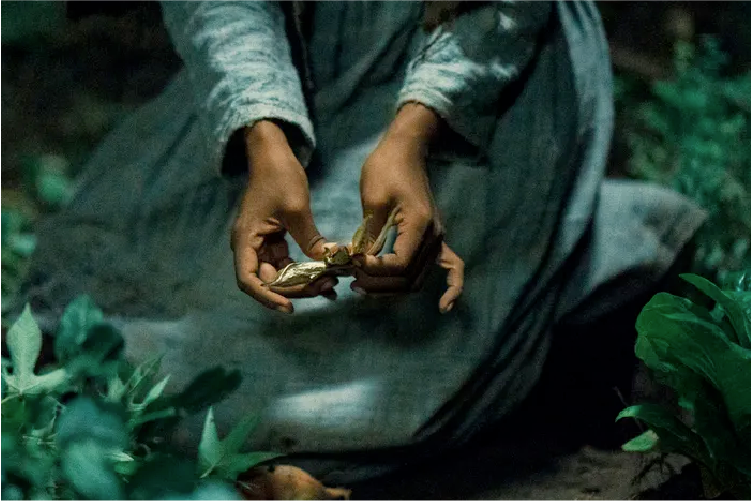
Underground | Cora picks okra seeds from her mother’s garden | Photo: Atsushi Nishijima/Amazon Studios
Recipe for Okra Water
In a large mixing bowl, add two handfuls of okra (fresh or frozen), and 4 cups of water.
Mix together with clean hands while you focus on the intention of your healing. Let mixture sit for 4 hours on the counter. (If frozen, give more time.)
Strain mixture and drink the first cup.
Then take the remaining water and heat on the stove. You want it warm, not boiling. Then take this into the shower for a spiritual bath. Think again about your intention to heal as you pour the liquid over your head. Massage into your hair to both moisturize and to honor the ancestors that used their hair to hide seeds for travels. Then let the liquid flow down your body.
As you rinse, focus on how the maladies and bad thoughts are washed away with the liquid.
It is a good practice to follow with moisturizing soaps and lotions, and dress in light colors after.
So important to us that there are stories of women hiding seeds in their braids to transport them when they were taken. Stories of elders growing in small gardens to supplement the foods they were given on plantations. Stories of ancestors working with the medicines offered by the plant to heal each other. Okra. This old friend. And of course, Okra, having the most mucilage of any of the mallows is far stronger than marshmallow.
So important to us that there are stories of women hiding seeds in their braids
Okra featured heavily in the short series, Underground, which was released on Amazon Prime in 2021. When the protagonist, Cora, runs from the plantation the only thing she takes with her is the okra seeds from her mother’s garden. When they realize she is gone, the slave catcher notes that he was certain she ran because she took with her “her inheritance”. Okra was her inheritance. Throughout the next 10 episodes, we watch Cora fondle the seeds whenever she is nervous. They are the connection to her ancestral line… the connection to her lost mother. In this way, okra becomes a character of its own in the show. And I can not recall another movie, tv-show, play, that has ever given a plant such an honoring. This is how important okra is to us.
The landscape in the greater Seattle is truly an amazing thing to behold. The Cascades to the East, The Olympics to the West, Mt. Baker to the North and Mt. Rainier to the South. These snow capped wonders create a bowl effect that traps the clouds keeping the air moist, the landscape well watered, and the air clean for three quarters of the year. But the summers. The summers are as dry as the deserts of California… and with global warming… getting to be as hot. You can’t see this with the lushness of the landscape. But you can feel it. Dry… dry… dry. As fire season has been raging the last few years in California, Oregon, Eastern Washington, and even Canada, all that smoke gets trapped here in that bowl — no rain to wash it away. So it’s hot, and dry, and smoky. And marshmallow wasn’t doing a thing for me.
I woke up one morning with a craving for Okra.
Because what is instinct, but the whispers of ancestors and genetic memories slipping through time.
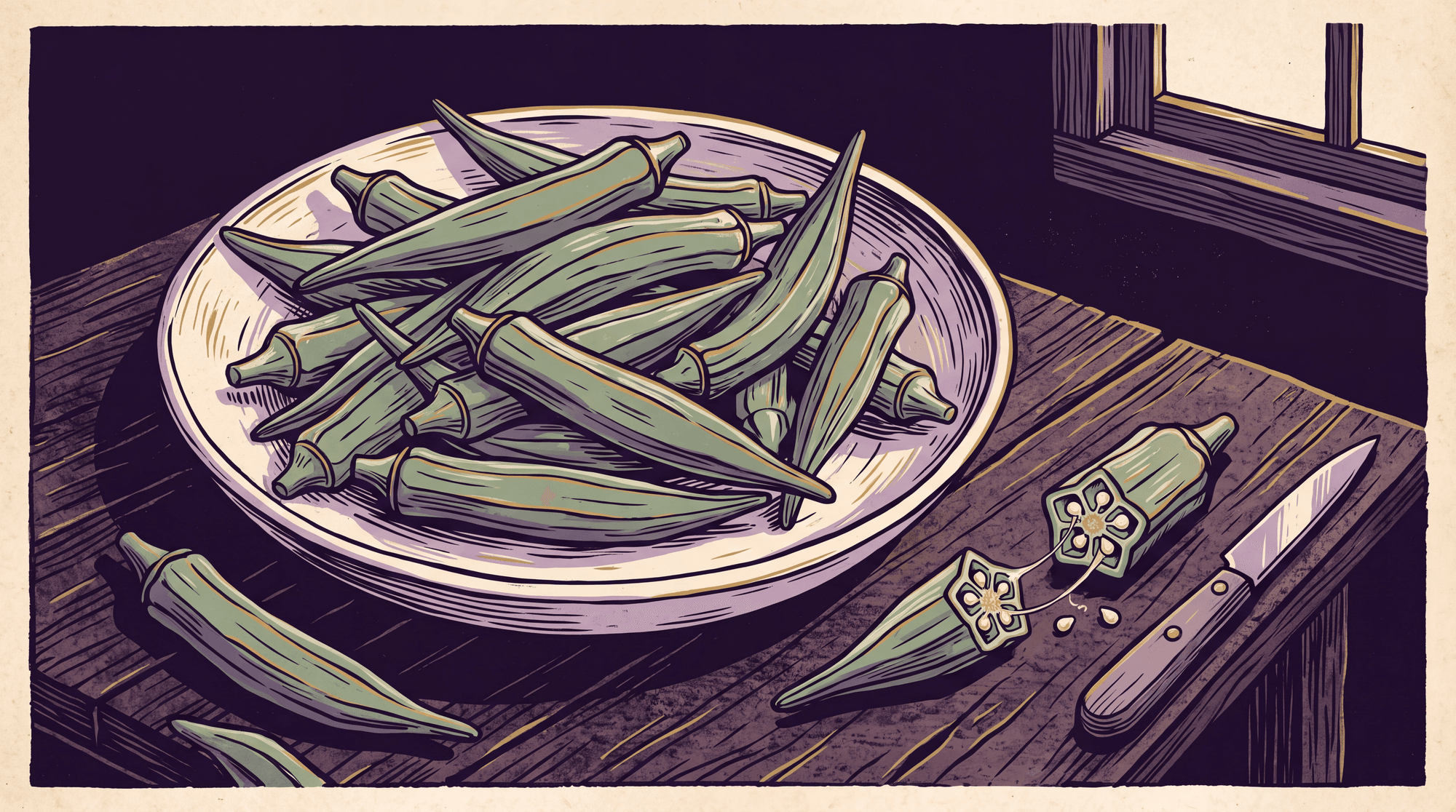
At the store my eyes found the lovely green pods… and it was my childhood flashing back. Well of course I knew what it looked like. Of course, I had seen it a million times on the counters at my grandmother’s house. In her hands, as she sliced into the pot. How had I forgotten? I decided to start with making Okra with tomatoes, sautéed in garlic with a pinch of salt and pepper. Cooking it was by instinct. Cooking it was the whispers of my Nana in my ears. Because what is instinct, but the whispers of ancestors and genetic memories slipping through time. On that first taste, I could feel the goopiness slipping down into my system, adding moisture to what had been dry, garlic helping to aid its way to my lungs and clearing the smoke.
Eating it was one thing, but now, I was looking for the medicine. I took my old marshmallow infusion recipe, but this time I used the Okra. The water it produced was thick thick. I drank a glass for my insides, then warmed the rest and poured it over my head. The shower both physical and spiritual allowed me to reunite completely with the beloved plant. And I vowed at that moment to eat as much as possible. Okra is meant to work that way, after all. If you tend it, harvesting daily, it gives daily… a relationship of co-care, of co-love. And so, I began to study in earnest, learning that okra could help with my gallbladder issues and support my liver health by lubricating my digestive system. Helped with my dry hair and scalp. It could be helpful for those with diabetes or at risk for cardiovascular diseases. Different ways of preparing changed the composition. Cooking helped reduce potassium which is good for those with a potassium-restricted diet, but calcium was not impacted. Mostly, I was learning in the wisdom of my ancestors and that food is never just food.
So finally, having mastered the Okra and tomatoes. It was time for the Callaloo. I searched the internet for recipes, finding a treasure trove of variations on the Caribbean Pot. And so I picked and chose my ingredients, spinach, squash, garlic, onions, green sauce, coconut milk, okra. It took me 3 hours to make, that first time. Tasting it was like returning to the self I had forgotten… a call to my childhood and a prayer to my grandmother.
— The Sage