Angelica
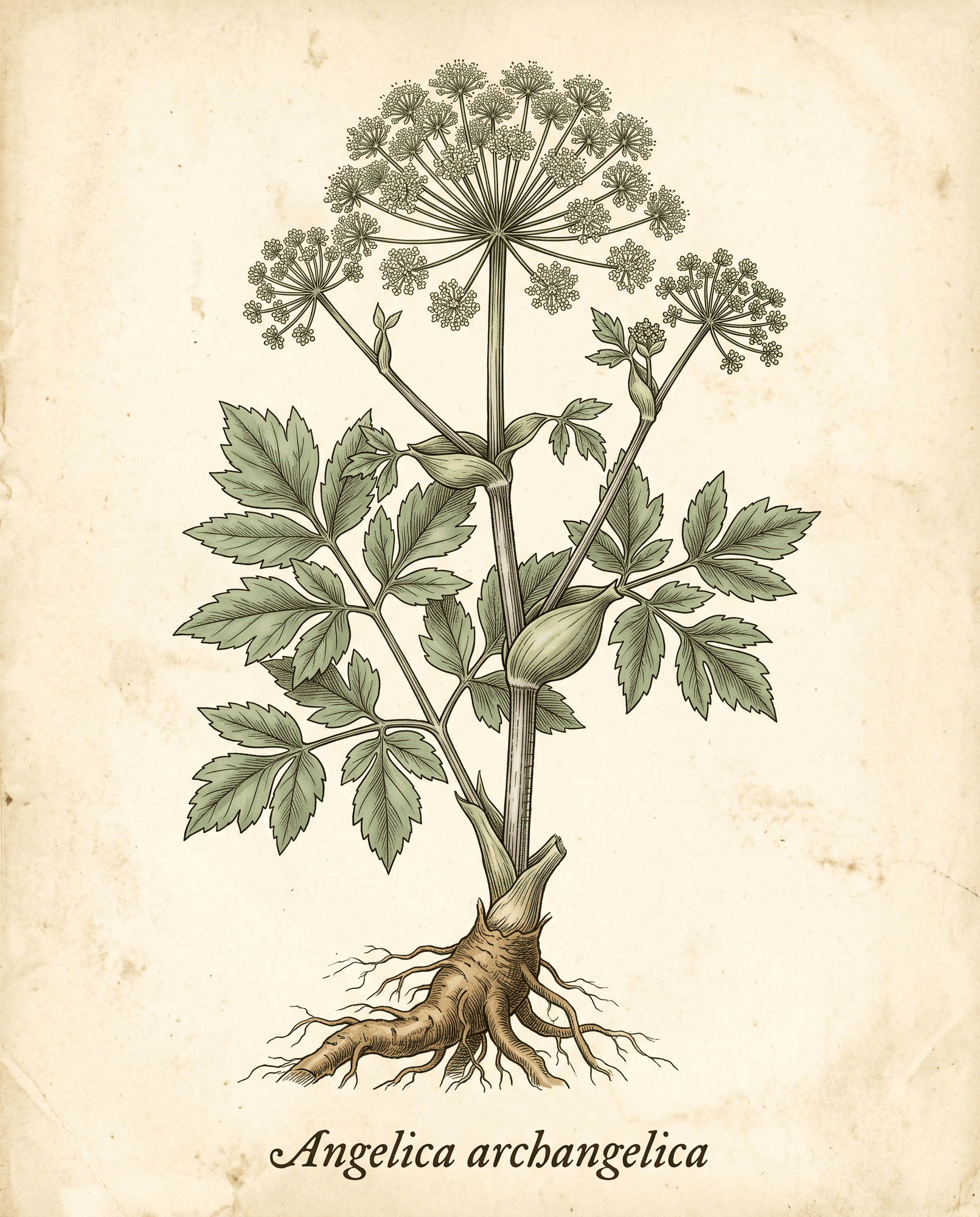
Angelica is the grandmother root — old, warm, aromatic, standing at the threshold with her hand on the door. She is one of the great protective medicines of the northern hemisphere, cultivated in monastery gardens and Sami sacred grounds and Hoodoo workers’ cupboards for the same reason across every one of those traditions: she keeps what should not enter from entering, and she opens the way for what has been asked to come through. Her taproot goes deep into cold, damp northern soil and pulls up something that tastes of sun and pepper and old smoke. She is warming where the body has gone cold, moving where things have stalled, and steady where fear has taken hold.
She has been called Holy Ghost Root and Root of the Archangel because Europeans could not otherwise account for a medicine so plainly divine — a plant that stopped plague, warmed the belly, opened the lungs, called back the appetite, and set the digestive fire alight again in bodies that had forgotten how to eat. But the tradition that named her is not the only tradition that knows her. Her cousin Angelica sinensis has been the premier blood tonic of Chinese medicine for two thousand years, called dang gui — the return, the coming home. Her American cousin Angelica atropurpurea has been carried in the ceremonial and healing work of Iroquois, Cherokee, Mvskoke Creek, and Ojibwe communities long before any European named her archangelica. Wherever cold and damp meet a body that has held too much for too long, some Angelica has been there.
The shape of her medicine
Angelica moves upward, outward, and into circulation. Angelica lifts what has gone cold and stagnant into motion — pushing warmth from the digestive core out into the peripheral tissues, from the belly into the chest and the limbs, from the settled marrow up into the breath. Her heat is not the sharp fire of cayenne or the acute pungency of ginger, though she shares kin with both. Her heat is deeper and slower — the warmth of an old stove that has been keeping the kitchen warm for a hundred years. She is a warming, drying, aromatic bitter, and she works on every system that has grown cold, damp, or sluggish.
She is bitter and pungent at once, and this is where her particular genius lives. Most bitters cool and drain; most warming aromatics stimulate but do not clear. Angelica does both simultaneously — she opens the digestive channel with bitterness while she warms it with volatile oil. The tongue registers the bitter first, and by the time the swallow is complete the belly has begun to heat. This is why she has been in bitters, tonics, cordials, and aqua vitae traditions from every latitude that could grow her.
As a warming digestive bitter, she wakes the entire upper digestive tract. The bitter compounds trigger salivation, stomach acid, bile flow, and pancreatic secretion, while the volatile oils relax the smooth muscle of the gut and disperse trapped gas. She is the medicine for the sluggish, cold, damp digestion — the belly that has forgotten how to warm food, the chronic bloating that follows meals, the pale coated tongue, the loss of appetite in cold weather or after long illness. She restores the fire under the pot when it has gone out.
Her carminative action is direct and quick. The volatile oils relax the intestinal wall, allow gas to move rather than distend, and settle the cramping ache that comes with cold stagnation in the gut. She is particularly useful where digestive spasm and gas travel together — a rounded, hard, uncomfortable belly that will not release.
As an antispasmodic, she softens smooth-muscle tension across the digestive tract, the uterus, the bronchi, and to a lesser degree the blood vessels. This is why she has been reached for in menstrual cramps, in bronchial spasm, in colicky digestive complaints, and in the peripheral coldness that comes when circulation has clamped down.
Her diaphoretic action opens the pores and moves fluids outward through the surface. In the traditional treatment of cold-stage fevers — the shivering, chilled, aching kind that will not break — she was given as a hot infusion or a warmed tincture to bring the sweat that carries the illness out. She works well in this register with elderflower, yarrow, and ginger, but she brings her own particular warmth: the warmth that reaches into cold, marrow-deep places the other three do not quite touch.
As an expectorant, she moves cold, wet, stuck congestion out of the lungs. She is not for hot, dry, tight coughs — those are for demulcents and cooling herbs. She is for the cold, damp cough with thick mucus that has been sitting in the chest, for the bronchial complaints that follow long cold weather, and for the wet asthma pattern that worsens with damp. Her aromatic oils thin secretions and open the breath.
Her emmenagogue action is one of the reasons she must be respected. She stimulates uterine circulation and can promote delayed or scanty menstruation, especially where the pattern is cold and stagnant. This same action is what makes her contraindicated in pregnancy. Her cousin Angelica sinensis is the deeper blood-mover of the two, but archangelica touches the same territory.
Her circulatory stimulant thread runs through her whole medicine. She warms the extremities, addresses cold hands and feet, and supports peripheral circulation in bodies that run cold. This is grandmother medicine — the herb for the person who has been chilled for so long they have forgotten what warm bones feel like.
Her nervine action is gentle and often overlooked. The aromatic oils have a mildly relaxant effect on the nervous system, and traditional European use includes her in formulas for anxiety accompanied by digestive complaint — the nervous stomach, the appetite lost to worry, the belly that clenches when the world grows unsafe. She calms without dulling.
Her antimicrobial and anti-inflammatory actions run through the whole plant, most concentrated in the essential oil and the furanocoumarins. This is the pharmacological backbone of her plague reputation — she genuinely does clear certain microbial loads, especially in the respiratory and digestive tracts, and she reduces inflammatory reactivity in tissues that have grown chronically hot from long stagnation.
Together, her actions form a single gesture: warming what has gone cold and moving what has gone still. She is for the body that has been asked to hold too much cold for too long, and for the spirit that has forgotten how to open the door.
What lives inside her
Whose medicine she carries
Earth (deep taproot, ancestral ground)
Mars
Aries
The Sun
The Hermit
Nana Burukú
Nana Burukú is the oldest of the Orisha. She is the ancient grandmother, the crone who was there before the others were named, the one who holds the mud where the river meets the earth, the still swamp where the water does not move because it has already arrived. She rules the transitions between life and death, the wisdom that comes only through long time, the medicine that requires patience and knowing rather than heat and hurry. Angelica belongs to her house.
Angelica is the plant for the medicine Nana Burukú carries. She is the root that has stood through plague and famine and long winter, the plant Europeans carried in their pockets against death itself, the medicine that the Sami people held sacred long before Christianity gave her a Latin name. She has the grandmother’s authority — the calm knowing that comes from having been present for many endings. When you work with Angelica, you are working with a plant that does not panic. She has seen this before. She knows what to do.
Nana Burukú’s medicine is also the medicine of the ancestral opening. She rules the line between the living and the dead — the ancestors who have crossed over, the grandmothers whose names may or may not be remembered but whose blood is still moving through your body. Angelica sits at that same doorway. She is a plant of thresholds. She protects the doorway between worlds while allowing the right kind of communication to pass through. When elders and grandmothers are called for, when the shape of the ancestral question is what needs answering, Angelica is often the plant that shows up in the tea, the bath, the smoke, the pocket.
Her warmth is the grandmother’s warmth. She is not the acute heat of a young fire — she is the deep, low, sustaining heat of the hearth that has been kept for generations. This is why she is the herb for the body that has been chilled for a long time, and for the spirit that has been asked to hold too much grief without a place to warm itself.
Elegua
Elegua is the guardian of the crossroads and the opener of the doorway. Nothing enters or leaves without his knowing. In the diasporic Yoruba tradition, no work begins without his acknowledgment — the doorway must be honored before the room can be entered. Angelica belongs to his medicine too, because she is a plant of thresholds.
Her most consistent traditional use across every culture that has known her is protection at the doorway — hung over the entryway, carried across the threshold, buried at the corners of the property, worn around the neck as a charm. In European folk practice, in Hoodoo, in Sami tradition, in medieval Christian custom, and in modern conjure work, Angelica root is the guard at the door. What she does not permit does not enter. Elegua sanctions this work. She is one of his plants of standing watch.
She also carries his medicine of opening the way. When a path has been closed too long, when the road has been blocked by grief or illness or ancestral inheritance, Angelica can be part of the work of unsticking. She opens the digestive channel; she opens the breath; she opens the menstrual flow; she opens the peripheral circulation. On the spiritual plane, she opens the crossings the person has been unable to cross. Elegua rules this opening.
The hands she has passed through
Angelica’s story is older than her Latin name, and older than most of the traditions that have named her. Across the far north — Scandinavia, the Sami lands, Iceland, Greenland — she was cultivated and gathered as sacred food and medicine long before written record. The Sami people held her as one of their most important plants: eaten as vegetable, chewed as medicine, used ceremonially, and traded south across Europe as early as the twelfth century. In Iceland she is documented in the medical laws as early as the tenth century. She grew where little else would grow, in cold damp meadows and sub-Arctic river valleys, and she fed and healed the people who lived there.
Her Latin name — Angelica archangelica — was given in the medieval Christian period. Legend held that an angel appeared to a monk during a great plague and revealed that the root of this particular umbellifer would protect the faithful. Different versions of the story name different angels — sometimes Michael, sometimes Raphael, sometimes an unnamed archangel — but the pattern is consistent: divine intervention through the plant. She was cultivated in monastery gardens, prescribed in monastic infirmaries, and became a foundation herb in the aqua vitae tradition — the “waters of life” that would later become gin, chartreuse, benedictine, and the whole family of European bitters and liqueurs.
During the Great Plague of London in 1665, angelica root was chewed, carried in pockets, hung over doorways, and burned in sickrooms across the city. Modern research suggests she genuinely did carry some antimicrobial protection against the secondary infections that accompanied the plague, but her presence in every household during that time was as much spiritual as it was pharmacological. She was the plant that stood between the family and death.
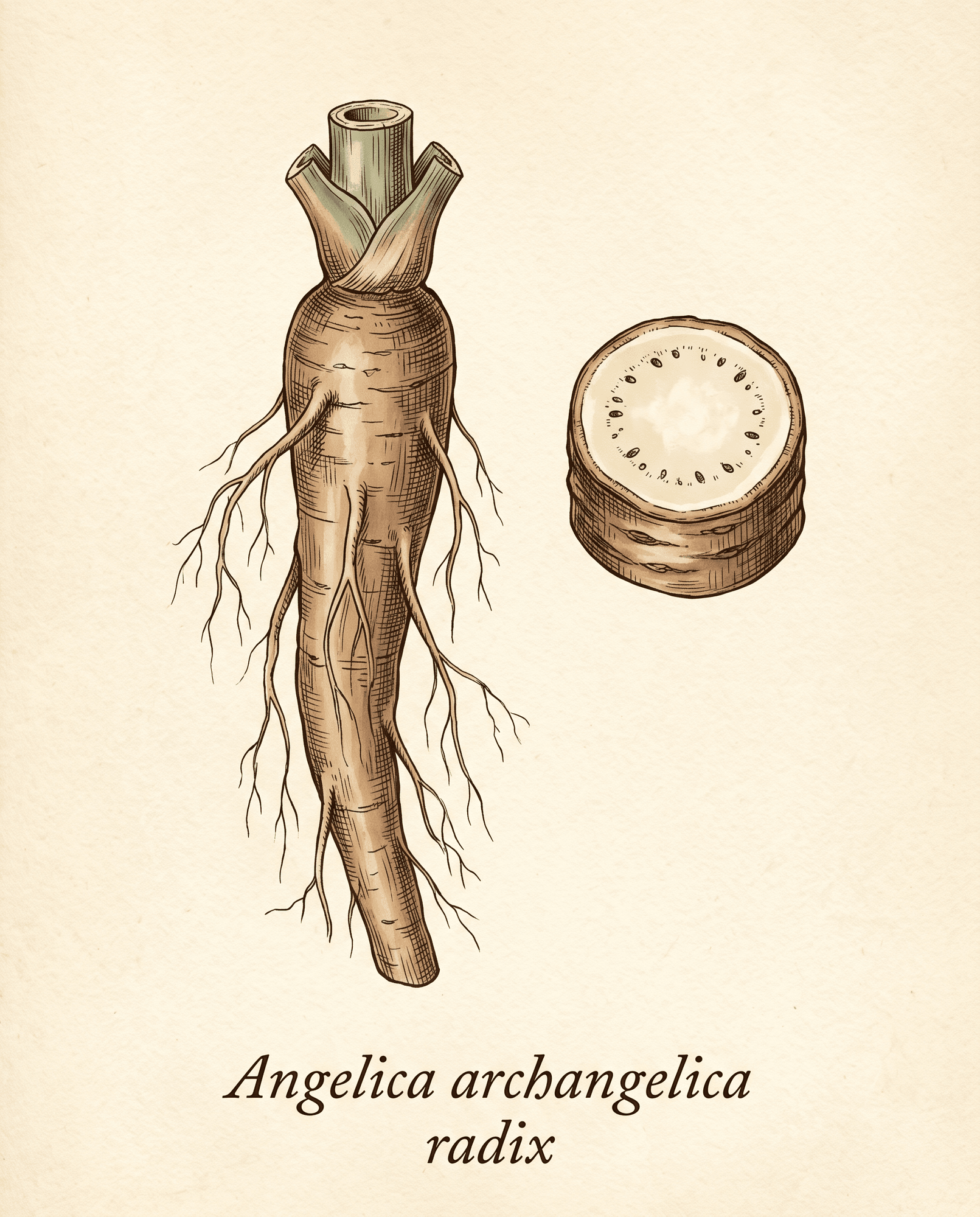
In African American Hoodoo and conjure tradition, Angelica root — often called Archangel Root or Holy Ghost Root — entered the Black diasporic materia medica through the meeting of West African plant knowledge, European colonial plants, and Indigenous American practice. Practitioners have used her for uncrossing, reversal of harm, protection against curses and evil work, spiritual cleansing, and the opening of ancestral channels. She is a foundational plant in the protection cabinet — string a whole root on a red cord and wear it against the skin, carry a piece in a mojo bag, boil the root and use the water to wash the doorway. Her authority in this tradition is unquestioned. She protects mothers, children, and the elderly especially, and she is a plant frequently associated with the grandmother line — the ancestresses who have gone before and who are still watching.
In Traditional Chinese Medicine, her cousin Angelica sinensis has been used for at least two thousand years and is called dang gui — literally “state of return” or “coming home.” She is the premier blood tonic and blood-mover, especially for women. Different parts of the same root do different work: the head of the root (dang gui tou) tonifies blood most strongly; the body of the root (dang gui shen) both tonifies and moves; the tails (dang gui wei) move blood most strongly. She is used for scanty or delayed menstruation, for post-partum recovery, for anemia and blood-deficient patterns, and for the deep chronic fatigue that comes when the body’s blood-store has been depleted. She is the herb that returns what has been lost.
Among many Indigenous nations of eastern North America — Iroquois, Cherokee, Mvskoke Creek, Ojibwe, and others — Angelica atropurpurea, the purple-stemmed native cousin, is used both medicinally and ceremonially. The Iroquois used her as a steam bath for headaches and frostbite, and for a range of respiratory, digestive, and rheumatic complaints. Many nations used the aromatic root for purification and in ceremonial contexts, and among Mvskoke Creek communities she carries both medicinal and ceremonial standing. She is sometimes called masterwort in North American folk usage.
In medieval and early modern European folk medicine, angelica appears in almost every herbal from Culpeper to Gerard to Parkinson, prescribed for plague, colic, wind, cough, cold extremities, absent menses, and the sluggish, cold digestion that came with long northern winters. The candied stems became a confection — one of the earliest culinary uses — still made in France and used in decoration and pastry. She entered the bitters and cordials tradition as a foundational aromatic and remains today in Chartreuse, Bénédictine, Aquavit, gin, and countless European bitters formulations.
The Eclectic physicians of the late nineteenth-century United States used her extensively as a warming aromatic bitter, as a diaphoretic in cold-stage fevers, as a menstrual regulator, and as a general tonic for depleted convalescents. She sits today in the toolkit of the modern clinical Western herbalist as one of the definitive warming digestive bitters, most often combined with fennel, orange peel, ginger, gentian, and cardamom in bitters formulations for cold, deficient, or sluggish digestive patterns.
She has been called the herb of angels, the grandmother’s root, the plague guard, the belly warmer, the women’s medicine, and the plant that stands at the door. She has been all of them. She still is.
Where she works in the body
Digestive system. This is Angelica’s clinical center of gravity. She is a warming aromatic bitter — the archetype of the medicine for cold, deficient, damp, sluggish digestion. Her bitterness activates the entire upper digestive tract from saliva through gastric acid through bile through pancreatic secretion, while her volatile oils simultaneously relax the smooth muscle, disperse trapped gas, and quiet the cramping ache of cold digestive spasm. She is the herb for the pale coated tongue, the lost appetite, the bloated belly, the chronic gas, the sluggish bowel that has forgotten how to move. She works particularly well where cold has taken up residence in the gut — the person who cannot eat cold food without discomfort, whose digestion has been getting weaker across the years, who wakes in the morning with a heavy, cold belly.
Respiratory system. Angelica warms and opens the lungs. She is not the herb for hot, dry, tight coughs — those need cooling and moistening allies. She is the herb for the cold, wet, stuck chest: bronchial congestion with thick mucus, chronic winter cough, wet asthma that worsens in damp weather, and the lingering respiratory fatigue that follows influenza or long cold-weather illness. Her aromatic oils thin secretions and support expectoration; her warming quality reaches into the cold marrow of the chest where the body has been holding damp too long.
Reproductive system. Angelica has been used for centuries as a warming reproductive tonic, particularly for cold, stagnant, deficient menstrual patterns — delayed or scanty menses, dark clotted blood, cramping that responds to warmth and hot compresses, and the amenorrhea that comes with chronic cold and depletion. Her cousin Angelica sinensis takes this work considerably deeper as the premier Chinese blood tonic for women’s medicine. In archangelica, this action is present but gentler and should be used with respect for her emmenagogue and uterine-stimulant nature. She is not for use in pregnancy.
Circulatory system. Angelica moves warmth from the digestive core out into the peripheral tissues. She addresses cold hands and feet, chilblains, the slow peripheral circulation of aging or chronic depletion, and the aching, cold-driven joint discomfort that worsens in damp weather. She works especially well in formula with prickly ash, ginger, and cinnamon for cold, stuck peripheral circulation. She also has a gentle blood-thinning action, which is both a therapeutic consideration and a caution for people on anticoagulant medications.
Nervous system. The aromatic volatile oils give her a mild but real nervine action. She is traditionally included in formulas for anxiety that lodges in the belly — the nervous stomach, the appetite that disappears in stress, the chest that tightens when the world grows unsafe. She calms without dulling, and she is often combined with lemon balm, chamomile, or lavender for this work.
Immune system. Her antimicrobial essential oils and immune-modulating polysaccharides give her a real if modest immune role. Traditionally she was reached for at the first sign of cold-stage influenza and respiratory infection, and modern research supports her antimicrobial activity against several respiratory and gastrointestinal pathogens. She is a good herb for the depleted, chilled person entering into or recovering from viral illness — she both supports the immune response and warms the underlying constitution that has grown too cold for the body to defend itself well.
Musculoskeletal system. Her warming, circulating, mildly antispasmodic quality makes her useful for cold, aching muscle and joint patterns — the arthritic complaints that flare in damp cold weather, the low-grade myalgia that follows long chronic depletion, and the stiff, cold peripheral tissue that will not relax. She works well externally as a warming infused oil or liniment for these conditions.
How to take her
Harvest calendar
Preparations
Root decoction: 1–2 teaspoons of dried, chopped root per cup of water. Simmer covered 15–20 minutes. Drink 1 cup up to 2–3 times daily as a warming digestive tonic. Best before meals for digestive action, after meals for wind and bloating.
Seed infusion: 1 teaspoon crushed seed per cup of just-boiled water. Steep covered 10 minutes. Aromatic, warming, particularly good for gas, colic, and the cold digestive complaint that comes with dietary change or stress.
Tincture, root: 1:5 dry in 40–60% alcohol, or fresh 1:2 in 60–70% alcohol. Typical dose 1–3 mL up to 3 times daily. Excellent in bitters formulations and digestive tonic blends.
Bitters formula: Combine angelica root with gentian, orange peel, fennel, cardamom, and ginger in high-proof alcohol; macerate 4–6 weeks; strain and take 5–10 drops on the tongue or in a small amount of warm water 15 minutes before meals to wake sluggish or cold digestion.
Warming winter tea blend: Angelica root, ginger, fennel, orange peel, cinnamon bark. Simmer together for a warming, digestive, circulatory tea for cold weather and cold constitution.
Candied stem: Peel and boil the young second-year stems in sugar syrup until translucent. Traditional French confection; culinary use only, but a beautiful teaching of how a bitter medicinal plant becomes food when the right processing is applied.
Topical, infused oil: Root or seed slow-infused in olive or almond oil for 4–6 weeks, used in warming liniments and salves for cold aching joints, chilled hands and feet, and chronic cold-damp muscle discomfort. Do not apply before sun exposure — furanocoumarins are photosensitizing.
Steam bath: Fresh or dried aerial parts steeped in a large pot of just-boiled water; the person sits with a towel over the head and the pot to receive the steam. Traditional Iroquois preparation for headaches, frostbite, and cold-damp respiratory complaints — a preparation still worth knowing.
Spiritual & ritual:
- Whole roots strung on red cord and worn around the neck as a protection charm, in the pattern shared by European folk practice and African American Hoodoo
- Roots hung above doorways, buried at the four corners of the home, or carried across thresholds to protect the household from unwanted spiritual entry
- Root water used as a floor wash and doorway wash for uncrossing and reversal of harm
- Dried root burned as incense or in a spirit-clearing fire for cleansing a home after illness, grief, or unsettled presence
- Root placed on altars dedicated to Nana Burukú, the grandmothers, or the ancestral line for opening communication with the eldest ancestresses
- A single piece of root carried in the pocket during travel, hospital visits, court appearances, or any threshold-crossing where protection is asked for
When to hold back
Use with caution if:
- You are pregnant. Angelica is a uterine stimulant and emmenagogue. Traditional and modern sources agree: not during pregnancy at any dose.
- You are breastfeeding. Not enough safety data. Better to wait or use only under professional guidance.
- You are taking anticoagulants (warfarin, heparin), antiplatelet drugs (clopidogrel, aspirin), or NSAIDs (ibuprofen, naproxen). Angelica’s coumarins and phenolics have mild platelet-modulating and blood-thinning activity, and the effects can be additive.
- You have a bleeding disorder or are approaching surgery. Discontinue at least two weeks before scheduled surgery.
- You are taking diabetes medications. Some evidence of hypoglycemic effect; monitor and work with a professional.
- You have known allergy to the Apiaceae family (carrot, celery, parsley, dill, coriander, fennel). Cross-reactivity is possible.
Topical considerations: The furanocoumarins in angelica are strongly photosensitizing. Do not apply topically before sun exposure. Do not use angelica oil or infused oil on skin that will be exposed to UV light — the result is phytophotodermatitis, a chemical burn triggered by sunlight on skin coated with furanocoumarins. Use at night, wash off before sun exposure, or apply only to skin that will remain covered.
General notes: Angelica is best used as a defined therapeutic course rather than as an indefinite daily tonic — a few weeks to a few months at a time, then a pause. Her strong warming, drying, and moving nature is meant for cold, damp, stagnant, deficient conditions and can be aggravating in hot, dry, or overly active constitutions used long-term. In Ayurvedic terms, she should not be used long-term in a strong Pitta constitution without balancing companions.
A word on wild-harvesting: Angelica archangelica has several relatives in the Apiaceae family that are lethally toxic — most notably poison hemlock (Conium maculatum) and water hemlock (Cicuta maculata), both of which can be mistaken for angelica by inexperienced harvesters. Do not wild-harvest angelica unless you are certain of your identification. Cultivated angelica or purchased dried root from a reputable source is the safer path for most practitioners.
Who walks with her
For warming, deficient, cold digestion: Fennel, ginger, cardamom, orange peel, gentian, calamus, cinnamon bark.
For cold-damp respiratory patterns: Elecampane, thyme, hyssop, mullein, licorice, garlic.
For cold, stuck, deficient menstrual patterns: Dong Quai (her own cousin), ginger, cinnamon, mugwort, red raspberry leaf, black cohosh.
For cold peripheral circulation: Prickly ash bark, ginger, cinnamon, cayenne (in small amounts), rosemary.
For nervous stomach and anxiety-with-digestive-complaint: Lemon balm, chamomile, lavender, holy basil, catnip.
For protection and boundary work: Rue, mugwort, rosemary, cedar, tobacco, salt.
In classical bitters formulations: Gentian, orange peel, cardamom, fennel, wormwood, calamus, dandelion root.
Angelica shines in the community of the warming carminative aromatics — the fennel, ginger, cardamom family — because she brings the deeper bitterness and the deeper warming range those milder aromatics do not quite reach. She partners her cousin Dong Quai beautifully in women’s blood work when both cold and depletion are in the pattern: archangelica opens the digestive absorption and warms the peripheral tissues while sinensis rebuilds the blood itself. With gentian she becomes a true clinical bitter — gentian brings the depth of bitterness, angelica brings the warmth that prevents gentian from over-cooling the belly. And in the protection cabinet, she stands with rue, mugwort, rosemary, and tobacco as one of the grandmothers who does not tolerate what she has not invited across the doorway.
How to know her
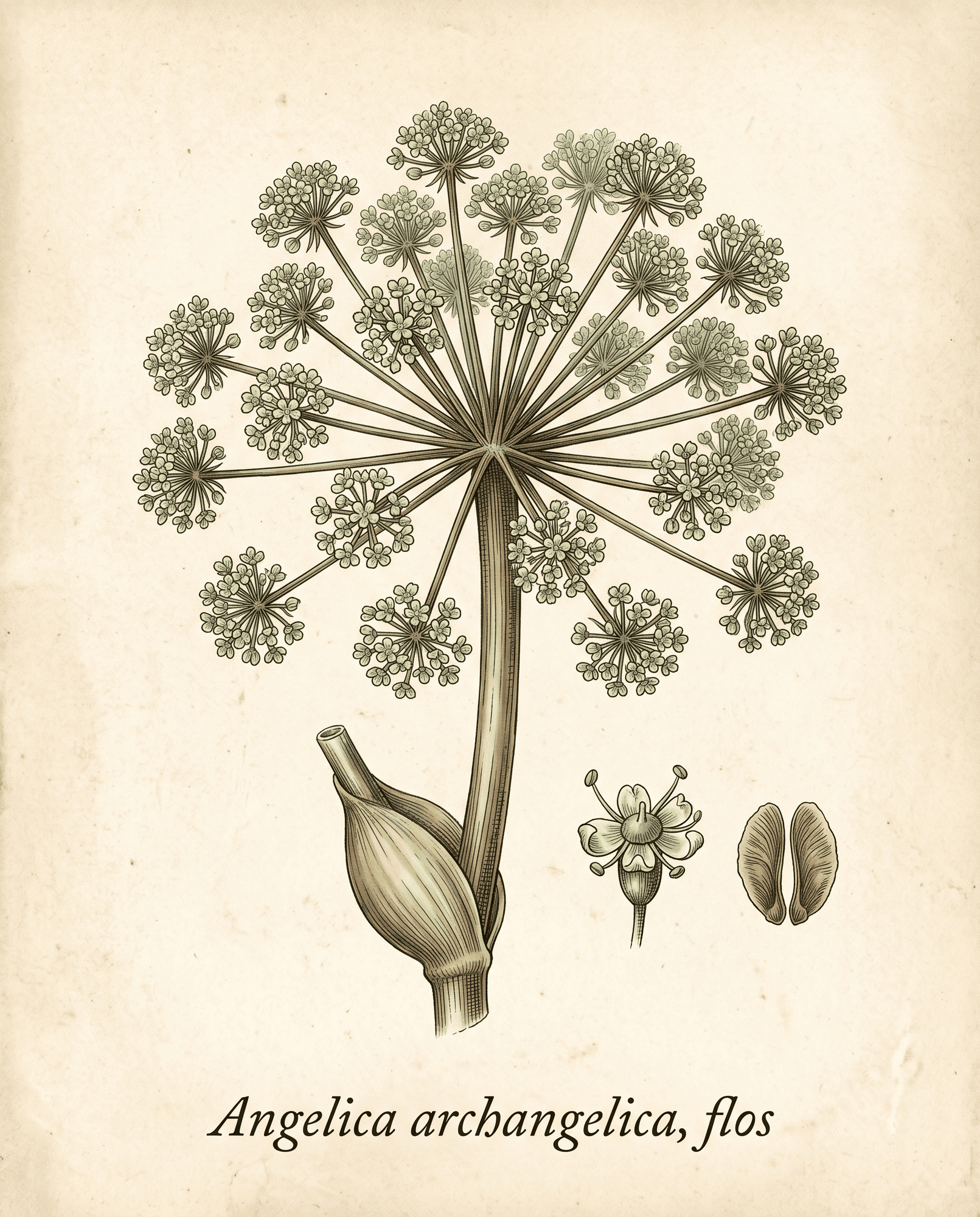
Plant walk: Find a cultivated angelica plant — a monastery garden, an herbalist’s garden, a botanic garden with a medicinal collection. She is not commonly wild in most of the United States and safe identification is not something to guess at. Sit with her. Notice the great hollow stem, the deeply divided leaves, the umbel of tiny greenish flowers that draws every bee within a hundred feet. She is a large, imposing plant — she does not hide. Ask what it means to be a plant that stands visibly at the doorway.
Winter fire ritual: In the cold season, make a strong decoction of angelica root, ginger, and cinnamon. Drink it warm at the beginning of a period of deep rest. As the warmth reaches the marrow of the belly, notice where the body has been running cold. Ask what has been asking for warmth that has not yet been given.
Doorway protection ritual: At the change of a season, or after an illness, grief, or unsettled time in the home, make a strong decoction of angelica root. Cool it and use it to wash the front and back doorways of the home — the threshold itself and the ground just outside the door. As you wash, name what is not permitted to cross the threshold, and name what is welcome. Leave the wash water at the base of a tree.
Ancestral opening ritual: On a night when the veil between the worlds feels thin — a new moon, the eve of a saint’s day, the anniversary of an ancestor’s crossing, or the deep quiet of winter — brew a cup of angelica root tea. Sit at the altar of the ancestresses, or at any quiet place where the grandmothers can be spoken to. Sip the tea slowly. Do not ask for anything specific at first. Listen. Notice which grandmother — named or unnamed, biological or chosen — comes forward.
Journal prompts
- Where in my body has the fire gone out, and what does it need in order to burn again?
- What doorway in my life is asking for a guardian, and what does the guardian look like?
- Which of my grandmothers am I being asked to sit with now — biological, chosen, ancestral, or otherwise?
- What have I been holding without warmth, and what would it mean to let that be warmed?
- Where have I let something cross the threshold that should not have been allowed to enter?
Tarot Spread
A spread for entering into relationship with Angelica as a plant ally:
- What has grown cold in me that Angelica has come to warm?
- Which doorway is she standing at in my life right now?
- What is she protecting me from that I have not fully acknowledged?
- Which ancestress is she making it possible for me to speak to?
- What am I being asked to let cross the threshold, and what am I being asked to turn away?
Keep a piece of dried angelica root on the altar with the cards. Sit long enough for the answers to settle. Do not rush the grandmother’s reply.
The same plant, multiple lenses
Angelica’s warming, bitter-pungent-sweet, drying, aromatic nature places her squarely in the camp of herbs that reduce cold and damp — particularly excess Vata with cold-deficient-digestive presentation, and excess Kapha with cold-damp stagnation. She is one of the classical warming digestive bitters, and her rasa (bitter and pungent), virya (warm), and vipaka (pungent) all point toward her role as a stimulator of the digestive fire in constitutions where that fire has grown weak.
Pitta Dosha — Fire & Water
Pitta is where Angelica needs the most care. Her warm virya and pungent vipaka can aggravate an already-hot constitution — the person prone to inflammation, hot rash, hyperacidity, irritability, or hot anger should not use her long-term in isolation. Where a Pitta type genuinely needs her digestive action, pair her with cooling and buffering allies such as fennel, coriander, licorice, or shatavari, and use short-course rather than daily-tonic dosing. Angelica is not the primary bitter of choice for Pitta — those are the cooling bitters like dandelion, gentian in small doses, and yellow dock.
Kapha Dosha — Earth & Water
This is where Angelica does some of her clearest work. Kapha imbalance shows up as cold-damp stagnation, heaviness, sluggish digestion, chronic mucus, slow circulation, damp cough, water retention, and depression that feels like fog — exactly the terrain her warming, drying, moving action is meant for. Her bitter-pungent taste directly reduces Kapha (bitter and pungent are two of the three tastes that most strongly decrease this dosha), and her circulating action helps disperse the settled dampness that Kapha holds in tissues and lungs. She is an appropriate strong ally for Kapha-dominant patterns.
Vata Dosha — Air & Ether
Vata is complicated with Angelica, and this is worth thinking through carefully. Vata’s fundamental qualities are cold, dry, light, mobile, and rough — and Angelica is warm, dry, light, moving, and aromatic. Her warmth and her aromatic-relaxing nature address Vata’s coldness, her nervous digestive complaints, her gas and bloating, and her tendency toward peripheral circulatory clamping. But her drying quality can aggravate Vata’s inherent dryness if used long-term without moistening buffers. The classical Ayurvedic solution is to pair her with ghee, sesame oil, licorice, marshmallow, or shatavari when a Vata constitution needs her particular warming action across time. Short-course use for cold Vata digestion is well-tolerated; long-term daily use in Vata requires moistening companions.
In Traditional Chinese Medicine, the primary species of note is Angelica sinensis — Dang Gui — the premier blood tonic and blood-mover of Chinese herbalism. Angelica archangelica is not a TCM herb in the classical sense, but her energetic profile can be read through TCM lens for cross-tradition understanding, and her cousin Dang Gui is essential to the fuller Angelica story.
Taste & Temperature: Sweet, acrid, slightly bitter; warm. (Dang Gui — A. sinensis.) A. archangelica runs similarly warm and acrid but is more pungent and less deeply sweet-tonifying.
Channels Entered: Heart, Liver, Spleen. (Dang Gui.) A. archangelica touches Spleen and Lung most directly in TCM-informed Western practice, with a supporting role in Liver.
Functions: Tonifies blood, invigorates and moves blood, regulates menstruation, relieves pain from blood stagnation, moistens the intestines. (Dang Gui.) A. archangelica’s functions read more as: warms the middle jiao, tonifies Spleen yang and Kidney yang mildly, resolves dampness in the middle and upper jiao, and moves stuck qi in the digestive and reproductive channels.
Tonifying Blood
This is Dang Gui’s central territory in TCM, and it is worth naming here because it is one of the deepest medicines the Angelica family carries into cross-tradition practice. Blood deficiency in TCM shows up as pale complexion, pale tongue, dizziness, dry skin, brittle hair and nails, scanty or delayed menstruation, blurred vision, insomnia with worry, and chronic fatigue. Dang Gui is one of the most-used herbs in Chinese medicine for this pattern, especially in women — she nourishes what has been depleted and gently restores blood volume, quality, and movement. She is central to classical formulas like Si Wu Tang (Four Substances Decoction) and Dang Gui Bu Xue Tang (Dang Gui Blood-Building Decoction). A. archangelica touches this territory only lightly by comparison — she is more of a digestive-warming herb whose blood action is indirect, working through her tonification of the Spleen (which produces blood in TCM understanding) rather than through direct blood tonification.
Moving Blood
Dang Gui is unusual among blood tonics in that she both builds blood and moves it — most tonics build without moving, and most movers do not build. This dual action is why she is central to the treatment of blood stasis with underlying deficiency: dysmenorrhea with dark clotted blood, post-partum abdominal pain, blood stagnation from injury, and chronic pain patterns rooted in poor blood flow. A. archangelica also has a mild moving quality — through her essential oils and her general circulatory-stimulant action — and can be understood as a peripheral blood-mover, warming and opening the small vessels of the extremities.
Warming the Middle Jiao and Resolving Damp
This is where A. archangelica’s TCM-informed reading is clearest. The middle jiao is the digestive center — Spleen and Stomach in TCM anatomy. When Spleen yang is deficient and cold-damp accumulates, the pattern is: cold hands and feet, cold belly, pale coated tongue, loose stools, chronic bloating, poor appetite, and heaviness. This is Angelica’s clinical territory. She warms Spleen yang, dispels cold from the middle, resolves the damp that Spleen deficiency creates, and moves the qi that has grown stuck in the digestive channel. In this register she partners well with dry ginger (gan jiang), atractylodes (bai zhu), and cardamom family members.
Yin/Yang Balance
Angelica — in all her species — is Yang in nature, a warming and moving medicine. She belongs to the toolkit for cold, deficient, stagnant patterns and is contraindicated in hot, excess, hyperactive patterns without significant cooling companions. Dang Gui is the deeper blood-tonifier and moves closer to a Yin-nourishing Yang mover — she is one of the few blood tonics that does not become excessively warming when used long-term. A. archangelica is more clearly Yang: warming, drying, and moving. Both must be respected in hot, dry, or overly active constitutions and are not for use in acute inflammatory heat.
For going deeper
- Bensky, Dan, Clavey, Steven, & Stöger, Erich. Chinese Herbal Medicine: Materia Medica (3rd edition). Eastland Press. — the authoritative entry on Dang Gui (Angelica sinensis), her differentiation of root parts, and her role in classical formulas.
- Wood, Matthew. The Earthwise Herbal: A Complete Guide to Old World Medicinal Plants. North Atlantic Books. — on Angelica archangelica in the Western clinical herbal tradition.
- Winston, David. Adaptogens: Herbs for Strength, Stamina, and Stress Relief. Healing Arts Press. — for angelica’s role in convalescence and depleted-constitution work.
- Popham, Sajah. Evolutionary Herbalism: Science, Spirituality, and Medicine from the Heart of Nature. North Atlantic Books. — for the spagyric, alchemical, and spiritual reading of aromatic bitter roots.
- Frawley, David & Lad, Vasant. The Yoga of Herbs: An Ayurvedic Guide to Herbal Medicine. Lotus Press. — for Ayurvedic classification of Angelica.
- Moerman, Daniel E. Native American Ethnobotany. Timber Press. — for documented Indigenous use of Angelica atropurpurea and related North American species across many nations.
- Culpeper, Nicholas. The Complete Herbal (1653). Widely available in reprint. — for the seventeenth-century English herbal tradition on angelica’s plague and digestive uses.
- Dorsey, Lilith. Writings on angelica in African American Hoodoo tradition (including her “HooDoo How We Do” essays). — for the diasporic Black practice of angelica root as protection and uncrossing medicine.
- Sami and Nordic ethnobotanical sources on kvann — the northern European sacred and food use of Angelica archangelica across the Arctic and sub-Arctic. Look for the work of the Sami Center for Traditional Knowledge and regional Nordic ethnobotany archives.
- Conversations with elders in African American, African, Caribbean, and Indigenous plant traditions on protection roots and grandmother medicines. These are oral and place-based, and worth seeking out where you live — they hold knowledge that is not always written down.
The Conversation
Questions, noticings, what this is teaching you — leave them here. This same conversation lives in The Circle.