Ginger
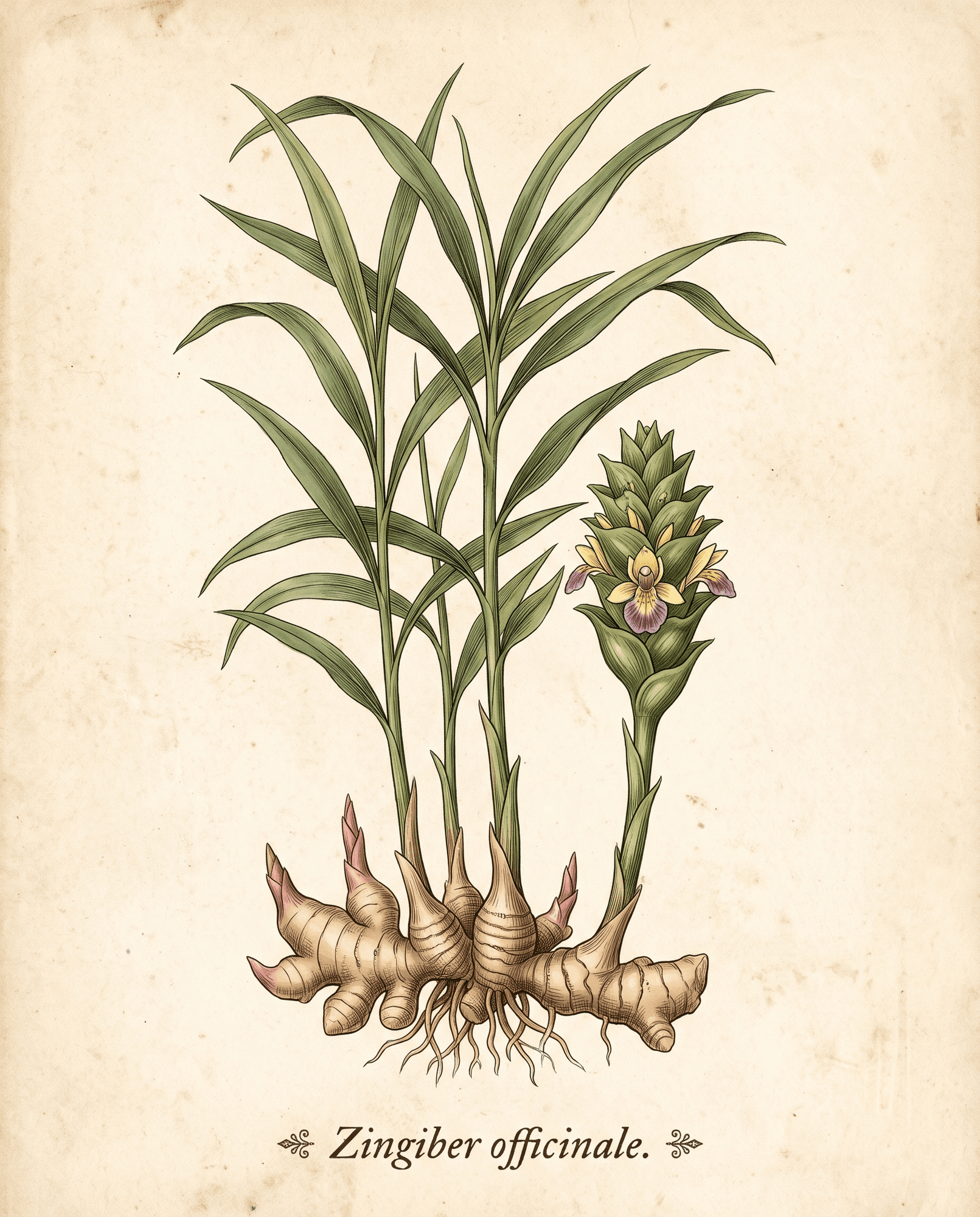
Ginger is fire that travels. She has no wild home. No one has ever found her growing on her own in any forest, and she almost never sets seed, so every ginger plant alive came from a piece of rhizome someone chose to carry. She went across the Pacific in Austronesian canoes, into South India, across the Arabian Sea, around Africa in Portuguese holds, and into Caribbean ground, and every place she landed, people took her into the kitchen and the sickroom at the same time. She is one of the most widely loved medicines on earth, and she got there because people needed her warmth enough to bring her along.
Her medicine is heat with a direction. The fresh root moves outward: she opens the pores, breaks a chill, and sends the blood to cold hands and feet. The dried root moves inward: she settles into the belly and rekindles a digestion that has gone cold and slow. She quiets nausea, eases cramps, loosens phlegm, and warms aching joints. In the doorway of a cold, in the queasy first months of a pregnancy, in the long winter when everything in the body slows down, she is the one people reach for first. She is the kitchen’s fire, kept in a root.
The shape of her medicine
Ginger is pungent, aromatic, warm, and drying, and her medicine depends on whether she is fresh or dried. Fresh ginger is warm and moves outward and upward. She opens the surface, makes you sweat, and clears the head and chest. Dried ginger is hotter and moves inward and downward, warming the center and holding the warmth there. The same rhizome does both, and an herbalist chooses between them the way a cook chooses between a quick flame and a slow coal. Her pungency comes from her gingerols, and when she dries, those turn into shogaols, which is why dried ginger tastes sharper and hotter than fresh.
She answers cold, the pale, slow, sluggish picture: cold hands and feet, a weak appetite, a belly that cramps and bloats after cold food, a cold coming on with shivering and clear mucus. She answers damp: heavy digestion, thin watery phlegm, swollen and stiff joints in wet weather. And she answers tense tissue, the gripping cramp in the gut or the womb.
As a stimulant, she warms and quickens circulation, drawing blood out to the edges of the body. You can feel it within minutes: heat rising in the chest and face, warmth arriving in cold fingers. Her stimulation is diffusive rather than jolting. It spreads warmth evenly through the body, and that is why she is so often the herb that helps other herbs travel.
As a carminative and aromatic, her volatile oils relax the smooth muscle of the gut and move trapped gas. She eases the bloat, the rumbling, and the griping pain of a digestion that has stalled. Her oils also give a formula its warmth and fragrance and make bitter or heavy medicines easier to take.
She is a sialogogue: the moment she touches the tongue, saliva flows, and gastric juice follows. This is the first step of her digestive work. She wakes the whole tract from the mouth down, kindles appetite, and helps food move through the stomach at a steady pace.
Her anti-emetic action is her best-known gift. She quiets nausea from many causes: motion, pregnancy, a cold stomach, bad food, the aftermath of anesthesia or harsh treatment. Her gingerols and shogaols work right in the gut, calming the signals that set off the urge to vomit, while she helps the stomach empty in an orderly way instead of churning.
As a diaphoretic, fresh ginger opens the pores and brings on a warm sweat. Taken hot at the first chill of a cold or flu, she pushes the illness out through the skin before it can settle in. This is the medicine of hot ginger tea, the hot bath, and getting under the blankets.
She is an expectorant, warming and thinning cold, white, watery phlegm so the lungs can bring it up. Her volatile oils add an antimicrobial thread, which is one reason ginger is so often in the cup when a household is fighting a cold.
Her anti-inflammatory and analgesic actions reach the joints and muscles. She damps the body’s inflammatory signaling and eases the dull, cold, achy pain of stiff joints, sore muscles, and old injuries that ache in the rain. Applied hot as a compress, she is a rubefacient: she draws blood to the skin and the warmth soaks down into the tissue.
As an antispasmodic and emmenagogue, she relaxes cramping and warms a womb that is cold and slow. Hot ginger tea is old medicine for painful periods that come late and scant, with cramping that eases under a hot water bottle.
All of these actions come back to one gesture: she brings warmth where it has gone missing, and gets things moving again.
What lives inside her
Whose medicine she carries
Earth (the rhizome itself)
Air (the fresh root's dispersing breath)
Strength
Knight of Wands
Shango
Shango is fire with a purpose: the lightning, the drum, the warrior-king whose heat is vitality and whose vitality is courage. His fire lives in the blood and the heart, the force that keeps a body moving and will not let it go cold and quiet. Ginger belongs to him because she carries that same fire into the most ordinary places, the cup, the pot, the sickbed. Her heat is not wild. It is directed. She knows where the cold has settled and goes there.
Where cayenne is a lightning strike, ginger is the fire that is tended. She warms the center first, then the blood, then the edges, and she keeps burning. That is Shango’s other face: not only the sudden blow but the hearth that keeps a household alive through the winter, the steady heat that a king owes his people. She rekindles a digestive fire that has gone out. She sends blood to cold hands. She gives a tired body the warmth it needs to fight off what has come for it.
She also carries his courage. To take ginger is to take on her willingness to move: to meet a chill instead of shrinking from it, to put heat and speed behind whatever is already underway. Rootworkers add her to a working to make it act faster and burn hotter. In her, the fire of the body and the fire of the will are the same fire, and that is Shango’s teaching: the strength to keep going and the courage to act come from one source, and that source has to be fed.
Oya (Fresh Root)
The fresh root belongs to Oya. Oya is the wind and the storm, the one who rules the threshold and the sudden change of weather, the breath that clears a stale room. Fresh ginger does Oya’s work in the body. She does not just warm; she disperses. She opens the pores, breaks the chill, and drives a cold back out through the skin the way a storm wind clears the air. Her medicine is the sweat that turns a fever, the deep breath that opens a tight chest, the change that comes all at once.
Oya also stands at the gate between the living and the dead, and she governs the turning points of a life. Fresh ginger is a medicine of thresholds. She is there at the first hour of an illness, when it can still be turned back. She is there in the queasy first weeks of a pregnancy, when a body is crossing into a new state. She is there on the road and on the water, the old remedy for the sickness of travel. She goes with people across borders, and she has crossed more of them than almost any plant alive. Oya’s wind and ginger’s warmth move the same way: outward, through, and clear.
The hands she has passed through
Ginger’s story begins with the Austronesian peoples of Island Southeast Asia, the first to cultivate her. They grew her alongside turmeric and other relatives, ate the rhizome and the leaves, wove the leaves into mats, and used her in healing rituals, in protection from harmful spirits, and in blessing ships before a voyage. When Austronesian sailors set out across the Pacific, beginning roughly five thousand years ago, ginger went with them, as far as Hawai’i. They likely carried her west as well, to Sri Lanka and South India around 3,500 years ago, and later to Madagascar and the Comoros. The blessing of the ship and the plant that rode in it were one gesture. She was the medicine for the journey and part of what made the journey safe.
In South Asia, ginger became one of the pillars of Ayurveda. Her Sanskrit name, śṛṅgavera, likely comes from an older Dravidian word related to the Tamil and Malayalam iñci-vēr, “root,” and it traveled through Prakrit, Greek, and Latin to become the English word ginger. Ayurveda calls the dried root vishwabheshaja, the universal medicine, and mahaushadha, the great medicine. Fresh and dried ginger are treated as two different medicines. In Gujarat and elsewhere, ginger powder goes into katlu, a warming, nourishing sweet given to women who are pregnant or recovering after birth.
In China, ginger has been both food and medicine for well over two thousand years. The Analects record that Confucius ate ginger at every meal. Chinese medicine, too, separated the fresh root, sheng jiang, from the dried root, gan jiang, and gave each its own work. In the early fifth century the traveling monk Faxian wrote of ginger carried aboard ships on long sea voyages, a tradition that echoes the Austronesian one.
By the first century, Arab and Indian traders had carried ginger across the Arabian Sea to the Middle East and the Mediterranean, and along the East African coast. Dioscorides and Pliny the Elder wrote about her, and Rome imported her at great cost. In medieval Europe she remained a luxury for centuries. In fourteenth-century England, a pound of ginger was said to cost about as much as a sheep. Her warmth went into spiced wines, preserved sweets, and gingerbread, and physicians gave her for cold stomachs and chills.
In the sixteenth century, Portuguese traders carried ginger from East Africa to West Africa, and the Spanish Crown encouraged her planting in the Caribbean. Of all the Asian spices tried there, ginger was the one that thrived. For a time she was the leading export of Hispaniola and Puerto Rico, until sugar, grown with the forced labor of enslaved Africans, became more profitable in the seventeenth century. In Jamaica she took hold so well that “Jamaica ginger” became a byword for quality around the world. The ginger trade, like the sugar trade that pushed it aside, was built on the same land and the same stolen labor, and the knowledge of how to grow and use her lived in the hands of the people who did that work.
West Africa took her in completely. Nigeria is now the second-largest grower of ginger in the world, and southern Kaduna has grown so much of it that the town of Kachia calls itself the “Home of Ginger.” Nigerian ginger is known for its sharp heat and high oil content. Across the region she goes into pepper soups and drinks like zobo, the hibiscus drink, and into the household remedies for colds, stomach pain, and fever that every family keeps.
Across the Caribbean diaspora, ginger is woven into everyday life and into celebration. Ginger tea, hot with lime and a little sugar, is the first answer to a bellyache, a cold coming on, or a body that has gotten chilled. At Christmas in Trinidad and Tobago, homemade ginger beer sits beside sorrel and ponche de crème as one of the drinks the season is not complete without. Families grate pounds of fresh root, leave it to steep in the sun with lime, and spice it with cinnamon and clove. Sorrel itself is often steeped with ginger. The fire of the root and the red of the hibiscus arrive together at the darkest point of the year.
In Southern conjure and rootwork, ginger is one of the hot roots. Practitioners add her to a working to heat it up and make it act faster, and use her to draw love, money, and success, and to put fire behind a person’s own will. In this tradition her heat is not just a flavor. It is a force that can be directed.
In nineteenth-century North America, the Thomsonian and Eclectic physicians made ginger a pillar of their practice. Samuel Thomson’s famous composition powder paired her with bayberry and cayenne to warm a chilled body and break a cold. The Eclectic physician Harvey Wickes Felter summed her up well:
“an admirable local stimulant, sialagogue, diaphoretic and carminative” — Harvey Wickes Felter, The Eclectic Materia Medica (1922)
He gave her for colds, painful and scanty periods, cold hands and feet, and a stomach that had lost its appetite and filled with gas.
Her popularity has also been used against people. During Prohibition in the United States, a patent medicine called “Jamaica ginger,” or “Jake,” was sold as a way to get alcohol. In 1930, batches adulterated with an industrial chemical paralyzed tens of thousands of people, most of them poor, many of them in the South. The injury came from the adulterant, not from ginger, but the story is a reminder that a plant’s good name can be borrowed by people who do not care what they sell.
She has been a blessing for ships, a luxury for kings, a crop grown in bondage, a cure for the morning queasiness of new mothers, a Christmas drink, and a hot root for a working. Through all of it, she has stayed what she was in the beginning: the warmth people would not travel without.
Where she works in the body
Digestive. This is where most people meet her. Ginger rekindles a digestion that has gone cold: poor appetite, heaviness after meals, gas and bloating, rumbling, cramping after cold or raw food, loose stools from a chilled belly. She stirs saliva and gastric juice, helps food move through the stomach in good order, and relaxes spasm in the gut. She is the first plant many traditions reach for in nausea, whether from motion, pregnancy, food, or treatment. Fresh ginger is lighter and better for queasiness and the beginning of a meal. Dried ginger is stronger and better for chronic cold digestion that needs steady warming over weeks.
Cardiovascular. She warms and moves the blood. As a diffusive stimulant, she brings circulation out to cold hands and feet and helps a body that runs cold and pale feel warm from the center out. She also thins the blood slightly by calming platelet stickiness. That is part of her gift for sluggish circulation, and it is why she needs care alongside blood-thinning medicines.
Respiratory. At the first chill of a cold, with shivering, a stuffy head, clear runny mucus, and a stiff neck, hot fresh ginger opens the surface and brings on a sweat. When phlegm has settled in the chest and comes up thin, white, and watery, she warms and loosens it. She is less suited to hot, dry coughs with sticky yellow phlegm or a raw, burning throat, which call for cooling, moistening plants.
Musculoskeletal. She warms and eases the joints and muscles, especially pain that is dull and deep, worse in cold and damp weather, and better with heat. She calms the inflammation behind stiff, achy joints and sore muscles, both taken internally over time and applied as a hot compress or warming oil.
Reproductive. She warms a womb that is cold and slow. Periods that come late and scant, with dark blood and cramping relieved by heat, are a classic picture for her. She also has a long history as an ally in early pregnancy, easing morning sickness at modest food-level doses, and in postpartum foods that warm and rebuild a new mother.
Immune. Her immune work comes through her warmth and her movement. As a diaphoretic she helps a body raise the heat it needs to throw off an infection at the start, and her volatile oils carry antimicrobial activity. She is household medicine for the season of colds, and she makes the whole household’s cup a little stronger.
How to take her
Harvest calendar
Preparations
Choose fresh or dried ginger according to the job. Fresh ginger is for the surface: colds, chills, nausea, opening a sweat. Dried ginger is for the center: cold digestion, cold joints, cold cramps, and steady warming over time. Dried ginger is about three times as strong as fresh by weight, so less is needed.
Fresh ginger tea (for chills, colds, and nausea): Slice about 1 inch of fresh root (roughly 3–10 grams) into 2 cups of water. Simmer covered for 10–15 minutes. Add lemon or lime and honey once it has cooled a little. Drink hot, 2–3 cups a day. For a cold, drink a large hot cup and go to bed under warm covers to let her bring on a sweat.
Dried ginger infusion or decoction: ¼–½ teaspoon of dried powder or a few slices of dried root per cup of water, steeped or simmered 10 minutes. Up to 3 cups a day.
Powder: 0.25–1 gram at a time, up to about 4 grams a day for adults. For nausea in pregnancy, keep to modest amounts, commonly up to about 1 gram of dried ginger a day in divided doses, and take it before the queasiness builds rather than after.
Fresh juice: Grate fresh root and squeeze through cloth. A teaspoon of juice in warm water with honey, or a few drops on the tongue for acute nausea. In Ayurveda, a little fresh ginger with rock salt before meals kindles the appetite.
Tincture: Fresh root 1:2 in 60–70% alcohol, or dried root 1:5 in 60% alcohol. Typical dose 1–2 mL of the stronger tincture, or 1.5–3 mL of the weaker, up to 3 times daily. A few drops are often added to other formulas as a warming catalyst.
Syrup and honey: Simmer sliced fresh ginger in water, strain, and stir in honey or sugar for a cough syrup or a base for drinks. Fresh slices can also be packed in raw honey for a ready winter remedy.
Ginger milk: Simmer dried ginger or fresh slices in milk with a little honey and cardamom, the Ayurvedic shunthi ksheerapaka. Warming and grounding in the evening.
Ginger beer: Steep grated fresh ginger in water with lime in the sun for a day, then strain, sweeten, and spice with cinnamon and clove. The Caribbean Christmas way.
Food: Fresh in curries, soups, stews, stir-fries, pepper soups, and marinades. Dried in baking, spice blends, and porridges. Candied or crystallized ginger is easy to carry for travel sickness.
Hot ginger compress: Grate a handful of fresh root, tie it in cloth, and steep in a pot of hot (not boiling) water for a few minutes. Wring out a towel in the ginger water and lay it over a cold, stiff joint, a cramping belly, the low back, or a congested chest, covered with a dry towel to hold the heat. Renew as it cools.
Ginger foot bath: Simmer a few inches of sliced fresh ginger in water for 15 minutes, add it to a basin of hot water, and soak the feet at the first chill of a cold or at the end of a cold day.
Warming oil: Infuse dried ginger in a carrier oil over very low heat, or add properly diluted essential oil (1–2%) to a massage oil for cold, achy joints and muscles.
Spiritual & ritual:
- A piece of ginger root or a pinch of dried ginger added to a working to heat it up and speed it along
- Carried in the pocket or a mojo bag for courage, drawing love and money, and success in what you are pursuing
- Simmered on the stove with cinnamon and clove to warm a home and its hearth in the dark months
- Placed in the luggage or the boat to bless a journey, as the Austronesian sailors did
- Ginger beer and sorrel shared at the year’s turning in remembrance of those who brought her across the water
When to hold back
Use with caution if:
- You take anticoagulant or antiplatelet medicines (such as warfarin or daily aspirin). At medicinal doses she may add to their effect and raise bleeding risk. Food amounts are generally fine.
- You have surgery coming up. Many practitioners stop medicinal doses about two weeks before surgery.
- You have gallstones. She increases the flow of digestive secretions and may aggravate them. Work with a practitioner first.
- You take medicines for diabetes or blood pressure. She may add to their lowering effects.
- You have acid reflux, heartburn, or stomach ulcers. Large doses, especially of dried ginger, can provoke heartburn.
- Your picture is hot: high fever with profuse sweating, a red and burning sore throat, hot skin eruptions, bleeding that is bright red. She will add fuel to this kind of fire.
- You run hot and dry from depletion: night sweats, a dry mouth, a red tongue with little coating. Both TCM and Ayurveda caution against long or large doses here, especially of dried ginger.
- You are pregnant. Food amounts are time-honored and are often a real comfort for morning sickness. Keep medicinal doses modest and avoid very large amounts, especially later in pregnancy.
Topical considerations:
- Fresh ginger juice and strong compresses can irritate or redden sensitive skin. Test a small area first and keep compresses comfortably warm, never scalding.
- Always dilute the essential oil, and keep it away from the eyes and from the faces of young children.
General notes:
- One of the safest and most widely used medicines in the world in food amounts. Most of her cautions come from medicinal doses taken over time, or from using her heat on a picture that is already hot.
- Do not use ginger that has rotted or turned soft and moldy. Discard it.
- For children, use smaller amounts, and keep strong preparations away from infants.
Who walks with her
For cold, sluggish digestion and gas: Cardamom, fennel, cinnamon, black pepper, long pepper, orange peel, angelica.
For nausea: Peppermint, spearmint, cardamom, fennel, lemon balm.
For the first chill of a cold: Cinnamon, elder flower, yarrow, peppermint, garlic, lemon, honey.
For cold, wet coughs: Thyme, elecampane, licorice, cinnamon, hyssop, onion.
For cold, achy joints and cramps: Turmeric, cinnamon, cayenne (topically), rosemary, black pepper.
For a cold, slow womb: Cinnamon, angelica, rose, raspberry leaf, cramp bark.
In the holiday cup: Hibiscus (sorrel), cinnamon, clove, allspice, lime, orange peel.
In trikatu, the “three pungents”: Dried ginger, black pepper, and long pepper in equal parts, to kindle a weak digestion and clear heaviness.
Ginger is a catalyst. A small amount of her makes a whole formula warmer, livelier, and easier to take in, so she shows up in an enormous number of blends as the plant that gets the others moving. With cinnamon she doubles the warmth of the center and the blood. With cardamom she loses some of her bite and gains sweetness, and together they are among the gentlest, kindest remedies for nausea. With turmeric, her own close relative, she shares the work of cold, achy joints and gives turmeric’s golden medicine the heat to travel. With peppermint, the pairing balances her: peppermint’s cooling, opening breath and ginger’s warmth make a nausea tea that suits almost any body. With hibiscus she makes the red-and-gold cup of the holidays, sour and hot, cooling and warming at once. Wherever a formula is too cold, too heavy, or too slow, a little ginger sets it in motion.
How to know her
Plant walk: Unless you live in the tropics, you will probably not walk among ginger in the field, so grow her. Choose a plump, firm piece of fresh rhizome with a few rosy buds. Soak it overnight, then plant it shallowly in a pot of rich, loose soil, buds up, and set it somewhere warm. Water lightly and wait. It may take weeks. When the first green shoot breaks the soil, sit with her. Remember that every ginger plant alive came from a piece like this one, carried by someone who wanted her warmth enough to bring her along. Ask her what it means to be a medicine that only exists because people keep choosing to carry it.
Seasonal practice: Make ginger beer at the turning of the year. In the weeks before the winter solstice or Christmas, grate a pound of fresh root, steep it with lime in the sun if there is any, then sweeten and spice it. As you grate, name what you want to carry warmth into in the coming year. Share it with family and friends, and pour a little out for the ancestors who carried her across the water and kept her in the kitchen through hard years.
Ritual of kindling: On a cold evening when your energy is low and your will has gone quiet, make a ginger foot bath. Simmer fresh ginger, pour it into a basin of hot water, and set a candle beside it. Soak your feet and feel the warmth climb from the soles upward. Notice where in your body the fire has gone out, and where in your life. Ask her to rekindle it. When the water cools, pour it out at your front door to warm the threshold.
Ritual of breaking the chill: At the first shiver of an illness, or at the start of any change you have been resisting, make a strong cup of fresh ginger tea. Drink it hot, wrap up warmly, and let yourself sweat. Imagine the cold, stuck thing moving outward through your skin and leaving. When you rise, open a window to let the room’s air change, and let the wind take what you released.
Journal prompts
- Where in my body, or my life, has the fire gone out?
- What am I carrying forward from the people who came before me, and what is worth carrying?
- Where am I being asked to act now rather than wait?
- What is the difference, for me, between a fire that consumes and a fire that is tended?
- Who carried me here, and what did they hope I would grow into?
Tarot Spread
A spread for entering into relationship with Ginger as a plant ally:
- Where is Ginger’s warmth needed in me right now?
- What has grown cold or stalled?
- What is she asking me to set in motion?
- What must I tend so that the fire lasts?
- What journey is she offering to go with me on?
Keep a piece of fresh root or a small jar of dried ginger on your altar with the cards, and light a candle beside it while you read.
The same plant, multiple lenses
Ayurveda holds ginger in such high regard that it calls her vishwabheshaja, the universal medicine. She is pungent in taste and heating in energy, and she is treated as two medicines. Fresh ginger, ardraka, is pungent in taste and pungent in post-digestive effect, heating and dispersing. Dried ginger, shunthi, is pungent in taste but sweet in post-digestive effect, which makes her steadier and better suited to long use. Here Ayurveda and the Western clinical reading part ways on intensity: Western herbalists usually call dried ginger the hotter of the two, while Ayurveda often treats fresh ginger as more provoking to heat. Both are true from where they stand. Dried ginger carries more raw pungency, while its sweet after-effect makes it gentler over time.
Her central work is kindling agni, the digestive fire, and clearing ama, the undigested residue that builds up when agni is weak. She is classically given in formulas for amavata, the painful, stiff, swollen joints of ama lodged in the tissues, and she is one of the three herbs of trikatu, with black pepper and long pepper.
Pitta Dosha — Fire & Water
Pitta is where she needs care. Her heat can aggravate an already hot constitution, adding to acidity, heartburn, skin inflammation, and irritability. Use fresh ginger sparingly here and avoid large doses in hot weather or when Pitta symptoms are active. Dried ginger in moderation is better tolerated, especially when paired with cooling herbs like fennel, coriander, or amalaki.
Kapha Dosha — Earth & Water
This is where she shines. Kapha’s heaviness, cold, and dampness, showing up as slow digestion, congestion, excess mucus, sluggishness, and weight that is hard to move, all respond to her heat and her drying, moving action. Dried ginger, especially in trikatu, is a cornerstone of Kapha-reducing work.
Vata Dosha — Air & Ether
She is excellent for Vata, whose cold, irregular digestion, gas, bloating, and cramping respond beautifully to her warmth. Fresh ginger with ghee and rock salt before meals is classic Vata medicine. For Vata types, pair her with moistening and grounding allies, such as ghee, sesame oil, warm milk, or licorice, since her drying quality can aggravate Vata’s dryness if she is used alone in large amounts.
In Chinese medicine, ginger is several herbs. Sheng jiang is the fresh rhizome, gan jiang the dried rhizome, pao jiang the dried rhizome quick-fried until blackened at the surface, and sheng jiang pi the peel.
Taste & Temperature: Sheng jiang is acrid and slightly warm. Gan jiang is acrid and hot. Channels Entered: Sheng jiang enters the Lung, Spleen, and Stomach. Gan jiang enters the Heart, Lung, Spleen, and Stomach. Functions: Releases the exterior and disperses Wind-Cold (sheng jiang). Warms the middle and stops vomiting (sheng jiang). Warms the interior and dispels Cold (gan jiang). Restores Yang and rescues from collapse (gan jiang). Warms the Lungs and transforms cold phlegm (both). Moderates the toxicity of other herbs (sheng jiang).
Releasing the Exterior and Dispersing Wind-Cold
Sheng jiang is a gentle herb for the beginning of a cold that has come in through the surface: chills more than fever, a stuffy head, sneezing, clear runny mucus, a mild headache, and a stiff neck. She opens the pores and brings on a light sweat, pushing the pathogen back out before it can go deeper. She is a mild exterior-releasing herb on her own and is most often a supporting herb in a larger formula.
Warming the Middle and Stopping Vomiting
Sheng jiang is often called the sage herb for vomiting. She warms a stomach that has been chilled by cold food or a cold constitution and turns its energy back downward, so nausea and vomiting settle. She is a classic herb for morning sickness, motion sickness, and nausea with thin, watery phlegm in the stomach. A few drops of fresh juice can be used for acute vomiting.
Warming the Interior and Dispelling Cold
Gan jiang goes deeper. She warms the Spleen and Stomach when cold has settled into the center: cold, aching abdominal pain that likes warmth and pressure, watery diarrhea with undigested food, vomiting of clear fluid, and no appetite. This is the long, steady warmth of the hearth rather than the quick flame of fresh ginger.
Restoring Yang and Rescuing from Collapse
In serious cold patterns where the body’s Yang is collapsing, with icy limbs, cold sweat, a faint pulse, and drowsiness, gan jiang is paired with fu zi (prepared aconite) to restore the body’s fire. This is strong, practitioner-level medicine and shows how deeply TCM trusts dried ginger’s warmth. Pao jiang, the charred form, warms the channels and helps stop bleeding that comes from cold and deficiency.
Warming the Lungs and Transforming Cold Phlegm
Both forms warm the Lungs, and both help with a cough of thin, white, watery phlegm, a cold, wet chest, and wheezing that worsens in the cold. Sheng jiang works more at the surface and in acute coughs. Gan jiang works more deeply, for chronic cold phlegm that keeps coming back.
Moderating the Toxicity of Other Herbs
Sheng jiang is traditionally used to reduce the toxicity of other herbs, most famously ban xia (pinellia) and tian nan xing (arisaema), and is also used for food poisoning from fish and shellfish. Fresh ginger and jujube appear together in countless formulas to protect the stomach and harmonize the other herbs.
Yin/Yang Balance
Ginger is a Yang herb, warming, moving, and dispersing. She is the right medicine for cold and damp patterns: a pale tongue with a white coating, cold limbs, watery phlegm, cold digestion, and cramping eased by heat. She is not suited to heat patterns or Yin deficiency: a red tongue with little or yellow coating, night sweats, dry mouth, high fever with profuse sweating, hot sore throat, or bleeding from heat in the blood. Long use of gan jiang in particular can damage Yin, so in a body that runs hot or dry she is either left out or balanced with cooling, moistening herbs.
For going deeper
- Ravindran, P. N. & Nirmal Babu, K. (eds.). Ginger: The Genus Zingiber. CRC Press. — a comprehensive reference on ginger’s botany, history, and chemistry.
- Plant Resources of South-East Asia (PROSEA), Zingiber officinale entry. — rooted in the region where ginger was first cultivated, with growing and harvest knowledge from tropical farmers.
- Bensky, Dan, Clavey, Steven, & Stöger, Erich. Chinese Herbal Medicine: Materia Medica (3rd edition). Eastland Press. (See entries on sheng jiang and gan jiang.)
- Frawley, David & Lad, Vasant. The Yoga of Herbs: An Ayurvedic Guide to Herbal Medicine. Lotus Press.
- Pole, Sebastian. Ayurvedic Medicine: The Principles of Traditional Practice. Singing Dragon.
- Felter, Harvey Wickes. The Eclectic Materia Medica, Pharmacology and Therapeutics (1922) — for Eclectic-era clinical use, available through Henriette’s Herbal.
- Yronwode, Catherine. Hoodoo Herb and Root Magic. Lucky Mojo Curio Co. — for ginger in Southern conjure.
- Bone, Kerry & Mills, Simon. Principles and Practice of Phytotherapy (2nd edition). Churchill Livingstone.
- Conversations with elders in Caribbean, West African, and South Asian kitchens about ginger tea, ginger beer, pepper soup, and the warming foods for new mothers. This knowledge is oral and place-based, and much of it is not written anywhere. It is worth seeking out where you live.
The Conversation
Questions, noticings, what this is teaching you — leave them here. This same conversation lives in The Circle.