Cardamom
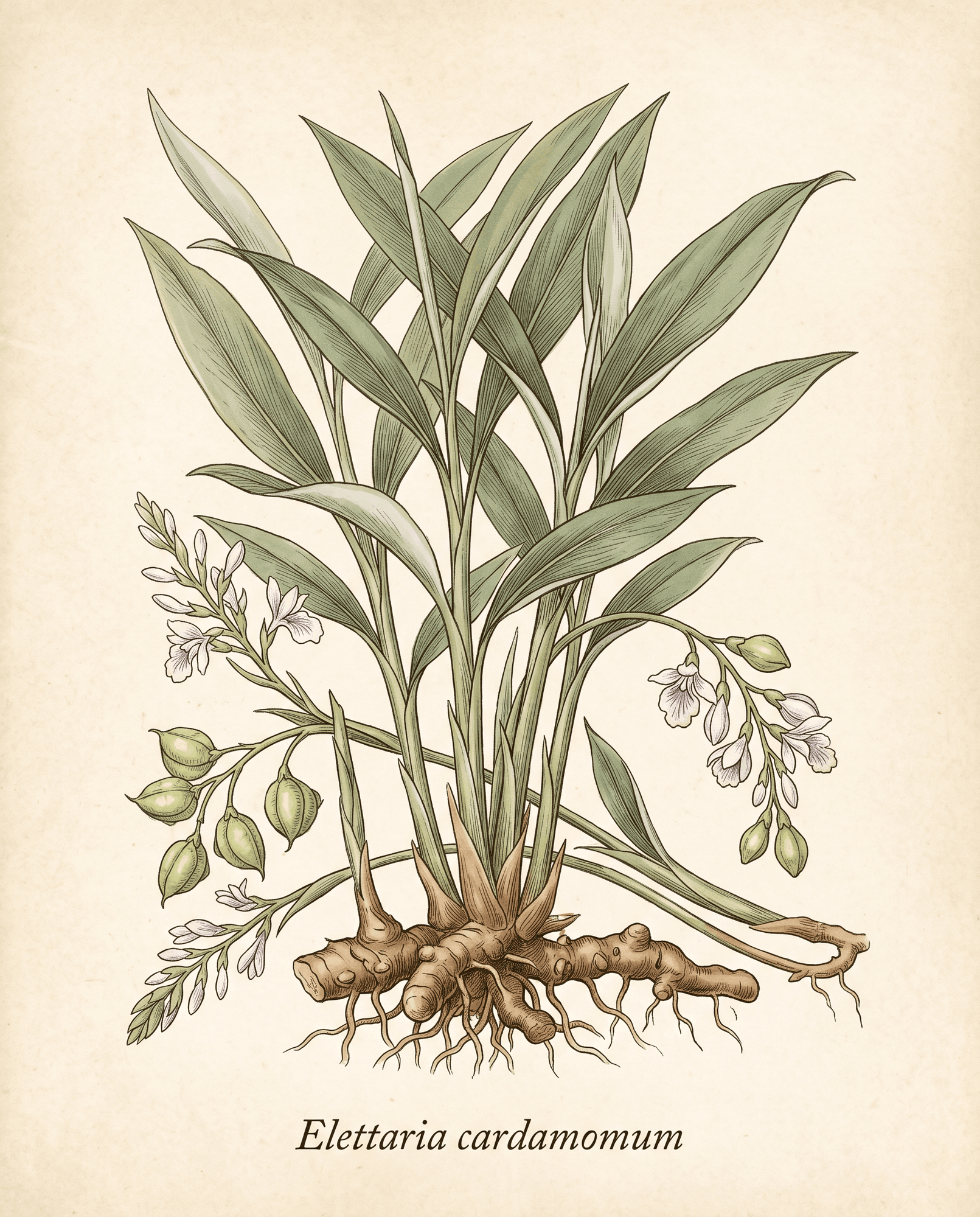
Cardamom is the sweetness that opens the way. Her plant is tall and green and keeps to the shade of the forest understory in the hills of southwest India. She hides her flowers along the ground and carries her medicine in a pod small enough to lose in your palm. Crack one open and she is already in the room: bright, cool and warm at once, a little like eucalyptus and a little like citrus, and sweet under all of it. She does not shout, as some spices do. She draws you near.
She has always been a spice of welcome. She is in the coffee poured for the guest, the chai simmered on a winter stove, the rice cooked for a wedding, the bread for a holiday table, and the pod chewed after a meal so the breath leaves the table sweet. In medicine she does the same work. She settles the belly, opens the breath, and lifts a heavy mood, and she makes the harder, heavier medicines easier to take in. She is medicine for the stomach that has gone cold and slow, for the chest that has gone thick, and for anyone who has forgotten that pleasure is also nourishment.
The shape of her medicine
Cardamom is warming, drying, and aromatic, and her movement is outward and down. She disperses what has pooled and stalled: gas trapped in the belly, mucus heavy in the chest, nausea rising where food should be descending. Her warmth is gentle. She has none of the fire of cayenne or the deep heat of clove. Hers is a clear, bright warmth, and her sweetness keeps it from scorching. This is why she sits so easily in so many formulas, and why traditions disagree on her temperature, as we’ll see.
She is aromatic first. Her medicine lives in her volatile oil, and the oil begins working the moment the pod is crushed and the scent reaches you. Aromatics wake up the senses and the digestion together. The smell alone starts the mouth watering and the stomach preparing. This is why the oldest way of working with her is also the simplest: chewing a few seeds after a meal.
As a carminative, she relaxes the smooth muscle of the gut and lets trapped gas move. The bloated, cramping, full-of-air belly is her classic territory, especially after heavy, rich, or starchy meals and in people whose digestion runs cold. Her antispasmodic action is part of the same gesture: she quiets griping and cramping in the stomach and bowels. The Eclectic physicians reached for her especially for colic in infants.
As a stomatic, she supports the stomach itself. She kindles appetite in the person who can’t face food, and she helps the stomach do its work without forcing it. Her anti-emetic action follows from this. She settles nausea and turns back the upward rush of a stomach that wants to empty itself. Across many traditions she is given for morning queasiness, travel sickness, and the nausea that comes with weakness.
She is a sialogogue: she starts the saliva flowing. Saliva is the first step of digestion, and it is also part of why she sweetens the breath so well. A mouth that is moist and moving doesn’t go stale.
In the chest she is an expectorant. The cineole in her oil is the same compound that gives eucalyptus its opening quality. She thins and loosens mucus and helps the lungs clear it, especially the cold, wet, white phlegm of a lingering cough. The Ayurvedic tradition has long counted her among the herbs that ease difficult breathing.
As a stimulant, she quickens and warms. She moves circulation gently toward the periphery, and lifts energy and mood without the jangle of caffeine. This is why she is so often paired with coffee and black tea: she brightens what they brighten, and she softens their edges.
Her antimicrobial action is real and well documented in the laboratory. Her oil inhibits a wide range of bacteria and yeasts, and is particularly strong against Candida. In practice this shows up most in the mouth: she freshens the breath by changing what lives there, not just by covering it.
As a nervine, she is mild and uplifting. The Eclectics described her as gently tonic and calming to the nerves, and gave her to depleted, nervous patients. Ayurveda counts her among the sattvic spices, the ones that clear the mind and open the heart. She brings people back into their senses.
And she is an aphrodisiac, though not in the hot, driving way of some. She awakens desire through the senses: through taste, through scent, through sweetened breath and a warm belly. Across South Asian and Arab traditions she has long been a spice of love and union.
All of her actions come down to one gesture: opening. She opens the appetite, the gut, the breath, the mood, the door to the guest. Wherever something has closed down from cold, heaviness, or tension, she softens it and invites it to move.
What lives inside her
Whose medicine she carries
Air (the volatile oil, the breath she sweetens)
Water (the love and sweetness she carries)
Mercury
Libra
Two of Cups
Temperance
Oshun
Oshun is sweetness that is also power. She is the river’s honey, the mirror and the brass bracelets, the laugh that turns a hard room. But her sweetness is not decoration. It is medicine and strategy. Oshun knows that people open to what delights them, and that a door offered sweetly gets walked through. Cardamom works exactly this way. She is the sweetness that makes the bitter cup drinkable. She is folded into a heavy root so that it can be digested, and she softens coffee into hospitality. What she adds is welcome, and welcome changes what the body and the household are able to receive.
Oshun is also love: the drawing together of people, the marriage feast, the sweet word spoken at the right time. Cardamom has lived in that place for a very long time. She has been cooked into wedding rice, poured for honored guests, and chewed before speaking so that the breath and the words would be sweet. Her flowers are white and veined with violet, and they open low along the ground in the shade, close to the earth and the water. Hers is not loud beauty. It is the kind you have to come close to see.
There is one more thread here. Oshun’s sweetness is never naive. The river that brings fertility can also flood. Cardamom has her own hard history: she was traded across oceans, hoarded for profit, and planted on land taken from Indigenous people. She carries the memory of who has picked her, and for how little. To work with her in Oshun’s spirit is to honor sweetness as something that should be shared fairly, and to remember the hands that brought it to your cup.
The hands she has passed through
Cardamom’s story begins in the Western Ghats, the mountain chain that runs down India’s southwest coast. In the forests of what is now Kerala she grew wild in the shade, and for centuries most of the world’s cardamom was gathered from these forests rather than from farms. One range there is still called the Cardamom Hills. She has names in many of the region’s languages: ela in Sanskrit, elakkai in Tamil, elaichi in Hindi. The English word comes through Latin from the Greek kardamomon, which scholars think was borrowed from a Dravidian language of South India. The Greek form may have been shaped by two Greek plant names, kardamon (cress) and amomon (a spice). The word itself carries the route she traveled.
In Ayurveda, she appears in the Charaka Samhita, one of the founding texts of the tradition. There she is counted among the herbs that relieve difficult breathing, among the substances held in the mouth to cleanse and freshen it, and in medicated smoke and nasal preparations. She was not only a flavor. She was an ingredient in formulas, often added so that strong purgatives and heavy preparations would sit better in the body. Some accounts trace her into Vedic ritual as well, among the fragrant offerings given to the marriage fire.
By the first centuries of the common era she had traveled west. Greek and Roman writers knew her well. Dioscorides recommended her as an aid to digestion, and the Roman recipe collection attributed to Apicius uses her generously. Pliny believed she grew in Arabia, a mistake that tells you how well the traders guarded their sources. The Persian and Arab physicians and cooks who handled the Indian Ocean trade wrote about her in detail, grading her by quality and type. In Arabic she is hāl, and in the Arabian Peninsula she became inseparable from coffee. Gahwa, Arabic coffee boiled with cardamom, is the heart of hospitality across the Gulf. The pot is held in the left hand and the small cup in the right, the eldest or most honored guest is served first, and a guest is not truly welcomed until coffee has been poured. UNESCO recognized the tradition as intangible cultural heritage in 2015. A great deal of the world’s cardamom still ends up in these cups.
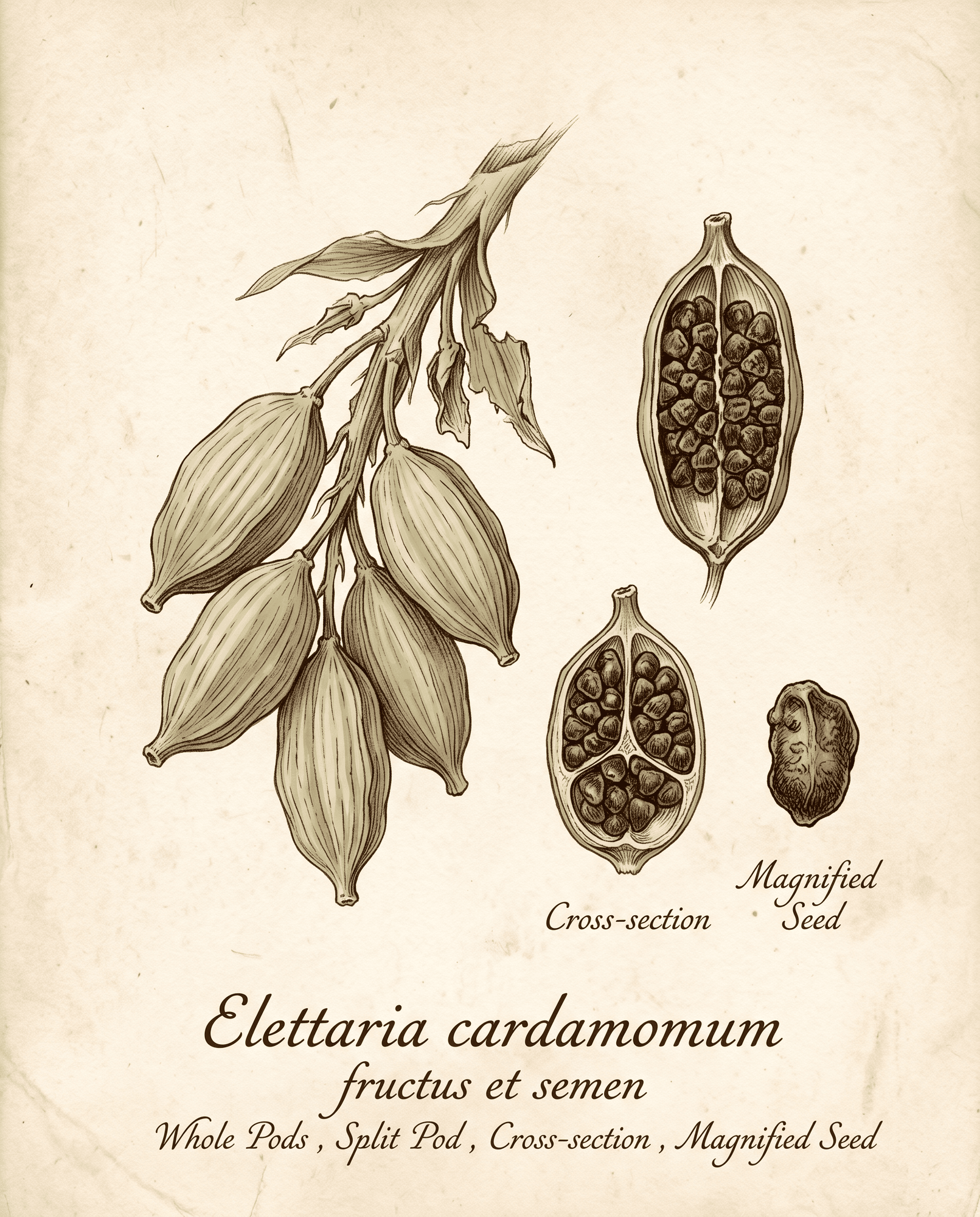
The same monsoon trade winds that carried her to Arabia carried her down the Swahili coast of East Africa. In Swahili she is iliki. On Zanzibar and along the coast she spices the sweet milky chai, the pilau, and the coffee sold in tiny cups from the street-side pot, and she is brewed into tea to settle the stomach after a heavy meal. In the Horn of Africa she has a close cousin: korarima (Aframomum corrorima), sometimes called Ethiopian cardamom. It is a separate plant in the same ginger family, native to Ethiopia and neighboring lands. Korarima is a staple of Ethiopian and Eritrean kitchens, in berbere, mitmita, and coffee, and in Ethiopian herbal practice its seeds are used as a tonic and carminative. These are two related plants, working in the same way, on two sides of the same sea.
Her arrival in Scandinavia is wrapped in legend. Vikings are often said to have brought her home from Constantinople, but food historians have found no evidence for it. The earliest documented Scandinavian recipes using her appear in a thirteenth-century Danish monk’s cookbook. Those recipes closely resemble Moorish recipes of the same era, and that resemblance suggests she came north through Moorish Iberia and the European trade routes. However she arrived, she became a winter spice of the North, baked into the breads and buns of holidays and long dark evenings.
Her modern history runs through Guatemala, and it is not a sweet one. In 1914 a German coffee planter named Oscar Majus Kloeffer planted Indian cardamom on his estate near Cobán, in the highlands of Alta Verapaz. The land and the labor there had been taken from the Q’eqchi’ Maya. After independence, communal Indigenous lands were treated as public land and given to foreign planters, mostly German, and Maya families were bound to the plantations under the finca system. They were paid in scrip, forced into seasonal labor by vagrancy laws, and later devastated by the violence of the civil war. Cardamom flourished in those highlands. Guatemala became a leading exporter by the 1970s and has been the world’s largest producer since around 2000. Today most of Guatemala’s cardamom is grown on small plots by Q’eqchi’ families, who are among the poorest farmers in the country and who receive the smallest share of what the spice earns. In recent years, cooperatives and growers in places like Ixcán have been working to change that. When you hold a green pod, there is a good chance a Q’eqchi’ hand picked it.
The Eclectic physicians of nineteenth-century America knew her mostly as a warming carminative. John Scudder described her as mildly stimulating and gently tonic to the nerves, and recommended her for gas, cramping, and colic, especially in infants, and for nervous, depleted women. In the old pharmacopoeias, compound tincture of cardamom was used to flavor and warm other medicines and to carry bitter ones. That is still one of her best uses.
She has been called the queen of spices, the wedding spice, the guest’s cup, the breath sweetener, the belly warmer, and the green gold of the Ghats. She has been all of them. She still is.
Where she works in the body
Digestive system. This is her home. From the mouth to the bowels, cardamom wakes digestion and keeps it moving. In the mouth she starts the saliva and sweetens the breath, and her antimicrobial oil changes the life of the mouth itself. In the stomach she kindles appetite, settles nausea, and helps a cold, slow stomach do its work. In the intestines she relaxes cramping and moves trapped gas. She is a classic remedy for bloating, belching, and the heavy fullness after rich or starchy food. She also makes heavy foods lighter: Ayurveda teaches that a pinch of cardamom in milk makes it easier to digest and less mucus-forming. Laboratory and animal studies suggest she protects the stomach lining as well. Her one caution here is the gallbladder (see Contraindications).
Respiratory system. Through the cineole in her oil, she opens the airways and loosens mucus. She is most at home with cold, damp patterns: the lingering wet cough, the congested chest in winter, the heavy, mucus-laden lungs of a person whose digestion is also slow and damp. In Ayurveda and TCM alike, a damp stomach and damp lungs are closely linked, and she clears both at once. Steam with her crushed pods opens a congested head, and a warm cup with honey eases a tired, rattling chest.
Nervous system. She is a gentle uplifter. Her scent clears a dull, heavy head, brightens a low mood, and brings scattered attention back into the body. She is not a sedative, but her warmth and sweetness settle the kind of anxiety that lives in the belly: nervous indigestion, the stomach that knots before a hard conversation. Ayurveda considers her one of the spices that clarify the mind and open the heart.
Reproductive system. Across South Asian, Arab, and many folk traditions, cardamom is a spice of love, union, and desire. Her aphrodisiac quality comes through the senses and through warmth: sweetened breath, a warm belly, the pleasure of scent and taste. She is often paired with saffron, rose, and honey in milk drinks and sweets meant for lovers and newlyweds. Her anti-emetic action has also long made her a gentle, food-level comfort for the queasiness of early pregnancy.
Cardiovascular system. Her stimulant action moves warmth gently outward toward the periphery, so she is helpful for people who run cold. In laboratory and animal work, cardamom extracts have shown blood pressure–lowering and antioxidant effects. One small clinical study in people with early-stage high blood pressure found that powdered cardamom lowered blood pressure and improved the body’s ability to break down clots, without changing blood lipids. This is promising but still early, and the strongest case for her here is the oldest one: a warm, aromatic spice in daily food and drink, taken over a lifetime.
How to take her
Harvest calendar
Preparations
Keep her in the pod until you are ready to use her. Once the seeds are ground and exposed to air, the volatile oil begins to escape, and with it most of her medicine. Buy whole green pods. Crack them with the flat of a knife or the back of a spoon just before use.
Chewing: One or two pods, or the seeds from them, chewed slowly after meals. This is the oldest and simplest way to work with her: for digestion, for gas, for sweet breath, and for the moment before you speak.
Infusion: 2–4 lightly crushed pods (or about ½ teaspoon of seeds) per cup of just-boiled water. Steep covered, 10 minutes, so the aromatic oil stays in the cup. 1–3 cups daily, after meals or whenever nausea or bloating rises.
In decoction: When she joins roots and barks in a simmered tea, add her near the end, in the last 5–10 minutes, so long boiling doesn’t drive off her oil. TCM teaches the same rule for the cardamoms in its own materia medica.
Powder: Around 1–2 g of freshly ground seed daily, divided, stirred into food, warm water, or milk. Grind small amounts at a time.
Milk decoction: A pinch to ¼ teaspoon of freshly ground seed simmered in a cup of milk, often with ginger, cinnamon, saffron, or turmeric, and with a heavier root such as ashwagandha. Let it cool to drinking warmth before stirring in honey. She makes the milk and the root easier to digest.
Tincture: 1:5 dried seed in 60–70% alcohol, which holds her aromatic oil well. Typical dose 1–2 mL, up to 3 times daily, usually in formula, where she warms, brightens, and carries the other herbs. A few drops before a meal wake the appetite.
Bitters: She is a classic aromatic in digestive bitters. She is macerated with gentian, orange peel, fennel, ginger, and angelica, and taken by the dropperful on the tongue before meals.
Food: In coffee and black tea; in chai; in rice dishes, stews, and curries; in breads, sweets, custards, and milk puddings; with fruit; in syrups and cordials. Most of her medicine is delivered this way, every day.
Essential oil: Diluted to 1–2% in a carrier oil for a belly rub to ease gas and cramping, or a few drops in a bowl of steaming water as an inhalation for a congested chest. Not for internal use without training.
Spiritual & ritual:
- A crushed pod or a little ground seed added to a sweet offering of honey, cinnamon, and oranges for Oshun
- Pods chewed before a hard or tender conversation, so the words come out sweet
- Coffee or tea brewed with cardamom and poured first for the guest, or for the ancestors, as an act of welcome
- Seeds added to love sachets, bath blends, and anointing oils for attraction and union
- A small bowl of pods set at the threshold or on the table to call harmony into a household
When to hold back
Use with caution if:
- You have gallstones. The seed can provoke spasmodic gallbladder pain. Keep to food amounts.
- You are pregnant. Cardamom in food is time-honored and is often a comfort for early queasiness. Keep to food amounts rather than concentrated medicinal doses or the essential oil.
- You tend toward dryness and heat from depletion: a dry mouth, a red tongue with little coating, a hot, empty, irritable feeling. Both TCM and many Ayurvedic practitioners would pair her with moistening allies or keep her doses small.
- You are working with her essential oil around infants and young children. Like other cineole-rich oils, keep it away from their faces and airways.
Topical considerations:
- Always dilute the essential oil. Undiluted, it can irritate the skin and mucous membranes. Patch test first if your skin is sensitive.
General notes:
- Very safe across the lifespan in food and ordinary medicinal amounts. No significant drug interactions are documented. Her warmth is gentle enough that she is well tolerated even by people who run warm, especially when balanced with cooling or moistening companions.
Who walks with her
For cold, sluggish digestion and gas: Ginger, fennel, cinnamon, clove, angelica, orange peel, black pepper.
For nausea: Ginger, peppermint, spearmint, fennel, lemon balm.
For damp, congested lungs: Ginger, cinnamon, licorice, thyme, elecampane, hyssop.
In the milk cup and with heavy roots: Ashwagandha, shatavari, turmeric, saffron, ginger, nutmeg, a little honey stirred in after cooling.
For love and sweetness: Rose, saffron, cinnamon, vanilla, honey, orange blossom.
In digestive bitters: Gentian, angelica, orange peel, fennel, dandelion root, ginger.
With coffee and black tea: On her own, or with cinnamon, clove, ginger, and saffron.
Cardamom is one of the great harmonizers. She is rarely the strongest plant in a formula, but she is often the one that makes the formula work. With ginger she doubles the warming and anti-nausea action, and her sweetness takes the edge off ginger’s bite. With fennel she makes a gentle pair for the bloated belly, mild enough for children. With cinnamon she warms the center and sweetens the whole blend. With heavy, nourishing roots like ashwagandha and shatavari, she helps a cold or weak digestion actually take them in. With rose she is pure Venus: love, sweetness, and an opened heart. In coffee and tea she softens the stimulant edge and turns a drink into a ritual of welcome. Wherever there is a medicine the body struggles to receive, she opens the door.
How to know her
Plant walk: Most of us will not walk among cardamom in the forest, so meet her where she has traveled to you. Take a single green pod. Hold it and notice its weight, its color, the faint ribs along its sides. Smell it whole, then crack it open and smell again, and notice how much more of her comes forward once she is open. Put one seed on your tongue and let it sit. Notice what happens in your mouth, your belly, your breath, your mood. Then think about the road this pod traveled to reach you: the forest in the Ghats she came from, the hands in Kerala or Alta Verapaz that picked her, the ships and markets that carried her. Thank those hands before you go on.
Seasonal practice: When the days shorten and the cold sets in, simmer a pot of chai with cardamom at its heart: black tea, crushed pods, ginger, cinnamon, clove, milk, and sweetness. Keep it on the stove through the dark months as a hearth. Pour the first cup for your ancestors, or for whoever walks through the door first.
Ritual of welcome: Before guests arrive, brew coffee or tea with cardamom and let the scent fill the house. Serve the eldest or most honored person first, with your right hand. Let the cup say what words don’t need to: you are welcome here. This ritual can also be done for the parts of yourself that have been kept waiting outside.
Ritual of sweet speech: Before a conversation that matters, a reconciliation, a confession, a proposal, or a hard truth told with love, chew a cardamom pod slowly. Let her sweetness fill your mouth. Set the intention that what you say will be honest and kind, and that it will be received. Speak while her scent is still on your breath.
Journal prompts
- Where in my life is sweetness the medicine, and where have I been refusing it?
- What heavy thing am I trying to take in that needs something to help it go down?
- Who poured for me first? Whom am I pouring for?
- What is the history behind the sweet things I enjoy, and whose hands are in it?
- What would I say differently if I let my words be sweet without being false?
Tarot Spread
A spread for entering into relationship with Cardamom as a plant ally:
- What has gone cold and heavy in me, waiting to be warmed and moved?
- What sweetness is Cardamom offering me right now?
- What heavy medicine in my life is she helping me take in?
- Whom am I being asked to welcome, and how?
- What do I owe the hands that bring me sweetness?
Lay the cards beside a small cup of cardamom tea. Drink it slowly as you read, and let the cup be empty before you close the spread.
The same plant, multiple lenses
In Ayurveda cardamom is ela, and she is honored as one of the most balancing spices, safe for all three doshas. The Charaka Samhita gives her rasa (taste) as pungent and sweet, her vipaka (post-digestive effect) as sweet, and her qualities as light and dry. It gives her virya (potency) as cooling. Western herbalism and TCM both call her warming, and many modern Ayurvedic teachers describe her as mildly heating. That disagreement is part of who she is. She is a pungent spice that does not burn, aromatic and warming as she opens, and cooling and sweet in her deeper action. This is why she can kindle agni, the digestive fire, without aggravating Pitta.
Pitta Dosha — Fire & Water
She is one of the few pungent spices Pitta can use freely in moderate amounts. Her sweet taste, sweet vipaka, and (in Charaka’s reading) cooling potency soften her warmth, so she kindles digestion without inflaming it. She is especially helpful for Pitta’s nausea, acid indigestion, and the irritability that rises when digestion is off. For strong Pitta imbalances, pair her with cooling allies such as coriander, fennel, and rose, and keep the dose modest.
Kapha Dosha — Earth & Water
This is where she shines most. Her pungent, light, dry, aromatic qualities cut straight through Kapha’s heaviness, dampness, and congestion: the slow, heavy digestion, the mucus in the chest and sinuses, the dull, sleepy mind after a heavy meal. She is classically added to milk, sweets, and grains to lighten their Kapha-building nature, and she clears phlegm from both the stomach and the lungs.
Vata Dosha — Air & Ether
She is excellent for Vata’s digestion: the gas, bloating, cramping, and irregular appetite of a cold, nervous belly. Her warmth, aroma, and sweetness settle the scattered, anxious quality of Vata in the gut. Because she is light and dry, Vata does best with her in warm, moist, oily preparations: in warm milk, with ghee, cooked into food, or alongside demulcent allies like licorice and shatavari.
Classical Chinese medicine works mostly with green cardamom’s relatives in the same family: bai dou kou (white or round cardamom, Amomum kravanh) and sha ren (Amomum villosum). Green cardamom itself is known as xiao dou kou, “small cardamom”. She has sometimes been used as a substitute for bai dou kou, though Chinese herbal tradition considers her a lesser grade. Her actions follow the same lines as her cousins’, and the reading below draws on that family of aromatic, damp-transforming herbs.
Taste & Temperature: Pungent and aromatic, warm. Channels Entered: Lung, Spleen, and Stomach. Functions: Aromatically transforms dampness and moves qi. Warms the middle and stops vomiting. Opens the stomach and promotes digestion.
Aromatically Transforming Dampness and Moving Qi
The aromatic herbs have a particular gift in TCM: their fragrance “awakens” a Spleen that has been weighed down by dampness. The pattern she addresses is damp obstructing the middle burner: a feeling of fullness and stuffiness in the chest and upper abdomen, poor appetite, a heavy body, a sticky mouth, and a thick, greasy tongue coating. She moves stuck qi and dissolves the dampness with her scent rather than by draining. She does this more gently than many aromatics, which is part of why she is so widely used in food.
Warming the Middle and Stopping Vomiting
She warms the Spleen and Stomach and turns rebellious Stomach qi back downward. This makes her useful for nausea and vomiting from cold and damp in the middle: queasiness after cold or greasy food, morning sickness of the cold, damp kind, and vomiting with a pale, coated tongue. Her warmth is mild, so she is especially suited to the lighter, earlier stages of these patterns and to people who can’t take stronger, hotter herbs.
Opening the Stomach and Promoting Digestion
For the person who has no appetite, feels full after a few bites, and belches and bloats after meals, she “opens the stomach.” She stimulates appetite and helps food move through. Because she enters the Lung channel as well, she also addresses the damp phlegm that so often accompanies a weak, damp digestion. As with her cousins, she should be added at the end of a decoction so her aromatic oil is not boiled away.
Yin/Yang Balance
Cardamom leans Yang: warming, aromatic, drying, and moving. She is best suited to patterns of cold and damp, especially in the middle burner and the lungs. She is not well suited to heat from yin deficiency or blood dryness: a red tongue with little coating, a dry mouth, night sweats, or vomiting from heat rather than cold. In those cases she should be avoided, or used only in small amounts within a formula that cools and moistens. Her mildness and sweetness make her one of the gentlest of the warming aromatics, which is why she works well as a daily spice.
For going deeper
- Ravindran, P. N. & Madhusoodanan, K. J. (eds.). Cardamom: The Genus Elettaria. Taylor & Francis. The comprehensive reference on the plant’s botany, cultivation, chemistry, and uses, written largely by researchers in Kerala.
- Charaka Samhita — the Ela entry and its references, via the Charak Samhita Online herb database (carakasamhitaonline.com).
- Frawley, David & Lad, Vasant. The Yoga of Herbs: An Ayurvedic Guide to Herbal Medicine. Lotus Press.
- Bensky, Dan, Clavey, Steven, & Stöger, Erich. Chinese Herbal Medicine: Materia Medica (3rd edition). Eastland Press. See the entries on bai dou kou and sha ren.
- Scudder, John M. The American Eclectic Materia Medica and Therapeutics (1898), entry on Elettaria, available through Henriette’s Herbal.
- Noumi, E. et al. “Chemical and Biological Evaluation of Essential Oils from Cardamom Species.” Molecules 23(11):2818, 2018.
- Heifer International. “Rooted in Racism: Cardamom” — on the history of cardamom in Alta Verapaz and the Q’eqchi’ Maya farmers who grow most of Guatemala’s crop.
- Slow Food Foundation, Ixcán Cardamom Presidium — on Guatemalan growers working to keep more of the spice’s value in their own communities.
- Abu Dhabi Culture, “Gahwa — Arabic Coffee” — on the customs of serving coffee and cardamom as hospitality.
- Conversations with elders and cooks from Kerala, the Gulf, the Swahili coast, Ethiopia and Eritrea, and Guatemala about cardamom in their kitchens and medicine. Much of what she means lives in households, and has never been written down.
The Conversation
Questions, noticings, what this is teaching you — leave them here. This same conversation lives in The Circle.