Blue Lotus
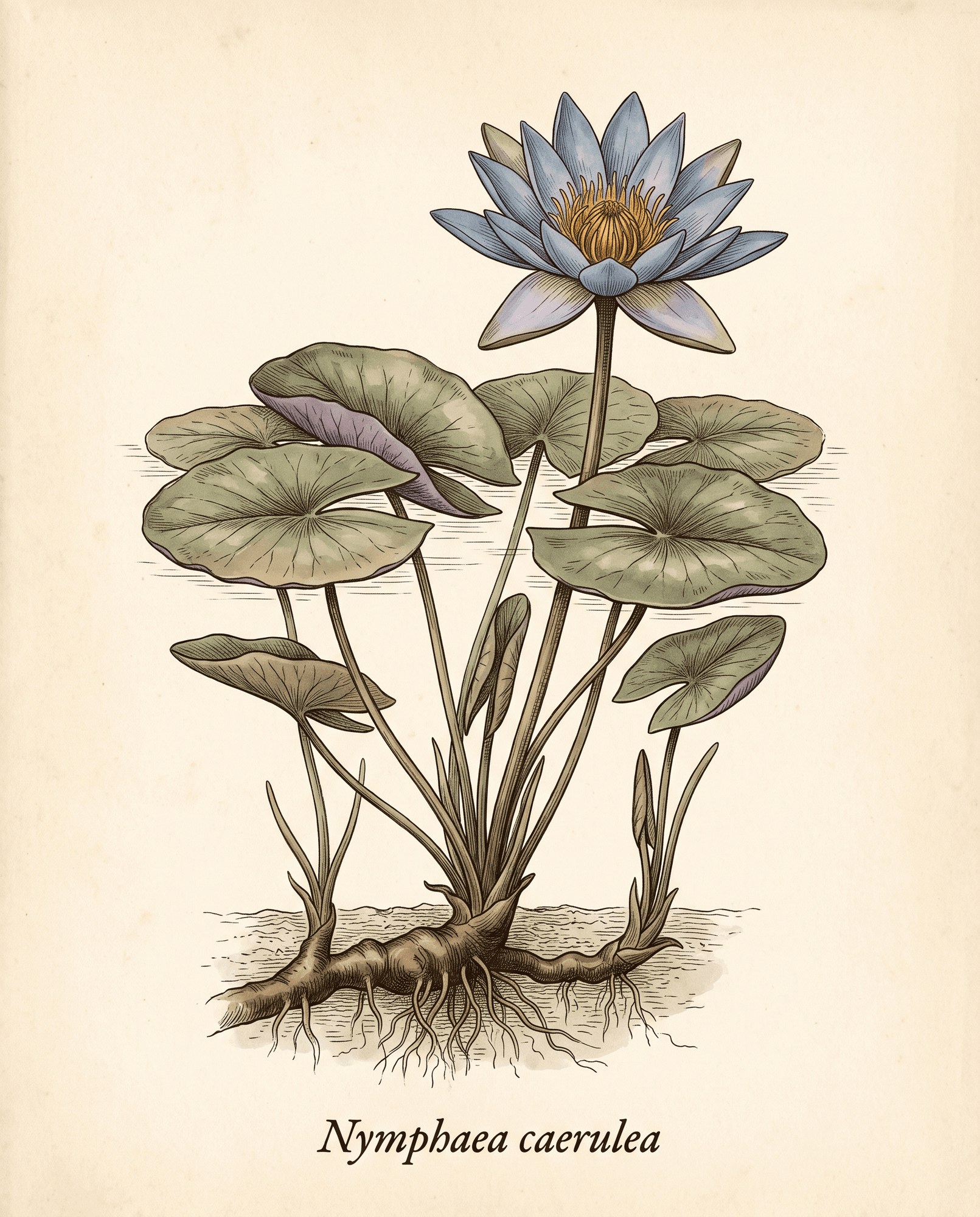
Blue lotus rises out of dark water. Her rhizome holds in the mud at the bottom of the pond, her leaves float flat on the surface, and each morning her flower lifts on its stalk into the air and opens toward the sun — narrow petals the color of early sky, a crown of gold at the center, a scent that people have been leaning into for five thousand years. By afternoon she closes and sinks back down. She does this for three or four days, and then she is finished. The people of the Nile watched her do it and understood the whole cycle of death and return in her body.
She is not a lotus, botanically. She is a water lily, and the flower Egypt called seshen is the same plant India calls nilotpala and utpala — one species that stretches from the Nile to Sri Lanka and gets named sacred everywhere she grows. Her medicine is quiet: she calms the head, softens the body, loosens the grip of the day, and opens the door to dreaming. She was drunk in wine at banquets, laid on the chests of the dead, held to the nose of the anxious, and offered to the sun each morning. She is a threshold plant. She works at the edge of sleep, the edge of intimacy, the edge of the world below the surface, and she asks you to go gently.
The shape of her medicine
Blue lotus moves inward and downward, and then opens. That is the shape of the flower’s day and the shape of her medicine. She takes the body out of the bright, forward, doing state and draws it down and in — toward the chest, toward the belly, toward the water — and once the body has settled there, something opens. A dream. A feeling that had been held. A softness between people. She does not push anything up and out the way the bitters and the diaphoretics do. She lowers the water level so what was underneath can be seen.
She is cool and faintly moistening, with a taste that is bitter first, then floral and slightly sweet, with a dry astringent finish. The bitterness is real and easy to overlook under the perfume; it is part of why she has been used as a bitter tonic in India and part of why she settles a nervous stomach.
As a nervine and mild sedative, she works on the nervous system through a different door than most of the calming herbs. The chamomiles and the skullcaps quiet the nerves by soothing them; blue lotus shifts the tone of the mind itself. Her alkaloids act on dopamine and serotonin, and the effect is a loosening — thoughts that had been circling slow down, the jaw unclenches, the body stops bracing. Many people describe a mild, dreamy lift, which is why she is also called a gentle euphoriant. This is not a stimulant lift. It is the feeling of having set something heavy down.
Her anxiolytic action follows from the same place. She is for the anxiety that lives in the head and keeps the body awake — the racing mind at bedtime, the tightness before ceremony, the tension that makes intimacy impossible. She is less useful for the depleted, exhausted kind of anxiety, where the body needs building rather than releasing.
As an oneirogen — a dream herb — she is one of the great ones. Taken in the evening, she tends to make dreams more vivid, more memorable, and more easily entered with awareness. This is the medicine Egypt used her for in temple sleep and the medicine mugwort shares with her in the diaspora. It is not a side effect. It is the point.
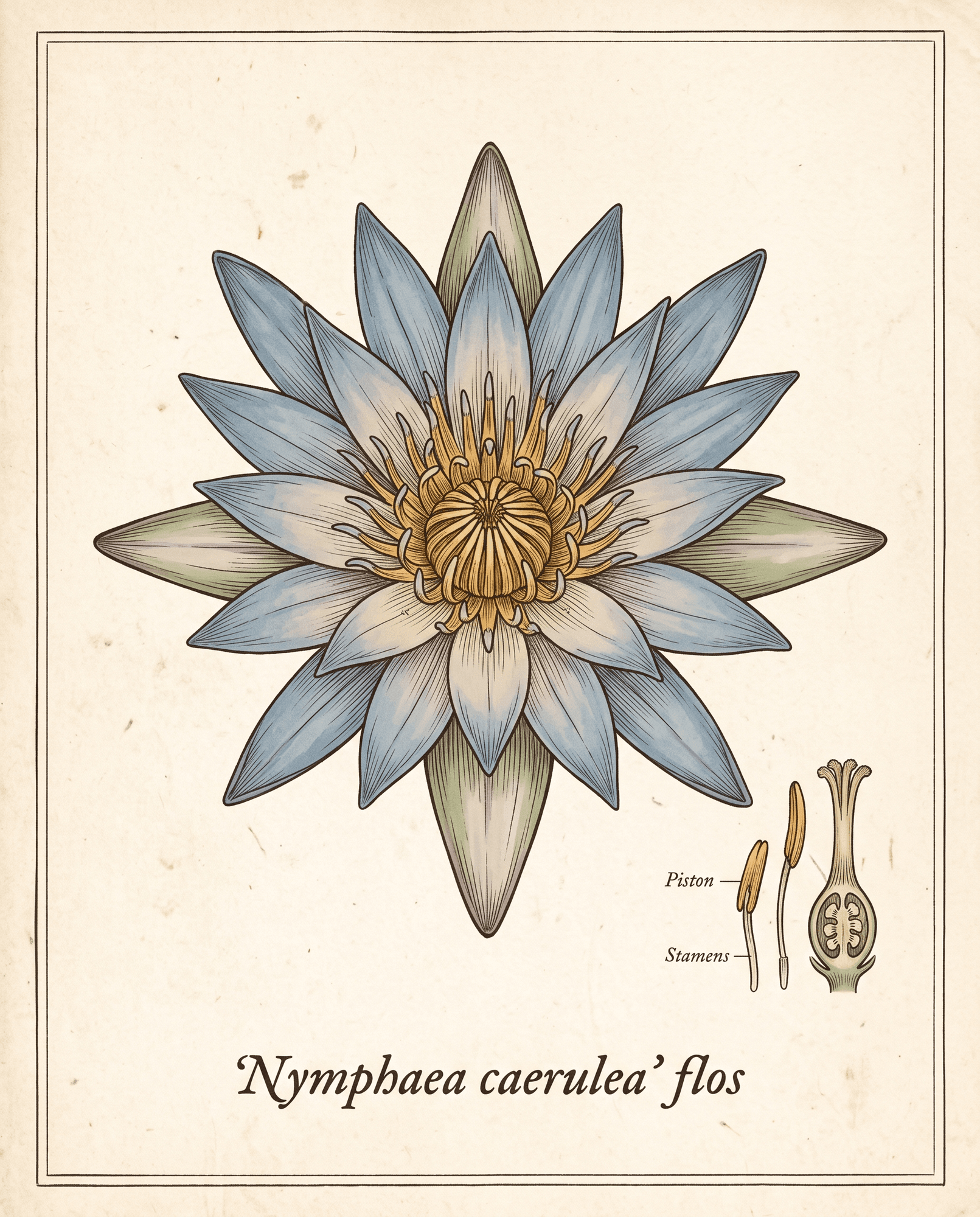
Her aphrodisiac action is one of relaxation, not stimulation. She does not heat the body the way damiana or cinnamon do. She removes what was in the way — anxiety, self-consciousness, the armor of the day — and lets desire arrive on its own. Her scent is part of this. The fragrance of the stamens is itself a medicine, and it was the reason banquet guests in Thebes are painted with a flower held to the nose.
As an antispasmodic she eases the physical tension that comes with a tight mind — clenched shoulders, a gripping belly, a cramping womb. And as a bitter tonic and astringent, most present in the rhizome and in the Indian tradition, she cools heat in the blood, tones bleeding tissue, and steadies digestion.
Together her actions form a single gesture: she lowers you into the water so you can see what lives there. She is for the body that cannot stop, the mind that cannot descend, and the person who has forgotten how to dream.
What lives inside her
Whose medicine she carries
Air (fragrance, dream)
Earth (rhizome in the mud)
Venus
Cancer
The High Priestess
The Star
Olokun
Olokun holds the bottom of the ocean — the deep that no light reaches, the place where what has been lost is kept, the unconscious of the world. Olokun’s medicine is mystery, hidden wealth, the memory of the ancestors who crossed water and did not arrive, and the parts of the self that live below the surface where the waves cannot disturb them. Blue lotus belongs to Olokun because she grows out of exactly that dark water and returns to it every day. She does not stay in the light. She goes back down.
Her medicine is the medicine of descent. The alkaloids in her flower quiet the surface of the mind and let awareness sink into the dreaming layer — the place where the dead speak, where the unresolved surfaces as image, where the body remembers what the day-mind has refused. The Egyptians drank her to reach the afterlife while still living; the temples used her for sleep in which the god would visit. This is Olokun’s work: the controlled, reverent going-under that brings something back. Working with blue lotus in Olokun’s name means preparing the vessel before the descent — a quiet evening, a clean room, a question held in the heart — and trusting that what rises in the dream is a gift from the deep, not an accident.
There is grief in this house too. Olokun holds the bones of the Middle Passage, and blue lotus is a flower of the African continent that did not make that crossing. She reached the diaspora late, through the return of Black people to the memory of Kemet, through the reclaiming of the Nile as an ancestral river. To sit with her is to sit with a plant that stayed on the other side of the water, and to let the dream carry across what the ships could not.
Obatala
Obatala rules the head — the orí, the seat of consciousness and destiny — and everything that keeps the head cool, clear, and at peace. White cloth, still water, calm counsel. The blue lotus flower is a crown: the god who rose from her at the beginning of the world wears her on his head, and the medicine she offers the head is Obatala’s medicine exactly. She cools the hot, racing, overfull mind. She brings the peace that has to be present before any clear seeing can happen. She is the flower you drink before ceremony so the head is settled enough to receive.
Obatala’s hand is also in her gentleness. She is not a plant that forces. She persuades. The tension goes out of the face, the breath slows, the thoughts that were shouting go quiet enough to hear underneath. This is Obatala’s patience — the elder who does not raise his voice — and blue lotus carries it in the way she opens: slowly, in the morning, without hurry.
Oshun
Oshun holds the sweetness — the honey, the perfume, the river where people bathe and fall in love. Blue lotus’s fragrance is her Oshun medicine, and so is the softening she brings to the body before intimacy. Five thousand years of banquet scenes show people breathing her in for pleasure, and the wine she was steeped in was Hathor’s wine, drunk at a festival of joy and release. The aphrodisiac work of this flower is not about performance. It is about the return of ease — the moment when the body stops guarding itself and can be touched.
Oshun also rules beauty as a healing force, and blue lotus is one of the most beautiful medicines there is. Her color, her scent, the way she rises from mud to open into the sun — this is Oshun’s teaching that what is lovely is not frivolous. The flower’s beauty is part of why she works.
The hands she has passed through
Blue lotus’s oldest story is on the Nile. In Kemet — the land Europe would later call ancient Egypt — she was seshen, and she was the flower of creation itself. In the cosmology of Heliopolis and Memphis, before there was land or light, there was only Nun, the dark primordial water, and from that water rose a single blue lotus, and from the opened flower came the young god Nefertem, whose name means something like the beautiful one who has come into being. He wears the flower as his crown. He carries it each morning to Ra to soothe him as the sun barque crosses the sky. He is the god of perfume and of healing, and the flower is his body. When Tutankhamun’s tomb was opened, a wooden bust of the boy king rising from a blue lotus was among the first things found — the king becoming Nefertem, being born again out of the water with the sun.
She was everywhere in Egyptian life, not only in temples. Tomb paintings from the New Kingdom show banquet guests holding blue lotus flowers to their noses, breathing her in with the wine. The flower was steeped in wine and drunk; her scent was captured in oils and unguents; medical papyri include her in remedies for the head, for fever, and for the heart. She was woven into funerary wreaths and laid on the mummies of the dead — dried blue lotus petals have been found in tombs three thousand years old — so that the dead, like Nefertem, would rise from the water and open again. A funerary text has the deceased declare themselves the lotus, the child of the sun, risen pure from the primal waters. The daily rhythm of the flower — up into the light at dawn, down into the dark at dusk, up again — was the pattern of the sun’s own journey and the proof that death was not an ending. Hathor’s Festival of Drunkenness, celebrated with lotus-steeped wine, was a night of ecstatic release held in that same knowledge.
Her roots run through the rest of the African continent as well. The genus grows in still water from Senegal to South Africa, and where she grows she has been food and medicine. Rhizomes were harvested, boiled, and eaten as a starch; seeds were parched and ground. In Yoruba land the water lily is òsíbàtà, worked with for fevers, for the womb, and for conditions of the blood. In Zulu country the blue water lily is izubu and iziba. In Hausa she is bado. She is not a plant that was carried into Africa from somewhere else. She is one of Africa’s own, and the Egyptian veneration was one expression of a much wider continental relationship.
She did not make the Atlantic crossing. Blue lotus is not among the plants that survived the Middle Passage in memory and seed — she needs still tropical water and a long season, and she was not in the hold. For most of the diaspora’s history she was known through story, if at all. Her return to Black spiritual life came later, through the Kemetic revival of the twentieth century: the reclaiming of the Nile as an ancestral river, the study of Egyptian cosmology as African cosmology, and the deliberate re-membering of a flower that belonged to us before the ships. She comes to us now as a plant we are choosing, which is its own kind of relationship.
In India and Sri Lanka, the same species is nilotpala — the blue utpala — and she is one of the water lilies Charaka names in the earliest layer of Ayurvedic medicine. The classical texts describe the utpalas as astringent and cooling, used to stop bleeding, clear fever, and calm the heart. She appears in the Mahabharata and the Ramayana; the eyes of the beloved are compared to her petals. In Buddhist art she is the flower held in the hand of Tara, the goddess of compassion who hears the cries of the world. She is the national flower of Sri Lanka and of Bangladesh. The Ayurvedic tradition works with the whole plant — flower, stalk, rhizome, seed — and includes a preparation of blue lotus in ghee for the mind.
In China, the water lily is shui lian — the sleeping lotus, named for the way she closes at night. She entered the written materia medica late, in the Qing dynasty supplement to the great Bencao Gangmu, where the flower is recorded for relieving summer heat, sobering the body after wine, and calming fright and convulsion in children. The classical dose was a handful of flowers — seven or fourteen — decocted. She is a folk medicine there more than a court one, a flower of the pond and the village.
In the modern world she has been rediscovered by herbalists and by the market, not always with the same care. Her flowers are sold for tea, for wine, for dreaming. But she is also sold as concentrated resins, extracts, and vape liquids, some of them dyed water lilies of other species and some of them cut with things that are not lotus at all, and it is those products — not the flower — that have sent people to emergency rooms. The plant herself has been safe in wine and tea for five millennia. What is new is the extraction.
She has been called the flower of creation, the crown of a god, the eyes of the beloved, the sleeping lotus, and a legal high. She has been all of these. She is still the flower that rises from the dark water and opens.
Where she works in the body
Nervous system. This is where blue lotus lives. Her aporphine alkaloids — nuciferine most of all — act on dopamine and serotonin pathways in a way that quiets mental noise and eases the body out of vigilance. She is for insomnia driven by an overactive mind rather than pain or depletion; for anxiety that lives in the head and jaw; for the restlessness that comes when the day will not let go. She is a dream herb of the first rank, increasing the vividness and recall of dreams and, for many people, the ease of becoming aware within them. She is not appropriate for those already sedated, those on dopamine-active medication, or those who need to stay alert.
Reproductive system. Her aphrodisiac work is relaxation-based. She lowers anxiety, softens muscular guarding, and opens the senses — especially smell — so that desire can arrive without being forced. She is useful where intimacy has become tense, performative, or armored, and less useful where the issue is low vitality or cold. In the Ayurvedic tradition the astringent flower and rhizome are also used to steady heavy menstrual bleeding and cool heat in the womb, and her antispasmodic action eases cramping when a tight body and a tight mind are feeding each other.
Digestive system. Underneath the perfume she is bitter, and the bitter taste on the tongue does what bitters do — it wakes secretion and steadies the belly. She is a gentle bitter tonic in the Indian materia medica and is worth remembering for the nervous stomach, the appetite lost to worry, and the digestion that seizes up under stress. The rhizome’s astringency has been used for diarrhea and gut irritation.
Hepatic and endocrine system. In Ayurveda and Siddha medicine the Indian blue lily is a liver herb and a herb for blood sugar, and the sterol nymphayol identified in her flowers supports that traditional claim. This is not her primary work in the Western apothecary, but it matters for safety: she can lower blood sugar, and anyone on medication for diabetes should treat her with care.
Skin. Her cooling, astringent, aromatic qualities make her a lovely topical ally — an infused oil or a floral water for hot, irritated, or inflamed skin, and a bath flower for the whole body when the nervous system needs to come down through the skin. Her absolute is one of the treasures of natural perfumery.
How to take her
Harvest calendar
Preparations
Flower infusion (tea): 3–5 grams of dried whole flowers (roughly one to two flowers, or a heaping tablespoon of petals) per cup of just-boiled water. Steep 10–15 minutes, covered, so the aromatics stay in the cup. Drink one cup in the evening, 30–60 minutes before bed for dream work, or in the afternoon for gentle calm. She is bitter-floral; a little honey is traditional and softens her. Water extracts mostly apomorphine and the flavonoids; the effect is calming and dream-forward but mild.
Wine infusion: The historical preparation. Place 3–5 whole dried flowers in a bottle of red or white wine and let them steep several hours to overnight at room temperature, then strain. A small glass — 2–4 ounces — is a full dose. Wine pulls both alkaloids and gives a fuller, warmer, more euphoric medicine than tea. One glass; not the bottle.
Tincture: 1:5 dried flower in 40–50% alcohol. 1–3 mL, once or twice daily, or 2–4 mL in the evening. Alcohol extracts the complete alkaloid profile, so start at the low end. Sublingual drops act within fifteen or twenty minutes.
Bath: A strong infusion of 10–15 grams of flowers, steeped 20 minutes and strained into an evening bath. The fragrance does much of the work. Excellent before ceremony or before sleep.
Infused oil / floral water: Dried flowers steeped in jojoba or sweet almond oil for 4–6 weeks for the skin and for anointing; or a simple floral water for the face and temples. The absolute (a solvent extraction used in perfumery) is precious and expensive and is used by the drop.
Smoking blends: The flower has a history of being smoked or blended for a calming effect. This is a traditional use and it is mild. It is a different thing entirely from the concentrated extracts and vape liquids now on the market, which are not recommended.
Rhizome and seed: Traditional foods across Africa and Asia. Cook the rhizome thoroughly. This is nourishment more than medicine, and a way to know the whole plant.
Spiritual & ritual:
- A cup of the infusion at dusk, with a question held, for dream incubation
- Flowers floated in a bowl of water on the altar for Olokun, Obatala, or Oshun
- Dried petals in a sachet under the pillow for dream recall
- A flower held to the nose and breathed before entering ceremony, as the Egyptians did
- Petals placed with the dead or on an ancestor altar for safe passage and return
- Lotus-steeped wine shared at a gathering of release and joy
When to hold back
Use with caution if:
- You are pregnant or breastfeeding. There is no safety data, and her dopaminergic alkaloids argue for abstaining.
- You drink alcohol with her beyond the single glass of infused wine. Sedation stacks.
- You take benzodiazepines, sleep medications, or any sedative. Sedation stacks here too, and the combination can be dangerous.
- You take medication that acts on dopamine — Parkinson’s medications, antipsychotics, and some antidepressants. Her alkaloids work in the same territory and can interfere.
- You take medication for blood sugar. She has a modest blood-sugar-lowering action.
- You need to drive or operate anything in the hours after. She impairs alertness even when she feels gentle.
- You have a history of psychosis or mania. Dopamine-active plants ask for professional guidance here.
Topical considerations: Generally very well tolerated on the skin. Patch test the absolute, which is concentrated.
General notes: The flower in tea and wine has a very long and gentle safety record. The problems on record — confusion, agitation, emergency visits — come from concentrated resins, extracts, and vape products, often of uncertain origin and sometimes adulterated. Buy whole dried flowers from a trusted source, work with the flower and not the extract, and start low. Tolerance builds with daily use; she is best kept as an occasional or cyclical ally rather than a nightly habit.
Who walks with her
For sleep and the racing mind: Passionflower, skullcap, chamomile, lavender, California poppy.
For dream work: Mugwort, calea, mullein, damiana, a pinch of rose.
For intimacy and ease in the body: Damiana, rose, cacao, vanilla, a little cinnamon to warm her.
For calming the head before ceremony: White sage, frankincense, holy basil, lemon balm.
For a ritual wine: Blue lotus with rose and a single cardamom pod; or blue lotus with damiana and orange peel.
Cooling the womb and steadying the blood (Ayurvedic pattern): Shatavari, red raspberry leaf, white peony, rose.
These allies share her commitment to descent and opening. Mugwort is her closest kin in the dreaming — where blue lotus lowers the mind gently into the water, mugwort sharpens what is seen there, and together they make a dream medicine that is both deep and clear. Passionflower and skullcap hold the body still while she works on the head. Damiana and rose warm what she cools, so that her aphrodisiac work does not tip into sleep. Cinnamon and cardamom are the warm hands that keep her from making a cold constitution colder. She is a flower that does not like to work alone at full strength — her allies give her the ground and the warmth she does not carry herself.
How to know her
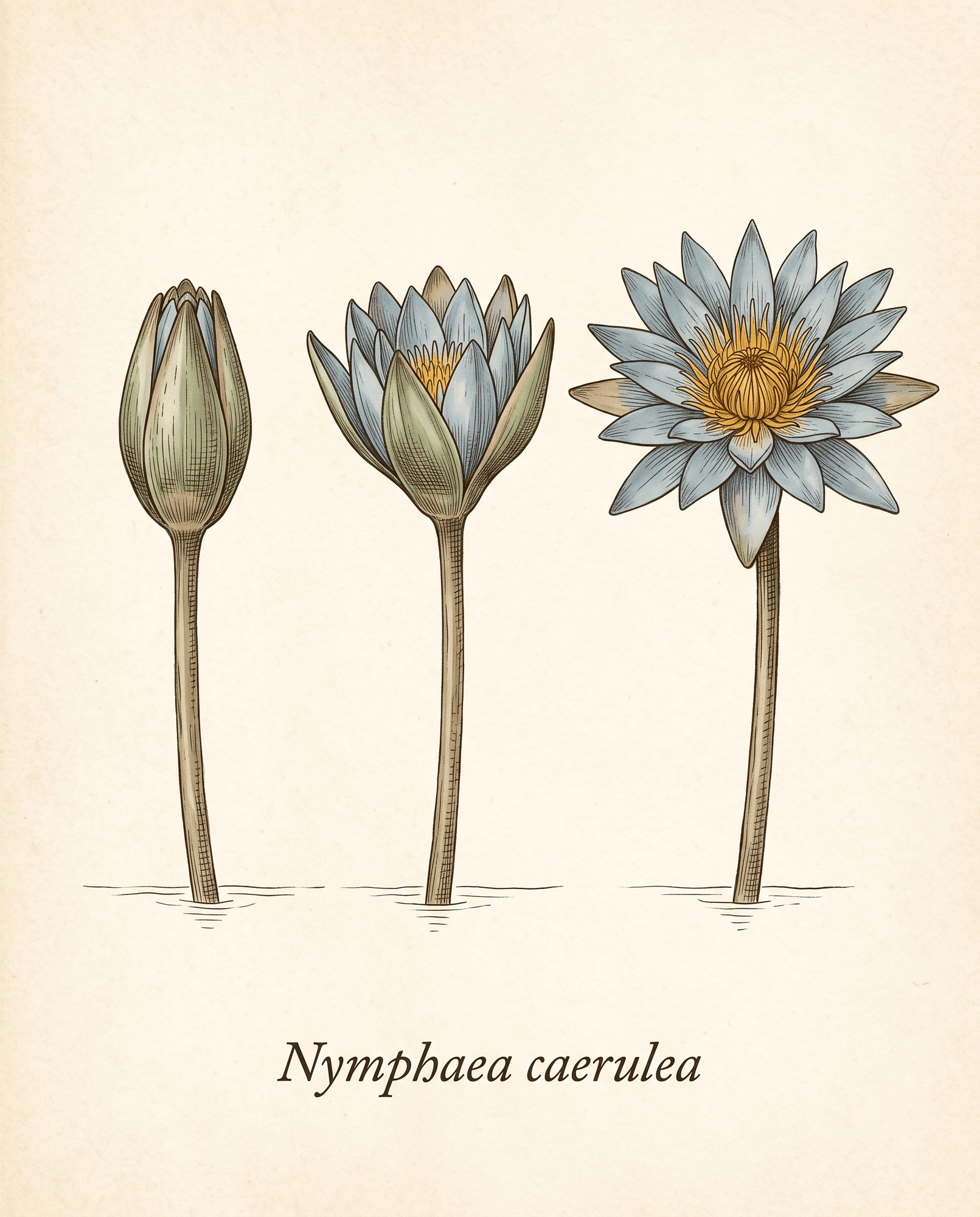
Plant walk: If there is a pond, a botanical garden, or a slow river near you with water lilies in it, go in the morning and go again in the late afternoon. Watch one flower. In the morning she is open; by evening she has closed and often sunk below the surface. Sit long enough to feel what it means that she does this every day without being asked. Then consider where in your own life you are refusing to close.
Dream incubation: In the hour before sleep, prepare a cup of the infusion. Before you drink, speak or write the question you want the dream to answer — one question, held simply. Drink slowly. Turn off the lights. Keep paper by the bed, and when you wake, write before you do anything else, even if what comes is only a color or a feeling. Do this for three nights in a row, and then rest from her for at least a week before asking again.
Offering to the deep water: Take a few dried flowers to a body of water — the ocean if you can reach it, a lake or river if not. Sit at the edge. Speak the names of the ones who crossed water and did not arrive, or the ones whose names you do not know. Float the flowers and let them go. Do not stay to watch where they end up.
Ritual of the closing flower: At dusk, run a bath and add the strong infusion. Undress slowly, as if the day were petals. Sit in the water with the lights low. Let the day close the way she closes — not because it failed, but because that is the shape of a day. Rise when you are ready. Sleep.
Journal prompts
- What have I been holding at the surface that wants to be allowed to sink?
- When did I last remember a dream? What was the last one that felt like it was for me?
- Where in my life am I performing openness instead of opening?
- What is the dark water I came from, and what do I know about who is still there?
- What would it mean to close every evening without apology?
Tarot Spread
A spread for entering into relationship with Blue Lotus as a plant ally:
- What is on the surface of my life right now?
- What lives beneath it, in the water she rises from?
- What is she opening in me?
- What does she want me to let close?
- What is waiting for me in the dream?
Keep a dried flower or a small dish of water on the altar with the cards. Read them in the evening, and sleep on what they say.
The same plant, multiple lenses
In Ayurveda the blue water lily is nilotpala — the blue utpala — one of several utpalas grouped with the white kumuda and the red raktotpala. Her taste is sweet, astringent, and bitter; her potency is cooling; her qualities are light, unctuous, and slightly slimy; and her post-digestive effect is sweet. The classical texts describe her as pacifying Pitta and Kapha, though her unctuous sweetness means she is gentler on Vata than most cooling herbs. Charaka names the utpalas as astringent and as remedies for raktapitta — bleeding disorders born of heat in the blood.
Pitta Dosha — Fire & Water
This is her clearest alignment. Pitta imbalances — heat in the blood, burning fevers, hot anger, inflammatory bleeding, irritability, the mind that runs hot and sharp and cannot rest — all respond to her cooling, sweet-astringent nature. She calms the heart and cools the head. For the Pitta type whose insomnia is driven by heat and intensity, she is a beautiful evening ally, and her traditional preparation in ghee for the mind is Pitta medicine exactly.
Kapha Dosha — Earth & Water
Her lightness and bitterness reduce Kapha, and her astringency dries the excess wetness Kapha holds — heavy bleeding, sluggish digestion, dampness in the tissues. But her sweetness and unctuousness are Kapha-like qualities, and her sedative action can deepen Kapha’s tendency toward heaviness and sleep. She is appropriate for Kapha in moderate amounts and with warming, drying companions — ginger, cardamom, tulsi — not as a nightly comfort.
Vata Dosha — Air & Ether
Vata is where she needs watching. Her cooling nature can aggravate Vata’s cold, and her descending, sedating quality can leave a Vata type spacey and ungrounded rather than rested. Her sweetness and unctuousness help — she is kinder to Vata than the dry bitters — and she can be a real gift for Vata’s anxious, racing, sleepless mind when she is warmed and grounded: taken in warm milk with cardamom and a little ghee, or in wine rather than tea, or alongside ashwagandha. Never cold, never alone, never for long.
In Chinese medicine the water lily is shui lian — the sleeping lotus — and her flower entered the written record in the Qing dynasty supplement to the Bencao Gangmu, with further notes in the regional Lingnan records. She is a folk medicine of the southern ponds more than a herb of the great classical formulas, and her uses are modest and specific.
Taste & Temperature: Sweet and slightly bitter, cool. Channels Entered: Liver and Spleen. Functions: Relieves summerheat. Resolves alcohol. Calms fright and settles the spirit.
Relieving Summerheat
Shui lian’s clearest classical use is for summerheat — the exhaustion, thirst, restlessness, and heat-in-the-body of the hot season. As a cooling flower that rises from the water, she carries the water’s coolness into the body and clears the heat that has lodged in the Liver and disturbed the Heart. A handful of flowers decocted was the traditional remedy for heatstroke and the irritable fatigue of summer.
Resolving Alcohol
The Lingnan records name her for sobering after wine — clearing the heat and dampness that alcohol leaves in the Liver and Spleen, easing the restless thirst of a hangover. There is a fitting irony in this, given how often she has been steeped in wine herself; she moderates the very medium she is carried in.
Calming Fright and Settling the Spirit
The Bencao Gangmu supplement records her for childhood fright and convulsion — the acute and chronic jing feng of children, in which heat and phlegm disturb the Heart and the spirit becomes agitated. Seven or fourteen flowers were decocted and given. This is the same medicine the West knows as her nervine action: she settles the shen, cools the Liver, and lets a frightened, overactive system come to rest.
Yin/Yang Balance
Blue lotus is Yin in nature — cool, descending, moistening, settling. She nourishes the Yin of the Heart and calms an excess of Yang rising to the head. She is appropriate for patterns of heat and agitation: restless Heart heat, Liver heat disturbing the spirit, summerheat, and the rising Yang of the mind that will not sleep. She is not appropriate for cold, deficient, or damp-cold patterns — cold limbs, pale tongue, loose stool, heavy sluggish sleep — without warming companions, and she should not be used where the spirit is already sunk and needs lifting rather than settling.
For going deeper
- Manniche, Lise. An Ancient Egyptian Herbal. British Museum Press. — The foundational reference for blue lotus in Egyptian medicine, perfume, and ritual, drawn from the papyri and tomb evidence.
- Manniche, Lise. Sacred Luxuries: Fragrance, Aromatherapy, and Cosmetics in Ancient Egypt. Cornell University Press.
- Wilkinson, Richard H. The Complete Gods and Goddesses of Ancient Egypt. Thames & Hudson. (See Nefertem, Hathor.)
- Diop, Cheikh Anta. The African Origin of Civilization: Myth or Reality. Lawrence Hill Books. — For the framework of Kemet as African civilization that underlies the diaspora’s reclaiming of the Nile.
- Burkill, H. M. The Useful Plants of West Tropical Africa, Vol. 4. Royal Botanic Gardens, Kew. — Documents Nymphaea uses across West Africa, including Yoruba and Hausa names and applications.
- Emboden, William A. “The Sacred Narcotic Lily of the Nile: Nymphaea caerulea.” Economic Botany 32 (1978). — The first modern scholarly argument for the flower’s psychoactive use in Egypt.
- Frawley, David & Lad, Vasant. The Yoga of Herbs: An Ayurvedic Guide to Herbal Medicine. Lotus Press. — For the utpala/kumuda group.
- Charaka Samhita, Sutrasthana 27 — the classical Ayurvedic reference for the utpalas.
- 《中华本草》 (Zhonghua Bencao) and 《本草纲目拾遗》 (Bencao Gangmu Shiyi) — the Chinese entries for shui lian.
- Poklis, J. L. et al. “The Blue Lotus Flower (Nymphaea caerulea) Resin Used in a New Type of Electronic Cigarette.” Journal of Psychoactive Drugs (2017), and Schimpf, M. et al. “Toxicity from Blue Lotus after Ingestion or Inhalation: A Case Series.” Military Medicine (2021). — For understanding why the extracts, not the flower, are the safety concern.
- Conversations with Kemetic practitioners, Yoruba herbalists, and elders in African pond and river communities who still harvest the rhizome and the flower. This knowledge is oral, seasonal, and place-based, and it holds what the papyri could not.
The Conversation
Questions, noticings, what this is teaching you — leave them here. This same conversation lives in The Circle.