Damiana
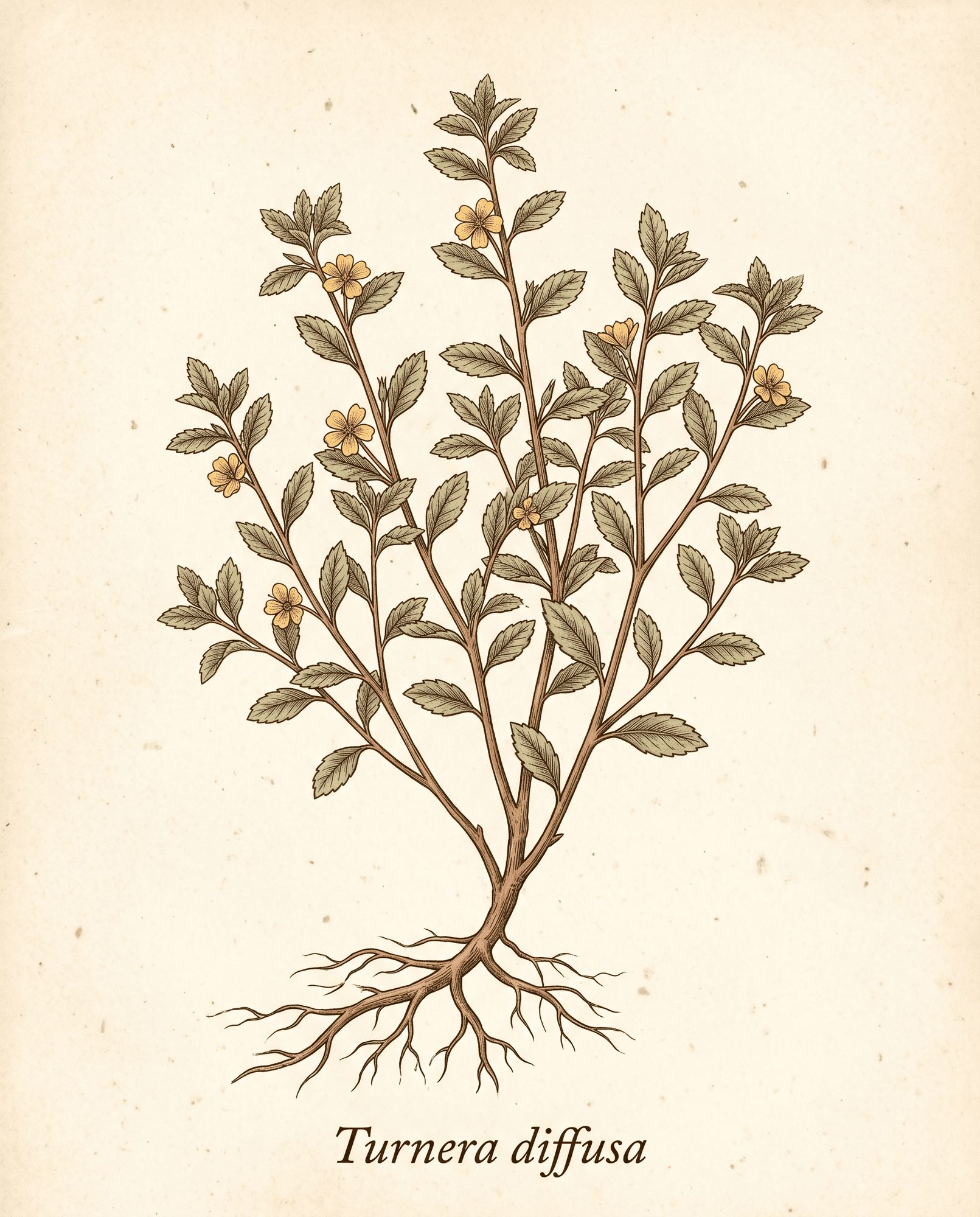
Damiana grows where the land gives almost nothing — the dry, rocky hillsides of Mexico and Baja California, the chaparral heat of south Texas, ground that asks every plant on it to prove she belongs. She is a small woody shrub, rarely taller than waist height, with little serrated leaves that release a fragrance somewhere between fig, chamomile, and warm resin when they are touched. Her flowers are small, golden, five-petaled, and brief — each one opens in the morning and closes by afternoon. She does not perform abundance. She embodies it quietly, blooming most generously right after the rains, as if to teach that pleasure follows relief, that the body opens when the pressure finally breaks.
Her medicine is the warming of what has gone cold. For centuries she has been the herb reached for when desire has dimmed, when the nerves are worn thin and flat, when the belly is tight with held worry, when a body has forgotten that it was made for enjoyment and not only for endurance. She lifts the mood and warms the pelvis in the same gesture, because she has never recognized the border between the two. The people who have known her longest have always taken her sweetened — honeyed infusions, cordials, liqueurs — an old instruction hiding in plain sight: this is medicine meant to be received as pleasure.
The shape of her medicine
Damiana is warm, dry, and aromatic, and her movement is doubled — she rises and she descends at once. The aromatic oils lift her into the head, brightening a flat, gray mood the way sun burns off a morning fog. At the same time her warmth sinks into the pelvic bowl, stirring circulation through the organs of desire and elimination. Herbalists call this quality diffusive: she spreads. A cup of the warm infusion can be felt moving outward through the chest and belly within minutes, a gentle loosening warmth that is her signature.
As a nervine trophorestorative, she does her deepest work in the worn-down nervous system — not the acutely panicked one, but the depleted one. Her territory is the flat, tired, uninterested state that follows long stress: the person who is not so much anxious as extinguished. She feeds and steadies the nerves over weeks, restoring tone the way food restores a fasting body.
Her antidepressant or thymoleptic action rides on the same current. She is a mood-lifter of the warming kind, best matched to depression that looks like coldness, heaviness, and withdrawal — the banked fire — rather than agitated, burning distress. The flavonoids she carries, apigenin among them, work along the body’s own calming pathways, so her lift comes without the jangle of a stimulant.
As an aphrodisiac she is the most famous of her kind, and the tradition is precise about how she works: she does not force desire, she removes what buries it. She warms the pelvic circulation, quiets performance-fear, loosens the held breath, and reconnects sensation to attention. Desire that has been suppressed by exhaustion, worry, grief, or disconnection is her specialty — for every body, in every season of life.
Her aromatic bitter and carminative actions wake the appetite and ease the tight, gassy, nervous digestion that stress installs in the belly. Her astringency tones lax tissue where warmth alone would not be enough. As a diuretic and urinary tonic she moves water gently and soothes irritated urinary passages — an old and half-forgotten branch of her medicine. And as an emmenagogue she encourages a delayed cycle to move, part of her general talent for restoring circulation to the pelvic bowl.
Taken together, her actions make one gesture: she rekindles. Where the vital fire has banked low — in the mood, the belly, the bladder, the womb, the desire — she blows gently on the coals.
What lives inside her
Whose medicine she carries
Air (uplift, the mood)
Mars
Scorpio
Two of Cups
Queen of Wands
Oshun
Oshun is the sweetness that makes life worth the labor of living it — the river that softens the hard land, the honey that is offered before anything is asked, the beauty that is not decoration but power. Her medicine is joy, sensuality, fertility, and the fierce insistence that pleasure and self-worth are not luxuries. Damiana belongs to her completely. She is a golden-flowered herb of the warm waters of the body, taken in honey and sweet wine for as long as anyone has written her story down, worked into love magic across the traditions she has touched. The oldest written record of her is a sweetened infusion shared for desire, drunk by the Indigenous peoples of Baja California. When she reached the hands of the diaspora centuries later, those who keep Oshun’s ways recognized the gesture on sight — herb, warmth, honey, love offered in a cup. The alignment rests on no archive. It rests on the medicine itself, which has always moved the way her medicine moves — golden, sweetened, and given so that joy can return.
But the deeper alignment is in how she works. Damiana does not manufacture desire, and Oshun’s medicine was never really about romance. Both restore something more fundamental: the capacity to receive. The person who needs damiana has often gone dry the way the riverbed goes dry — long effort, long grief, long seasons of being needed by everyone and replenished by no one, until pleasure itself starts to feel like something owed to other people. Damiana’s warmth moves through that body like the river returning, reminding the belly, the hips, the heart that they were made for enjoyment and not only for service. Working with her is Oshun’s own instruction: sweeten the medicine, honor the body, let the honey be part of the healing and not a bribe for taking it. She is the herb of pleasure reclaimed as a birthright — and of the quiet, radical act of wanting again.
The hands she has passed through
Her oldest names are Indigenous. To the Maya of the Yucatán she is mizib-coc, and their healers worked with her for dizziness, loss of balance, and troubles of breath — a plant for restoring steadiness to a shaken body. Across the north of Mexico she became hierba del venado, the deer herb, named for the animal that embodies swiftness and vitality in the dry country where she grows. The peoples of Baja California — among them the Guaycura, who hunted, fished, and gathered their living from that hard peninsula — knew her as a plant of stamina and desire long before any European wrote her name.
The written record begins in 1699, when the Jesuit missionary Juan María de Salvatierra reported that the Indigenous peoples of Baja California drank a sweetened infusion of the herb as an aphrodisiac. It says something that her first appearance in the colonial record is already the recipe — herb, water, sweetness, desire — that has never changed. In Mexican traditional medicine she settled into broad and steady use: for the nerves, the digestion, delayed menstruation, weakness after illness, the general dimming of vitality that curanderas read as a body whose fire needs tending.
Baja California still holds her most famous vessel. The damiana liqueur of the peninsula — golden, honeyed, herbal — is poured in a bottle shaped like a full-bodied goddess, and the region tells with a straight face that the original margarita was made with damiana liqueur, not orange liqueur. Whatever the truth of it, Baja’s bartenders and the liqueur’s makers keep the story alive with conviction, and the claim itself is the folklore: this is a plant people credit with making celebration possible.
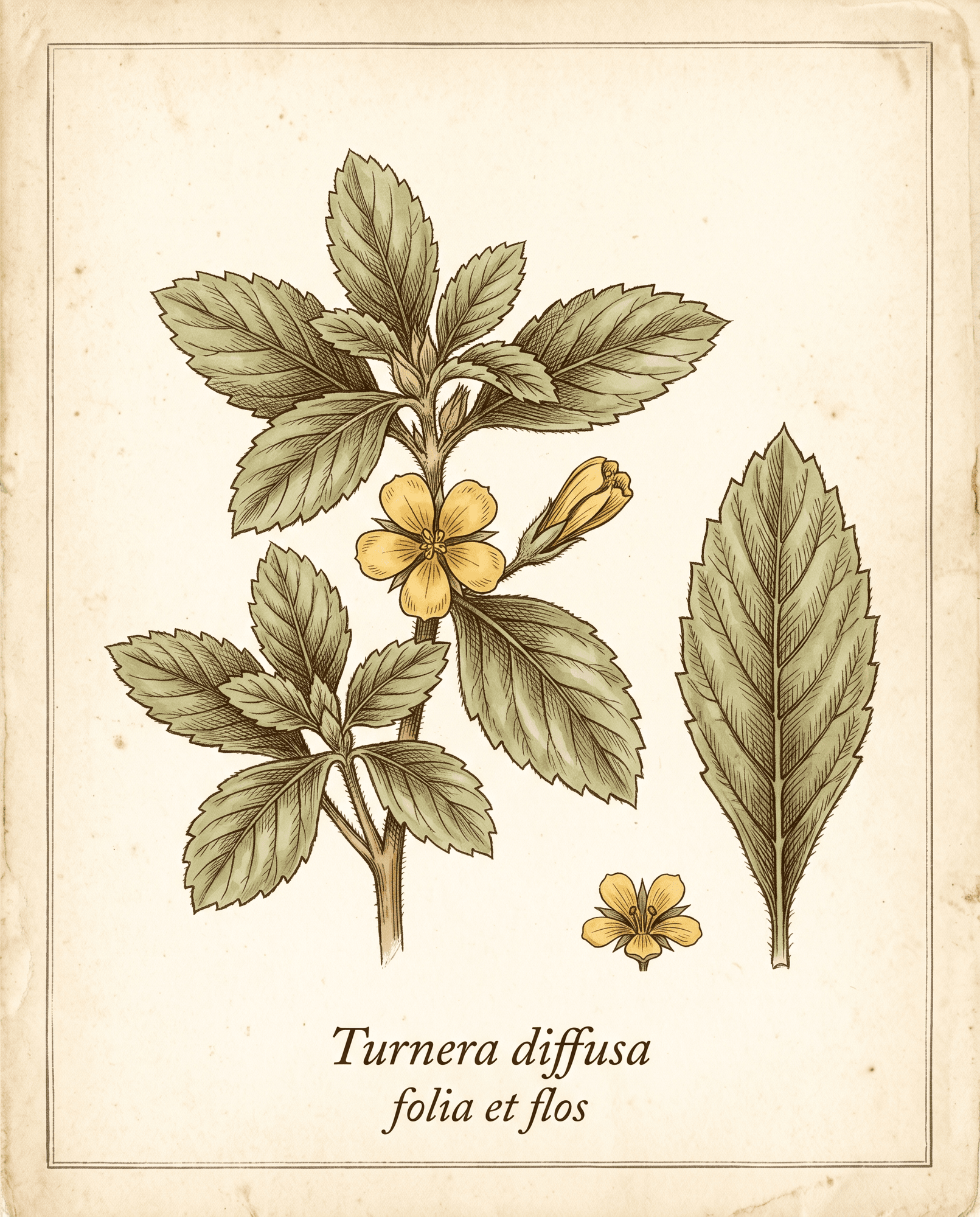
She crossed into United States commerce in the 1870s amid extravagant patent-medicine promises, but the sober record outlasted the hype — damiana entered the National Formulary in 1888 and remained listed until 1947. The Eclectic physicians valued her as a nerve tonic and remedy for sexual debility, especially where the cause was worry and depletion rather than disease.
And she found her way into African American conjure. In hoodoo, damiana is a love herb of the first rank — burned, carried, brewed, and worked into love-drawing formulas, called on to restore passion where it has faded and to draw a lover near. The rootworkers’ logic is the same as the herbalists’: she rekindles what has gone cold. That a Mexican desert shrub became part of the Black American magical pharmacy is the diaspora’s oldest habit — medicine recognized across borders, taken in, and set to work for the people who needed sweetness most. Contemporary Black herbalists keep her in that lineage; Karen M. Rose recommends her “for those recovering their pleasure after experiencing disconnection due to trauma.”
Across every tradition that has held her — Maya, Mexican, Eclectic, hoodoo, modern clinical herbalism — she keeps one character: the warm, sweet restorer of what depletion has dimmed.
Where she works in the body
Nervous system. This is the root of all her other work. Damiana is a trophorestorative for the depleted, flattened nervous system — the state of being worn past anxiety into dullness. She lifts mood, steadies the autonomic swings that follow long stress, eases tension headaches, and clears the fog of a tired mind. Her lift is warm and gentle rather than stimulating, which makes her sustainable where coffee and its cousins are not. She is best matched to the cold, heavy, discouraged presentation; in the hot, racing, overstimulated person she can occasionally add too much spark.
Reproductive system. Her most storied territory. She warms and increases circulation through the pelvic bowl, supporting arousal, sensation, and responsiveness in every body. For men the tradition names sexual debility, and the research record adds anti-aromatase and testosterone-supportive activity to the old claims. For women she has served for delayed menstruation, cramping tied to cold and stagnation, low libido, and the menopausal transition, where her mild estrogenic flavonoids and her nervine warmth meet hot flashes, dryness, and flatness of mood together. Her deepest reproductive medicine is the psychological one — desire dimmed by stress, grief, or disconnection.
Urinary system. An older layer of her use, worth remembering. The arbutin she shares with uva ursi lends a gentle antiseptic, tonifying influence on the urinary passages, and she was long given for irritated, inflamed bladder conditions and for recovery after infection — especially where the urinary and reproductive tissues are both lax, cold, and under-toned. She moves water mildly without harshness.
Digestive system. As an aromatic bitter she wakes appetite and digestive secretions; as a carminative she eases the gas, tightness, and colicky gripping of a nervous gut. She suits the digestion that shuts down under stress — the person who cannot eat when worried. Her mild laxative action relieves the sluggish bowel that accompanies the same pattern.
Endocrine system. Her flavonoids interact with the machinery of the sex hormones — restraining aromatase, offering mild estrogenic support — and the tradition credits her with a regulating influence on the deeper glandular intelligence that governs energy and desire. She is terrain medicine here: taken over weeks, she helps a depleted system remember its own rhythms.
Respiratory system. Her aromatic oils open and relax the chest. The Maya worked with her for troubles of breath, and she retains a place in smoking and steam blends for tight, spasmodic coughs and the held breath of anxiety — a smaller room of her house, but an old one.
How to take her
Harvest calendar
Preparations
Infusion: 1–2 teaspoons of dried leaf per cup of just-boiled water, covered, steeped 10–15 minutes. 1–3 cups daily. Cover the cup — the medicine is partly in the aromatic steam. Traditionally sweetened with honey, and better for it.
Tincture: 1:5 dry in 50–60% alcohol. Typical dose 2–4 mL, 2–3 times daily. A reliable addition to nervine, digestive, and reproductive formulas.
Cordial: Her signature preparation. Dried damiana steeped in brandy or another warm spirit for 2–4 weeks with rose petals, a little cinnamon or vanilla, then sweetened with honey. A small glass, shared or savored slowly, is both dose and ritual.
Infused honey: Dried leaf covered in raw honey and infused gently for 2–4 weeks. Taken by the spoon, stirred into tea, or served where sweetness is the point.
Herbal bath: A strong infusion added to a warm bath for the cold, depleted, disconnected body — often with rose petals. Old love-work and good nervous system medicine in the same water.
Infused oil: Dried leaf slow-infused in a carrier oil for 4–6 weeks, for warming massage — including intimate massage. Patch test first; this is the herbal oil, never an essential oil.
Smoke: She has a long history in smoking blends, usually softened with mullein or mugwort, for relaxation and ceremony. An occasional-use preparation, not a daily one.
Spiritual & ritual:
- Worked into love-drawing preparations, honey jars, and sweetening work — her oldest magical employment
- A cordial shared between lovers to open honest speech about desire
- Added to baths before ritual, celebration, or reunion
- Placed on altars dedicated to Oshun, with honey and yellow flowers
- Burned or carried to rekindle passion that has faded
When to hold back
Use with caution if:
- You are pregnant — she is a traditional emmenagogue and her history includes use to bring on menstruation. Avoid. Avoid also while breastfeeding, where safety is simply unestablished.
- You take blood-sugar-lowering medication. She has a mild hypoglycemic influence that may be additive; monitor closely.
- You run hot and anxious. Her warmth suits the cold and depleted; in agitated, overstimulated, insomniac presentations she can add fuel.
- You are anemic or rely on iron-rich meals — her tannins can hinder iron absorption. Take her away from meals or in tincture form for long-term use.
- You have active urinary or kidney inflammation of a hot, acute kind — she is for the recovering, toned-down phase, not the acute fire.
Topical considerations: The infused oil is generally gentle; patch test before intimate use. Never apply concentrated extracts to mucous membranes.
General notes: Respect the dose. Her normal range is generous and safe, but truly excessive amounts — many times the traditional dose — are unwise on account of her cyanogenic glycosides, with old reports of serious trouble at extreme quantities. This is medicine that rewards the moderate, sweetened, unhurried cup, not the heroic one.
Who walks with her
For the depleted nervous system: Milky oats, skullcap, passionflower, tulsi, lemon balm.
For desire and warmth: Cinnamon, ginger, rose, cacao, vanilla.
For the grieving or guarded heart: Rose, mimosa, motherwort, hawthorn.
For hormonal transitions: Red clover, vitex, shatavari, black cohosh.
For the nervous belly: Chamomile, fennel, lemon balm, ginger.
As the classic cordial: Damiana, rose, cinnamon, orange peel, honey, brandy.
Her community gathers around one project: restoring warmth and sweetness to the depleted body. Milky oats rebuilds the substance of the nerves while damiana rekindles their spark — the great pairing for the burned-out. Rose opens the guarded heart so that damiana’s warmth has somewhere to arrive; the two share the love-work of every tradition that has held them both. Cinnamon doubles her pelvic warmth and makes the cordial sing. Passionflower and skullcap hold her steady where there is agitation mixed into the exhaustion. She is generous in formula — a diffusive, aromatic warmth that carries quieter herbs outward through the body — and like all good hosts, she makes everyone around her more welcoming.
How to know her
Meeting through scent: Most of us will meet her dried before we meet her growing. So meet her properly: take a pinch of the dried leaf, crush it slowly between your fingers, close your eyes, and breathe in. Fig, resin, chamomile, warmth. Scent is the oldest road to memory and desire, and it is exactly the road she travels in the body. Notice what softens in you before you have swallowed anything at all.
The cordial ritual: Begin at the new moon. Steep damiana in brandy with rose petals and a stick of cinnamon, and let it sit in a dark place through the full cycle, shaking the jar gently when you pass and naming, each time, one pleasure you are ready to take back. Strain and sweeten with honey at the next new moon. Pour a small glass. Drink it slowly, without multitasking, as an act of devotion to your own body.
Ritual of returning: For the season when pleasure has gone distant — after loss, after depletion, after too long being only useful. Draw a warm bath and add a strong damiana infusion, rose petals, and a spoonful of honey dissolved in the water. Candlelight if you have it. Stay until the water begins to cool, and let your only task be noticing what the warmth touches. Before you rise, speak one sentence that begins: I am allowed to want.
Journal prompts
- Where in my life has the fire banked low — not gone out, but gone untended?
- What pleasures have I deferred until some imagined time when I will have earned them?
- What would it mean to receive as readily as I give?
- When did I last feel fully at home in my own body, and what was present then?
- What am I ready to want again, out loud?
Tarot Spread
A spread for entering into relationship with Damiana as a plant ally:
- Where has my vitality gone cold or quiet?
- What buried desire is she warming back toward the surface?
- What stands between me and receiving pleasure without apology?
- What sweetness is already present in my life that I have not tasted?
- What does she want me to know about my own worthiness?
Keep a small dish of the dried leaf or a vial of the cordial on your altar with the cards. Let the scent be part of the reading.
The same plant, multiple lenses
Damiana is not part of the classical Ayurvedic materia medica — she is a plant of the Americas — but her pattern reads clearly in its language. She is pungent and bitter in taste, heating in potency, with a drying quality, and her work places her among the vajikarana herbs — the classical category of medicines that restore vitality, virility, and the capacity for love. Like the great vajikarana remedies, she treats desire as an expression of ojas, the deep vital reserve, rather than a performance to be forced.
Vata Dosha — Air & Ether
Her closest kinship. The depleted, anxious, cold, scattered Vata state — worn nerves, vanished appetite, desire buried under worry — is exactly her territory, and her warmth is genuine medicine for Vata’s chill. Her dryness is the one caution, since Vata is already dry; in long use she is best carried by moistening, building companions — milky oats, shatavari, ashwagandha, honey itself.
Pitta Dosha — Fire & Water
Handle with awareness. Damiana adds warmth, and a Pitta system already running hot — irritable, inflamed, burning-eyed, sharp — does not need her fire. In moderate doses and cooling company (rose is the classic softener) she can still serve Pitta’s depleted states, but she is not the first herb for a hot constitution.
Kapha Dosha — Earth & Water
A good match. Kapha’s heaviness — the slow, damp, unmotivated sinking of mood and libido, the sluggish digestion — answers well to her pungent, warming, drying movement. She lightens what has grown heavy and stirs what has settled, and her bitterness helps cut through Kapha’s accumulation.
Damiana has no classical entry in the Chinese materia medica — she never crossed into that tradition’s formative centuries — but her pattern language translates directly.
Taste & Temperature: Acrid (pungent) and bitter, warm. Channels Entered: Kidney, Heart, and Liver. Functions: Warms and tonifies Kidney Yang. Moves Liver Qi in the lower burner. Lifts and calms the Shen.
Warming Kidney Yang
In TCM’s reading, sexual vitality, deep energy, and the will to live forward are the province of the Kidneys, and their decline — cold low back and knees, low libido, fatigue, discouragement — is Kidney Yang deficiency. This is precisely the terrain damiana has always served: the cold, depleted body whose fire has banked low. Her warmth rebuilds the gentle heat of the lower burner the way the classical Yang tonics do, in a milder key.
Moving Liver Qi in the Lower Burner
Stagnation — the held, stuck, frustrated pattern that shows as pelvic congestion, delayed or crampy menstruation, tight nervous digestion, and mood that cannot move — belongs to constrained Liver Qi. Damiana’s diffusive, aromatic movement unbinds it, circulating warmth and Qi through the pelvis and the hypochondrium. Her gift for desire blocked by frustration or worry is, in this language, simply the freeing of Liver Qi.
Lifting & Calming the Shen
Her flavonoids’ quiet, mood-brightening influence reads as Shen medicine — settling the spirit while gently lifting it, the both-at-once action TCM prizes in herbs that treat a disturbed heart without sedating it. She suits the dispirited, flat Shen more than the agitated one.
Yin/Yang Balance
Damiana is Yang-leaning — warming, moving, and mildly drying. She is medicine for cold, deficient, and stagnant patterns: the banked fire, the stuck pelvis, the dispirited heart. She is not for Yin-deficient heat — night sweats, red tongue, restless burning insomnia — where her warmth aggravates, nor for any acutely hot, inflamed condition. Where there is cold and stillness, she is the returning warmth; where there is already fire, she should stand aside or come well accompanied by cooling, moistening allies.
For going deeper
- Biblioteca Digital de la Medicina Tradicional Mexicana (UNAM) — the deepest place-based record of damiana in Mexican traditional medicine, in Spanish; her entry gathers regional names and uses across the country.
- Wood, Matthew. The Earthwise Herbal, Volume II: A Complete Guide to New World Medicinal Plants. North Atlantic Books.
- Rose, Karen M. The Art & Practice of Spiritual Herbalism. Fair Winds Press. — a contemporary Black herbalist’s lineage-keeping, including damiana’s place in pleasure and trauma recovery.
- yronwode, catherine. Hoodoo Herb and Root Magic: A Materia Magica of African-American Conjure. Lucky Mojo Curio Company. — for her role in the conjure love pharmacy.
- Felter, Harvey Wickes & Lloyd, John Uri. King’s American Dispensatory (1898) — the Eclectic-era entry on Turnera, available through Henriette’s Herbal.
- Herbal Reality. Damiana monograph — a careful modern clinical profile with energetics and safety.
- Rätsch, Christian. The Encyclopedia of Psychoactive Plants. Park Street Press. — for the deeper ethnobotany of her Mexican and Maya history.
- Conversations with curanderas and yerberas where you live, and with the elders of the conjure tradition — her sweetened cup has been passed hand to hand for three centuries, and the living instruction still travels that way.
The Conversation
Questions, noticings, what this is teaching you — leave them here. This same conversation lives in The Circle.