Rose
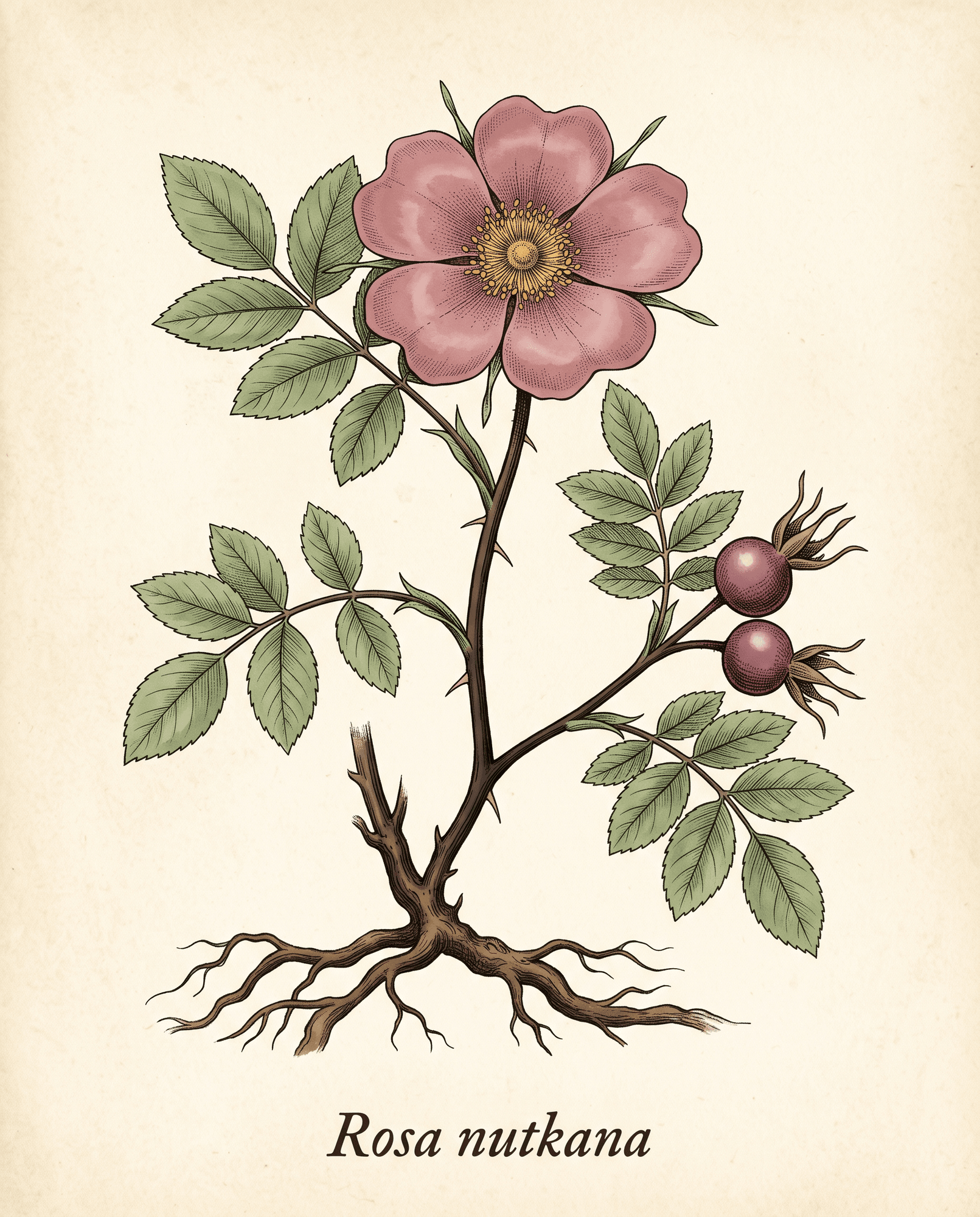
Rose is the plant we reach for when the heart has had to armor itself. She grows the bloom and the thorn on the same cane, and she does not apologize for either — you cannot come close to her softness without meeting the thing that guards it. This is not a contradiction she is asking us to resolve. It is the whole of her teaching, offered on a single stem.
The rose most of us were handed is a florist’s rose, doubled and doubled again until she is all petal and no fruit, bred for a scent and shipped across an ocean. That is not the rose this monograph is about. Ours is the Nootka rose, Rosa nutkana — the one growing in the thicket at the edge of the field, along the bluff, in the ditch by the road you drive every day. She wears five petals, the way a wild rose does. She throws hips the size of a thumbnail that go purple-red after the frost. She has held this ground long before it was given the name it carries now, and she has fed and doctored the people of this coast the whole time. You do not have to buy her. You have to go outside.
The shape of her medicine
Rose moves cool, dry, and inward. Hers is not the outward, dispersing gesture of the aromatics; she draws in, settles, tones, and gathers. Where there is too much heat — flushed skin, a short fuse, inflamed eyes, the simmering that comes just before tears — she brings the temperature down without shutting anything off. She does not sedate. She softens.
The first thing to know about the wild rose, and the thing that separates her from her cultivated cousins, is that she is astringent before she is anything else. Taste a petal and it puckers. Taste a hip and it is sour and drawing. That astringency is tannin, and it runs through the whole of her — petal, leaf, root, bark, and fruit alike. The garden rose has been bred toward perfume; the wild rose has kept her structure. This is the tissue-toning, edge-holding, boundary-making rose, and everything else she does rests on that.
Her astringency is the ground note. She tones tissue that has gone lax, boggy, or weeping — a slack gut, a weeping wound, a membrane that has stopped holding its line. That same drawing-in is her anti-inflammatory action, gathering back tissue that has puffed and reddened with heat, and her vulnerary action, closing a wound rather than merely covering it. This is why the old preparations of her are washes and gargles and eyewashes and poultices: she is at her most reliable where she can meet the tissue directly.
As a nervine relaxant she meets the wired and the heat-tense — the ones whose stress arrives as agitation rather than collapse, who are raw and close to snapping. She does not knock them down; she takes the charge out of the air. This is why she belongs to grief so completely: grief lives in the body as a held breath and a braced chest, and rose gives the holding somewhere to go. Be honest about the register, though. The wild rose is fragrant, but she is not the perfume the damask is, and much of rose’s reputation as a nervine rides on volatile oils the cultivated rose is bred to concentrate. Ours works more through tissue and less through scent. She is the quieter medicine, and the more available one.
As a cardiotonic she tends the physical heart — antioxidant, gently circulatory, steadying under pressure. Her reputation as heart medicine has always lived in both registers at once, and the plant herself does not appear to distinguish between them.
As a nutritive she is a genuine food, and this is not a lesser category. The hip is one of the great sources of vitamin C on this continent, and she has carried people through winters on that alone. Her antimicrobial thread runs through petal and hip. Her refrigerant nature cools an overheated system. And as a mild antidepressant she lifts a low, closed mood — less by stimulating than by dissolving the armor that was in the way.
Taken together, her actions form one gesture: tending the boundary. She is for the tissue that has lost its edge, and for the body that has protected itself so well it can no longer be reached. Those turn out to be the same problem, approached from opposite sides.
What lives inside her
Whose medicine she carries
Fire (bloom, eros)
Libra
The Lovers
Oshun
Oshun is the Orisha of the sweet waters — the rivers and the springs — and of love, sensuality, beauty, fertility, the arts, and the self-worth that all of those rest upon. She holds the honey and the gold. Her sweetness is not shallow; it runs over real depth, and she has a temper that surfaces when she is not given her due.
Rose is Oshun’s flower without any strain in the joining. She is the bloom of love and beauty, of adornment and pleasure, of the heart that wants to be wanted. Her sweetness is Oshun’s honey. Her petals belong on the surface of the river — and the wild rose obliges, growing thick along the riverbank and the creek edge, leaning her blooms over the water. When the work is calling love in — including love of the self, which Oshun insists comes first and refuses to let anyone skip — rose is the ally who answers. She softens the face we turn toward the world, restores the sense of being worth tending, and warms a desire that has gone cold under grief or exhaustion.
But the thorn is Oshun’s too, and this is the part that gets left out when people want her to be only sweet. Oshun’s waters run deep, and her diplomacy turns fierce when she is disrespected. Rose carries that same refusal in her body, and the wild rose carries it more plainly than any garden rose does: her prickles come in pairs, standing at the base of every single leaf, and she grows into thickets nothing can walk through. She will give you the bloom and she will draw your blood on the way to it, and she does not consider these two different gestures. This is the teaching she holds most insistently: you are allowed to be beautiful and soft and open, and you are allowed to defend that softness. A self-love with no boundary is not love — it is a slow leak. Rose holds both at once, exactly as Oshun does, and she asks us to learn how.
The hands she has passed through
She is a food and a medicine of this coast, and that is where her story starts.
Long before this land was given the name it carries now, the Nootka rose was worked by the peoples of the Salish Sea and the rivers running into it — among them the Skagit, the Lummi, the Quinault, the Saanich, the Nitinaht, the Cowichan, the Bella Coola, and the Nlaka’pamux. She was not a specialty herb. She was infrastructure.
The hips were eaten fresh, dried for the winter, boiled into a drink, and mixed with salmon eggs — a pairing that puts the fruit’s sourness against the roe’s richness and, not incidentally, marries one of the great sources of vitamin C on this coast to one of the great sources of fat. The young shoots were eaten in spring while still short and reddish, sweetest where they grew in the sun, and the Hul’qumi’num name for them, the’thqi, belongs to that harvest. The leaves went into the cooking pit, laid over food to steam it and keep it from scorching. The Lummi peeled the twigs and made them into a beverage tea.
The medicine ran the length of the plant. An infusion of the roots and sprouts was a wash for sore eyes — a use so widespread across these nations that it may be the single most consistently attested thing anyone did with her. A decoction of the roots eased a sore throat, and was taken by women after giving birth. A decoction of the bark was drunk to ease the pains of labor, and used as a wash for the hair and body. A decoction of the branches — sometimes with chokecherry and red willow — met diarrhea, vomiting, and the complaints of women. A poultice of chewed leaves took the fire out of a bee sting. Leaves went into the shoes against the rot that grows there.
And then there is what she did at the two thresholds. Rose wood was bent into cradle hoops. Rose branches were used to sweep the gravesites before a burial, and were carried at the passing of a loved one. She met the newborn and she swept the ground where the dead were laid. Hold that next to the rest of what the world has done with her, and something opens up.
The wider genus, and the roses who were bred.
Across the Atlantic and further east, other roses were taken into cultivation and carried different work. In Mesopotamia the rose was sacred to Inanna-Ishtar, goddess of love and of war, and the thorn and the petal together were read as her whole nature. In Egypt roses went into funeral garlands and temple rites, sacred to Isis, and it was said they grew from the tears she wept for Osiris. The Greeks told the same story of Aphrodite, whose roses first bloomed from her weeping over the dying Adonis, and Rome carried it to Venus — and gave us sub rosa, “under the rose,” the phrase for what is spoken in confidence.
In Persia and the Arabic world, the damask was distilled into rose water for ailments of the heart and the mind, and in Sufi poetry she became the face of the divine beloved. In India she is Gulab and Shatapatri — the hundred-petaled — woven into medicine, food, and ritual for thousands of years. In China, mei gui hua is the beach rose, Rosa rugosa, taken as a mild daily tea for the stuck and irritable heart. Medieval European herbalists used Rosa gallica, the apothecary’s rose, as an astringent and a tonic; the courtly tradition made her the symbol of the beloved, and the Church gave her to the Virgin as a sign of divine love.
Beneath all of it runs the rose of mourning — white for the young, red for a love continuing past death, pink for grace in the remembering. Cemetery roses were said to bloom with unusual vigor, fed by memory.
Which is the thing worth sitting with. Egypt put her in the funeral garland. Greece grew her from a goddess’s grief. Europe planted her over the graves. And on this coast, with no contact and no shared root, people swept the burial ground with her branches. Four lineages that never spoke to one another, reaching for the same flower at the edge of the same loss. That convergence is not decoration. It is evidence, and it is the kind of evidence this work takes seriously.
Where she works in the body
Cardiovascular system. She is an antioxidant, gently circulatory, steadying tonic for the physical heart, and she supports a heart that has been running hot and pressured to come back down. Her astringency tones the vessel walls; her flavonoids protect them. What is remarkable is that no tradition has ever felt the need to separate this from her work on the emotional heart. The plant treats them as one organ with two registers, and that refusal to split them is not poetic license — it is the center of what she has to teach.
Nervous system. She meets the wired, overheated, irritable nervous system — the one that frays toward anger and tears rather than shutdown. This is her grief medicine. Heartbreak sits in the body as a braced chest and a breath that never fully lands, and she does not numb that. She makes it survivable to feel. Her aromatic compounds settle the nervous system and lift a low mood, though here the cultivated rose is frankly the stronger tool, and it is worth saying so rather than overselling the plant in the thicket.
Reproductive system. This is the oldest and best-attested of her uses on this coast, and it deserves its weight. The bark was decocted to ease the pains of labor, and the root taken by women after giving birth — a plant met at the hardest hour and again in the recovery. Her astringency is what makes that work: she tones the tissue that has been stretched past itself, and she checks a bleeding that has gone on too long. That same astringency has long met heavy menstrual flow. And her petals ease the tension of a cycle that arrives braided with irritability and heat. The line running between the emotional heart and the womb is one she keeps lit, and she treats a closure in one as related to a closure in the other.
Digestive system. Her astringency firms a loose, relaxed, weeping gut — which is precisely why a decoction of her branches met diarrhea and vomiting here. She settles a digestive tract running hot: acidity, irritation, the queasy stomach that arrives with stress and does not leave with it. And the hip is a food, sour and mineral-rich, that the gut simply likes. She does this without dampening the digestive fire, which is part of why she is tolerated across such a wide range of constitutions.
Musculoskeletal system. This is the hip’s territory, not the petal’s, and the distinction matters — the rose who tends the heart and the rose who tends the joints are the same plant working through different parts of herself. The whole hip, seeds and husk together, carries a galactolipid that quiets the migration of inflammatory white cells into joint tissue, alongside the broad antioxidant load of her carotenoids and flavonoids. What that looks like in a body is a slow lowering of chronic inflammatory heat: less morning stiffness, less ache in the weight-bearing joints, a gentler baseline in the connective tissue.
She is not a fast remedy here. She works the way food works — taken over months, held in formula, lowering a baseline rather than interrupting a flare. Someone in acute pain will not thank you on Friday. Someone who has taken her through a winter will notice, come spring, that the mornings have gotten easier. And note where the medicine lives: in the whole fruit, nothing fractionated out. The hedgerow answers this one, not the pharmacy.
Skin. Here her cooling and her astringency meet the body’s own boundary. Topically she quiets inflamed, red, reactive skin, tones lax tissue and weeping irritation, closes pores, and supports the healing of wounds — the chewed leaf on the bee sting, the ash poultice on the swelling, the root wash for the inflamed eye. All of it is the same gesture arriving at the surface. The skin is the literal interface between self and world — and rose, whose entire medicine is the tending of a tender boundary, does that work right there on the membrane where the question is being asked.
How to take her
Harvest calendar
Preparations
Hips, decoction: 1–2 teaspoons of dried, split hips per cup of water. Simmer gently 10–15 minutes, then strain well through cloth. Sour, mineral-rich, and where the vitamin C actually lives. Harvest after the first frost.
Hips, syrup: The decoction reduced and finished with honey. The form children will take willingly, and the one that carries a household through a winter.
Hips, vinegar or oxymel: Split hips steeped in raw cider vinegar for 4–6 weeks. The acidity suits her better than any other menstruum — it holds the vitamin C more stably than water or alcohol, and it draws her minerals besides. An underused preparation, and arguably her best.
Hips, tincture: Dried hips 1:5 in 25–40% alcohol. A different medicine rather than a stronger decoction. Alcohol reaches the flavonoids, the carotenoids, and the fat-soluble galactolipids that water leaves behind in the jar — but it extracts the vitamin C poorly and holds it badly. Reach for the tincture when the work is antioxidant and anti-inflammatory; reach for water and vinegar when the work is nourishment. A middle-proof menstruum splits the difference honestly.
Hips, powder: The whole dried hip — seeds, husk, and all — milled fine and taken by the spoonful in food or stirred into a warm drink. Plain, unglamorous, and the form this medicine has always been carried in. Nothing is fractionated out, which is likely the point: the oil-loving and the water-loving parts of her arrive together, the way they do in the fruit. Sieve it well.
Hips, food: Fresh, dried, boiled, cooked to jam or purée. Traditionally eaten with salmon eggs, which is a better formulation than it sounds — the sour against the rich, the vitamin C against the fat.
Petal infusion: 1–2 teaspoons dried petals, or a small handful fresh, per cup of just-boiled water. Steep 5–10 minutes covered — the covering matters, or the aromatic medicine leaves with the steam.
Petal or leaf wash: A strong infusion, cooled, for inflamed skin, weeping irritation, and wounds that need closing. This is her most dependable topical form.
Root or bark decoction: Simmered, and taken sparingly. This is the strongest astringent she offers, and the form the old preparations reached for in sore throat, in heavy bleeding, and in the tissue-toning work after birth. Take root only where the stand is generous and you are prepared to lose the plant.
Eyewash: A weak, scrupulously strained and cooled infusion of root or young sprouts. The most widely attested use of her on this coast. Sterile technique, or don’t.
Leaf poultice: Chewed or bruised fresh, laid on a sting, a bite, a hot swelling.
Young shoots: Eaten in spring, raw or briefly cooked, while still short and tender.
Seed oil: Cold-pressed from the achene rather than infused from the fruit — a different extraction, and a regenerative skin medicine in its own right.
Spiritual & ritual:
- Petals floated on rivers and sweet water as offering to Oshun
- Petals strewn in work for love, self-return, and the restoration of worth
- A grief bath with petals and honey, taken at dusk
- Branches carried, or laid, at a passing
- Dried buds kept on the altar during heart-tending or ancestral work
When to hold back
Use with caution if:
- You are working with whole hips. The fine hairs packed around the seeds are a real irritant to the mouth, the gut, and the skin. Split, clean, and strain — this is the reason every old preparation insists on it, and it applies to the tincture as much as to the tea.
- You are very dry or depleted by constitution and intend to use her heavily over the long term. Her astringency asks for moistening, building companions alongside.
- You are reaching for root or bark. These are considerably stronger than petal or hip, and are taken in small amounts and short courses.
- You are pregnant. The petal and the hip are food and are safe. Bark and root are a different matter — they were reserved for labor and for the days after it, and that is a clinical context with a midwife in the room, not a daily tea.
- You have a known sensitivity to the Rosaceae family. Uncommon, but not impossible.
Topical considerations: For the eyes, only a weak, thoroughly strained, freshly made preparation. Rose essential oil — a cultivated-rose product — is diluted before it meets skin, never applied neat.
General notes: Harvest matters more than dosage here. Take her from ground you know: not the sprayed verge, not the roadside where the exhaust settles, not the park that gets treated. Take the hips generously, the petals lightly, the root rarely. Leave the thicket standing — she is shelter and food for half the birds on this coast, and she was theirs before she was ours.
Who walks with her
For the heart, in both registers: Hawthorn, motherwort, mimosa, linden.
For grief and anxious heat: Lemon balm, milky oats, skullcap, lavender.
For the womb and the birthing year: Raspberry leaf, motherwort, cramp bark.
For the joints, over the long haul: Nettle, meadowsweet, turmeric.
For the skin and the wound, topically: Calendula, plantain, chamomile.
Hawthorn is her closest kin and her most natural partner — another of the Rosaceae, another thorn-bearer, another plant that refuses to separate the physical heart from the grieving one. Together they hold heartbreak while quietly rebuilding the ground beneath it. Raspberry leaf is the other Rosaceae in the birthing work, and the two of them tone the same tissue by the same means. Where rose tends the boundary of the heart, mimosa moves what has gotten stuck inside it, and motherwort holds the line for a heart under long strain. Milky oats and lemon balm balance her astringency with genuine nourishment, so that over a long protocol she does not over-dry what she is trying to soften. Notice how many of her allies carry thorns or grow at the edges. That is not coincidence. It is a family, and they keep the same kind of company.
How to know her
Plant walk: Find a wild rose in her thicket — the bluff, the ditch, the edge of the field. Reach for a bloom. Notice that you cannot get to it without negotiating the thorn, and notice what your body does in that negotiation. Do not rush past this. Count the petals: there will be five. Then look at where the prickles sit — paired, at the base of each leaf, guarding the joint where the new growth comes. She does not defend herself randomly. She defends herself precisely, at the places where she is opening.
Seasonal practice: Meet her three times in a year. Take the young shoots in early spring, when they are red and short and sweet. Take the petals at the height of her bloom. Take the hips after the first frost, when the cold has done its work on them. Each harvest is a different medicine and a different mood, and the year will teach you the difference better than any book will.
Ritual of the open heart: Make a strong petal infusion, pour it into a warm bath at dusk, and get in. Speak to whatever you are grieving — out loud, if you can. Let the tears come if they are coming; she is entirely at home in tears, which is where the goddesses first found her. Stay until the water cools.
Ritual of the threshold: She meets both ends of a life — bent into a cradle hoop, and swept across the ground where the dead are laid. When you are standing at either edge, sit with her. Carry a branch. Lay petals down. You do not need to invent a ceremony; you are joining one that has been running on this ground for a very long time. Go quietly, and go with respect for whose ceremony it was first.
Journal prompts
- Where have I armored my heart, and is that armor still serving me — or has it outlived the thing it was built for?
- What would it mean to be soft and protected at the same time, instead of choosing between them?
- The rose defends herself precisely at the joints where she is opening. Where do I need protection — and is it where I have been putting it?
- What grief am I carrying inside my love? Can the two live together without canceling each other out?
- What am I willing to receive from a plant I did not buy, and did not plant, and cannot own?
Tarot Spread
A spread for entering into relationship with Rose as a plant ally:
- How does Rose meet me — what face does she turn toward me right now?
- What in me is the petal: soft, open, waiting to be met?
- What in me is the thorn: what am I protecting, and how?
- What does she want to teach me about holding both at once?
- What is the offering she asks of me in return?
Keep a dried bloom, or a handful of hips, beside the cards. Sit long enough for the answer to arrive rather than be assembled.
The same plant, multiple lenses
A necessary honesty first: the Ayurvedic material on rose describes the cultivated rose. Shatapatri means hundred-petaled, which is a literal description of a bred flower — our wild rose wears five. So what follows is her cousin’s reading, offered because it is genuinely useful and because the underlying gesture carries across, with the differences named where they fall.
She is classed among the Sita Virya herbs — cold in potency — with a sweet and astringent taste. The cultivated rose is called tridoshic, balancing to all three. Our wild rose is more astringent and less sweet, which sharpens her toward Pitta and Kapha and away from Vata.
Pitta Dosha — Fire & Water
This is her strongest alignment and the one she is most revered for. Aggravated Pitta shows up as irritability, sharp anger, inflammation, hyperacidity, heat rashes, inflamed eyes, and burnout, and her cooling answers all of it. Most tellingly, she is said to balance Sadhaka Pitta — the subtle fire seated in the heart that governs how we process and digest our emotions. When sadhaka pitta runs hot we burn through our feelings as anger and overwhelm rather than metabolizing them. Rose cools that fire so the heart can do its work instead of combusting. She is named a hridya, a tonic for the heart, and a medhya, a plant that clears and steadies the mind. That the wild rose’s most attested traditional use on this coast is a wash for the inflamed eye — the classic Pitta site — is the kind of convergence worth noticing.
Kapha Dosha — Earth & Water
Her astringency cuts congestion and the heaviness Kapha accumulates, and she lifts the dullness that settles into a Kapha-heavy system. The wild rose, being the drier of the two, does this more readily than her sweet cultivated cousin. In genuine cold-damp excess, pair her with a warming spice — ginger, cardamom, cinnamon — so that her coolness does not deepen the very stagnation she was called for.
Vata Dosha — Air & Ether
Here the two roses part ways. The cultivated rose, with her sweet unctuous quality — rose oil, rose water — soothes the nervousness and scattered anxiety Vata brings, and her fragrance settles the wind. The wild rose is drier and more astringent, and used heavily and long in an already dry, depleted Vata body, she can aggravate rather than soothe. Give her demulcent, building companions to hold her: marshmallow, milky oats, licorice, a good fat. Notably, neither rose smothers agni, the digestive fire, which is much of why she sits so easily in so many bodies.
Here is where the species question stops being academic, and it is worth teaching slowly.
Mei gui hua — the rose bud of Chinese medicine — is Rosa rugosa, the beach rose. Not the damask, and not the Nootka. And she is classified as warm, where nearly every other rose in nearly every other tradition is called cooling.
That looks like a contradiction until you see what it actually is. Chinese medicine is not disagreeing about rose. It is describing a different rose. Rosa rugosa runs warmer than her kin, and the tradition read her accurately. The contradiction was never in the medicine; it was in our assumption that one word — rose — names one plant. It does not. Species changes the medicine, exactly as preparation does. That is the whole teaching, and this is the cleanest place in the entire materia medica to demonstrate it.
Taste & Temperature: Sweet, slightly bitter, aromatic; warm. (Rosa rugosa.) Channels Entered: Liver and Spleen, reaching the Heart. Functions: Moves Liver Qi and relieves constraint. Harmonizes and invigorates the Blood. Awakens the Spleen. Calms the Shen.
Moving Liver Qi & Relieving Constraint
Liver Qi stagnation is the picture of emotion that has gotten stuck: irritability, mood that swings, a stifling tightness across the chest and ribs, sighing, tension that builds and will not discharge. Mei gui hua moves that stuck Qi the way a long-held sigh finally releases — gently, without the depleting force of the stronger Qi-movers, which is why she is mild enough to be taken as tea every day rather than saved for a formula.
Harmonizing & Invigorating the Blood
Qi moves Blood; when Qi locks, Blood slows and congeals behind it. Because she frees the Qi, she also gets the Blood moving — the mechanism behind her long use for menstrual pain, irregular cycles, and stagnation held in the pelvis. Her Blood-moving action is real but restrained. She persuades rather than forces, and that restraint is a feature.
Awakening the Spleen & Calming the Shen
When the Liver constrains and then overacts on the Stomach, digestion suffers: epigastric distension, poor appetite, nausea that tracks with mood. Her aromatic quality rouses a sluggish Spleen while she is simultaneously softening the Liver that was crowding it. And she settles the Shen — the spirit, the heart-mind — which is the register in which most people actually meet her.
Yin/Yang Balance
Rosa rugosa is warm and moving — she is for constraint, for the Qi and Blood that have locked, for the heat that is smoldering because nothing is flowing. She is not for a body that is already hot and dry and empty.
Our Nootka rose is Yin in nature — cool, astringent, gathering, descending. She is not a Qi-mover. She is a toner. Where rugosa unsticks what has locked, nutkana draws in what has gone slack. Read them side by side and you have two roses doing nearly opposite work, both correct, both called rose. Which is the last word on the matter, and the reason this monograph names its species.
For going deeper
- Turner, Nancy J. Ancient Pathways, Ancestral Knowledge: Ethnobotany and Ecological Wisdom of Indigenous Peoples of Northwestern North America. McGill-Queen’s University Press. — the essential work for this plant on this ground.
- Gunther, Erna. Ethnobotany of Western Washington. University of Washington Press. — the older record, and a direct one.
- Pojar, Jim & MacKinnon, Andy. Plants of the Pacific Northwest Coast. Lone Pine. — the field guide to actually carry.
- Moerman, Daniel E. Native American Ethnobotany. Timber Press. — for the breadth of the record across nations.
- The Hul’qumi’num Ecosystem Guide, and the plant knowledge held by the nations of the Salish Sea. Where this knowledge is offered, receive it as a gift and cite it as a lineage. Where it is not offered, leave it.
- Wood, Matthew. The Earthwise Herbal. North Atlantic Books. — for rose in the Western clinical tradition.
- Popham, Sajah. Evolutionary Herbalism. North Atlantic Books. — for rose under Venus, and the five-petaled signature.
- Bensky, Dan, et al. Chinese Herbal Medicine: Materia Medica. Eastland Press. — for mei gui hua, and for the reminder that she is Rosa rugosa.
- Teish, Luisah. Jambalaya. HarperOne. — for Oshun, the sweet waters, and the practice of offering.
- And the thicket at the edge of the field. Go in autumn, after the frost. She will teach you more in a season than this page can.
The Conversation
Questions, noticings, what this is teaching you — leave them here. This same conversation lives in The Circle.