Horehound
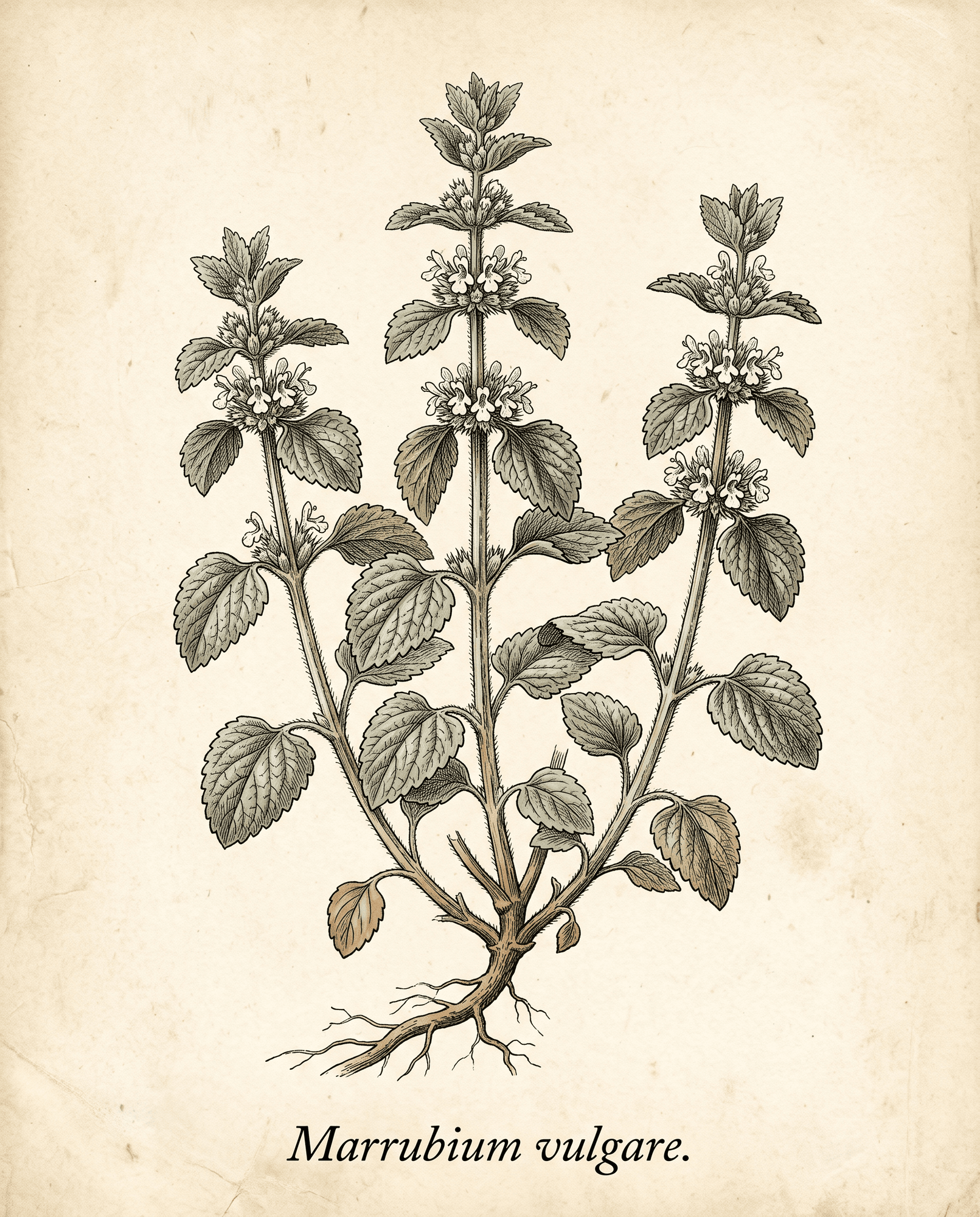
Horehound grows where almost nothing else will. She takes the dry lot, the roadside, the overgrazed field, the sandy waste behind the barn, and she holds it — woolly, gray-green, square-stemmed, her crinkled leaves wearing a coat of white down that keeps the sun from burning her and the livestock from eating her. She is a mint who gave up sweetness. Where her cousins offer perfume, she offers bitterness, and that bitterness is the whole of her gift: the taste that wakes the body, moves what has settled, and drives out what has overstayed.
Her medicine is the medicine of the stuck chest. For as long as people have been writing down remedies — and longer — she has been the herb reached for when the breath grows heavy, when the cough rattles but will not clear, when phlegm sits in the lungs like a tenant who stopped paying rent. Temple physicians in Egypt kept her, grandmothers in Alabama brewed her, Appalachian kitchens boiled her down into dark candy, and conjure workers bathed in her to break what had been laid on them. Across all of it she does one thing, faithfully: she gets things moving, up and out.
The shape of her medicine
Horehound’s medicine moves upward and outward. Where dandelion drains toward the body’s lower exits, horehound lifts — she raises phlegm out of the chest, stirs the appetite up from a cold stomach, and pushes stagnation toward the surface and out through the breath. She is warm and dry: her heat thins and loosens what cold has thickened, and her dryness clears the damp, boggy congestion that settles into lungs and gut when the body’s fires burn low. Matthew Wood places her hot and dry in the second degree, and the old Galenic reading matches what the body feels — she is a stimulant, not a soother.
She is bitter first, sharply so, with a pungent edge underneath. Her signature action is that of a stimulating expectorant. The marrubiin in her leaf provokes the bronchial passages to secrete, thinning thick, stubborn mucus so the cough can finally do its work and carry it out. This is a different gesture from the demulcents — mullein and marshmallow soothe and coat; horehound agitates and expels. She is for the wet, rattling, unproductive cough, the chest that gurgles but cannot clear, the lingering congestion after a cold that has technically ended.
At the same time she is a bronchial antispasmodic. She relaxes the smooth muscle of the airways even as she stimulates their secretions, which is why the old herbalists trusted her in whooping cough, asthma, and the tight wheezing of elders — she loosens the grip and the load at once. Kerry Bone and Simon Mills note her traditional place as a respiratory spasmolytic for exactly this tight, breathless pattern.
As a bitter tonic, she does for digestion what she does for the lungs: she wakes the secretions. The bitterness on the tongue calls up saliva, gastric juice, and appetite, and her cholagogue and choleretic actions move the liver and gallbladder to make and release bile. She has long been given for the cold, sluggish stomach — poor appetite, slow digestion, fullness after meals — and the German Commission E still endorses her for exactly these complaints.
Her diaphoretic thread is gentle: taken hot, she opens the surface and supports a fever in doing its work. As an emmenagogue she stirs the pelvic circulation and can call down a delayed cycle — an action to respect, and the reason she is set aside entirely in pregnancy. Her antimicrobial and vulnerary qualities round out the older uses: a wash for slow wounds, a gargle for the raw throat, an herb that cleans as she clears.
Together her actions form a single gesture: expelling what is stuck. She is for the body — and the spirit — holding on to something it needs to cough up.
What lives inside her
Whose medicine she carries
Fire (warming, driving through)
Earth (waste-ground endurance)
Mars
Aries
Strength
The Hermit
Oya
Oya is the wind — the gust that strips the dead leaves from the tree, the storm that clears the air, the breath at the beginning and the end of a life. Horehound belongs to her because horehound is wind medicine in a body: she moves stagnant air, she raises what has settled in the chest, and she makes the breath — Oya’s own element — pass clean again. Every cough she loosens is a small storm doing its proper work, violence in service of clearing.
Oya also governs release, and horehound teaches release in its least romantic form. What she moves out of the lungs is not beautiful. It is the accumulated weight of illness, of held grief, of air breathed shallow for too long — and she does not negotiate with it. She thins it, lifts it, and sends it out. Working with horehound in Oya’s current is to accept that some clearing cannot be gentle, that the chest sometimes needs a wind rather than a lullaby, and that the sweetness comes after the storm, not instead of it.
Her domain is wider than weather, though. Oya keeps the gate between worlds — the cemetery entrance, the marketplace where strangers meet and fortunes turn, the passage from one state of being to the next. She is the Orisha of transition itself, standing at every boundary where something ends and something else begins. Horehound has kept those boundaries for as long as anyone has recorded her: grown at the edge of the village where tended ground gives way to waste, hung above the door between the household and the world, gathered in summer heat to be given in winter cold. Her medicine works at the crossing between sickness and recovery, and the breath she clears is the same breath Oya holds at both ends of a life. A plant that lives at the boundary and works at the boundary belongs to the Orisha who governs it.
Babalu Aye
Babalu Aye walks with the sick — with the tubercular, the whooping child, the elder short of breath — and horehound has walked beside him through every one of those rooms. Whooping cough, bronchitis, consumption, the “cold rheums” Culpeper described settling into the lungs of the aged: these are the illnesses she has served for two thousand years, the long respiratory sicknesses that keep a body confined and a family keeping watch. She is one of the herbs of the sickroom, the tea brought to the bedside, the syrup spooned out through the worst weeks of winter.
She shares his temperament, too. Like the other plants of his house, she is the medicine of the disregarded — a bitter, woolly thing on waste ground that livestock refuse and gardeners pull, holding some of the oldest continuously documented medicine in the herbal record. She asks nothing of the soil and gives her remedy to whoever is humble enough to gather it. That is Babalu Aye’s teaching in a plant: the healing lives at the edge of the village, wearing gray.
Elegua
The uncrossing work is Elegua’s. In Hoodoo and conjure, horehound is a bitter herb of reversal and protection — added to baths and washes, often alongside hyssop and rue, to break crossed conditions and send back what was thrown. In medieval Europe she was hung at doorways and grown by thresholds to turn away malice, and carried for clear thinking and safe passage. All of this is road work: opening what has been blocked, guarding the door, making sure the way stays passable.
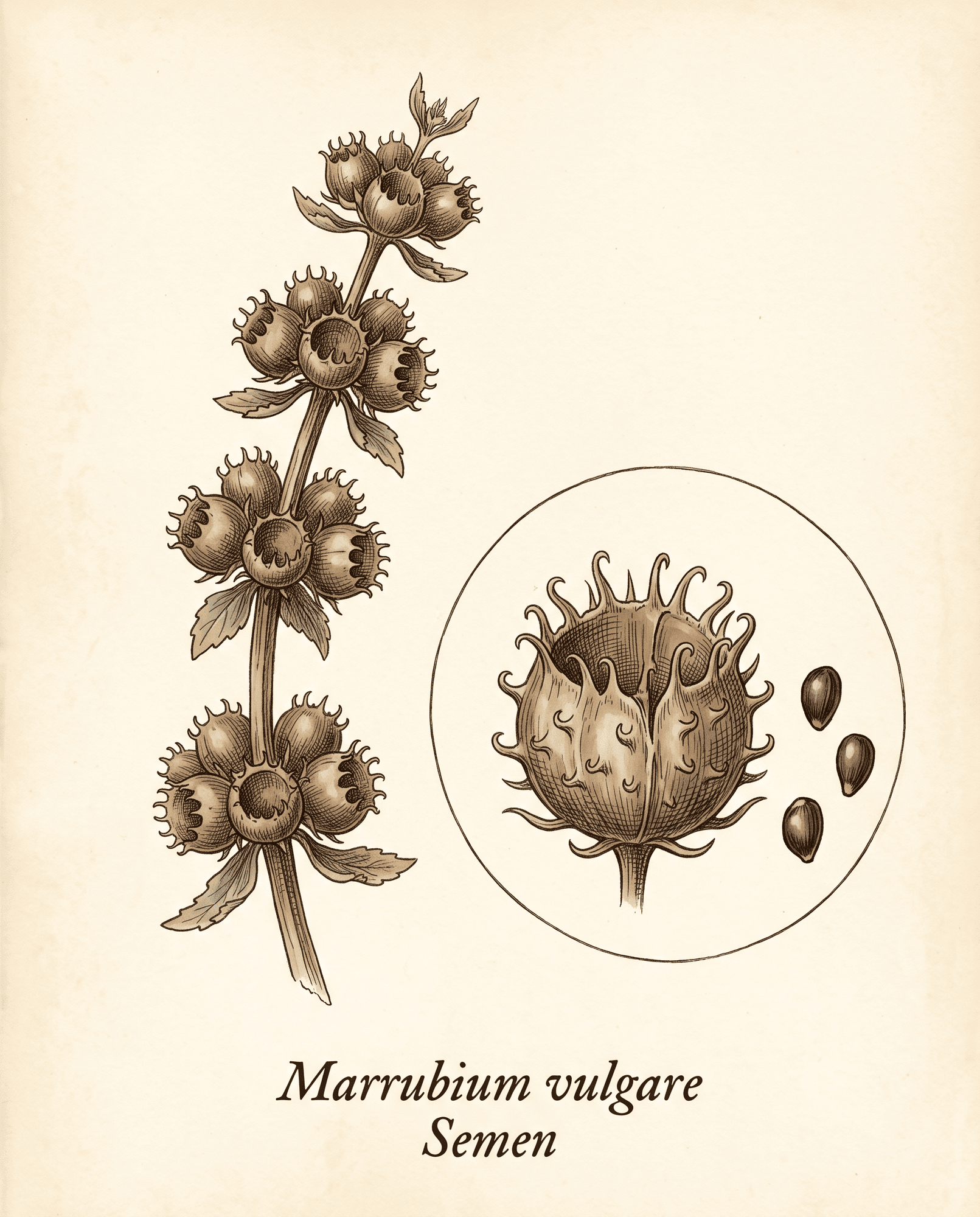
Her body carries the signature. The hooked burr of her seed calyx catches on whatever passes — she literally travels the roads on the hems and hides of travelers, seeding herself along paths and crossroads and settling in wherever the ground is disturbed. A plant that lives by the roadside, moves by the road, and clears the road: she has been doing Elegua’s work since before anyone wrote it down.
The hands she has passed through
Horehound is native to North Africa as well as Europe and western Asia, and her documented story begins on African soil. The priests of ancient Egypt held her in high regard and are recorded as calling her by names of power — the Seed of Horus, Bull’s Blood, the Eye of the Star — keeping her among the remedies of the pharaohs’ medicine chests, working with her for the chest and the breath, and counting her among the antidotes to poison. One line of scholarship traces her very name to Horus himself. Whatever the etymology, the reverence is not in question: she entered the written record already sacred.
The Mediterranean world carried her forward. Dioscorides wrote of her for coughs and diseases of the chest in the first century, and the Romans esteemed her as both remedy and antidote. Her genus name Marrubium is often traced to the Hebrew marrob, “bitter juice,” and some traditions have counted her among the bitter herbs of Passover — the taste of affliction remembered, eaten so that hardship is not forgotten. Bitterness as memory-keeping is old, old medicine.
Across medieval and early modern Europe she was both pharmacy and protection. Gerard praised her as a syrup for the infected chest; Culpeper recommended her to clear tough phlegm from the lungs of the old, the asthmatic, and the short-winded. In Central Europe she was called Lungenkraut — lung-herb — a name that says everything about her reputation. And alongside the medicine ran the magic: she was hung over doors and grown at thresholds to repel ill intent, carried against sorcery, and burned or bathed with for clarity of mind. The bitter herb that drives sickness from the chest was trusted to drive malice from the house — the same medicine read at two depths.
In African American tradition, horehound holds a place both tender and hard. In the Federal Writers’ Project interviews of the 1930s, formerly enslaved people remembered her as sickroom medicine; Sally Murphy of Alabama recalled, “When any of us got sick, we was give horehound tea and rock candy.” On plantations where respiratory disease — whooping cough, bronchitis, consumption — ran unchecked and doctors were withheld, horehound tea was part of the knowledge that kept people alive: medicine gathered from the edges, administered by the community’s own healers, sweetened when sweetness could be found. She belongs to the same lineage of quiet medical sovereignty as the greens and the garden plots — care practiced by people the system refused to care for. In the Hoodoo tradition that grew from that same soil, her bitterness was turned to spiritual use: uncrossing baths, protection work, reversal — the biting herb that bites back on behalf of the one who carries her.
In Southern and Appalachian life she became the famous candy — the herb boiled strong, cooked down with sugar to hard crack, and broken into dark, root-beer-bitter pieces that sat in general-store jars and grandmothers’ tins for generations. The candy was never only candy. It was the cough syrup made shelf-stable and child-acceptable, folk pharmacy disguised as a treat, and for many families it was the taste of being tended through winter.
The Eclectic physicians of the nineteenth century kept her in use for coughs, asthma, and menstrual complaints, and she remains in European practice today — Germany’s Commission E approves her for coughs, appetite loss, and dyspepsia, and the European Medicines Agency recognizes her as a traditional expectorant. The United States took a stranger path: in 1989 the FDA removed her from over-the-counter cough remedies for lack of submitted evidence, even as European agencies affirmed her — which is why Ricola crosses the ocean carrying her quietly while American labels stay silent. She has outlasted the paperwork either way. She always does.
Where she works in the body
Respiratory system. This is horehound’s heartland. Her marrubiin-rich bitterness stimulates the bronchial mucosa to secrete, thinning thick, stuck phlegm so the cough can raise it, while her antispasmodic action relaxes the airways’ grip. She is the herb of the wet, rattling, unproductive cough — bronchitis, the lingering chest cold, the congested cough of winter, and traditionally whooping cough and the labored breathing of elders. She pairs her stimulation with enough relaxation that the clearing does not exhaust; still, she is for damp, cold, congested chests, not for the dry, irritated, tickling cough, which wants a demulcent instead.
Digestive system. Her bitterness opens the whole tract. Saliva, gastric secretion, appetite, and peristalsis all answer her, which is why she has served for centuries as a remedy for the cold, sluggish stomach — poor appetite, slow digestion, bloating, and heaviness after meals. She suits the digestion that has gone dim and damp; she is too stimulating for the hot, acid, ulcerated stomach.
Hepatic system. Through marrubiinic acid she is genuinely choleretic — she moves the liver to make bile and the gallbladder to release it, supporting fat digestion and the clearing of what leaves the body by that road. Research also points to hepatoprotective and antioxidant activity in her phenolic fraction. Her liver work is quieter than dandelion’s, but it is real, and it is part of why the old physicians reached for her in jaundice and sluggish-liver states.
Cardiovascular system. Her relationship with the heart asks for respect. In small, ordinary doses the old literature credits her with steadying an irregular pulse, and marrubenol shows vasorelaxant, blood-pressure-easing activity in research. But in large doses the same cardioactive character can tip toward disturbing the rhythm rather than settling it. She is a teacher of dosage: the difference between medicine and trouble, with her, is quantity.
Reproductive system. She is a traditional emmenagogue — a warming mover of the pelvic circulation, used historically for delayed or painful menses and retained conditions after birth. This action is exactly why she is set aside completely in pregnancy, and why anyone working with their cycle should bring her in deliberately rather than casually.
Skin. Externally she is an old wound herb: a wash or poultice of the strong tea for slow-healing cuts, bites, and irritations, backed now by documented antimicrobial and wound-healing activity. The fresh juice, though, can bite — sensitive skin may react to her latex-like sap, so the dried-herb preparations are the gentler road.
How to take her
Harvest calendar
Preparations
Infusion: 1–2 teaspoons (1–2 g) of dried aerial parts per cup of just-boiled water, steeped 10–15 minutes, covered. Up to 3 cups daily. Drink hot for chest congestion and fever support; sweeten with honey, because she has earned her reputation for bitterness honestly.
Syrup: Make a strong infusion or gentle decoction, strain, and combine with an equal part of honey (or simmer with sugar in the older style). By the spoonful for coughs, as needed. This is her most beloved form — the one that became the candy.
Candy / lozenges: The strong tea cooked with sugar to hard crack (about 300°F), poured, scored, and broken. The old general-store cough drop, still worth making. Let a piece dissolve slowly for a nagging cough or a raw throat.
Tincture: 1:5 dried herb in 25–40% alcohol; 1–2 mL, three times daily. Fits well in respiratory and bitter-digestive formulas.
Bitter before meals: A few drops of tincture or a small mouthful of cool tea 15–20 minutes before eating, to wake a dim appetite and a slow stomach.
Gargle / wash: Strong cooled infusion as a gargle for sore, phlegmy throats, or as a wash over slow-healing skin.
Spiritual & ritual:
- Added to baths and floor washes, often with hyssop, for uncrossing, reversal, and cleansing work
- Dried bundles hung at the door or grown at the threshold for protection of the home
- Carried in a sachet for protection and clarity of mind on the road
- Burned in small amounts with clearing herbs when a space feels heavy or held
- A cup of her tea taken slowly, with intention, when something gripping the chest — a grief, a fear, a held breath — is ready to be let out
When to hold back
Use with caution if:
- You are pregnant — do not use at all. Horehound is an emmenagogue and uterine stimulant with reported abortifacient effects. She also lacks safety data for breastfeeding beyond food amounts; err on the side of leaving her out.
- You have a heart condition or arrhythmia. Large doses may disturb heart rhythm; keep to ordinary medicinal amounts or choose another ally.
- You take blood pressure medication. Her mild hypotensive action may be additive.
- You take antidiabetic medication. Her blood sugar–lowering activity may compound the effect; monitor closely.
- You have gastritis, ulcer, or an acid, over-hot stomach. Her bitter stimulation of gastric secretion can aggravate these states.
- You have gallstones or bile duct obstruction — as with any strong bile-mover, professional guidance first.
Topical considerations: The fresh juice can cause contact dermatitis in sensitive people. Patch test, or work with the dried herb.
General notes: In ordinary medicinal doses she is well tolerated and has a long record of safe use, including in traditional practice with children for coughs. Very large doses are laxative and, over time, too drying and stimulating to sustain — she is acute and seasonal medicine more than a daily tonic. Her warmth and dryness can aggravate hot, dry, irritated conditions; she wants the damp, cold, stuck ones.
Who walks with her
For the wet, congested cough: Elecampane, thyme, hyssop, ginger, wild cherry bark.
For the tight, spasmodic cough: Mullein, wild cherry bark, licorice (which also softens her bitterness and her dryness).
For sore throat and raw airways: Marshmallow, licorice, honey — the demulcents that cushion her stimulation.
For the cold, dim digestion: Fennel, ginger, chamomile, gentian.
For clearing and uncrossing work: Hyssop, rue, rosemary, sage.
These allies balance what she is. Horehound stimulates and dries; elecampane and thyme deepen her expectorant work while their aromatics warm the exchange; mullein and marshmallow moisten the tissues she might otherwise chafe, so the phlegm moves without the airways going raw. With hyssop she is doubled — two bitter, wind-moving mints who share both the chest work and the cleansing bath, in medicine and in spirit alike. And motherwort is her close kin in chemistry and temperament, carrying marrubiin’s relatives to the heart the way horehound carries them to the lungs. She works best held in formula: the storm needs a landscape around it.
How to know her
Plant walk: Find her where she chooses to live — the dry roadside, the gravel edge, the neglected corner of a field. Touch the wool on her leaves and notice how she keeps her own counsel: unpalatable, unbothered, silver in full sun. Ask what she knows about surviving in a place that offers nothing, and about guarding your substance so completely that nothing can graze you down.
Ritual of the cleared breath: Brew her tea strong and hot. Sit with the steam first — breathe it in slowly, and name, silently or aloud, what has been sitting on your chest. Then drink, unhurried. With each long exhale, let one held thing ride out on the breath. She teaches that release is respiratory: what you cannot put down, you can sometimes breathe out.
Threshold work: Hang a small dried bundle of her above the door, or add her strong tea to a wash for the doorstep and the entry floor. As you work, speak plainly about what is welcome in your home and what is not. She has kept thresholds for a thousand years; she knows the job.
Winter apothecary practice: In early summer, when she first flowers, harvest and dry a season’s worth. On a cold day months later, make the syrup or the candy — slowly, as an act of provision. This is the old rhythm of her medicine: gathered in heat, given in cold, love made shelf-stable.
Journal prompts
- What has settled in my chest that I have been carrying instead of clearing?
- Where in my life am I soothing something that actually needs to be moved?
- What bitterness have I refused to taste that might be medicine?
- What do I guard so well that nothing can feed on me — and what has that protection cost?
- Who tended me through sickness, and what did their care taste like?
Tarot Spread
A spread for entering into relationship with Horehound as a plant ally:
- What am I holding in that is ready to be released?
- Where do I need her bitterness — the truth that wakes rather than the sweetness that soothes?
- What threshold in my life is she offering to guard?
- What storm is trying to clear my air, if I stop bracing against it?
- What does she want me to know about thriving on hard ground?
Keep a sprig of dried horehound or a piece of the old candy beside the cards. Let the bitter and the sweet sit together while you read.
The same plant, multiple lenses
In Ayurvedic terms horehound carries a bitter (tikta) and pungent (katu) rasa with a heating (ushna) virya — a combination that lightens, dries, and moves. She is a reducer of accumulation.
Kapha Dosha — Earth & Water
This is her strongest alignment. Kapha excess is her home terrain: the heavy, damp, congested states — thick mucus in the chest, sluggish cold digestion, low appetite, lethargy, the body waterlogged and slow. Her bitterness scrapes, her pungency warms and moves, and her dryness clears the damp. For Kapha-dominant folks in the wet cold of late winter and early spring, she is a natural seasonal ally.
Vata Dosha — Air & Ether
Vata is where the traditions read her two ways, and the disagreement is worth naming. Her warmth comforts Vata’s cold, and some Ayurvedic readings count her as pacifying Vata for that reason; but her drying, dispersing, bitter character can just as easily aggravate Vata’s dryness and depletion when she is used alone or long. The practical resolution: Vata constitutions can borrow her for acute chest congestion, held in warm, moist company — honey, licorice, ginger, marshmallow — and set her down when the work is done.
Pitta Dosha — Fire & Water
Her heating virya asks Pitta to be careful. In an acute damp chest cold she can serve anyone briefly, but sustained use adds fire to fire — she can aggravate the hot stomach, the irritable liver, the inflamed and dry conditions Pitta tends toward. Pitta types with congestion often do better with her cooler allies, or with horehound only in small doses and cooling formula.
Horehound is a Western herb rather than a plant of the classical Chinese materia medica; her TCM-style reading comes through the integrative Western herbalists — Peter Holmes chief among them — who mapped her actions into that language. The mapping fits her well.
Taste & Temperature: Bitter and pungent, warm, dry. Channels Entered: Lung, Spleen, Stomach, Liver. Functions: Resolves phlegm-cold and promotes expectoration. Diffuses Lung qi and calms coughing and wheezing. Warms and awakens the middle burner. Moves Liver qi and promotes bile.
Resolving Phlegm-Cold & Promoting Expectoration
Her central function. She addresses cold-damp phlegm obstructing the Lung — the productive-but-stuck cough with copious white or clear mucus, the rattling chest, the congestion that follows wind-cold invasion and lingers. Her warmth transforms the cold phlegm; her pungent, rising quality carries it up and out. She is not the herb for Lung heat with scanty yellow phlegm and a dry throat — that pattern wants cooling, moistening medicine instead.
Diffusing Lung Qi & Calming Wheezing
When phlegm and constraint bind the chest — tightness, wheeze, breath that will not deepen — she both opens and relaxes. This is her classical place in whooping cough and asthmatic patterns: she unbinds the Lung qi so the breath can descend and the cough can complete its work instead of spasming against it.
Awakening the Middle Burner
Her bitterness and warmth stir a cold, damp, dim Spleen and Stomach — poor appetite, fullness, sluggish transformation of food. She dries the damp and rekindles the digestive fire, the same gesture the Western tradition names in her use as a bitter tonic for the appetite of convalescents and elders.
Moving Liver Qi & Promoting Bile
Her choleretic action reads in this language as moving Liver qi and draining the gallbladder — easing the stagnation that shows up as fullness under the ribs, poor fat digestion, and the irritability of a stuck Liver. A supporting function rather than her lead, but part of why she suits the whole cold-stagnant pattern rather than one organ alone.
Yin/Yang Balance
Horehound is Yang in nature — warming, drying, ascending, dispersing. She treats patterns of cold, damp, and stagnation and is contraindicated in their opposites: yin deficiency with heat signs (dry cough, night sweats, red tongue with little coat), dry unproductive coughs, and hot, irritated digestive states. She is also acute medicine in this reading — a mover, not a tonic — best used for a season of clearing and then set down, or balanced with moistening herbs if the work runs long.
For going deeper
- The Federal Writers’ Project slave narratives (Library of Congress, “Born in Slavery” collection) — first-person testimony of horehound and other remedies in the healing practices of enslaved and formerly enslaved people. Primary source; sit with the voices themselves.
- Covey, Herbert C. African American Slave Medicine: Herbal and Non-Herbal Treatments. Lexington Books — context for horehound within the broader medical knowledge of enslaved communities.
- Wood, Matthew. The Earthwise Herbal: A Complete Guide to Old World Medicinal Plants. North Atlantic Books.
- Holmes, Peter. The Energetics of Western Herbs. Snow Lotus Press — the fullest TCM-style reading of her pattern.
- Frawley, David & Lad, Vasant. The Yoga of Herbs: An Ayurvedic Guide to Herbal Medicine. Lotus Press.
- Grieve, Maud. A Modern Herbal (1931) — for the Egyptian names, the etymologies, and the European folk record; available free through botanical.com.
- Felter, Harvey Wickes & Lloyd, John Uri. King’s American Dispensatory (1898) — Eclectic-era clinical use, via Henriette’s Herbal.
- Aćimović, M., et al. “Marrubium vulgare L.: A Phytochemical and Pharmacological Overview.” Molecules 25, no. 12 (2020) — open-access review of her chemistry and researched actions.
- Herbal Reality, white horehound monograph — a solid contemporary clinical summary with traditional energetics.
- Elders in Southern, Appalachian, and African American family traditions who remember the candy, the tea, and the sickroom. This knowledge is oral and living; ask before it goes quiet.
The Conversation
Questions, noticings, what this is teaching you — leave them here. This same conversation lives in The Circle.