Motherwort
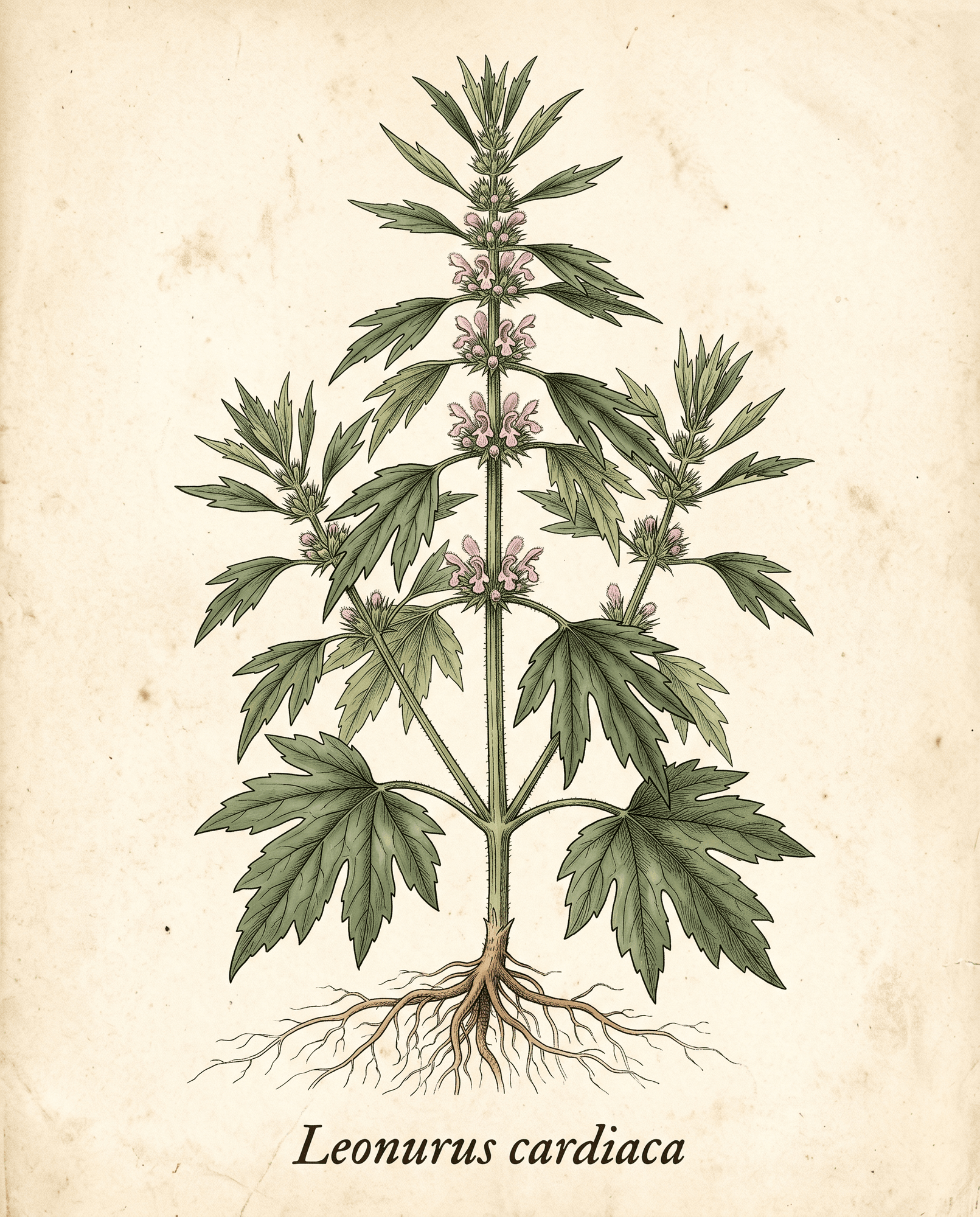
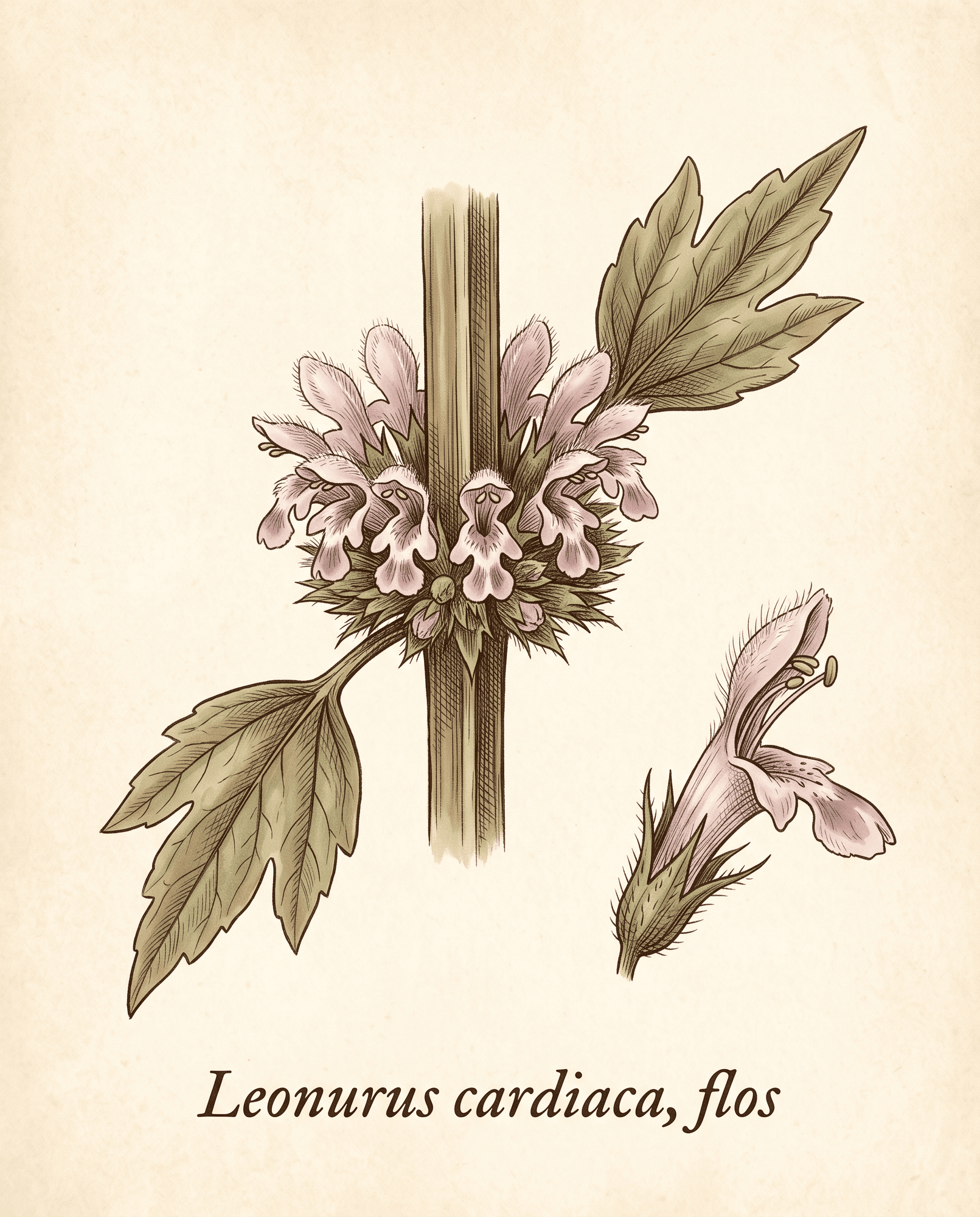
Motherwort does not come to you soft. She comes bitter — one of the few in the mint family who refused the family perfume and kept only the bite. She grows tall and square-stemmed at the edges of old barnyards and along the riverbank, and she rings her own body with whorls of small pink flowers, one collar at every leaf node, all the way up. Her name in Latin is lion’s heart. Her name in English is mother-herb. She is both at once, and she has never seen a contradiction in that.
This is the medicine for the heart that is racing and the womb that is clenched, and for the person who has been holding a whole household together with a body that is trembling. She steadies the beat. She loosens the grip. She is the plant you reach for when someone says I feel like I’m coming out of my skin — the fluttering chest, the tight jaw, the anger that has nowhere to go, the grief that has been carried so long it has become a physical clench in the tissue. She does not sedate you into stillness. She returns you to your own strength.
The shape of her medicine
Motherwort’s medicine moves down and in. She is cool where things have gone hot and frantic, and drying where the tissue has grown swollen and boggy. Her direction is the settling of something that has been flying — the heart rate that comes back down, the racing thought that lands, the blood that stops pooling and starts moving again through the pelvis.
She is bitter and acrid, and both tastes are doing work. The bitterness drains downward: it wakes the liver, opens digestion, and pulls stuck heat out of the upper body toward the exits. The acridity disperses: it breaks up what has congealed, particularly in the blood and particularly in the womb. Together, these two tastes are the whole gesture — break it up, and move it out through the bottom of the body.
As a cardiotonic and antiarrhythmic, she works on a heart that is beating badly rather than a heart that is failing. This is her signature and the reason for her name: the palpitations that arrive with fear, the tachycardia of an overstimulated nervous system, the flutter that comes on before a hard conversation, the pounding that wakes you at three in the morning. Her alkaloids relax the vessel walls and slow an over-fast rhythm without dulling the person carrying it. She is not the herb for the deeply depleted, weak, cold heart — she is the herb for the heart that is working too hard because it is afraid.
Her hypotensive action follows from the same mechanism. She lowers blood pressure primarily by relaxing the vessels rather than by dumping fluid, which is why she does her best work in the person whose pressure rises with stress, whose face reddens, whose sleep is thin and broken.
As a nervine relaxant, she is unusual: she calms without heaviness. Most people can take her in the middle of the afternoon and keep working. What she softens is specifically the nervous tension that has moved into the muscle and the vessel — the held breath, the clenched belly, the shoulders up around the ears. Matthew Wood describes her constitutional picture as one of excessive emotionality — the flushed face that is not quite anger, the staring eyes, the person who cannot settle. If you have met her, you know the look.
Her antispasmodic action reaches the smooth muscle everywhere it goes tight, but she has a clear affinity for the uterus. She is the herb for the cramp that comes with cold hands and a tight jaw — the menstrual pain that is held rather than merely inflamed.
As a uterine tonic and emmenagogue, she works at both ends of the same movement. She encourages a delayed period that is stuck behind tension to release, and she strengthens the tone of the uterine muscle over time. This is the action that gives her the name mother-herb, and the same action that makes her unsafe in the middle of pregnancy.
Her bitter and hepatic threads open the liver and the digestion — which matters more than it looks, because the liver is where excess hormone is cleared and where anger is metabolized in more than one tradition. Her diaphoretic quality opens the surface and lets pressure off the chest and diaphragm. Her mild diuretic action, most emphasized in the Chinese materia medica, moves the water that has stopped moving and settled into the tissues.
Her thyroid-modulating action is real but narrow: she gently damps an overactive thyroid, and she is used most reliably not to change the gland itself but to hold the cardiac symptoms — the racing heart, the tremor, the flooded-with-adrenaline feeling — while the deeper work is done.
Taken together, her actions form one gesture: the arms around the racing body. She holds. She slows. She moves out what is stuck. And then she gives you back your own courage.
What lives inside her
Whose medicine she carries
Fire (the lion's heart, courage)
Moon
The Empress
Queen of Cups
Yemaya
Yemaya is the mother of all waters, the one who holds the ocean and the amniotic sea, the one whose love is vast and whose anger is a tide. Motherwort is hers because she is the great herb of the mothering body — the womb that carries, the womb that labors, the womb that bleeds and stops bleeding and bleeds again on its own tidal schedule. Yemaya’s medicine is the medicine of holding, and motherwort holds: she is the hand on the back of the person who is coming apart, the arms that make it possible to keep standing.
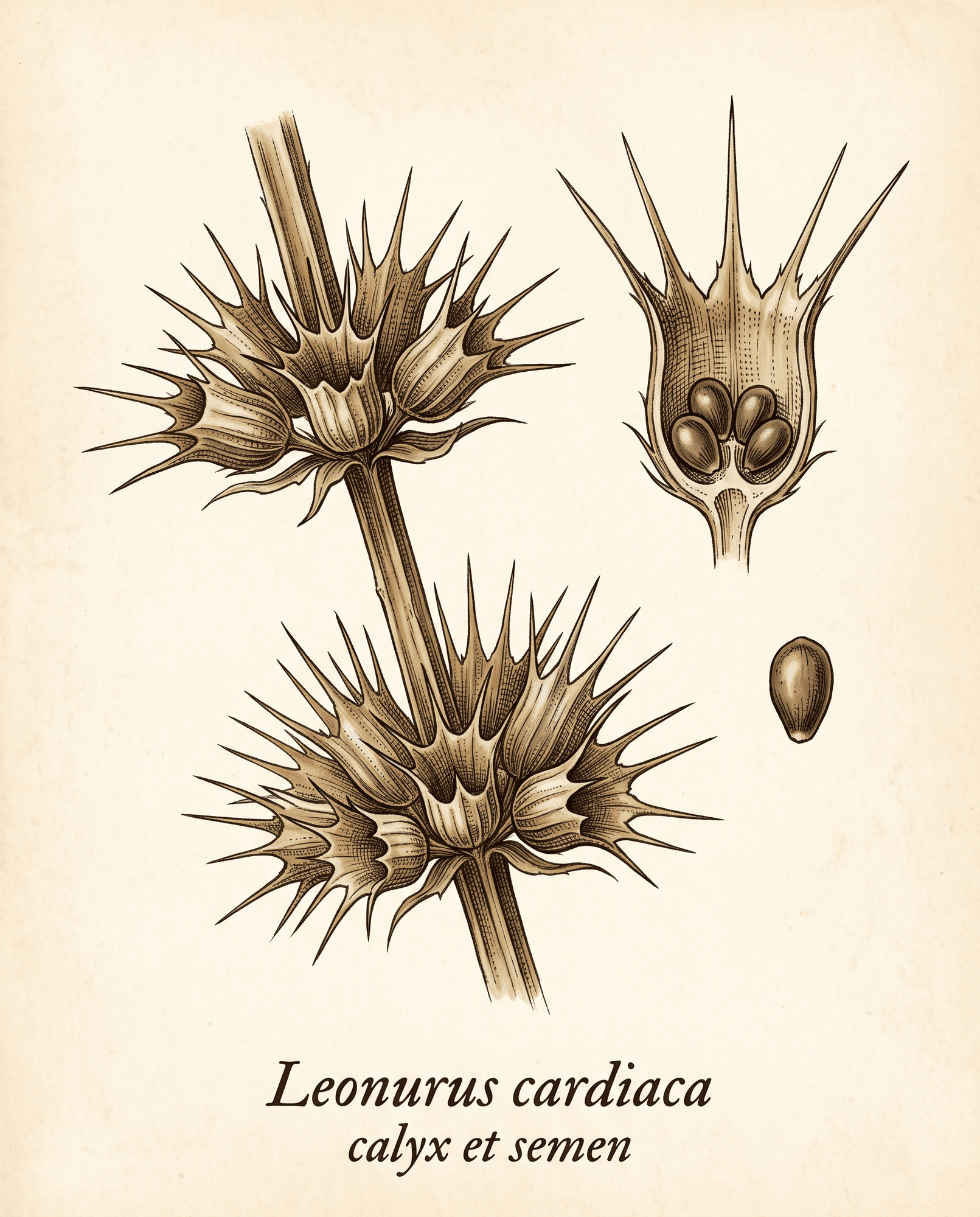
But Yemaya is not only softness, and neither is this plant. The ocean drowns. The mother who protects her children is the most dangerous thing on the water. Motherwort’s spined calyx — the hard, five-pointed armor she grows around her seed after the flower falls — is Yemaya’s truth stated in botany. Softness at the center. Blades at the boundary. To work with her in Yemaya’s name is to learn that being tender and being unwilling to be crossed are the same devotion, wearing different faces.
Oshun (The Emotional Heart)
Oshun holds the sweet waters, the blood in its flowing, the honey and the heartbreak both. Motherwort comes to her through the two places blood gathers and turns: the chest and the pelvis. Where Oshun’s rivers have grown stagnant — the period that will not come, the flow that clots and stalls, the cramp that comes from held tension rather than heat — motherwort moves them. And where the heart has gone hard and fast in self-protection, she is the herb that lets it beat at a human speed again.
This is the register in which she meets the broken heart. Not the acute wound of it, but the aftermath: the chest that has learned to brace, the flutter that arrives whenever love is asked for. Motherwort in Oshun’s hands is the practice of softening without becoming defenseless — the return of sweetness to a body that decided sweetness was too expensive.
Oya (The Threshold)
Oya stands at the gates. The storm, the marketplace, the cemetery, the moment where the old life ends and the next one has not yet arrived. Motherwort belongs to her at every threshold of the reproductive life: the onset of labor, the wild disorganized hours of birth, the raw days after, and the long strange passage of menopause. She is the herb that midwives have carried into the birthing room for centuries — for the pain, for the afterbirth, for the fever that follows, for the mother whose body has just been split open and must now walk back into the world.
Oya’s other domain here is the warding. Motherwort was hung in doorways and carried in pockets across old Europe as protection — against spirits, against ill luck, against whatever it was that pressed at the edges of a household. That folk use is not decoration. It is the same medicine spoken at a different scale: this is the boundary, and it will hold. She is the herb for hauntings, the ghostly and the emotional kind alike.
The hands she has passed through
Motherwort’s two names carry two whole traditions inside them, and she has never chosen between them.
In ancient Greece, she was given to pregnant women and to the anxious — for what was understood as the disturbance of the womb and the trembling of the spirit, which were not thought of as separate problems. The Romans continued her, and the name that came down to us — Leonurus cardiaca, from leon (lion) and oura (tail), and cardiaca for the heart — preserves both the shape of her leaf and the seat of her medicine.
In China, she is yi mu cao — literally benefit-mother herb — and she is one of the oldest and most trusted herbs in the gynecological materia medica. She appears in the earliest strata of the Chinese herbal record and has been used continuously since for irregular menstruation, painful periods, retained lochia after birth, and the swelling that comes when blood and water both stop moving. She was also credited with promoting longevity, which is a claim usually reserved for herbs that touch the heart. The plant used there is her close kin, Leonurus japonicus, and the two are close enough in medicine that the traditions read each other cleanly.
Across medieval and early modern Europe, she moved through three worlds at once. Farmers wanted her: John Gerard noted her value in treating diseases of cattle. Village women wanted her: bundles of her hung in doorways to turn away evil spirits and ill fortune, and young women carried her as a charm. And the physicians wanted her — most famously Nicholas Culpeper, who in 1652 put her under Venus and under the sign of Leo, and wrote that she drives melancholy from the heart:
There is no better herb to take melancholy vapours from the heart. — Nicholas Culpeper, The Complete Herbal (1652)
He recommended her for the heart, for the nerves, and for the wombs of mothers — the same three territories every herbalist since has found her in. That her three medicines have never separated across four centuries and several continents should tell you something about how she actually works.
When she crossed the Atlantic she did not stay in the settlers’ gardens. Several Indigenous nations of the northeast, among them the Delaware, Mi’kmaq, and Shinnecock, took her up for women’s medicine. The Eclectic physicians of the nineteenth century used her for nervous heart complaints, for suppressed menstruation, and for what they called female hysteria — a diagnosis that told the truth about the symptoms and lied about the cause. William Cook wrote of her in 1869 as a calmer of nerves and a reliever of spasm.
There is an old story, repeated in more than one herbal, of a town whose water ran through banks of motherwort, and whose people lived to a hundred and thirty. Take from it what you like. What the story is really saying is that she was understood, everywhere she grew, as an herb that lengthened a life by making it bearable.
Where she works in the body
Cardiovascular system. This is where her name lives. Motherwort is the specific for a heart that is beating too fast, too hard, or unevenly because the nervous system is on fire — palpitations, nervous tachycardia, arrhythmia with an anxious signature, angina that flares under emotional pressure, and hypertension that rises with stress. She relaxes the vessel walls, slows the rate, and steadies the electrical rhythm without flattening the person. Her flavonoids strengthen capillaries and her triterpenes protect the vessel lining over the long term. She is not the herb for a cold, weak, exhausted heart with no fire in it; she is the herb for the heart that has been running from something.
Nervous system. She calms the body first and the mind second, which is the right order for the kind of anxiety that lives below the neck. Held breath, clenched belly, muscles that will not release, sleep that is thin and full of waking — these are her territory. Because she is relaxant without being strongly sedative, she works in daylight as well as at night. She pairs naturally with the restorative nervines when the person is not only wound tight but genuinely worn through, since she loosens but does not rebuild.
Reproductive system. She tones the uterine muscle and moves stagnant blood out of the pelvis. She is foundational for delayed or scanty menstruation held back by tension, for cramping that is gripping rather than merely inflammatory, for the clotted, dark, stalled flow that signals blood that has stopped moving, and for the mood storms that ride the cycle. In the final weeks of pregnancy and during labor she is a traditional ally of midwives — she strengthens contractions, eases the pain, helps the uterus release the afterbirth, and supports the tissue in the first days after. She belongs to the perimenopause too, where the same three symptoms she has always treated — palpitations, anxiety, and an erratic bleed — arrive together like an old triangle.
Endocrine system. Her thyroid action is gentle and specific: she damps an overactive thyroid modestly and, more reliably, manages the cardiac and nervous symptoms of hyperthyroid states — the racing heart, the tremor, the heat, the wired exhaustion. This is careful work that belongs alongside diagnosis and monitoring, not instead of it. The same action makes her the wrong herb entirely for a sluggish, underactive thyroid.
Hepatic system. Her bitterness opens the liver and the digestion — modest compared with the great bitter roots, but real, and important to how the rest of her medicine lands. Hormonal clearance runs through the liver; so does the metabolism of stress. When she is used cyclically for reproductive complaints, the liver support is part of why she works and not an afterthought.
Urinary system. Chiefly emphasized in the Chinese tradition, where she is trusted to move water that has stopped moving — the edema that arrives with stalled blood, the swelling of the ankles and the face, the fullness that comes when the pelvis has gone stagnant and the fluid has nowhere to go. She clears the water by moving the blood, which is a different mechanism from the diuretics that simply flush.
How to take her
Harvest calendar
Preparations
Tincture (the preferred form). Fresh flowering tops 1:2 in 95% alcohol, or dried 1:5 in 40–50%. Typical dose 1–4 mL up to three times daily. For acute palpitations or a panic that has landed in the chest, 10–20 drops repeated every fifteen minutes until the body settles is a well-worn approach. She is bitter enough that the tincture is the kindest delivery for most people, and she is fast in this form — often within minutes.
Infusion. 1–2 teaspoons dried aerial parts per cup of just-boiled water, covered, steeped 10–15 minutes, up to three cups daily. Bracingly bitter. Honey, lemon balm, or rose soften her considerably without dulling the medicine, and the bitterness itself is part of what opens the liver, so do not bury it entirely.
Vinegar or honey. A honey infusion of the fresh flowering tops makes her palatable for people who cannot take alcohol, and the honey carries her into the heart in a register she likes.
Flower essence. Widely used for the person who has boundaries so thin that other people’s states move straight through them — the one who cannot tell where their own feeling ends.
Steam or bath. A strong infusion added to a bath eases pelvic tension and post-birth soreness. As a womb steam she is traditionally used in the postpartum and for stagnant, painful cycles — never in pregnancy, and not during active bleeding.
Poultice or wash. Applied over the lower belly in labor in the older midwifery traditions; used externally in the Chinese materia medica as a wash for sores, boils, and itching rashes.
In formula. She is rarely a soloist. Her bitterness and her cool, drying edge both ask for company — see the plant allies below.
Spiritual & ritual:
- Bundles hung in the doorway or over the bed for protection of the household, and specifically of the birthing room
- Carried on the body — a sprig in the pocket, a dram of tincture in the bag — when walking into a room that requires courage
- Dried in a dream pillow for the person whose nights are haunted, in either sense
- Placed on the altar for Yemaya, Oshun, or Oya in work concerning the womb, the heart, or the crossing of a threshold
- Taken as a single drop before speaking a boundary aloud
When to hold back
Use with caution if:
- You are pregnant. She is a uterine stimulant and is contraindicated through pregnancy — with the traditional exception of the final weeks and active labor, under the care of a skilled midwife or practitioner.
- You have heavy, flooding, or prolonged menstrual bleeding. She moves blood; she can increase flow.
- You have an underactive thyroid or take thyroid replacement medication. Her mild antithyroid action works against you here.
- You take cardiac medications — beta blockers, antiarrhythmics, digoxin, antihypertensives. Her effects are additive and the combination needs supervision.
- You take anticoagulants or antiplatelet drugs. Her blood-moving action compounds them.
- You take sedatives. Additive relaxant effect.
- You are in a cold, deficient, depleted state — pale, chilled, exhausted, loose stool from cold. Her cool, drying, downward nature will deepen that pattern unless she is held by warming, building companions.
- Matthew Wood cautions against her in inflamed bowel presentations — pain on pressure, dry tongue with red tip and edges.
Topical considerations: Generally well tolerated. Handle the late-season plant with gloves; the hardened calyx spines will draw blood.
General notes: She is not a nightly sedative and she is not a long-haul tonic on her own — she is a specific, best used with a clear indication and in formula. Overuse can cause stomach upset. Her medicine is meant to be worked with in courses, not indefinitely.
Who walks with her
For the anxious, racing heart: Hawthorn, linden, lemon balm, skullcap.
For the broken and armored heart: Rose, hawthorn, lemon balm.
For painful, stagnant, clotted menstruation: Cramp bark, yarrow, ginger, mugwort.
For the birthing and postpartum body: Raspberry leaf, yarrow, nettle, rose.
For perimenopause — the palpitation-anxiety-flood triangle: Sage, hawthorn, yarrow, milky oats.
For hyperthyroid cardiac symptoms: Bugleweed, lemon balm. This is practitioner-guided work; the trio is classic and should be used with monitoring.
For the nervous system that is wrung out as well as wound tight: Milky oats, skullcap, ashwagandha.
These allies do two things for her. The first is temperamental: motherwort is cool, dry, and downward, and she is happiest when someone else in the formula is warm or moistening or building — milky oats to rebuild what she only loosens, ginger to warm the pelvis she is emptying, rose to sweeten what she opens. The second is directional. Hawthorn holds the heart’s structure while motherwort steadies its rhythm; cramp bark releases the muscle while motherwort moves the blood behind it; yarrow governs how much blood leaves while motherwort insists that it move. She is a plant who does one thing very well and trusts her company to do the rest — which is, when you think about it, exactly how mothering is supposed to work.
How to know her
Plant walk: Find her in late summer, when the flowers have gone and the seed is setting. Reach for her the way you would reach for any plant. Feel the spines. Sit down with the sting of it. Ask her why the same body that offers the softest medicine in the garden armed itself this thoroughly — and ask yourself where you have believed you had to choose.
Ritual of the held heart: When the heart is racing and the reason is fear, sit down. Take her — a dropper of tincture, a cup of the bitter tea, whichever is at hand. Put one palm flat on your sternum and the other flat on your low belly. Do not try to calm down. Just wait, and feel for the moment the beat begins to come back to you. When it does, say aloud what you are afraid of. She will hold the floor while you do.
Ritual of the boundary: Cut a length of her, dried, and hang it above the door of the room where you have been most porous — the workroom, the bedroom, the place where you take the calls. As you hang it, name what is not allowed to cross. Say it plainly, without apology or explanation. Leave it up until the next season asks you to take it down.
Ritual of the threshold: For anyone standing at a crossing — a birth, a leaving, a body that is changing its rules. Steep a strong infusion. Pour half of it into the bath and drink the other half. Sit in the water until it cools. When you stand, you are on the other side of something. Do not narrate it. Just get out and get dry.
Journal prompts
- Where is my heart racing for a reason my mind has not admitted yet?
- Who or what have I been holding together with a body that is trembling?
- Where have I decided that being soft and being protected cannot both be true?
- What is the boundary I have been describing to myself instead of speaking?
- If I were mothered exactly the way I mother, what would change?
Tarot Spread
A spread for entering into relationship with Motherwort as a plant ally:
- What is my heart doing that I have not stopped to notice?
- Where in my body am I holding a grip I did not choose?
- What is she offering to carry with me — not for me?
- Where am I being asked to arm the edge so the center can stay soft?
- What courage is already mine that I have been calling by another name?
Keep a sprig of her on the table with the cards. Sit long enough for your pulse to slow.
The same plant, multiple lenses
Motherwort is not a classical herb of the Ayurvedic materia medica — she grew in Central Asia and Europe, not the Indian subcontinent, and the tradition did not build a formal seat for her. But her qualities read cleanly through the doshic lens, and herbalists working across the two systems place her without much difficulty.
Her rasa is bitter (tikta) and pungent (katu); her virya is cooling; her vipaka is pungent. She is light and dry, moving downward, dispersing what has congealed. That places her among the reducers.
Pitta Dosha — Fire & Water
This is her strongest alignment. The Pitta picture of a heart driven hot and fast — the flushed face, the sharp temper, the pressure that rises with frustration, the burning irritability that comes before the bleed — meets her cool, bitter, downward nature directly. She takes heat out of the chest and drains it down through the liver and the pelvis rather than suppressing it. For Pitta-dominant folks with cardiac heat, inflammatory cycles, or a fiery perimenopause, she is foundational.
Kapha Dosha — Earth & Water
Kapha’s version of her indication is stagnation rather than heat: the sluggish, heavy, boggy pelvis; the clotted flow; the water that pools in the ankles; the dampness that will not clear. Her drying, moving, dispersing action is well-suited here, and the bitter taste is itself one of the great reducers of Kapha. She is safe and useful for Kapha constitutions over reasonable stretches.
Vata Dosha — Air & Ether
Vata is where the traditions have their most interesting disagreement, and it is worth sitting with rather than resolving. By quality alone — cool, light, dry, downward — she should aggravate Vata, and over the long haul she does: she can deepen dryness, coldness, and depletion in a constitution already prone to all three. But her clearest indication is a Vata picture: the trembling, the fluttering heart, the racing thought, the spasm, the boundaryless anxiety. Two truths at once. In practice this means she is often exactly the right herb for a Vata person in an acute moment, and rarely the right herb for a Vata person alone and indefinitely. Pair her with warmth and with substance — ashwagandha, milky oats, ginger, sesame oil, marshmallow — and she becomes safe to keep company with.
In the Chinese materia medica she is yi mu cao — benefit-mother herb — and the plant used is her close kin Leonurus japonicus. She sits among the blood-invigorating, stasis-dispelling herbs, and she is one of the most trusted herbs in that whole category for women’s medicine.
Taste & Temperature: Acrid and bitter; slightly cold. Channels Entered: Heart, Liver, and Bladder. Functions: Invigorates the Blood and regulates menstruation. Promotes urination and reduces swelling. Clears Heat and resolves toxicity.
Invigorating Blood & Regulating Menstruation
This is her central function and the one the tradition trusts most. Her acrid taste opens and disperses; her bitter taste drives downward. Together they break up Blood stasis where it has settled in the lower burner and restore the direction of flow. She is the herb for irregular or absent menstruation from stasis, for dysmenorrhea with dark clotted blood, for retained lochia and abdominal pain after birth, and for abdominal masses arising from stagnant Blood. She is prized because she moves Blood without being harsh — she can be given where the stronger blood-breakers would be too aggressive for a depleted body.
Promoting Urination & Reducing Swelling
She enters the Bladder channel and moves water, but the mechanism the tradition names is worth catching: she clears edema by moving the Blood that the water is stuck behind. Stasis and swelling reinforce each other, and she breaks that cycle from the blood side rather than simply flushing the fluid. She is used for acute systemic edema and for painful, difficult urination that accompanies stagnation.
Clearing Heat & Resolving Toxicity
A smaller but real function. She is used internally and as an external wash for sores, boils, carbuncles, and hot itching rashes — the skin conditions read as Heat and toxin lodged in the Blood.
Yin/Yang Balance
She is cool and dispersing — a mover, not a builder. She treats excess and stasis, not deficiency. She is not appropriate for Blood deficiency without stasis, for cold-depleted patterns, or in pregnancy. Where the body is both stagnant and depleted — which is common, and is exactly the postpartum picture — the tradition pairs her with rich tonifying herbs rather than using her alone. This is the logic of the classic postpartum formulas, where she is added to a base of blood-building herbs precisely so that the tonification does not itself become another stagnation. That is a teaching worth carrying beyond the formula: what you build, you must also keep moving.
For going deeper
- Wood, Matthew. The Earthwise Herbal: A Complete Guide to Old World Medicinal Plants. North Atlantic Books. — for the constitutional picture and the specific indications.
- Bensky, Dan, Clavey, Steven, & Stöger, Erich. Chinese Herbal Medicine: Materia Medica (3rd edition). Eastland Press. — see the entry on yi mu cao.
- Holmes, Peter. The Energetics of Western Herbs. Artemis Press. — for the cross-tradition energetic reading.
- Bennett, Robin Rose. The Gift of Healing Herbs. North Atlantic Books.
- Soule, Deb. The Roots of Healing / Avena Botanicals writings — for the lineage of motherwort in women’s herbalism and midwifery practice.
- Rose, Karen M. The Art & Practice of Spiritual Herbalism. — for the spiritual register.
- Hoffmann, David. Medical Herbalism. Healing Arts Press. — for the clinical cardiovascular material and cautions.
- Felter, Harvey Wickes & Lloyd, John Uri. King’s American Dispensatory (1898), available through Henriette’s Herbal — for Eclectic-era use.
- Moerman, Daniel E. Native American Ethnobotany. Timber Press. — for documentation of Indigenous adoption of motherwort in the northeast.
- Midwives and birthworkers in your own community. Motherwort’s birthing-room medicine is carried in practice more than in print, and it is worth learning from the people who have used her at three in the morning with someone’s life in their hands.
The Conversation
Questions, noticings, what this is teaching you — leave them here. This same conversation lives in The Circle.