Hibiscus
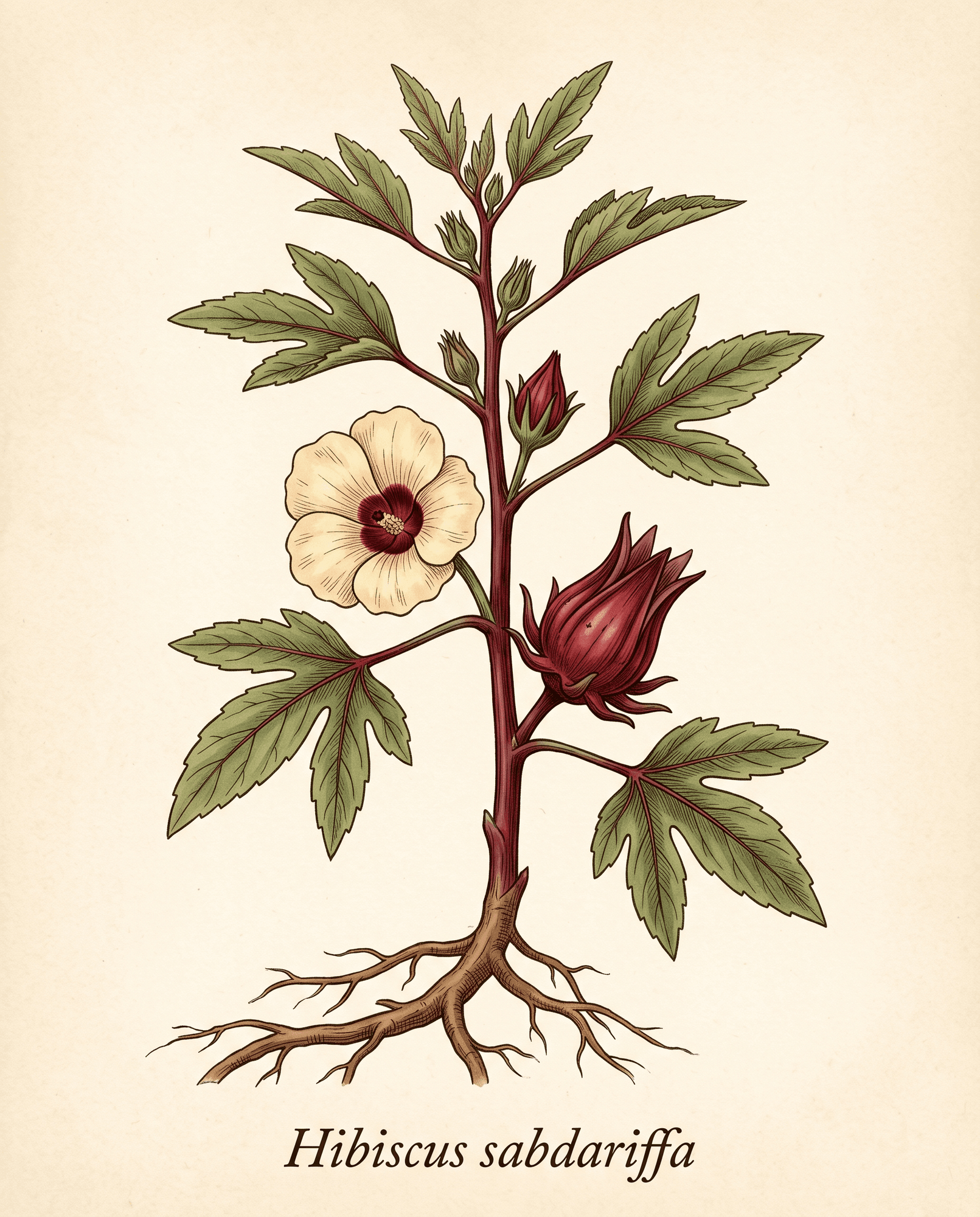
Hibiscus is the blood made visible. Steep her calyces and the water turns the deep, unmistakable red of the thing itself — and this is no accident of the eye but the center of her teaching. She is the plant that shows you the blood in the glass before she ever touches the blood in the body. Sour, cool, and flowing, she is a river of medicine: she softens the vessel and quiets the pressure, cools the heat of the heart, and carries rather than drives.
And she is the red that crossed the water. Born in West Africa, she was carried in the seams of memory across the Atlantic by people who were themselves being carried against their will, and she put down roots on every shore they reached. Bissap in Senegal, sobolo in Ghana, zobo in Nigeria, sorrel in the Caribbean, agua de Jamaica in Mexico, red drink in the American South — one plant, one color, a thousand names, poured out at Christmas and at Juneteenth, at weddings and at funerals, wherever the scattered people gathered to remember who they were. To drink her is to drink lineage. To pour her out is to pour a libation. She is blood as memory, blood as belonging, blood as the thing that traveled and did not forget itself.
The shape of her medicine
Hibiscus’s medicine moves downward and inward, cooling as it goes. She is sour and astringent, and the sourness is the doorway to her work: it draws tissue together, tightens what has grown lax, and turns the body’s heat back down from the surface. She gathers inward in a wash of cool. She is refrigerant in the old sense — she takes heat out of an overheated system — and she does it gently, as a long cool drink does on a hot day.
Her hypotensive action is her most celebrated and her most studied. She lowers blood pressure through several doors at once. Her anthocyanins and polyphenols support the relaxation of the vessel walls, easing the tension that drives pressure up. She works on the enzyme cascade — the same angiotensin-converting-enzyme pathway that pharmaceutical blood-pressure drugs target — softening the body’s own signal to constrict. And she is mildly diuretic, gently reducing the volume of fluid the vessels must carry. Softer vessels, a calmer constricting signal, less fluid to move: three gestures toward the same end, which is blood that presses less hard against the walls that hold it.
Her antioxidant and anti-inflammatory threads run all through this work. The same deep-red anthocyanins that color the glass are potent antioxidants, and they protect the vessel walls from the oxidative damage that stiffens and narrows arteries over time. This is why she is not only a pressure remedy but a vessel remedy — she tends the health of the pipes, not just the force within them.
Her astringent quality gives her a second register. Sourness and tannin tighten and tone tissue, which is why the tradition has reached for her in patterns of excess flow and lax tissue — and why, in more than one lineage, she has been used both to cool the blood and to tone the tissues of the reproductive tract. She is cooling and gathering where so much of her cardiovascular work is softening and releasing, and holding both is part of her intelligence.
Her hypolipidemic action rounds out the cardiovascular picture: over time she helps shift the balance of blood lipids and, with her pectin and organic acids, supports the body in clearing excess. And beneath all of it runs her simple nutritive gift — she is rich in vitamin C, the vitamin the vessel walls themselves are built to need. Together her actions form a single gesture: cooling, softening, and easing the pressure of the blood. She is for the body that runs hot and tight, whose blood presses too hard and whose heart could stand to be cooled.
What lives inside her
Whose medicine she carries
Fire (color)
Mars
Libra
Temperance
The Lovers
Shango
Shango is the lightning and the drum, the king, the fire in the blood — the Orisha of the beating heart, of vital force, of the red that runs through everything alive. Hibiscus is his in her color first: she is red the way blood is red, red the way fire is red, and she stains everything she touches with it. She is the plant that makes his element visible in the glass. But her deeper alignment with him is subtler than her color: she is the medicine that tends his fire without extinguishing it.
Shango’s fire, unbanked, becomes the overheated heart — the pounding pressure, the blood driven too hard, the heat that damages what it was meant to enliven. Hibiscus cools that fire to a workable warmth. She does not put out the flame; she keeps it from consuming the vessel. She is the queen’s medicine to the king’s heat — the cool red drink poured for the one whose blood runs too hot, easing the pressure without quenching the life. In his house she is the tempering of power, the drink that lets the fire burn on without burning down the body that carries it.
Oshun
Oshun is sweetness, beauty, the river, and the feminine blood — the honey and the gold, the joy that is itself a form of medicine, and the cyclical mysteries of the womb. Hibiscus belongs to her in the celebration and in the flow. She is the red drink of every gathering: the sweet-sour libation poured at the wedding and the naming, the beauty carried in a glass, the hospitality that says you are welcome here, drink and be glad. That joy is not incidental to her medicine. Oshun teaches that pleasure and beauty are healing, and hibiscus is a plant whose medicine arrives disguised as delight — the remedy you drink because it is delicious.
And she carries Oshun’s blood-work. Her astringent, cooling nature has long been turned toward the tissues of the womb and the regulation of feminine flow, and her red is the red of that blood too — the cyclical shedding and renewing that Oshun governs. Where Shango’s blood is the fire of vitality, Oshun’s is the tidal blood of the feminine body, and hibiscus tends both from her one red cup.
Yemaya
Yemaya is the great mother, the ocean, the deep cooling waters that hold and carry all life. Hibiscus belongs to her in two ways. The first is her cooling itself — Yemaya’s medicine is the calm of deep water, the temperature dropping, the fever easing, and hibiscus is refrigerant medicine, water that cools the overheated blood. The second is the crossing. Yemaya is the ocean that the diaspora was carried across, the mother who held her children through the middle passage and did not let the memory drown. Hibiscus made that crossing too, and came up red on the far shore, still herself. When she is poured out as libation to the ancestors, it is Yemaya’s waters she is poured upon — the great mother receiving the red drink her children carried across her own body and never forgot how to make.
The One Red Cup
She does not divide herself between them. Shango, Oshun, Yemaya - she holds all three in the same red water, the same stained glass, the same cup lifted at the same table. The fire of vitality and the tidal blood of the feminine and the cooling memory of the crossing are not three separate medicines. They are one medicine, held in one plant, poured from one tradition that was wise enough to know that blood is not a single thing - that it burns and flows and remembers, that it pounds in the chest and moves with the moon and crossed an ocean and arrived still red, still itself, still healing. Every time she is brewed, all of that is in the cup. The one who drinks for their pressure drinks from Shango’s cooling. The one who drinks for the body’s rhythm drinks from Oshun’s governance. The one who pours for the ancestors pours into Yemaya’s keeping. And the plant holds all of it, as she always has - red the way blood is red, tending the fire and the flow and the memory at once, from her one unbroken tradition of care.
The hands she has passed through
Hibiscus begins in West Africa, where she is native and where her deep-red infusion has been drunk for many centuries — as refreshment against the heat, as medicine for the heart and the blood, and as the ceremonial drink of gathering and celebration. In Senegal she is bissap, the national drink; in Ghana, sobolo; in Nigeria, zobo. The red of the drink carries meaning in many West African cultures — strength, spirituality, the cycles of life and death — and she has always been more than a beverage. She is hospitality poured into a cup, and she is medicine that happens to taste of celebration.
She crossed the Atlantic in the seams of the transatlantic slave trade, carried as seed by people who were themselves being carried, and she flourished in the warm soils of the Caribbean and Latin America. In Trinidad she became sorrel, and across Jamaica and the wider West Indies she took the same name and the same place at the table. She is steeped with ginger, cloves, cinnamon, allspice, and orange peel, sweetened, and left to sit for days before serving. That spiced brew is the base; at Christmas it is built up with rum into a punch, and it is the rum as much as the season that makes that version the holiday one. The written record almost always calls her the drink of Christmas, and she is that — but in many households she has never been only that. She is the pot boiled up on a Saturday so it will be ready for Sunday dinner, the jug waiting in the icebox through the ordinary weeks of the year, the red drink poured because the family is coming to the table. That steady, unremarkable presence is the truer measure of her place. In Mexico and Central America she became agua de Jamaica and flor de Jamaica, the ruby-red agua fresca sold on every corner. One plant, adapted to every new shore with the local spices, holding its color and its meaning wherever it landed.
In the United States, the soil in much of the South would not easily grow the roselle, and so the tradition adapted: enslaved people and their descendants made the red drink with what would grow — berries, cherries, and other red fruits held in water and sweetened. That improvisation was real ingenuity, the same knowledge working with a different plant, and the red drink kept its place at the table and its meaning in the gathering.
What happened next was not adaptation. In the twentieth century the commercial powders and sodas arrived — Big Red, the red packets of flavored drink mix — and they were marketed hard into Black communities, cheap and shelf-stable and everywhere. They took the color and the occasion and left the plant behind. What had been a calyx that lowers blood pressure, feeds the vessel walls, and cools inflammatory heat became sugar, water, and dye. This was not a tradition evolving; it was a medicine displaced by a product, and it was profitable. The bitterness of it is that the communities carrying the heaviest burden of hypertension and diabetes in this country had, in their own inherited drink, a plant that tends exactly those conditions — and it was replaced by something that worsens them.
What survived was the gesture, not the knowledge. Red is still on the table at Juneteenth, still poured at emancipation celebrations, still called “liquid soul” — but ask why it must be red and most people cannot say. The answer went missing somewhere between the calyx and the powder. Generations have kept the practice faithfully without being told what it was for, that the color reaches back to West Africa, that the drink in their grandmother’s hands was once a medicine. That is the deeper theft, and it is worth naming as such: not only was the plant taken out of the glass, the reason was taken out of the ritual. A people can hold onto a tradition and still be robbed of it.
So the remembering is itself part of the work. To go back to the calyx — to boil the actual plant, spiced and steeped, and to know why red — is not nostalgia. It is a repossession: taking back the drink that was ours, with the medicine still in it and the story still attached.
In the pharmacopoeia of Senegal and much of West Africa, hibiscus stands among the most frequently used plants for high blood pressure, a traditional application that generations of clinical study have since borne out. In Mexican traditional medicine the agua de Jamaica is drunk as a diuretic, for the liver, for fever, and for high cholesterol and high blood pressure. In Ayurveda — where the related Hibiscus rosa-sinensis, japa pushpa, is best known — she is a cooling Pitta remedy used for the heart, for high blood pressure, for the hair and skin, and in women’s medicine as a styptic and menstrual regulator. In Traditional Chinese Medicine she is luo shen hua, sour and cooling. Everywhere she has traveled, the reading is the same: a cooling, red, blood-and-heart medicine that also happens to be one of the most beloved drinks on earth.
Where she works in the body
Cardiovascular system. This is hibiscus’s heartland, and her work here is among the best-documented of any herb in the materia medica. She lowers blood pressure through several coordinated actions — supporting the relaxation of the vessel walls, softening the angiotensin-converting-enzyme signal that would constrict them, and gently reducing fluid volume through mild diuresis. Her anthocyanins protect the vessel walls themselves from oxidative damage, so she tends the pipes as well as the pressure within them, and over time she helps shift the balance of blood lipids. She is a specific for the hot, tight, pressured cardiovascular pattern — the blood that presses too hard — and she does this work gently enough to be taken as a daily drink.
Urinary system. Her mild diuretic action moves the kidneys gently, reducing fluid retention and supporting the clearing of the urinary passages. This is part of how she lowers blood pressure — less fluid for the vessels to carry — and it is why the Mexican tradition drinks agua de Jamaica specifically as a diuretic. Her sourness and cooling suit hot, irritated urinary conditions.
Digestive system. Sour and cooling, hibiscus supports a hot or sluggish digestion, and her organic acids and mild astringency have long made her a remedy for gastrointestinal complaints across her home traditions. Her pectin and mucilage lend a gentle, moistening quality that softens her sourness. The one caution mirrors her strength: in someone already prone to reflux, her acidity can aggravate rather than soothe.
Skin. As a cooling, antioxidant, vitamin-C-rich plant, hibiscus supports the skin from within — the anthocyanins and vitamin C that protect the vessel walls also support the collagen and the capillaries of the skin. In her home traditions she is used both internally and topically for the skin and, especially the rosa-sinensis species, for the hair. Her astringency tones and her cooling quiets heat and inflammation at the surface.
How to take her
Harvest calendar
Preparations
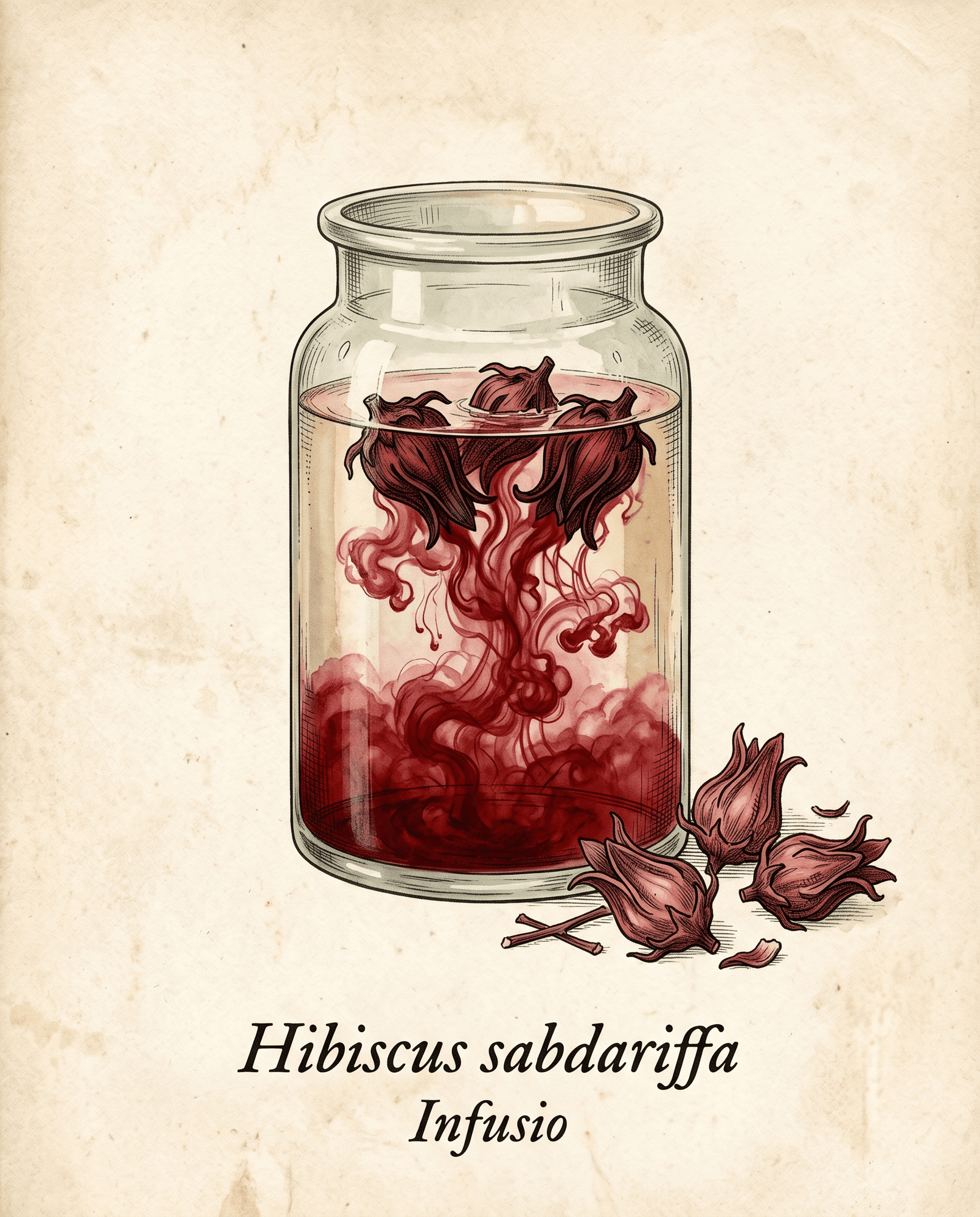
Cold or hot infusion (the red drink): The foundational preparation. One to two tablespoons of dried calyces per cup of water. Steep in hot water 10–15 minutes, or cold-brew for several hours to a deep red. Drink 1–3 cups daily. This is the form carried in every tradition and the form most of the blood-pressure work is built on.
Traditional sorrel / bissap: Steeped with ginger, cloves, cinnamon, allspice, and orange peel, sweetened to taste. The spices add warmth and circulation to her cooling — a beautifully balanced preparation that is medicine and celebration at once.
Tincture: Less common than the infusion, since her medicine is water-soluble and she is so pleasant to drink, but available; typical dosing follows standard tincture ranges.
Cooking: The fresh calyces are made into jams, sauces, and chutneys; the leaves are used as a sour cooking green in parts of West Africa.
Topical: Cooled strong infusion as a face rinse or added to the bath for the skin; rosa-sinensis especially infused in oil for the hair.
Spiritual & ritual:
- Poured as a libation to the ancestors, especially in remembrance of the diaspora and the crossing
- Shared as the drink of celebration, hospitality, and gathering — the medicine that arrives as joy
- Brewed and drunk to cool the heat of anger or a heart that runs too hot
- Placed on altars dedicated to Shango, Oshun, or Yemaya
- Used in love and beauty work for her red color and her Venus signature
When to hold back
Use with caution if:
- You take antihypertensive medication or have already-low blood pressure. Her blood-pressure-lowering action is real and additive; monitor for readings that drop too low.
- You are pregnant. Hibiscus is traditionally avoided in pregnancy across several traditions — she carries emmenagogue associations and some hormonal activity, and Ayurveda notes her use to stimulate menstruation. Best set aside until after birth.
- You take acetaminophen (paracetamol) or other medications with narrow timing. Hibiscus can alter the absorption and clearance of some drugs — notably it has been shown to affect acetaminophen pharmacokinetics — so separate her from medication doses and raise it with your prescriber if you take time-sensitive drugs.
- You have active reflux or a hot, irritated stomach. Her sourness can aggravate an already acidic gut.
Topical considerations: Generally well tolerated on skin and hair; patch test as with any new botanical.
General notes: Very safe and food-like in normal amounts across the lifespan. Some studies note mild estrogen-modulating potential, worth holding in mind for hormone-sensitive conditions. Her medicine is gentle and cumulative — she is a daily drink, not a heroic dose.
Who walks with her
For the blood and blood pressure: Garlic, hawthorn, and her own warming spice companions (ginger, cinnamon). Hibiscus brings the cooling and the easing of pressure; warming, moving herbs supply the heat and circulation she lacks, and hawthorn tends the heart’s structure and rhythm beneath both.
For celebration and warmth: Ginger, cinnamon, clove, allspice, orange peel. These are her diaspora companions, the spices of sorrel and bissap, and they do real work — adding warmth and circulation to balance her cool, so the drink neither chills nor overheats.
For the vessel and the heart over time: Hawthorn, rose. Hawthorn is the great heart tonic; rose cools and opens the heart while hibiscus cools the blood; together they make a heart-and-vessel formula that is as beautiful as it is effective.
For cooling heat and the skin: Rose, calendula, red clover. The cooling, alterative, vessel-tending herbs keep good company with her for hot, inflamed, or congested patterns.
These allies share hibiscus’s capacity to cool and to tend. The warming spices balance her so she neither overcools nor loses her edge; hawthorn and rose deepen her heart-work; the warming, moving herbs supply exactly what she lacks — heat and movement to her cool and ease. She is a generous, easy plant in formula: pleasant, water-soluble, and forgiving, happy to carry other herbs in her red cup.
How to know her
The libation: Brew her strong and red. Before you drink, pour a little onto the earth for the ancestors — for the ones who carried her across the water, and for your own dead. Speak their names if you know them, and let the red drink be the thread back to them. This is old practice, older than any of us, and she was made for it.
The drink of gathering: Make a great pot of her — sorrel or bissap, spiced and sweetened — for a celebration, a holiday, a coming-together. As you brew, remember that you are doing what has been done across the whole diaspora for centuries: making the red drink that says we are still here, drink and be glad. Hospitality is a form of medicine. Pour generously.
Ritual of cooling the heart: When anger or grief has your blood running hot, brew her cool and drink her slowly. As you drink, feel the heat come down — not extinguished, but eased to something you can carry. Ask her to cool the fire without putting out the life in it.
Journal prompts
- What runs too hot in me right now — in my body, my blood, my heart — and what would it mean to cool it without quenching it?
- What have I carried across a hard crossing and not forgotten? What red thread still connects me to where I came from?
- Who are the ancestors I would pour a libation to? What do I want to say to them?
- Where in my life is pleasure itself the medicine I have been refusing?
- What pressure am I holding that I could let ease?
Tarot Spread
A spread for entering into relationship with Hibiscus as a plant ally:
- What heat in me is she offering to cool?
- What am I carrying across the water that she wants me to remember?
- Where does she want me to let the pressure ease?
- What celebration or sweetness is she asking me to pour out?
- What does the red in the cup want to show me about my own blood?
Keep a cup of the red infusion on your altar with the cards. Let its color be part of the reading.
The same plant, multiple lenses
In Ayurveda, hibiscus — japa or gudhal, best known through the related Hibiscus rosa-sinensis — is a cooling plant, sweet and astringent in taste (madhura and kashaya) with a cold potency (shita virya). She is classically a Pitta remedy, and she carries a styptic (stambhana) and blood-tending reputation, used for the heart, for high blood pressure, for the hair and skin, and in women’s medicine.
Pitta Dosha — Fire & Water
This is hibiscus’s clearest dosha alignment. Pitta is heat, fire, and inflammation, and hibiscus is one of the cooling remedies that meets it directly — for the hot, pressured heart, for inflammatory heat in the blood, for the flushed and irritable Pitta pattern. Her sweet, astringent, cold nature draws Pitta’s fire down and in. For the person who runs hot, she is foundational cooling medicine, and the classical texts reach for her precisely in Pitta fevers and heat disorders.
Kapha Dosha — Earth & Water
Her astringency makes her acceptable and often useful for Kapha as well — the astringent taste is a reducer of Kapha, and her tightening, toning quality helps with the lax, damp, congested Kapha patterns. She is one of the cooling herbs that does not aggravate Kapha the way sweet, heavy, moistening remedies can, because her astringency counterbalances her moistening side.
Vata Dosha — Air & Ether
Vata is where hibiscus asks for care. Her cold, astringent, drying-toward-the-tissues nature can aggravate Vata’s inherent coldness and dryness if used heavily or alone. For a Vata-dominant person who wants her cardiovascular medicine, she is best warmed and softened — this is exactly what the traditional sorrel and bissap preparations do, wrapping her cool in the warmth of ginger, cinnamon, and clove so she cools the blood without chilling the constitution.
In TCM, hibiscus is known as luo shen hua, and she is a cooling, sour, yin-nourishing herb.
Taste & Temperature: Sour, cool. Channels Entered: Primarily Liver and Kidney, with action on the Heart. Functions: Clears heat; generates fluids and nourishes yin; astringes; calms and cools the blood and the Liver.
Clearing Heat & Cooling the Blood
Luo shen hua’s cool, sour nature clears heat from the blood and the Liver — the flushed face, the pressured head, the irritability and heat of a Liver running too hot. She is a gentle heat-clearer, appropriate for the long-standing low heat of a pressured cardiovascular system rather than acute high fever.
Generating Fluids & Nourishing Yin
The sour taste in TCM generates fluids, and hibiscus is a fluid-generating, yin-nourishing herb — she moistens and cools a body that has run dry and hot, the way a sour drink slakes a deep thirst. This is part of why she suits the hot, tight, depleted-yin pattern so well: she replenishes even as she cools.
Astringing
Her sour and astringent nature gathers and holds — the TCM reading of the same quality that makes her a styptic in Ayurveda. She tightens what has grown lax and stems excess flow, and this astringing action is part of her tissue-toning, blood-tending work.
Yin/Yang Balance
Hibiscus is Yin in nature — cooling, moistening, descending, and gathering. She is medicine for heat, dryness, and yin-deficient patterns with heat — the hot, pressured, flushed, thirsty presentation. She is less suited to cold, damp, deficient patterns without warming companions, which is precisely why her home traditions almost always brew her with warming spices.
For going deeper
- Da-Costa-Rocha, Inês, et al. “Hibiscus sabdariffa L. – A phytochemical and pharmacological review.” Food Chemistry. (A thorough modern review of her constituents and actions.)
- Miller, Adrian. Soul Food: The Surprising Story of an American Cuisine, One Plate at a Time. University of North Carolina Press — for the history of the red drink in African American foodways.
- Twitty, Michael W. The Cooking Gene. Amistad — for foodways, memory, and the diaspora’s carried plants.
- Frawley, David & Lad, Vasant. The Yoga of Herbs: An Ayurvedic Guide to Herbal Medicine. Lotus Press.
- The ethnobotanical and clinical literature on Hibiscus sabdariffa and hypertension, much of it grounded in the Senegalese and Mexican traditional pharmacopoeias where her use is oldest.
- Oral traditions of sorrel, bissap, sobolo, zobo, and agua de Jamaica — held in families and communities across the diaspora. Seek the recipe from the elders who make it; the medicine and the memory travel together.
The Conversation
Questions, noticings, what this is teaching you — leave them here. This same conversation lives in The Circle.