Peppermint
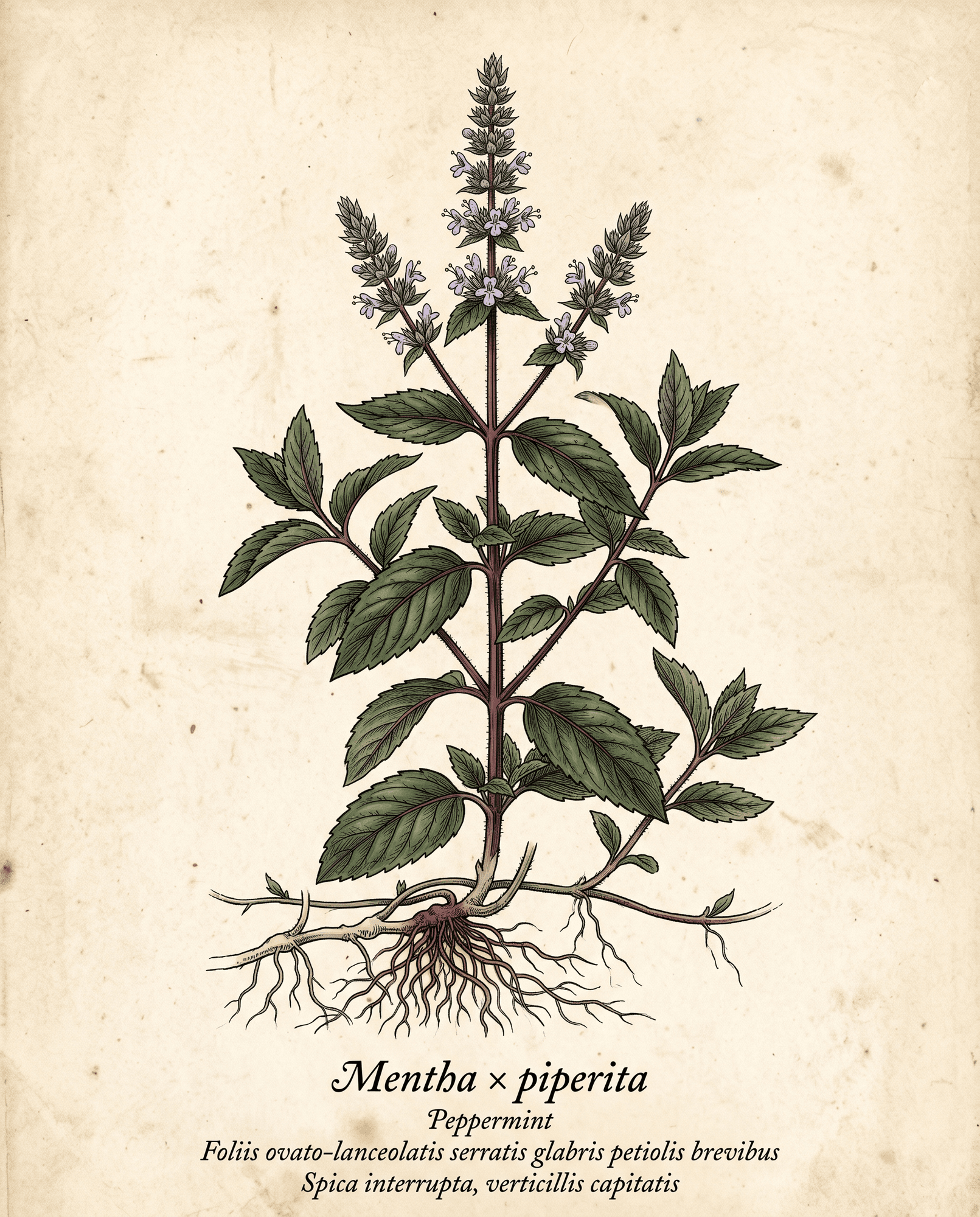
Peppermint is the youngest elder in the apothecary. Her whole documented life spans barely three centuries — a natural cross of water mint and spearmint, first set down on paper in England in 1696 — yet she carries herself like she has always been here, and in a sense she has: her mother-lines run back through every mint the ancient world ever crowned a feast with. She is sterile and sets no seed, which means every peppermint plant alive today is her, traveling by runner and cutting from garden to garden, hand to hand, across the whole world. There is something worth sitting with in that: a medicine that cannot reproduce except through relationship.
What she carries is the cold fire. Crush a leaf and menthol reaches the cold receptors of your body before your thought catches up — a chill that is not a chill, a coolness the nervous system believes completely though the temperature never dropped. Behind that chill comes the wake-up: circulation quickening, breath widening, the fogged head suddenly clear. She is the sharp sister, the one you reach for when something needs to move now — the cramping gut, the pounding temples, the sinuses sealed shut, the mind gone to static. Her gentler sister spearmint keeps her own monograph in this library; this page belongs to the bright blade of the family.
The shape of her medicine
Peppermint moves upward and outward, and fast. She rises to the head, opens at the surface, and disperses what was stuck — heat vented through a light sweat, breath through opened airways, thought through a cleared mind. She is medicine for congestion in every register: the congested sinus, the congested gut, the congested attention.
Her temperature is the traditions’ most honest disagreement, and the disagreement is the teaching. On the tongue she is unmistakably cool — menthol binds the body’s cold receptors, so the nervous system reads her as cold water even in a boiling tea, and TCM and Ayurveda both classify her as cooling on the strength of it. But the Western tradition, from the old physiomedicalists through Matthew Wood, has always noted she is first cooling, then warming: behind the chill comes a stimulant lift, a quickening of circulation, a gentle flush. Both are true. She is a cool touch that wakes the fire underneath — which is why she belongs equally to iced summer tea and to the winter cold-care pot.
Her actions unfold from that gesture. As a carminative she is among the finest in the materia medica: her volatile oil relaxes the smooth muscle of the gut, releasing trapped gas, easing the knotted fullness after meals, settling nausea. As an antispasmodic she takes that relaxation deeper — intestinal cramping, colic, the gripping spasm of an irritable bowel. Enteric-coated peppermint oil, which carries her past the stomach to where the spasm lives, holds one of the most robust clinical records in herbal medicine for easing the global symptoms of IBS.
As an aromatic diaphoretic she opens the surface: taken hot at the first sign of a fever she raises a light sweat and vents heat through the skin — her seat in the old cold-care trio with yarrow and elderflower. As a decongestant she does something subtler than emptying the sinuses: menthol opens the felt sense of the airway, cooling and widening the perception of every breath, while her antispasmodic thread quiets the tight, hacking cough.
As a nervine she holds her signature paradox — relaxing and awakening in the same cup. She loosens the tension headache and burns off the mental fog together. As a topical analgesic she confuses pain signaling and cools inflamed tissue; the diluted drop at the temples is old, reliable medicine. Her cholagogue thread gently moves bile — the truth beneath the after-dinner mint — and her antipruritic coolness quiets the maddening itch of bites and rashes.
What lives inside her
Whose medicine she carries
Fire (the stimulant warmth beneath the chill)
Virgo
Temperance
Obatala
Obatala is the cool head — the elder of the white cloth, the owner of clarity, patience, and the dignity of calm thought. Peppermint belongs to him completely, and needs no second house. Everything she does in a body is his medicine performed at speed: she clears the head and brightens the eyes, cools heat that has risen to the face and throat, quiets the churning belly and the racing thought with the same breath. When the mind is hot, cluttered, and quarrelsome, peppermint is the cool white cloth laid across it — and unlike most of Obatala’s slow, patient medicines, she works in the time it takes to inhale.
There is a purity to her that is his signature. She cleans without harshness — the breath, the palate, the sickroom air, the water on the altar. The old practice of strewing mint across floors, from Mediterranean temples to synagogues, was his kind of work: preparing a space for clear minds and honest speech. Her whiteness is in the menthol itself, the crystalline cold at the center of her oil. To drink peppermint with intention is to ask for a cool head before a hard conversation, a clean tongue before an important word, stillness where there has been static. She teaches that clarity is not the absence of feeling but the settling of it — the moment the water goes still enough to see through.
The hands she has passed through
Peppermint’s paper trail is short and bright; her inheritance is long. The mints as a family were medicine in Egypt by 1550 BCE, when the Ebers Papyrus recorded them as a calmer of the stomach, and the older Hearst Papyrus prescribed mint plasters for congestion. Mint scented the liturgical perfumes of the Temple of Horus at Edfu, and dried leaves traveled into the tombs — wealth enough to carry into the afterlife. The ancient records rarely distinguish species; what they describe is the family gesture peppermint would come to perform better than anyone. In Greece and Rome, Pliny records mint crowning the heads of feasters, scenting wine and sauces, perfuming the arms in the baths of Athens — the plant of refreshment and welcome. The underworld thread of the family story, the nymph Minthe herself, belongs to the older mints and is told in full in spearmint’s monograph; peppermint inherited the fragrance without the grief.
Her own story begins in an English field. Around the end of the seventeenth century, botanists noticed a mint that was neither water mint nor spearmint but something sharper than both — John Ray described her formally in 1696 as “pepper-mint,” named for the bite. She proved sterile, a true hybrid, and had to be propagated entirely by hand: divided, cutting by cutting, gardener by gardener. By 1750 the village of Mitcham in Surrey had built the world’s first commercial peppermint industry, and Mitcham oil became the standard the world measured against. Within a century she had crossed every ocean — American growers in Michigan, Indiana, and Oregon eventually came to dominate the oil trade — and Mentha × piperita became one of the most cultivated medicinal plants on earth.
The Eclectic physicians of nineteenth-century America leaned on her hard: for colic, for flatulence, for nausea and the vomiting of pregnancy, for cholera morbus, as a vehicle to carry harsher medicines gently. Their essence of peppermint sat in nearly every household medicine chest. In Traditional Chinese Medicine, the classical bo he is her cousin field mint, but peppermint — hu jiao bo he, “pepper mint” — has been folded into the same work of dispersing wind-heat and clearing the head, and Western practitioners of TCM reach for the two nearly interchangeably. In Ayurveda she is the sharpest of the pudinas, the household cooler of Pitta.
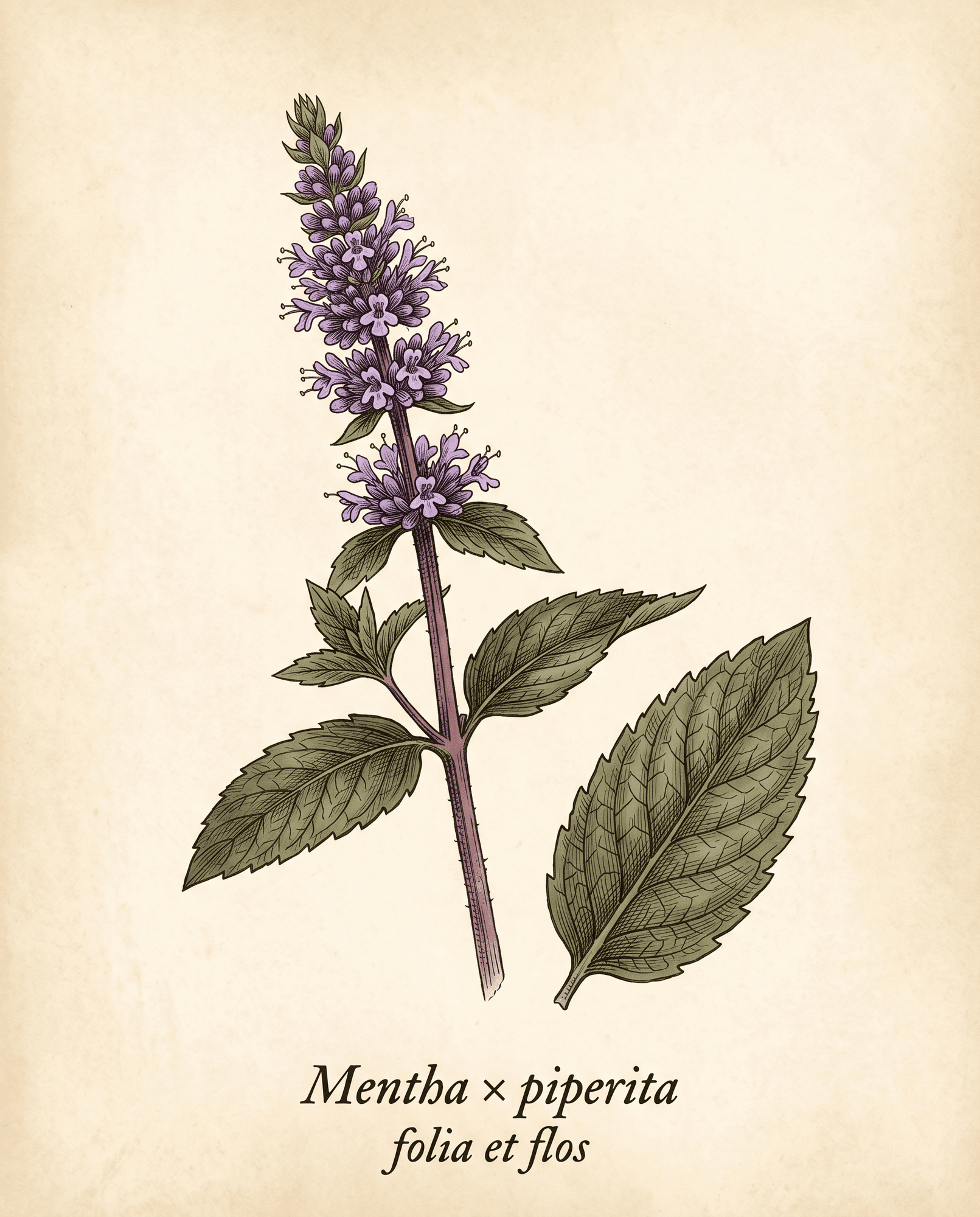
And the modern chapter is hers alone: peppermint is one of the very few herbs to walk into the clinical literature and hold her ground. Enteric-coated peppermint oil for irritable bowel, menthol for tension headache and topical pain — she has been trialed, measured, and confirmed doing exactly what the Eclectics, the grandmothers, and the Mitcham growers always said she did. The world’s most modern mint keeps proving the oldest claims.
Where she works in the body
Digestive system. Her heartland. The volatile oil relaxes smooth muscle along the entire tract — releasing gas, easing cramping and colic, settling nausea, quieting the spasm-and-urgency of irritable bowel. Enteric-coated peppermint oil, which delivers her past the stomach to the intestines, has repeatedly outperformed placebo for the global symptoms of IBS and stands among the best-evidenced herbal preparations in existence. As a mild cholagogue she supports bile flow and the digestion of rich food. The one digestive place she does not belong is reflux: the same muscle-relaxing gift loosens the valve at the top of the stomach, and heartburn-prone bellies should call on her gentler sister or a different ally entirely.
Nervous system. The nervine that relaxes and awakens in one gesture. She eases the tension headache — a diluted smear of her oil at the temples has held its own against standard pain relievers in clinical study — while sharpening attention and clearing the dulled, foggy head. She suits the state of being wound tight and worn dull at once: the overworked afternoon, the anxious stomach, the mind that can neither rest nor focus.
Respiratory system. Menthol opens the felt sense of the airway — every breath after peppermint seems wider and cleaner. As a steam she loosens congestion in sinus and chest; as a hot tea with yarrow and elderflower she vents the heat of an early fever through a gentle sweat; her antispasmodic thread calms the tight, unproductive cough.
Musculoskeletal system. Topically she is reliable pain medicine. Diluted in a carrier oil and rubbed into sore muscles, a seized neck, or an aching low back, menthol cools the tissue’s perception of pain while drawing fresh circulation through — the old counterirritant wisdom, now well described by science.
Skin. Cool and antipruritic, she quiets the itch: bug bites, heat rash, the prickle of healing skin. A cooled strong infusion makes a compress or bath addition for hot, irritated skin. The essential oil is always diluted, and on broken or sensitive skin the gentler tea is the better form.
How to take her
Harvest calendar
Preparations
Leaf infusion: 1–2 teaspoons dried leaf (or a generous sprig of fresh) per cup of just-boiled water. Steep 7–12 minutes, covered — her medicine is volatile and leaves with the steam. 1–3 cups daily.
Tincture: Fresh leaf 1:2 in 60% alcohol, or dried 1:5 in 40%. Typical dose 1–3 mL up to 3 times daily, most useful in digestive and nervine formulas.
Enteric-coated peppermint oil capsules: The studied preparation for IBS, typically 0.2–0.4 mL of oil per capsule taken between meals. Use prepared products; do not improvise with raw essential oil.
Topical oil: Essential oil diluted to 2–5% in a carrier for temples (headache), belly (cramping), and sore muscles. Keep well away from the eyes, and never on or near the face of a baby or young child.
Steam: A handful of fresh leaf or 1–2 drops of essential oil in a bowl of hot water, towel over the head, eyes closed, slow breaths, for congestion.
Food: Fresh in fruit, chocolate’s oldest ally, cool summer water, after-dinner tea. Her culinary life is continuous with her medicine.
Spiritual & ritual:
- A covered cup drunk slowly before hard conversations or decisions, for the cool head
- A strong infusion added to wash water for the sickroom, the workspace, or any room gone stale
- A fresh sprig in the altar water, refreshed weekly, to keep the connection cool and clean
- Steam with intention: exhale the static, inhale the clear
When to hold back
Use with caution if:
- You have GERD, chronic reflux, or hiatal hernia. She relaxes the lower esophageal sphincter and can worsen heartburn — this is her clearest exclusion.
- You have gallstones or bile duct obstruction. Her bile-moving action calls for professional guidance.
- You are nursing and supply is fragile — regular, substantial peppermint may reduce milk supply. Culinary amounts are not a concern.
- You have G6PD deficiency — avoid menthol-rich preparations.
- You take medications with a narrow therapeutic window (such as cyclosporine); her oil can affect their metabolism. Check interactions for concentrated forms.
Topical considerations: Always dilute the essential oil — straight menthol can irritate and even burn sensitive skin. Never apply peppermint oil on or near the face, chest, or nose of infants and young children; menthol can trigger reflexive breath-holding and laryngospasm in little ones.
General notes: As tea and food she is gentle and forgiving across most of the lifespan. Nearly every caution above belongs to the concentrated essential oil, which is strong medicine and never taken internally undiluted.
Who walks with her
For digestion: Fennel, ginger, chamomile, lemon balm, catnip.
For colds and fevers: Yarrow, elderflower — the classic hot-tea trio for venting a fever at its start.
For the head: Rosemary, lavender, feverfew, wood betony.
For the sickroom and the itch: Calendula, plantain, chickweed in topical work; eucalyptus in the steam.
These communities gather around what she does best — opening, cooling, moving — and around what she needs held. Yarrow and elder give her fever work its depth and duration; ginger and fennel warm the digestive formula so her coolness never overshoots a cold constitution; lemon balm meets her in the nervous belly, where worry and indigestion tie the same knot. Rosemary is her closest kin in the head-clearing work — the warm clarity to her cool clarity — and the two together are a formula for the fogged and weary mind. She is a top note by nature: quick, bright, and best when something slower is holding the base.
How to know her
Plant walk: Find a peppermint plant and look for the purple in her stems — the sure sign it is her and not her green-stemmed sister. Crush one leaf and hold it to your face. Notice that the cold you feel is not cold at all: nothing changed temperature, only perception. Sit with what else in your life might be a signal rather than a fact.
Ritual of the cool head: Before a hard conversation or a decision that keeps sliding sideways, brew a covered cup and sit with it until it is just cool enough to drink. As it cools, let the heat of the situation cool with it. Drink slowly. Speak only after the cup is finished.
The clearing steam: When the head is congested — with mucus or with static — pour just-boiled water over a handful of fresh peppermint, tent a towel over your head, close your eyes, and take ten slow breaths. Name what leaves with each exhale.
Winter threshold: In cold-season sickness, keep a pot of peppermint, yarrow, and elderflower going. Serve it hot to whoever is ailing, and take a cup yourself at the door of the sickroom — the old herbalist’s habit of tending the tender.
Journal prompts
- Where in my life am I being asked to keep a cool head, and what would that actually require of me?
- What in me feels frozen that is actually just a signal — a perception of cold rather than the thing itself?
- Where has fog settled in my thinking, and what am I avoiding by leaving it unexamined?
- What would I say if my tongue were perfectly clean and my head perfectly clear?
- I am a medicine that only travels through relationship. Who handed me the things that heal me?
Tarot Spread
A spread for entering into relationship with Peppermint as a plant ally:
- Where is my head clouded, and what would her clarity reveal?
- What is she cooling in me that has run hot too long?
- What is the fire beneath my chill — the vitality waiting behind the numbness?
- What conversation is waiting for my clean tongue?
- What does she ask of me in return for her wake-up?
Keep a sprig of fresh peppermint or a small dish of dried leaf beside the cards. Let the scent be part of the reading.
The same plant, multiple lenses
Pudina’s pungent taste (katu rasa), light and penetrating quality, and cooling action make her a reducer of excess — with the same honest complication the Western tradition sees. Most sources hold her potency as sheeta (cooling) with a sweet vipaka; a few classical lineages read her stimulant fire and call her ushna. Both readings appear below where they matter.
Pitta Dosha — Fire & Water
Her clearest gift. Pitta’s heat — acid indigestion, hot skin, irritability, the flushed face of an overheated body — meets her cooling, venting action directly. Mint water and cool mint tea are classical Pitta pacifiers, calming the digestive fire without extinguishing it. The exception is the Pitta type with reflux, for whom her sphincter-relaxing action outweighs her coolness.
Kapha Dosha — Earth & Water
Her lightness, pungency, and drying quality move Kapha’s heaviness well — sluggish digestion, congested chest, the foggy morning head. Taken warm she opens what Kapha has let settle, and in cold damp seasons she serves Kapha best in warming company: ginger, black pepper, tulsi.
Vata Dosha — Air & Ether
Mixed, and worth respecting. Her carminative gift genuinely serves Vata’s gas, bloating, and nervous stomach — mint with fennel or ajwain is a classical pairing for exactly this. But her cooling, drying, dispersing nature aggravates Vata’s cold and dryness as a daily solo habit. For Vata constitutions: keep her warm, keep her in grounding company, keep her occasional.
The classical bo he of the Chinese materia medica is field mint (Mentha haplocalyx), peppermint’s close cousin; peppermint herself — hu jiao bo he — is used along the same lines, and Western TCM practice reaches for the two nearly interchangeably. The classification below is bo he’s, which peppermint’s chemistry serves faithfully.
Taste & Temperature: Acrid (pungent), cool. Channels Entered: Lung and Liver. Functions: Disperses wind-heat. Clears the head and benefits the throat and eyes. Vents rashes. Soothes the Liver and moves constrained qi.
Dispersing Wind-Heat
A primary herb for wind-heat invasion — the cold or flu that arrives with fever more than chills, sore throat, headache, and red eyes. Her acrid taste pushes the pathogen outward while her coolness counters its heat; she anchors famous formulas like Yin Qiao San. She is added in the last five minutes of any decoction, because her medicine is in the volatile oils and long cooking drives it off.
Clearing the Head, Throat & Eyes
Her light, rising nature carries her to the upper body: the hot headache, the swollen sore throat, the red irritated eyes, the fogged and heavy head. This is the action the whole world has felt in a single crushed leaf — the sudden brightening at the top of the body.
Venting Rashes
For eruptions in their early stage — measles classically, hot itchy rashes by extension — she encourages the rash to express fully at the surface and resolve rather than sink inward and linger. Her wind-expelling quality also quiets itching.
Soothing Liver Qi
Her subtlest function. Constrained Liver qi — the chest tightness, sighing, irritability, and rib-side distension of held stress — responds to her gentle dispersing movement. She is the light, cool note in formulas like Xiao Yao San that lets stuck emotion begin to move.
Yin/Yang Balance
She is cooling and dispersing — a clearer of excess in the exterior and the upper body, used in small doses for short courses. She is not for deficiency: avoid her in yin deficiency with night sweats, in qi deficiency with spontaneous sweating, and in cold patterns without heat, where her dispersing nature drains what is already scarce. Nursing mothers use her sparingly.
For going deeper
- Bensky, Dan, Clavey, Steven, & Stöger, Erich. Chinese Herbal Medicine: Materia Medica (3rd edition). Eastland Press. (See entry on bo he.)
- Wood, Matthew. The Earthwise Herbal: A Complete Guide to Old World Medicinal Plants. North Atlantic Books.
- Frawley, David & Lad, Vasant. The Yoga of Herbs: An Ayurvedic Guide to Herbal Medicine. Lotus Press.
- The Herbarium / Herbal Academy. Peppermint monograph — thorough on her energetics across traditions.
- Felter, Harvey Wickes & Lloyd, John Uri. King’s American Dispensatory (1898) — for Eclectic-era clinical use, available through Henriette’s Herbal.
- The modern IBS literature on enteric-coated peppermint oil — a rare and worthwhile case study in an herb walking into clinical trials and holding her ground.
- The gardeners of Mitcham and everywhere since. Peppermint cannot seed; every plant is a relationship. Find someone with a patch and ask for a runner.
The Conversation
Questions, noticings, what this is teaching you — leave them here. This same conversation lives in The Circle.