Elder
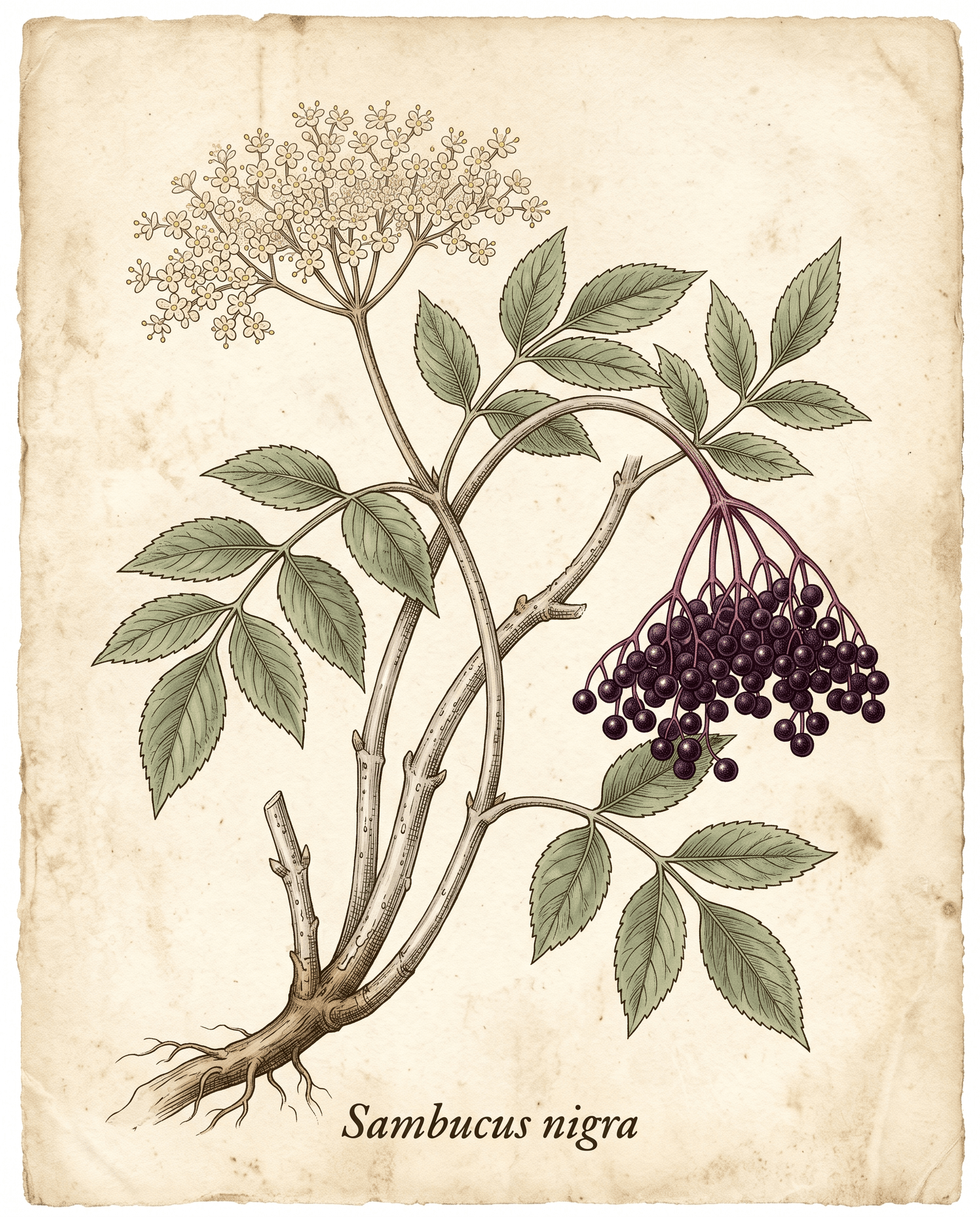
Elder grows where the ground stays damp and the old life of a place still lingers: along the ditch, at the edge of the creek, at the back of the churchyard, beside the ruins of a house nobody remembers building. She is fast and a little unruly, throwing up arching canes from her base, and when she is cut to the ground she comes back within a season as though the cutting were only a conversation. In early summer she opens into wide flat umbels of cream-colored flowers that smell of honey and something wilder underneath, and by the turn toward fall those same umbels hang heavy with fruit so dark it reads as black until the juice runs out purple-red across your hands.
She is one of the oldest medicines people have carried, and one of the most widely shared. She has been food, dye, flute, bellows, wine, cradle-taboo, and guardian of the door. Her flower breaks fevers by opening the skin and letting the heat walk out on the sweat. Her berry, cooked down with honey, has carried families through cold season after cold season. And across nearly every land she grows in, people have understood her as someone to ask before anything is taken. Elder is medicine for the fever that will not break, the chest that will not clear, the grief that has settled into the body like stagnant air, and for anyone standing at a threshold who needs a keeper at the door.
The shape of her medicine
Elder’s medicine moves outward first, then down. The flower opens the surface of the body, relaxing the small vessels of the skin and the pores so that heat trapped inside can release as sweat. Once the surface is open, she turns the water downward through the kidneys. Her nature is cool and drying, and she answers heat, dampness, and the particular kind of tension that holds a fever in the body: the dry, burning skin that will not sweat, the shivering person who is hot inside and cannot get warm, the tight chest and stuffed head of catarrh that has nowhere to go.
The old doctors noticed that she changes her direction with the temperature of the cup. A hot infusion of the flower, taken in bed under a blanket, is a diaphoretic; it brings the blood to the surface and opens the sweat. The same flower steeped and drunk cool moves toward the kidneys instead, working as a diuretic and a gentle alterative. This is worth teaching slowly, because it shows that preparation is not neutral. How you meet her decides which door she opens.
Her taste tells the rest of the story. The flower is faintly sweet and faintly bitter, with a floral, aromatic lift. The berry is sweet and sour together, with a little astringency at the back of the tongue that deepens as it is cooked. Sweetness nourishes, sourness gathers and cools, bitterness drains, and the aromatic oils of the flower stir and disperse. She holds all of them lightly.
As a diaphoretic, the flower is among the most trusted in any tradition. She relaxes the periphery rather than heating the body into a sweat, which is why she suits fevers that burn high and dry. She is the fever-breaker of the nursery, gentle enough for children and steady enough for the grown body in the thick of a flu.
As a febrifuge, she brings temperature down by working with the fever rather than against it. The body raises its heat for a reason. Elder helps it finish that work and let the heat go, so the fever resolves instead of lingering.
Her antimicrobial and immunomodulant actions live mostly in the berry. The dark anthocyanins that stain everything they touch also bind the surface proteins influenza viruses use to enter and leave cells, and the berry has shortened the course of colds and flu for generations of families who never needed a laboratory to tell them so. She does not whip the immune system into a frenzy. She steadies and supports it, which is why she is taken at the first scratch of the throat and through the length of an illness rather than as a single dose.
As an anti-catarrhal, she clears the excess mucus that thickens in the sinuses, ears, and upper chest. The flower is especially good where catarrh comes with heat and swelling: the hot, red, congested head of a summer cold or seasonal allergy.
Her anti-inflammatory and antioxidant threads run through both flower and berry. The flower’s flavonoids protect the fine capillaries and cool inflamed tissue; the berry’s pigments protect cells from the slow wear of oxidative damage.
As a diuretic and alterative, she moves water and gently shifts the terrain through the organs of elimination. The Eclectic physicians reached for her where tissue had become full, boggy, and swollen, where the skin wept serum and crusted over, where water pooled in the body after illness. She clears by opening the exits: skin, kidneys, and bowel.
The berry is an aperient, a very mild laxative, easing the bowel without force. And the flower is an emollient on the skin, softening and calming it, which is why elderflower water sat on dressing tables for centuries.
Together, her actions form one gesture: opening the door so what has been trapped can leave. Heat out through the skin. Water down through the kidneys. Catarrh up and out through the head and chest. She is for the body, and the spirit, that has closed around something it needs to release.
What lives inside her
Whose medicine she carries
Water (berry, the damp ground she loves)
Fire (the bellows, the fever broken)
Saturn
Scorpio
The Tower
The High Priestess
Oya
Oya is the wind that turns before the storm, the lightning that splits the sky, the breath that enters at birth and leaves at death. She guards the gates of the cemetery and walks with the dead across the threshold. She is change that does not ask permission and cannot be bargained with, and she is also the fierce protector of those who honor her. Her colors are the deep wine and burgundy of old blood and dark fruit.
Elder carries Oya’s medicine in her body. Her name in the old English is tied to fire and the bellows: the hollow stems, pushed free of their soft pith, were used to blow air into the heart of a fire. Wind made into flame. The same hollow stems became flutes and whistles and pipes across Europe and among many nations of North America, so that the breath passing through her turned into song. She is a plant of moving air, and the air she moves is the kind that feeds fire and carries voices.
In the body, she works the way the storm works on a heavy summer day. A fever builds like pressure in the sky: hot, close, unbearable. Elderflower does not suppress it. She opens the skin, and the sweat comes the way rain finally comes, and the heat breaks, and the air afterward is clean. This is Oya’s medicine: the release that arrives through the storm, never around it.
And she stands at the threshold between the living and the dead. Across the British Isles and northern Europe, elder was planted in graveyards and at the doors of houses. Crosses of elder were set on new graves, and a flourishing tree over a grave was taken as a sign that the one buried there was at peace. The drivers of hearses carried whips with elder handles to keep harm away from the dead on their final road. Her berries ripen at the turning of the year toward the dark, and their juice is the color of Oya’s own cloth. Working with elder in Oya’s name is to learn how to tend the dead without being pulled after them, how to let grief move like weather instead of settling like fog, and how to stand at a doorway with respect.
Her folklore also carries Oya’s fierceness. The Elder Mother who lives in the tree must be asked before anything is taken, and those who cut without asking meet misfortune. The teaching underneath is about power: what protects you asks for your respect, and the right relationship with a guardian begins with knocking before you enter.
The hands she has passed through
Elder’s medicine is written into the record of nearly every people who have lived beside her. In Indigenous North America, where the black elder of the East (Sambucus nigra subsp. canadensis) and the blue elderberry of the West (subsp. cerulea) grow wild, more than sixty nations are documented working with her, among them the Iroquois, Cherokee, Paiute, and Nlaka’pamux, for fevers, colds, skin troubles, digestive complaints, and pain. Here in the Pacific Northwest, blue elderberry was a major fall food: Coast Salish peoples gathered the berries in quantity and dried them on skewers or pressed them into cakes for winter, and across the West they were steamed, cooked with oils, and stored against the lean months. The flowers were given to children to chew or steeped as tea for fever and sore throat; the crushed leaves and stems were laid over aching, rheumatic joints. Paiute and many other nations carved the hollow stems into flutes and clapper sticks and whistles. Indigenous peoples were her first tenders on this continent, and that knowledge is living. It is still gathered, still taught, still carried by the nations who hold it.
In the American South, elder moved into the medicine of enslaved Africans and their descendants, who learned her from Indigenous neighbors and folded her into their own healing practice. Berries, leaves, and roots were worked for coughs, colds, fever, asthma, inflammation, and constipation, alongside the other plants gathered from ditch banks and field edges and woods where medicine could be found outside the plantation’s reach. That line of knowledge did not break. Elderberry cooked with honey and warming spice, taken by the spoonful when the weather turns, is still Southern kitchen medicine, and elderflower tea is still what many families steep when a child runs hot.
Across Cuba, Mexico, and Latin America, she is saúco, one of the most familiar remedies of the home and the healer alike. The flowers are steeped for fever, cough, hoarseness, catarrh, and flu, often with chamomile, and cloths soaked in the tea are laid across the forehead and the back of the neck. The same flower tea is used as a gargle for sore throats and as a wash for inflamed eyes.
In Europe, her lore runs as deep as her medicine. Hippocrates, Dioscorides, and Pliny all recorded her uses. The Scandinavian and English countryside knew her as the home of the Elder Mother, the Hyldemoer of Denmark and the “Old Lady” or “Old Girl” of Lincolnshire, a spirit who lived in the trunk and guarded the tree. Before cutting even a stick, a woodsman asked her permission, and in Lincolnshire the asking took the form of a promise: give me some of your wood, and I will give you some of mine when I grow into a tree. It was a pledge of reciprocity, one life offered back for what is taken. Elder was never burned on the hearth, for fear of what the smoke would call up, and a cradle was never made of her wood. She was planted by the doors of houses and dairies and bakehouses to guard against lightning and ill intent, and in parts of Scotland she was second only to rowan as protection against harm. Some tales told that sleeping beneath her in full blossom on midsummer’s eve would carry a person into the land of the fair folk and the dead, and that they might not find their way back.
Christian storytellers later grafted darker tales onto her: that the cross was made of elder, or that Judas hanged himself from one. Those stories speak mostly to how much power people already felt in her. A tree does not collect that many warnings unless it is understood to hold something real.
By the time the Eclectic physicians of 19th-century America wrote her up, she was a fixture of the materia medica. They used the flowers in warm infusion to open the sweat and in cool infusion to move the kidneys, and they reached for her ointment in weeping eczema and old ulcers where the tissue had turned full, flabby, and swollen with serum. Today the flower is recognized across European herbal practice as a traditional medicine for the feverish common cold, and the berry has become one of the best-known plant allies in the world for cold and flu season.
She has been a flute, a bellows, a wine, a dye, a guardian, a fever-breaker, and a home for spirits. She is still all of them.
Where she works in the body
Immune system. The berry is where elder’s immune medicine lives most strongly. Her anthocyanins interfere with the way influenza and other respiratory viruses attach to and leave the body’s cells, and the berry supports the immune response in a steadying way rather than a stimulating one. She is at her best taken at the first sign of illness and continued through recovery, and she is a familiar winter preventive, a spoonful of syrup a day through the cold months. The flower supports immunity differently, by helping the body finish the work of a fever so that illness resolves instead of dragging on.
Respiratory system. Elder clears the upper respiratory tract. The flower eases the hot, swollen, stuffed-up head of colds, sinus congestion, and seasonal allergies, and softens the catarrh that gathers in the ears and throat. The berry syrup soothes a sore, raw throat and a lingering cough. She pairs naturally with yarrow and peppermint for the classic fever-and-congestion picture, and with mullein when the cough settles into the chest.
Skin. Elderflower is one of the old beauty waters. Infused in water, vinegar, or oil, she softens, cools, and calms the skin, eases redness and sunburn, and brightens a dull complexion. Taken internally, she works the skin from the other side, opening the pores and helping the body move heat and waste out through the surface. The Eclectic tradition used her ointment specifically for weeping, crusting eczema and slow ulcers with swollen edges, where the tissue was boggy and discharging.
Urinary system. Taken cool, the flower is a gentle diuretic, moving water through the kidneys and easing puffiness and fluid retention. The Eclectics recorded her use for swelling that followed illness and for sluggish kidneys with gravel and aching muscles. This is quiet, steady medicine, most useful in formula with other kidney allies.
Musculoskeletal system. Elder has long been worked for rheumatic aches and stiff, painful joints, especially the kind that worsen in damp weather. Across Indigenous North America, crushed leaves and stems were laid over aching joints, and European folk medicine used the berries for rheumatic pain and neuralgia. In the Chinese tradition, a related elder is named “bone-joining wood” and is used to mend fractures and ease wind-damp joint pain. Her drying, moving quality helps clear the damp heaviness that settles into tissues and joints.
How to take her
Harvest calendar
Preparations
Flower infusion, hot (to open the sweat): 1–2 teaspoons of dried flower, or a small handful of fresh florets, per cup of just-boiled water. Cover and steep 10–15 minutes. Drink hot, up to three or four cups a day during a fever, ideally resting under a blanket so the sweat can come.
Flower infusion, cool (for the kidneys and skin): Prepare as above, then let it cool fully before drinking. A cold overnight infusion of fresh flowers in water, about eight hours, makes a softly sweet summer drink.
Berry decoction: 1 tablespoon dried berries per cup of water. Simmer covered 15–20 minutes, then strain.
Berry syrup: Simmer fresh or dried ripe berries in water until reduced by about half, at least 30 minutes, then strain well and stir in raw honey once the liquid has cooled to warm. Ginger, cinnamon, clove, or orange peel are traditional additions. Typical dose for adults is 1 tablespoon daily as a winter preventive, or 1 tablespoon three to four times daily at the start of a cold. Children take about a teaspoon. Refrigerate and use within a few months.
Tincture, flower: 1:5 dried flower in 40% alcohol, 2–5 mL up to three times daily.
Tincture, berry: Dried berries 1:5 in 40–50% alcohol, or fresh ripe berries that have been frozen and thawed, 1:2 in 50–60% alcohol. 2–5 mL up to three times daily. Berries for tincture should be fully ripe and cleanly stripped of stems.
Elixir or oxymel: Ripe berries or flowers in brandy and honey, or in apple cider vinegar and honey, make a medicine that is also a pleasure to take.
Food: Elderflower cordial, fritters (whole umbels dipped in batter and fried), elderflower champagne, elderberry jelly, pie, and wine. The berries also make a deep purple dye.
Topical: Elderflower water or a cooled infusion as a face wash, toner, or compress for sunburned, reddened, or tired skin, and as a wash for irritated eyes (strained well through fine cloth). Flower-infused oil for creams and salves. Warm flowers in a cloth bag laid over a swollen, inflamed area.
A note on the hot and the cool: How you prepare her decides which door she opens. Warm and taken in bed, she sweats. Cool and taken through the day, she moves water. Match the cup to the need.
Spiritual & ritual:
- Elder branches or a planted elder at the door or gate to guard the threshold of the home
- Flowers or berries set on an ancestor altar, or dried berries placed on the altar of Oya, in work with the dead and with transitions
- Elderflower water as a wash for the head and hands after a funeral, a hospital visit, or any passage through heavy places
- A handful of dried flowers offered back at the base of the tree whenever you harvest from her, as payment for what you take
- The hollow stem as a pipe or whistle to carry breath, voice, and prayer
When to hold back
Use with caution if:
- You are working with raw or unripe berries, or with leaves, stems, bark, or root. These contain sambunigrin, a cyanogenic glycoside, along with lectins and a nauseating resin in the seeds. Eaten raw they cause nausea, vomiting, diarrhea, and cramping, and larger amounts have caused serious illness. Take the berries only when fully ripe, strip away every stem, and cook, dry, or tincture them before internal use. Leaves, bark, and root are not for internal use.
- You are gathering wild elder. Red elder (Sambucus racemosa) is its own plant with its own cautions and is not interchangeable with black or blue elder. Know your tree before you harvest.
- You have an autoimmune condition or take immune-suppressing medication, including after an organ transplant. Because elderberry encourages immune activity, this combination is best worked out with your prescriber.
- You take diuretic medication. Her diuretic action may add to it.
- You take blood-sugar-lowering medication. Elder has a traditional reputation for lowering blood sugar, so watch your numbers closely when adding her.
- You are pregnant or nursing. Flower tea and cooked berries have long been eaten as food, but medicinal doses have not been well studied in pregnancy. Stay at food amounts, or work with an experienced herbalist.
Topical considerations:
- Elderflower water and oils are very gentle. As with any new preparation, patch test on sensitive skin, and strain eye washes carefully so no plant material remains.
General notes:
- Prepared well, the flower and ripe cooked berry are among the gentlest and most widely loved medicines there are, safe enough to be children’s remedies across many cultures. Nearly every caution around elder comes back to preparation: ripe, stripped, and cooked for the berry, and the right plant from the right tree.
- Heavy diaphoretic use can dry and deplete. Rest, warm broth, and plenty of water belong alongside the fever-breaking cup.
Who walks with her
For fever and the first days of a cold or flu: Yarrow, peppermint, linden, boneset, ginger.
For immune support through cold season: Echinacea, astragalus, rose hip, ginger, cinnamon, reishi.
For hot, stuffed sinuses and seasonal allergies: Nettle, eyebright, goldenrod, peppermint, ground ivy.
For cough and the chest: Mullein, thyme, licorice, marshmallow, wild cherry bark.
For the skin: Calendula, rose, chamomile, lavender, plantain.
For grief, thresholds, and the dead: Hawthorn, rosemary, mugwort, cypress.
The fever trio of elderflower, yarrow, and peppermint is one of the oldest formulas in Western folk practice, and it shows why elder works best in company. Yarrow opens the surface and moves the blood; peppermint lifts the heat up and out and clears the head; elder relaxes the skin and cools, so the sweat comes gently. Ginger warms the chilled, shivering phase of a fever, and linden softens the tension that keeps the body braced against the illness. With echinacea and rose hip, the berry becomes a winter guardian. With mullein and thyme, she follows a cold down into the chest. Hawthorn meets her at the grieving heart and rosemary at remembrance, and together they tend the living through the loss of the dead. Elder is a door-opener. Her allies decide which room she walks into.
How to know her
Plant walk: Find an elder growing wild, along a creek or ditch or at the edge of an old cemetery. Here in the Pacific Northwest, blue elderberry lines roadsides and forest openings and is easy to spot by her flat cream umbels in June or her dusty blue fruit in August. Before you touch her, stop and ask. Speak it out loud if you can. Notice how it feels to wait for an answer, and notice what the tree, the air, or your own body tells you. If the answer is yes, take only a little, and leave something in return: a strand of your hair, water, a few words of thanks, a promise.
Seasonal practice: Meet her twice a year. In early summer, gather the flowers on a dry morning and make a cordial, a tea, or a skin water. At the turning toward fall, gather the berries and cook them into syrup. Keep a little of each through the dark months. Notice how the same plant offers opening in summer and protection in winter, and which of the two you are hungry for.
Ritual for the threshold: When someone you love has died, or when you are standing at the edge of any great change, brew a strong cup of elderflower tea. Pour a little at the doorway of your home, and a little at the grave if you can reach it. Drink the rest slowly. Say the name of what is ending. Let the warmth move out through your skin the way weather moves through a valley, and let the grief go with it, knowing the door stays guarded.
Ritual of the broken storm: When heaviness has gathered in you and will not move, when you feel close and pressured, like the sky before rain, take a hot elderflower bath or a cup of hot tea wrapped in a blanket. Let yourself sweat. Do not rush it. When the heat breaks, open a window and breathe the air in. Notice what has cleared.
Journal prompts
- What have I been holding inside that needs to break and release, the way a fever breaks?
- Where in my life am I taking without asking, and what would it look like to ask first?
- What threshold am I standing at right now, and who or what is guarding it for me?
- How do I tend my dead? What do they still need from me, and what do I need from them?
- What in me has been cut down and is already growing back?
Tarot Spread
A spread for entering into relationship with Elder as a plant ally:
- What door is Elder guarding for me right now?
- What is trapped inside me that she can help release?
- What must I ask permission for before I proceed?
- What does she want me to know about my dead?
- What is growing back from what was cut?
Keep a sprig of dried flowers or a small bottle of berry syrup on your altar beside the cards. Before you read, ask her, the same way you would ask before cutting a branch.
The same plant, multiple lenses
Elder is not part of the classical Ayurvedic materia medica. She came into the tradition through translation, as practitioners working with Western plants read her qualities in Ayurvedic terms. Those readings describe the flower as bitter, pungent, and cooling, and the berry as sweet and sour. Most place her as reducing to Pitta and Kapha, with a mixed effect on Vata, though a few writers see her as balancing to Vata as well. That disagreement is worth keeping in view rather than settling, because it reflects how differently her flower and berry behave.
Pitta Dosha — Fire & Water
The flower is at home here. Pitta’s heat shows up as high fevers, hot inflamed skin, red irritated eyes, sunburn, and the burning congestion of a summer cold. Elderflower’s cooling, bitter, opening nature releases that heat outward through the skin and downward through the kidneys. The berry needs more care with Pitta, since sourness can feed fire in excess. When a Pitta constitution runs hot, favor the flower, and keep berry preparations sweetened and moderate.
Kapha Dosha — Earth & Water
Kapha’s heaviness and congestion, the thick catarrh, stuffed sinuses, swollen tissue, water retention, and sluggish damp joints, respond well to elder’s drying, moving, opening action. Her diaphoretic and anti-catarrhal work lightens what Kapha holds. The flower’s pungent, aromatic lift and the berry’s gentle stimulation of immunity both suit Kapha, especially through the wet cold months when Kapha illness tends to gather.
Vata Dosha — Air & Ether
Vata is where she needs support. Elder is drying, and the sweat she brings can deplete a body that already runs dry, cold, and thin. For Vata constitutions, the berry is the better choice: cooked slowly into syrup with honey and warming spices like ginger, cinnamon, and clove, she becomes nourishing and grounding. When Vata types need the flower for a fever, pair her with licorice or marshmallow to moisten, and follow the sweat with warm broth, rest, and oil on the skin.
Black elder is not a classical Chinese herb, but two lines of TCM thinking meet her. The first is the Chinese elder, Sambucus williamsii, whose twig is known as jie gu mu, “bone-joining wood,” and is recorded in the Chinese materia medica. The second is the way Western practitioners of Chinese medicine have translated elderflower into TCM language, reading her as a cooling herb that releases the exterior.
Taste & Temperature: Elderflower (Western reading): acrid, slightly bitter, cool. Jie gu mu: sweet, bitter, neutral. Channels Entered: Elderflower (Western reading): Lung. Jie gu mu: Liver. Functions: Elderflower releases the exterior and disperses wind-heat. Jie gu mu dispels wind-damp and unblocks the collaterals, invigorates Blood and alleviates pain, strengthens the sinews and bones, and promotes urination to reduce swelling.
Releasing the Exterior and Dispersing Wind-Heat
In the Western TCM reading, elderflower belongs among the cool, acrid herbs that release the exterior, in the same family of action as chrysanthemum and honeysuckle. She is for wind-heat invading the Lung: fever with mild chills, sore throat, a red swollen throat, headache, stuffed nose with yellow mucus, and a floating, rapid pulse. By opening the pores and bringing a light sweat, she pushes the pathogen back out the way it came.
Dispelling Wind-Damp and Joining Bone
Jie gu mu is known above all for mending broken bones and injured tendons; her name records centuries of use for fractures. She also clears wind-damp lodged in the joints and muscles, easing rheumatic pain, stiffness, and gout, and she moves Blood to relieve the pain of trauma and injury. This is the same thread that runs through elder’s folk use for rheumatic joints across Europe and North America.
Promoting Urination and Reducing Swelling
Jie gu mu promotes urination and reduces edema, and the cool infusion of elderflower works in the same direction, moving water downward and out. Both reflect elder’s drying, draining quality and her affinity for dampness that has settled into the body.
Yin/Yang Balance
Elder is a Yang-moving herb with a cool nature. She opens, disperses, and drains, pushing outward to the surface and downward through the water passages. She is best for excess patterns: heat at the surface, wind-heat in the Lung, damp obstruction in the joints, and fluid that has gathered and will not move. She is less suited to deficient patterns, such as spontaneous sweating from weak defensive qi, dryness from depleted Yin, or the chronically cold, exhausted body, unless she is held by tonifying and moistening companions. Once the exterior has released, set her down and turn to nourishment.
For going deeper
- Moerman, Daniel E. Native American Ethnobotany. Timber Press. For the documented work of more than sixty Indigenous nations with elder across North America.
- Native Memory Project (nativememoryproject.org). Elderberry entry, for traditional food and medicine use of blue elderberry in the West.
- Covey, Herbert C. African American Slave Medicine: Herbal and Non-Herbal Treatments. Lexington Books.
- Lee, Michele E. Working the Roots: Over 400 Years of Traditional African American Healing. Wadastick Publishers.
- Mitchell, Faith. Hoodoo Medicine: Gullah Herbal Remedies. Summerhouse Press.
- Cabrera, Lydia. El Monte. For the plant world of Afro-Cuban religion and the relationship between ewe and the Orisha.
- Wood, Matthew. The Earthwise Herbal: A Complete Guide to Old World Medicinal Plants. North Atlantic Books.
- Felter, Harvey Wickes, and John Uri Lloyd. King’s American Dispensatory (1898), and Felter’s The Eclectic Materia Medica (1922). Available through Henriette’s Herbal (henriettes-herb.com).
- ESCOP Monographs. Sambuci flos (Elder flower).
- Bensky, Dan, Steven Clavey, and Erich Stöger. Chinese Herbal Medicine: Materia Medica (3rd edition). Eastland Press. See jie gu mu.
- Oregon State University Extension. Play It Safe When Preserving Elderberries (2024). For safe preparation of North American elderberries.
- Conversations with the Indigenous nations whose homelands blue and black elder share, and with elders in Southern Black, Caribbean, and Latin American families who still make the syrup and steep the flowers. Much of what is most alive about this plant is carried in those kitchens and gathering places rather than on the page.
The Conversation
Questions, noticings, what this is teaching you — leave them here. This same conversation lives in The Circle.