Spearmint
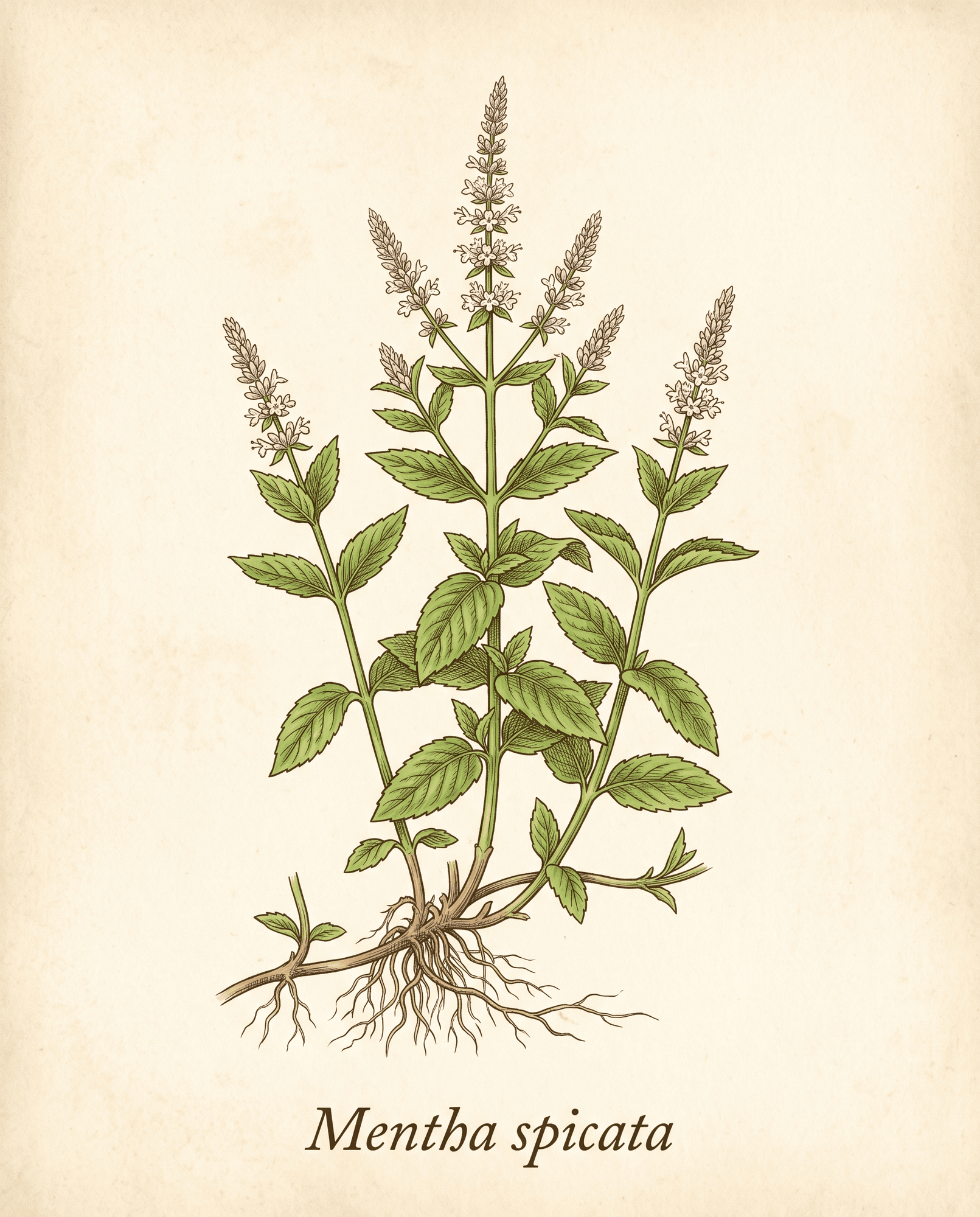
Spearmint is the elder sister, and the sweet one. She is the mint of the old world’s records — the one whose kin were paid as tithes in Palestine, strewn across Greek tables, tucked into Egyptian tombs — and she is the mint of the world’s most enduring ritual of welcome, poured steaming and gold from a raised Moroccan teapot into a small glass held out to a guest. Where her hybrid daughter peppermint carries menthol’s cold fire, spearmint carries carvone’s sweetness: the same family gifts of cooling, settling, and refreshing, offered with a gentler hand. She is the mint you give a child with a bellyache, the mint the abuela grows by the kitchen door, the mint that says sit down, you are welcome here.
And she keeps one medicine entirely her own. Beneath the sweetness, spearmint tends the feminine waters — a quiet, clinically documented lowering of excess androgens that has made her a steady ally for the woman navigating PCOS, unwanted hair, and the hormonal acne that traces the jaw. The tea of hospitality turns out to also be a tea of restoration, offered the same way: two cups at a time, day after day, with patience.
The shape of her medicine
Spearmint moves upward and outward like all her family, but softly. She rises to the head and opens at the surface without peppermint’s sting — a cooling that soothes rather than startles, a lift that clears the mind without jolting it. Her sweetness is not decoration; it is energetic information. The sweet taste nourishes and relaxes even as the aromatic pungency moves and opens, and that pairing is why she settles the nervous stomach so well: she calms and mobilizes in the same sip.
Her temperature is cool, though gently — she lacks the menthol that makes peppermint read as cold, and some traditions register her as nearly neutral or even mildly warm for it. The practical truth: she refreshes without chilling, which makes her safe daily company for constitutions that peppermint would overshoot.
As a carminative and antispasmodic she does the family’s signature digestive work — releasing gas, easing cramping, settling nausea — in a form gentle enough for children, elders, pregnancy queasiness, and the sensitive gut. As an anti-emetic she is often the better mint for morning sickness and the delicate stomach, precisely because she asks less of the body. As a nervine she is quietly steadying: the tea that unknots the worry sitting in the belly, the herb of the long exhale over a shared pot.
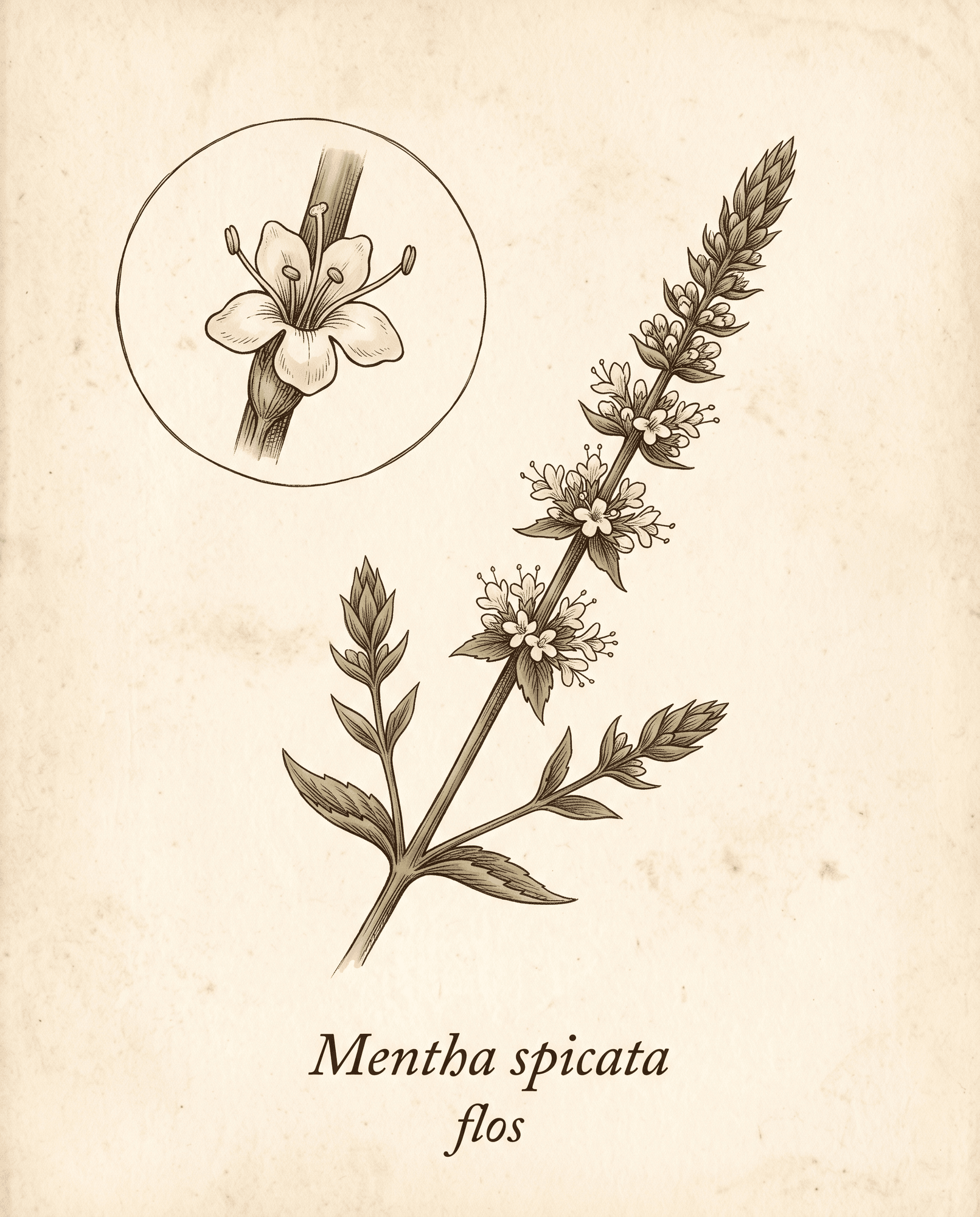
Her anti-androgenic action is her own room in the house. Two cups of spearmint tea daily, held over weeks, measurably lowers free testosterone and nudges the signaling hormones of the cycle back toward their own rhythm — the finding has held across clinical trials in women with PCOS and hirsutism. The mechanism is still being mapped; the effect is real, repeatable, and slow, the way hormonal medicine honestly is. Her mild diaphoretic, antimicrobial, and anti-inflammatory threads round out the family inheritance, each in her softer register.
What lives inside her
Whose medicine she carries
Air (breath, dispersal, conversation)
Mercury
Libra
Six of Cups
The Star
Oshun
Oshun is the sweetness that heals — the river of honey, the keeper of the feminine waters, the medicine of joy, self-worth, and the cycle returned to its own rhythm. Spearmint is hers twice over.
The sweetness first. Spearmint is the mint of the honey-gold glass, the nana at the center of the Maghreb’s great ceremony of welcome, the pleasure that is also nourishment. Her whole spirit is generous: she spreads herself freely, flavors the water, sweetens the breath, makes a plain afternoon into an occasion. Oshun’s medicine has never apologized for being sweet, has never accepted that pleasure and healing are different departments — and neither has this plant. To pour spearmint tea for a guest is to perform her teaching: that abundance shared multiplies, that beauty in the everyday is a form of care.
And then the waters. Spearmint’s quiet hormonal work — the steady lowering of excess androgens, the easing of the PCOS constellation, the return of a cycle to its own timing — is ovarian intelligence, Oshun’s deepest domain. This is medicine for the woman whose body has been pulled off its center and shamed for it: the unwanted hair, the jawline acne, the cycle that won’t come home. Spearmint meets all of it without harshness, two sweet cups at a time, and something in that gentleness is itself the healing. She restores the body’s sweetness to the body. That is Oshun’s signature, written in a plant.
Obatala
The cool head is the family inheritance, and spearmint carries her share of it. Like her sharper sister, she clears and settles the mind, cools heat risen to the face and temper, cleans the breath and the palate and the air of a room. Hers is the gentler expression of that clarity — not the cold splash that startles the mind awake, but the calm that arrives over a shared pot of tea, the third glass poured, the conversation finally honest. Where peppermint clears the head by force of sensation, spearmint clears it by creating the conditions for peace: sweetness, welcome, and time. That, too, is the elder of the white cloth at work.
The hands she has passed through
Spearmint’s story is the mint family’s oldest thread. In Egypt, mint was medicine by 1550 BCE — the Ebers Papyrus names her a calmer of the stomach — and wealth besides: dried leaves traveled into the tombs, and her scent was written into the liturgical perfumes of the Temple of Horus at Edfu. From Egypt she moved into Palestine, where mint was valuable enough to be paid in taxes; the Gospels record the Pharisees tithing their mint while neglecting justice, a rebuke that only lands because everyone listening knew mint was real currency. Scholars read the mint of those hillsides as her close kin Mentha longifolia, native to North Africa — the elder branch of her own line.
In Greece, she is grief and welcome at once. Minthe was a naiad of the underworld river Cocytus, loved by Hades and transformed into the low sweet herb by a jealous Persephone — and in some tellings Hades, unable to undo the spell, gave her the fragrance that rises whenever she is stepped on, so that she would be loved anyway. Mint softened the air of funerary rites, and the same households rubbed her across the table before guests arrived. The plant of the underworld was also the plant of hospitality; she has always stood at that threshold, tending both the departing and the arriving. Pliny records Greeks and Romans crowning their feasts with mint, scenting wine and sauces, perfuming their arms in the baths of Athens. Crusaders and traders carried her varieties from Egypt and the Levant north into Europe, where she settled into the convent physic gardens by the ninth century and never left the kitchen garden after.
In North Africa, she became the center of a civilization’s daily ceremony. Moroccans had grown and healed with their native nana for centuries when, in the mid-1800s, Chinese gunpowder green tea began arriving in quantity through the Atlantic ports. The meeting of bitter tea, fresh nana, and the sugarloaf produced atay — Moroccan mint tea — which spread through the Maghreb and along the trade routes into West Africa within a generation. The preparation is not a chore but a ceremony: the rinse, the sweetening, the pour from a height that crowns each glass with foam, the three rounds every guest is owed. To be handed that glass is to be told, without words, that you are welcome in this house. It remains one of the great living rituals of hospitality on earth, and it is African ground she holds there.
Across the Americas, Spanish and Indigenous plant knowledge braided around yerba buena — “the good herb” — the name spearmint and her close kin carry from Mexico through the Caribbean and the Southwest. She is the abuela’s stomach tea, the remedy for empacho and nerves and childhood fevers, grown by the kitchen door where she can be reached in the dark. In Black American folk medicine she did the same work from the plantation South forward — mint tea for the troubled belly, the feverish child, the sleepless night — growing in the kitchen gardens and ditch-edges that held the people’s pharmacy. And in hoodoo, mint works for money and clearing: leaves tucked into the wallet or the cash drawer, brewed into washes for floors and doorways to draw customers in and sweep crossed conditions out. Her chemistry and her spirit were never separate in that tradition — what cools and refreshes the body clears and refreshes the road.
The newest chapter is quietly hers: in the 2000s, clinicians in Turkey noticed that women in a spearmint-tea-drinking region reported hormonal effects, and the trials that followed confirmed her anti-androgenic action. The world’s oldest hospitality herb walked into the endocrinology literature and was found to have been doing women’s medicine all along.
Where she works in the body
Digestive system. The family heartland, in her gentlest form. Her volatile oil — carvone where her sister carries menthol — relaxes the smooth muscle of the gut, releasing gas, easing cramping and colic, settling nausea. She is the mint of choice for children’s bellyaches, for the delicate or elderly stomach, for pregnancy queasiness, and for anyone peppermint overshoots. Reflux-prone bellies should still keep her light: she relaxes the same upper valve, only less so.
Endocrine system. Her own room. Regular spearmint tea — the studied dose is two cups daily — measurably lowers free testosterone and supports the signaling hormones of the cycle, making her a steady ally for PCOS, hirsutism, and hormonal acne along the jaw. The trials are small and short, and the shift shows in the bloodwork before it shows in the mirror; hair follicles change on a timescale of months. She belongs in the slow, patient tier of hormonal work, alongside vitex and red raspberry leaf, given seasons rather than weeks — and her androgen-lowering gift is precisely why she stays occasional in pregnancy.
Nervous system. A soft nervine. She unknots the worry that sits in the belly, eases the tension that gathers over a long day, and steadies without sedating. The ritual around her does half the work: the pot shared, the glass warmed in the hand, the pause the ceremony enforces.
Respiratory system. Milder than her sister, but present. A hot cup opens the breath and comforts the stuffy head; her gentleness makes her the better steam and tea for children’s colds.
Skin. Cooling and calming for hot, irritated skin — a cooled strong infusion as a compress or bath addition for heat rash, bites, and the itch of healing. Her essential oil, like all mint oils, is diluted before it touches skin.
How to take her
Harvest calendar
Preparations
Leaf infusion: 1–2 teaspoons dried leaf (or a generous handful of fresh) per cup of just-boiled water. Steep 7–12 minutes, covered — her medicine is volatile and leaves with the steam. 1–3 cups daily. For the hormonal work: 2 cups daily, steadily, over months.
Nana tea (the welcome glass): Rinse a spoonful of gunpowder green tea with a splash of boiling water and pour it off. Add a large handful of fresh spearmint and sugar to taste, fill the pot with boiling water, steep, and pour from a height into small glasses so the foam crowns. Return the first glass to the pot once or twice to marry the flavors. Serve three rounds.
Tincture: Fresh leaf 1:2 in 60% alcohol, or dried 1:5 in 40%. Typical dose 1–3 mL up to 3 times daily, most useful in digestive and nervine formulas.
Topical: Essential oil diluted to 1–3% in a carrier for the belly and temples; the cooled tea as a wash or compress for hot, itchy skin.
Food: Fresh in tabbouleh, chutneys, raita, agua fresca, and fruit; muddled into summer water; dried into spice blends. Her culinary life is continuous with her medicine — most of the world takes her hormonal and digestive gifts at the table without ever calling it herbalism.
Spiritual & ritual:
- Fresh leaves in the wallet, purse, or cash drawer for steady money work
- A strong infusion added to floor and doorway washes to clear a space and draw good traffic in
- The welcome glass itself, prepared with care and poured for a guest, as an act of offering
- A sprig in the altar water, refreshed weekly, to keep the connection sweet and clean
When to hold back
Use with caution if:
- You have GERD or chronic reflux — she relaxes the lower esophageal sphincter less than peppermint does, but the direction is the same. Keep her light if heartburn follows.
- You are pregnant — tea in normal culinary amounts is traditionally considered fine, but her androgen-lowering action is a reason to keep her occasional rather than a daily habit.
- You are pursuing the hormonal work — pair her with cycle tracking or bloodwork if you can, be patient on the timescale of months, and loop in your care provider if you are on hormonal medication, since her effects run in the same waters.
- You have significant kidney or liver disease — very large daily amounts over long periods are best avoided.
Topical considerations: Dilute the essential oil before it touches skin, and keep concentrated oils away from infants and young children.
General notes: As tea and food she is among the gentlest herbs in the apothecary — safe for children, elders, and long acquaintance. Her cautions are few, and nearly all of them belong to concentration and quantity rather than to the plant herself.
Who walks with her
For the hormonal work: Red raspberry leaf, vitex, tulsi, nettle, red clover.
For digestion: Fennel, chamomile, lemon balm, ginger, catnip.
For the tea glass: Gunpowder green tea, hibiscus, lemon verbena, a good honey.
For children and gentle constitutions: Chamomile, catnip, lemon balm — the soft nursery formulary she anchors.
Her communities form around gentleness and time. In the hormonal formulas she brings the studied androgen work while raspberry leaf and vitex hold the longer rhythm of the cycle and nettle feeds the terrain — patient allies for patient medicine. In the digestive blends, fennel and chamomile meet her sweetness and deepen her calm; nothing in the formula shouts. And in the tea glass she keeps her oldest company — the bitter green tea she balances, the sugar that carries her, the hibiscus that turns the pot crimson — teaching the lesson she has taught for two centuries of atay and four millennia before it: that medicine shared is medicine doubled.
How to know her
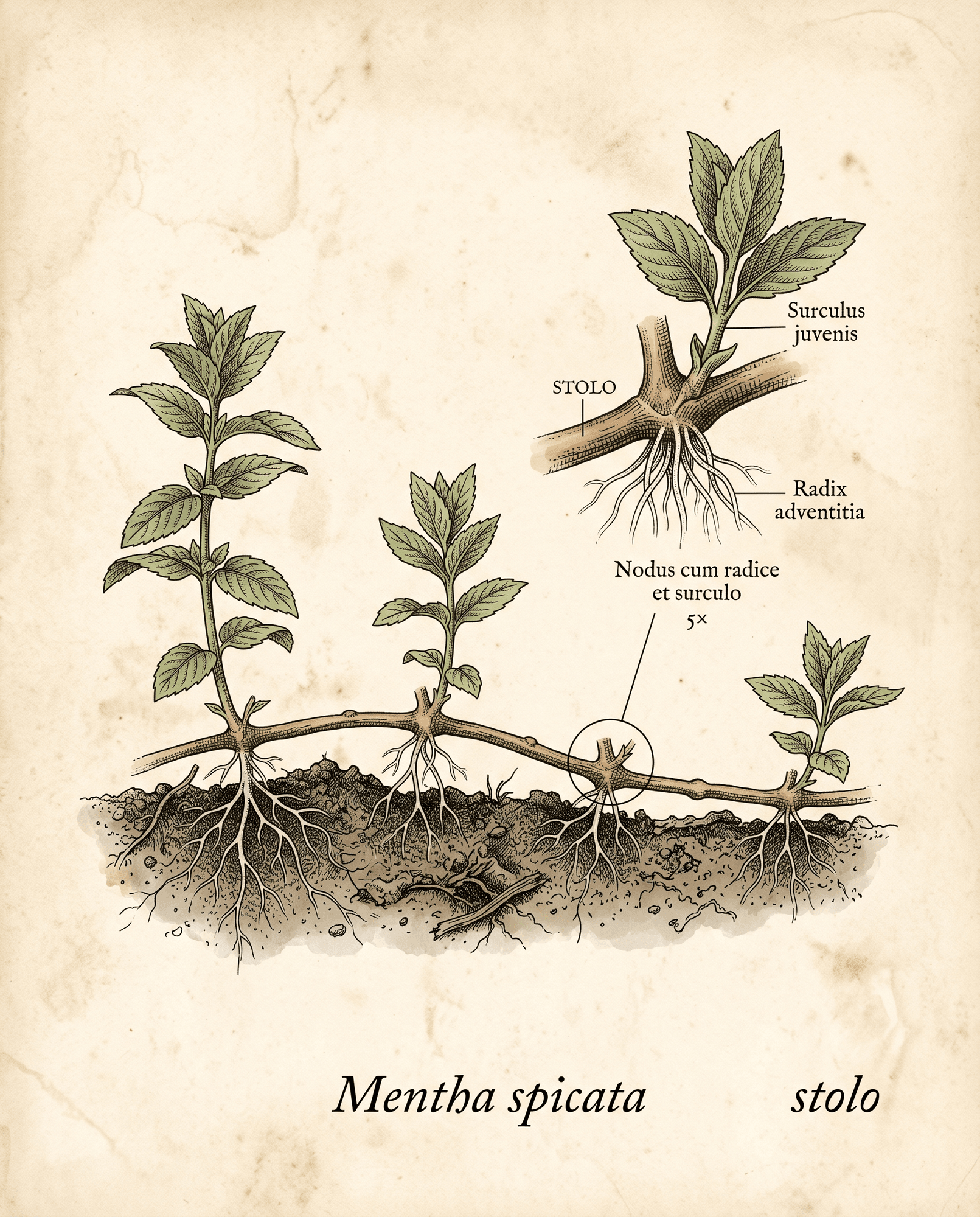
Plant walk: Find mint growing somewhere she was never invited — the ditch behind the garden bed, the crack beside the downspout, the yard she quietly crossed into. Follow a single runner with your finger and count the nodes where she has rooted. Ask her what she knows about spreading good things without permission, and whether anything in your own life deserves to travel that freely.
The welcome glass: Choose someone — a guest, a friend, yourself after a long week — and make them mint tea as a deliberate act of hospitality rather than a habit. Prepare it with attention, pour it from a height, serve it with both hands. Notice what changes in a room when refreshment is offered as ceremony instead of convenience.
Threshold wash: Brew a strong pot, let it cool, and add it to your wash water. Wipe down the front door, the doorframe, the threshold — working inward if you are drawing something toward you, outward if you are clearing something away. Speak plainly about what the door is now open to and what it is closed to.
Ritual of the returning cycle: If you are working with her hormonally, make the two daily cups a small ceremony rather than a chore — same glass, same hour, a hand on the low belly, a word to the body about coming home to its own rhythm. The medicine is slow; let the ritual hold the patience for you.
Journal prompts
- What is my relationship to welcome — how do I offer it, and how do I receive it?
- Where has sweetness been treated as unserious, in my work or in myself?
- What in my body or my life is asking to return to its own rhythm rather than someone else’s?
- What good thing in my life wants to spread, and where have I been containing it?
- Who taught me hospitality, and what did their pouring hand look like?
Tarot Spread
A spread for entering into relationship with Spearmint as a plant ally:
- What am I being asked to welcome in?
- Where does my life need sweetening that I have been treating as a luxury?
- What rhythm of mine has been pulled off center, and what would restore it?
- Where does my medicine want to travel next?
- What does she ask of me in return for her gentleness?
Keep a sprig of fresh spearmint or a small dish of dried leaf beside the cards — or better, a glass of her tea, poured properly. Let the sweetness be part of the reading.
The same plant, multiple lenses
As pahadi pudina, spearmint carries a sweet and pungent rasa (madhura and katu), a cooling virya (sheeta), and a sweet vipaka (madhura) — a gentler energetic signature than her menthol-bright sister, and one that widens her welcome across constitutions.
Pitta Dosha — Fire & Water
Her cooling, sweet nature pacifies Pitta beautifully — the acid stomach, the hot temper, the flushed summer body all soften under her. Mint water, chutney, and cool spearmint tea are everyday Pitta medicine across the subcontinent. She is the mint Pitta can keep as a daily habit without the reflux price her sister more often charges, though the heartburn-prone still go gently.
Kapha Dosha — Earth & Water
Her lightness and aromatic pungency move Kapha’s heaviness — sluggish digestion, damp congestion, the slow foggy morning — though her sweetness means she reduces Kapha less decisively than sharper herbs. In cold, damp seasons she serves Kapha best warm and in stimulating company: ginger, black pepper, tulsi.
Vata Dosha — Air & Ether
Her friendliest audience among the mints. The sweet rasa and sweet vipaka nourish and settle where peppermint’s sharpness can scatter — and paired with fennel or ajwain she is a classical remedy for Vata’s gas, bloating, and nervous stomach. Her coolness still asks for warmth in cold seasons, but of the household mints she is the one Vata can befriend.
Spearmint sits beside, rather than inside, the classical Chinese materia medica. The bo he of the formularies is field mint (Mentha haplocalyx) — treated fully in Peppermint’s monograph, whose chemistry hews close to it — while spearmint is known as liu lan xiang (留兰香), a distinct plant the tradition reads differently: sweeter, gentler, and warmer than bo he, carvone-led where bo he is menthol-led, and used in food and folk practice more than in classical formula. What follows is honest to that lighter footprint.
Taste & Temperature: Acrid and sweet; gently warm to neutral (where bo he is cool). Channels Entered: Stomach and Lung, by her actions. Functions: Harmonizes the middle burner and moves qi. Gently releases the exterior.
Harmonizing the Middle & Moving Qi
Her main work in this lens: warming and settling the stomach, dispersing the stagnation that shows as fullness, gas, and queasiness, and easing the knotted qi of a worried gut. Where bo he vents heat from the surface, liu lan xiang tends the center — the digestive hearth — which is exactly the role the world’s kitchens have always given her.
Gently Releasing the Exterior
As a warm cup at the start of a mild cold she opens the breath and comforts the head, a softer echo of her cousin’s wind-heat work, suited to children and the delicate.
Yin/Yang Balance
She is mild, sweet-acrid, and centering — a harmonizer more than a clearer, without bo he’s cautions around sweating out the deficient. Her contraindications in this lens are few; her limitation is simply that for a true wind-heat invasion with fever and sore throat, the tradition reaches past her to bo he. Do not substitute one for the other in formula — they are sisters, not synonyms.
For going deeper
- Grant, Paul. “Spearmint herbal tea has significant anti-androgen effects in polycystic ovarian syndrome: a randomized controlled trial.” Phytotherapy Research, 2010 — the key spearmint/PCOS trial, building on Akdoğan’s 2007 Turkish study of spearmint tea in hirsute women.
- Wood, Matthew. The Earthwise Herbal: A Complete Guide to Old World Medicinal Plants. North Atlantic Books.
- Frawley, David & Lad, Vasant. The Yoga of Herbs: An Ayurvedic Guide to Herbal Medicine. Lotus Press.
- yronwode, catherine. Hoodoo Herb and Root Magic. Lucky Mojo Curio Co. — for mint’s money and clearing work in conjure.
- Moerman, Daniel E. Native American Ethnobotany. Timber Press — for the wild mints and yerba buena across Indigenous North America.
- Bensky, Dan, Clavey, Steven, & Stöger, Erich. Chinese Herbal Medicine: Materia Medica (3rd edition). Eastland Press — for bo he and the distinction from liu lan xiang.
- The tea makers of the Maghreb. The knowledge of atay — the rinse, the pour, the three glasses — is living oral tradition. If you are ever offered the glass, accept it, watch closely, and say thank you.
- The abuelas of the yerba buena tradition, whose knowledge is kept in kitchens rather than books. Ask before it is gone.
The Conversation
Questions, noticings, what this is teaching you — leave them here. This same conversation lives in The Circle.