Sarsaparilla
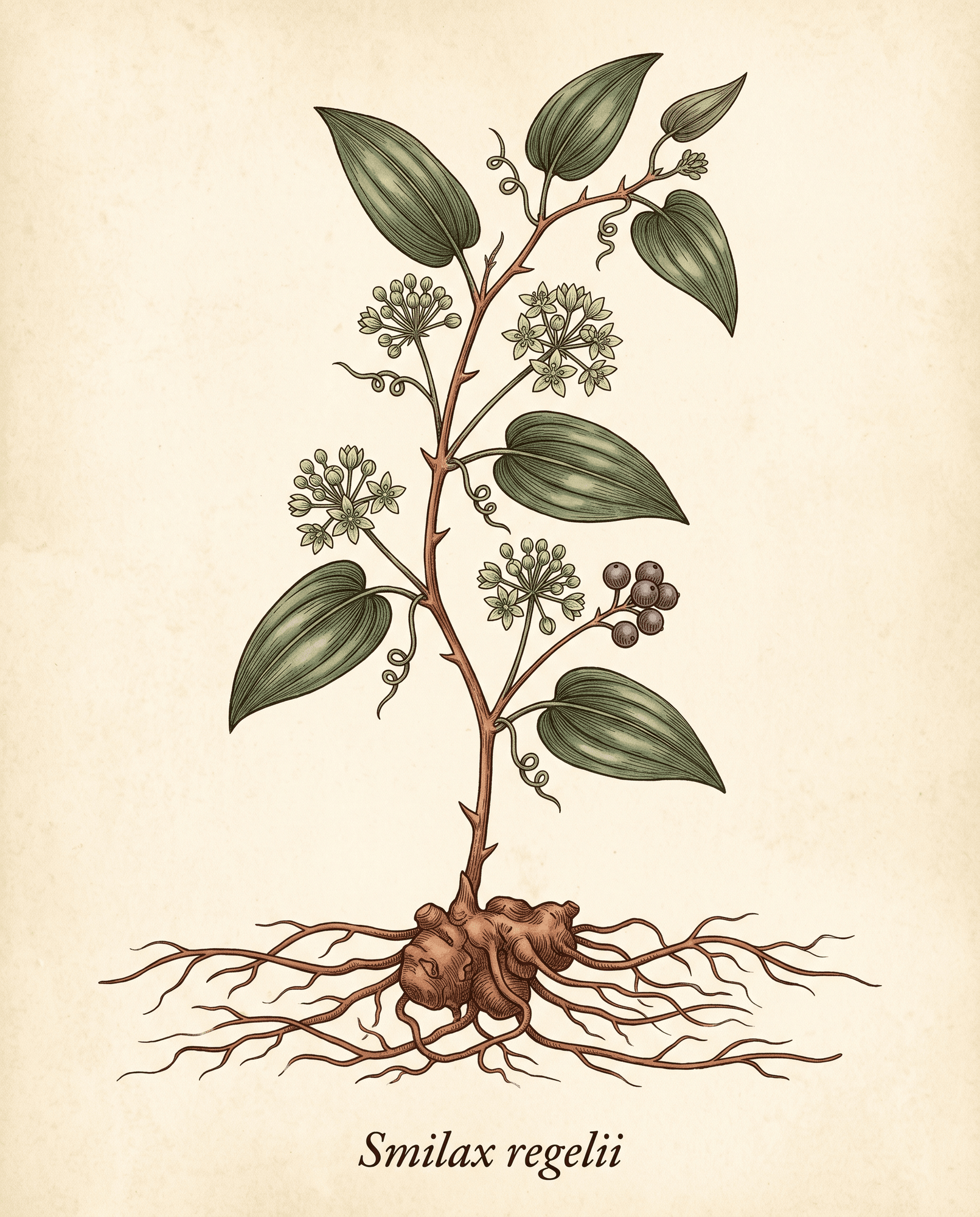
Sarsaparilla is a climber. She does not drive downward the way the taproot plants do — she runs. Her rhizome sends out long reddish cords just beneath the leaf litter, six feet and further from the crown, while above ground she throws a thorned stem into the canopy and holds on with paired tendrils that rise from the base of every leaf. She is looking for light and she is willing to travel for it. Everything about her medicine follows this shape: patient, lateral, unhurried, and finally upward.
She is the root that was asked to answer for the diseases nobody would name out loud. Syphilis, leprosy, the psoriasis that wouldn’t quit, the joints that swelled and stayed swollen, the body worn thin by work and heat and time. She was dug in Honduran and Jamaican forest, tied in bundles, and shipped by the ton into ports where people were desperate and ashamed. Some of that was commerce and some of it was theater. But underneath the patent-medicine noise, the plant is real, and what she actually does is quiet and specific: she lightens the load the blood is carrying, cools the joints, restores the skin, and gives a body back its strength.
The shape of her medicine
Sarsaparilla moves downward and outward at once. She drains through the kidneys and the bowel while she opens the pores and pushes toward the surface — clearing through the low road and the high road together. Her temperature sits close to neutral, tipping warm. This is where the traditions argue with each other, and the argument is worth keeping: the Ayurvedic reading of her calls her ushna, frankly hot, drying, a breaker of accumulated ama. Chinese medicine calls her sweet, bland, and neutral, cool enough to drain damp-heat but mild enough for long courses. Several Western herbalists have written her as cooling and moist. All three are describing something true. She cools inflamed tissue while warming a depleted constitution, and which effect you notice depends entirely on the body you hand her to.
Her taste is the first instruction. She is sweet and faintly slippery, only slightly bitter, with an acrid-spicy edge at the back. That sweetness matters — she is not a hard bitter like gentian or a scouring one like yellow dock. She restores as she clears, which is why she can be taken for months without hollowing a person out.
As an alterative, she works on terrain rather than symptom. Her saponins are surface-active molecules that bind endotoxins in the gut — the fragments of bacterial cell wall that slip across the intestinal lining and travel to the liver. When there are too many of them, or when the liver is already overwhelmed, they spill into circulation and drive inflammation everywhere: the skin, the joints, the gut wall itself. Sarsaparilla intercepts them before they get that far. This is the mechanism underneath four hundred years of calling her a blood purifier, and it is one of the few places where the old language and the modern chemistry point at exactly the same thing.
Her anti-inflammatory and antirheumatic actions are the same medicine met further downstream. Where heat and damp have settled into the joints — the hot, swollen, immovable kind of pain, gout and the damp rheumatic patterns rather than the cold stiff ones — she drains and cools and slowly frees the movement. Her dihydroflavonols carry part of this, including a real effect on how the kidney handles uric acid.
As a diuretic and a diaphoretic together, she gives the body two exits. She increases urine flow, which is why she has been reached for in painful urination, gravel, and chronic urinary heat; and taken hot and strong she opens the skin and brings sweat. Traditional practice knew this and used the temperature of the cup to steer her: hot and strong to push outward, cool and steady to draw down.
Her antimicrobial and immunomodulant threads are why she survived the syphilis era with her reputation partly intact. She does not sterilize an infection. She changes the ground the infection is standing on, and she steadies an immune response that has been running hot for years without resolving. This is the same reason she keeps turning up in modern work on autoimmune inflammation.
Her endocrine-modulating action needs care in the telling. Her sapogenins are shaped like steroid hormones, close enough that industry has used them to build progesterone and cortisone in a laboratory. That resemblance is not the same as activity in the body. She contains no testosterone. What she appears to do is subtler and more interesting: she supports the liver in its work of clearing and converting hormones, and a body whose liver is keeping up is a body whose hormones settle. The vitality people report from her is not a hormone spike. It is the ordinary return of strength to a system that stopped fighting itself.
Together her actions make one gesture: she unburdens. Not by force, and not quickly. She lightens what the blood is carrying until the skin, the joints, and the nerves can finally do something other than cope.
What lives inside her
Whose medicine she carries
Water (blood and damp)
Fire (generative warmth)
Mars
Scorpio
Strength
The Devil
Babalu Aye
Babalu Aye keeps the diseases that do not resolve. Smallpox and leprosy, the open sore, the chronic skin condition, the wasting illness, the infection that carries shame with it. He is the Orisha of the body at its most unhidden — the body that other people flinch from — and his medicine is not only the healing. It is the walking alongside. He goes to the encampment at the edge of town, the ward nobody visits, the house where the sick person has been left. His crutch and his covered face are not symbols of weakness. They are the marks of someone who has been where the afflicted are and came back.
Sarsaparilla is his root because she went to exactly those bodies. She was the herb of the syphilitic and the leper — the sicknesses that arrived wrapped in judgment, where the illness and the moral verdict on the person were spoken in the same breath. She was in the official pharmacopoeia for that purpose for ninety years. She was in the leprosaria. She was in the Chinese formulas built for the same disease and for the mercury poisoning that came from trying to cure it, which is its own teaching: she was reached for after the treatment itself became the affliction. That is Babalu Aye’s territory precisely. The harm compounds, the shame compounds, and someone still has to come sit with the body that is left.
Her work with him is the long kind. Psoriasis does not lift in a week. Chronic eczema, old rheumatism, autoimmune inflammation that has been running for a decade — these ask for months of steady tending, and sarsaparilla is built to be taken for months. She is sweet enough and restorative enough not to deplete the person she is clearing. That is the whole discipline of this house: the willingness to stay past the point where fast medicine has given up, and to keep offering dignity to a body the world has already finished discussing.
Ogun
Ogun is iron. The forge, the machete, the blade that opens a road where there was none — and the one who goes ahead of everyone else to do the cutting so the rest can pass. He is the Orisha of labor itself: the work that wears a body down, and the tools that make the work possible at all. He does not sentimentalize it. He is what it costs and what it takes.
Sarsaparilla meets him twice. First in the harvest. She is not pulled up; she is followed — a blade worked under the leaf litter, tracing a single root line six feet and further out from the crown through wet forest, cutting as you go. Every bundle of her that ever left that ground came out at the end of an iron tool in somebody’s hand.
Then in the blood. Her mineral content is not metaphor — she carries iron into a system gone thin from hard work, poor food, and long illness, which is the plain physical basis of her Caribbean reputation as a blood builder. That is Ogun’s own substance moving into the body that spends itself. And the joints: she drains the hot, swollen, damp obstruction that makes labor impossible, which is no small mercy for anyone whose living depends on their back and their hands. Ogun’s medicine here is not inspiration. It is the difference between being able to work tomorrow and not.
Shango
Shango carries fire, thunder, and the generative force — the heat that makes a body strong enough to work, to want, to father, to lead, to stand up straight in front of people. He is also the Orisha most concerned with justice and with public standing, with a person’s name and their bearing.
Sarsaparilla’s other life is his. In Jamaican bush medicine she is the backbone of the roots tonic — simmered with chaney root, strong back, medina, guinea hen weed, and ginger, sweetened with molasses or honey and drunk daily by people who work with their bodies. Ogun’s share of that bottle is the endurance. Shango’s is what the endurance is for: potency, appetite, the heat that makes a person want something again. The names people give the bottles are frank about it. This is not a decorative tradition — it comes out of African herbalism carried across the water and adapted in Maroon country to whatever grew there.
What she gives is not a jolt. It is the slow return of appetite to someone who had stopped expecting it. She steadies the endocrine terrain enough that desire and energy come back on their own, and she does it by supporting the liver’s clearing work rather than by pushing on anything. Shango’s fire is not a stimulant’s flicker. It is a body recovered enough to burn steadily.
And here his justice face comes into it, because the two halves of her history are the same root. She was dug by people who were paid nothing and sold to people who paid a fortune — the labor system took the bodies and the profit both. The roots tonic is what happens when that root stays home. The same medicine that was extracted by the ton for someone else’s ledger gets simmered in a yard pot and drunk by the person who dug it, to rebuild the body that the work is consuming. That is not only stamina. It is a claim: my strength is mine, and I will keep it. Shango’s thunder answers what is owed, and a working body reclaiming its own vitality on its own terms is the quietest form of that answer.
The hands she has passed through
She was known long before she was named in Spanish. The peoples of Mesoamerica and the Caribbean — Maya, Nahua, and others across her range — worked her roots as a tonic and a cleanser, and prepared her as a drink well before any European saw her. When the Spanish arrived in the sixteenth century they found the medicine already in use, already understood, and did what they did with everything else: they took it, renamed it, and shipped it. Zarzaparrilla is their name, not hers — bramble and little vine, a description of the thorned stem, told from the outside. The genus name is older and stranger: in the Greek telling, Smilax was a nymph who became a vine.
What followed was one of the great colonial drug booms. Between 1568 and 1619, hundreds of tons moved through Seville alone. By 1831 more than 176,000 pounds went into England in a single year. She was the great hope for syphilis, which was tearing through Europe, and she was carried on that hope into the U.S. Pharmacopoeia, where she stayed as an official syphilis remedy from 1820 until 1910. Whole fortunes were built on bottled sarsaparilla compounds that promised far more than the root could deliver. The bundles came out of Honduran, Guatemalan, and Jamaican forest on the backs of people who saw almost none of that money. Any honest account of her history has to hold both facts: the plant does real work, and the trade in her was another extraction from the same lands and the same hands that everything else was extracted from.
In Chinese medicine, the related rhizome tu fu ling (Smilax glabra) walked a parallel road on the other side of the world. First recorded in the Yunnan materia medica and elaborated in later texts, she was the principal herb for syphilitic sores and, notably, for the mercury poisoning that the mercury cures produced. The classical formula built around her carried her at very high doses. Today she remains a cornerstone of Chinese dermatology for damp-heat skin disease and a first reach for gout — the same medicine, arrived at independently, described in a different language.
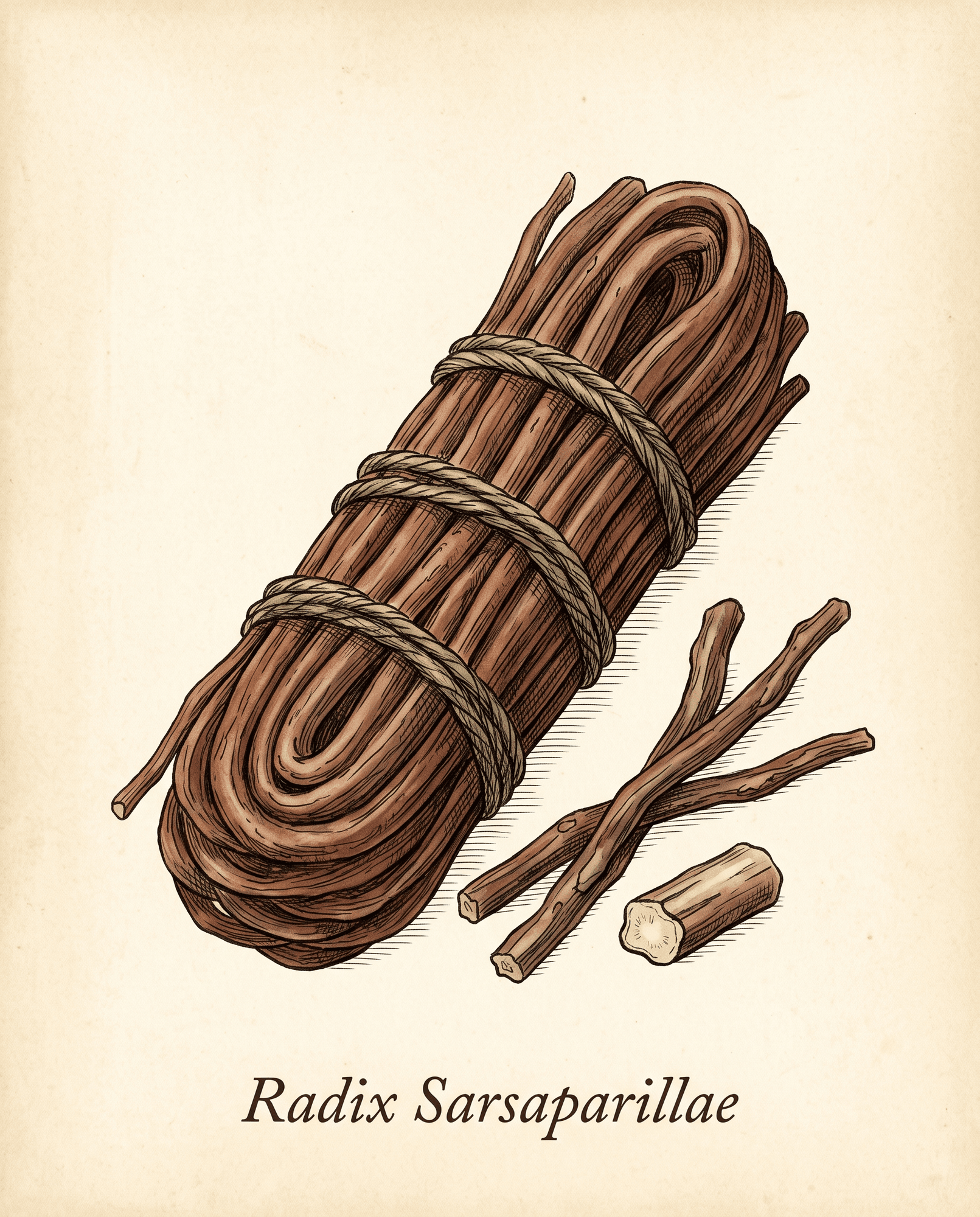
In Ayurveda and Unani, the root entered as chobchini, madhusnuhi, dvipantara vacha — “the sweet one,” “the vacha from across the water.” The Sanskrit names remember that she is an import; Persian and Arabic sources called her China root. A caution for anyone reading the classical texts closely: chobchini properly names Smilax china, the East Asian species, and several authorities distinguish it from the American root. The traditions traded across a genus, not a single plant, and the substitutions ran in every direction. What follows describes how the Smilax roots were used in these systems; which species a given text meant is not always recoverable. She was folded into raktashodhaka work, the purification of blood, and prescribed for kushtha — the broad category of stubborn skin disease — for joint pain, and for the same venereal complaints. Unani physicians wrote whole treatises on her, and used her for phlegmatic and melancholic conditions, the temperaments that sit heavy and will not shift.
In the Caribbean and across the African diaspora, she became something else again: not a colonial commodity but a household staple. Enslaved Africans brought botanical knowledge with them and rebuilt a working materia medica out of whatever the new land offered. Sarsaparilla was in it. She sits at the center of the Jamaican roots tonic tradition — appearing in the overwhelming majority of tonics that have been botanically surveyed, simmered together with chaney root, strong back, medina, guinea hen weed, and ginger. That tonic is brewed at home and sold at roadside stands, and it is understood to build the blood, wash the system, and restore strength and potency to a working body. Elders speak of taking a cleansing tonic in the turn of the season to clear the winter out. This is African herbalism, Taíno knowledge, and Maroon practice grown together into one bottle, and it never stopped.
In North America, she took a stranger turn. Sarsaparilla flavored the soda fountain and the saloon; she was one of the roots in old root beer alongside sassafras, and temperance politics made her the respectable thing to order. The frontier saloon bottle and the patent-medicine label are what most people now think of when they hear her name, which is a curious afterlife for a plant that spent four centuries at the bedside of the seriously ill.
In African American conjure and rootwork, sarsaparilla belongs to the drawing herbs. A note on what system you are standing in when you read this: the planetary attributions of hoodoo are not the Orisha correspondences given above, and the two should not be collapsed. Rootwork built its own astrological vocabulary out of European grimoire and almanac magic — material that circulated cheaply in America through mail-order occult publishing — laid alongside retained West and Central African practice. It is a distinct stream with its own logic, developed by people working with what was available to them. Held side by side rather than merged, the two readings sharpen each other.
She is worked for health and long life, for money when burned with cinnamon and sandalwood, for blessing a house when burned with frankincense and myrrh, and for love and desire in mojo hands and dressing powders. Her attribution runs to Jupiter — expansion, good fortune, the liver and the blood — and the magical use and the medicinal use are saying the same thing in two registers. A body with its vitality back is a body that draws.
Where she works in the body
Skin. This is where her reputation was made and where it holds up. She is for the chronic, scaling, itching conditions — psoriasis above all, along with eczema, stubborn acne, boils, and old inflammatory eruptions that keep returning. She does not work on the skin from the outside. She works on the load the blood is carrying, binding endotoxins in the gut before they reach circulation, so the skin stops being the body’s overflow route. The 1942 trial that put her in a medical journal was a psoriasis trial, and it found real improvement in most of the people who took the saponin extract. She is slow. She is also one of the few plants with both centuries of use and a plausible mechanism pointing the same direction.
Blood. In every tradition that has worked her, she is a blood herb — raktashodhaka in Ayurveda, blood purifier in the Eclectic materia medica, blood cleanser and blood builder in Caribbean bush medicine. What that means practically is twofold. She reduces the inflammatory burden circulating in the plasma, and she carries iron and minerals into a system that has gone thin from long illness, hard labor, or poor food. Clearing and building at once is rare in a single plant, and it is the reason she anchors the roots tonic rather than merely appearing in it.
Musculoskeletal system. For hot, swollen, damp arthritic pain — gout, rheumatoid patterns, joints that are red and full rather than cold and creaking — she drains and cools. Her flavonoids affect how the kidneys handle uric acid, which is the specific chemistry underneath the gout use. She pairs naturally with the herbs that move damp out of the lower body, and she is more suited to the wet, hot presentation than to the dry, cold one.
Urinary system. She increases urine flow and clears heat downward through the bladder, and has been used for burning urination, chronic urinary infection, gravel, and the low-grade damp-heat that settles into the pelvic bowl. This same action is her caution: she asks a lot of the kidneys, and she carries oxalates, so she is not the herb for someone whose kidneys are already compromised.
Hepatic system. She protects the liver rather than driving it. By intercepting endotoxins in the gut she reduces what arrives at the portal vein in the first place, and her phenolic compounds are directly hepatoprotective. This is upstream medicine — she lightens the liver’s work instead of stimulating it, which makes her a good partner for the bitter hepatics rather than a substitute for them.
Endocrine and reproductive systems. She has a four-century reputation as a tonic for virility and vitality, and it has been badly served by people selling her as a steroid. What she actually offers is regulation through the liver’s hormone-clearing work, mineral and iron repletion, and the general recovery of a depleted body. In practice she shows up well for low libido that comes with exhaustion, for hormonal acne, for irregular cycles in a body under long inflammatory strain, and for the flattened vitality that follows chronic illness. She is a restorative, not a stimulant.
Immune system. Her saponins and dihydroflavonols modulate rather than simply boost. She is suited to the immune response that has been running hot and unresolved for years — autoimmune inflammation, chronic low-grade infection, the aftermath of illness that never fully closed. She is not an acute-infection herb. She is for what the infection left behind.
Digestive system. Her action in the gut is the hinge for everything else she does. Binding endotoxin at the intestinal wall, mildly antimicrobial, faintly mucilaginous — she settles an irritated and leaky gut lining, which is where the inflammatory chain that ends in the skin and the joints usually begins. At high doses her saponins can irritate the stomach, so she is taken with food or in formula rather than pushed hard alone.
How to take her
Harvest calendar
Preparations
Decoction (the primary preparation): 1–2 teaspoons of dried chopped root per cup of water. Bring to a boil and simmer 15–20 minutes, covered. Her saponins and starches need real heat and time — a steeped infusion will not reach them. Drink 1–3 cups daily. Taken hot and strong she pushes toward the skin and the sweat; taken cool and steady she drains downward through the kidneys.
Roots tonic (traditional Caribbean method): A long simmer of several roots and barks together — sarsaparilla with chaney root, strong back, medina, ginger, and whatever the maker’s family recipe calls for — reduced, sweetened with molasses or honey, and often kept bottled and drunk daily in small glasses. Made in quantity, kept cold, taken as ordinary life rather than as treatment.
Tincture: 1:5 dry in 40–45% alcohol. Typical dose 2–4 mL, up to three times daily, or 15–60 drops two to three times a day depending on the practitioner’s tradition. She extracts well in that range.
Powder: 1–4 g of dried root daily, taken with food or stirred into something warm. Capsules of 2–4 g three times daily appear in the clinical literature for skin work. Powder taken dry can be hard on the stomach.
Powder in milk: The Ayurvedic method — the powder simmered into milk, taken for skin disease and for reproductive complaints. The fat and sweetness soften her acrid edge and carry her deeper into tissue.
Long courses: For chronic skin and joint conditions she is worked in weeks and months, not days. Six to twelve weeks before judging her, taken five or six days a week with rests. This is not a plant that shows off early.
Topical: A strong decoction cooled and used as a wash for itching, scaling, and inflamed patches, or as a compress over hot swollen joints. Also used traditionally as a wash for genital irritation and discharge.
Spiritual & ritual:
- Root simmered as a bath for a body coming out of long illness — the water poured from the shoulders down, over the marks the illness left
- Burned with cinnamon and sandalwood to draw money toward a house or a business
- Burned with frankincense and myrrh to bless a home
- Carried in a hand or a pouch for vitality, longevity, and desire
- Placed on the altar for Babalu Aye alongside offerings for anyone in the long middle of a healing
When to hold back
Use with caution if:
- You are pregnant or nursing. Her safety has not been established in either, and she is traditionally avoided.
- You have kidney disease or renal insufficiency. Her diuretic action asks work of the kidneys, and high doses have been reported to cause transient kidney irritation.
- You have a history of oxalate kidney stones. The root contains oxalic acid.
- You take digoxin or other cardiac glycosides. Her saponins can affect their absorption and renal clearance.
- You take lithium or pharmaceutical diuretics. Her own diuretic action may be additive and affect blood levels.
- You take any medication with a narrow therapeutic window. Saponins alter intestinal permeability and may change how much of a drug is absorbed. Separate doses by several hours and involve a practitioner.
- You have a sensitive or ulcerated stomach. High doses irritate the gastric lining. Take with food, or in formula.
Topical considerations: Generally well tolerated as a wash or compress. Patch test on inflamed or broken skin before using over a large area.
General notes: She is safe for long courses at ordinary doses, which is central to how she is used — but “long course” means moderate amounts over months, not large amounts pushed hard. She is not a source of testosterone or any anabolic steroid, no matter what the label says. That claim has been used to sell her for a century and it has never been true of her or of any plant. Buy her from someone who knows which Smilax they are selling; the trade has always been mixed, and the old dispensatories complained about inert and substituted root as far back as the 1890s.
Who walks with her
For chronic skin conditions: Burdock root, yellow dock, cleavers, red clover, calendula, figwort.
For hot damp joints and gout: Celery seed, nettle leaf, meadowsweet, devil’s claw, ginger, birch leaf.
For the roots tonic tradition: Chaney root, strong back, medina, guinea hen weed, ginger, molasses.
For blood building alongside clearing: Nettle, yellow dock, dandelion leaf, molasses.
For restoring vitality after long illness: Ashwagandha, licorice, oats, nettle, ginger.
For liver support underneath her work: Dandelion root, burdock, milk thistle, schisandra.
These allies divide the labor. Burdock and yellow dock scour where sarsaparilla soothes, and the three of them together cover more ground in a skin formula than any of them manage alone. Cleavers moves the lymph she cannot reach from the gut. Ginger warms her and speeds her outward, which is why nearly every traditional preparation that includes her includes ginger too. Nettle and molasses give her the minerals to build with while she clears. And licorice — another sweet root with a saponin backbone — extends her endocrine work and softens her edge for a depleted constitution. She is a formula plant. Alone she is good; in company she is what people have kept her for.
How to know her
Plant walk: You will likely not meet her in the ground where most of us live — she wants wet tropical forest. So meet her kin instead. Find any climbing vine near you: a greenbrier, a wild grape, a honeysuckle running up a fence line. Sit with it and follow the climb with your eyes, from where it enters the soil to where it disappears into the canopy. Notice that it did not choose the shortest route. Notice where it reached and found nothing and reached again. Ask what it knows about arriving late and arriving anyway.
Ritual of the long middle: For anyone in the endless stretch of a recovery — after the diagnosis, before the return. Make a strong decoction of the root and let it cool to warm. Pour it slowly from the shoulders down while standing, and say out loud the thing your body has been through. Not the outcome, not the prognosis. Only the record: this happened to me, and I am still here. Let the water run and do not rinse it off.
Ritual of restoration: Brew a roots tonic. Sarsaparilla, ginger, and whatever else the season and your own lineage offer — simmered long, reduced, sweetened with molasses. Bottle it. Drink a small glass each morning for a month, and let it be ordinary. The medicine here is partly in the plant and mostly in the daily act of feeding yourself something your people made to keep bodies working.
Ritual for the marked body: Sit with the part of your body you have been taught to hide — the scar, the patch, the swelling, the place that changed. Anoint it with oil the root has been infused into. Do not ask it to leave. Tell it what it survived.
Journal prompts
- What has my body been carrying that I keep asking my skin to hold for me?
- Where am I in the long middle — past the crisis, not yet returned — and what would it mean to be tended there instead of hurried?
- What has been named as my failing that is actually my affliction?
- Where in my life am I climbing laterally, and calling it lost time?
- What would strength look like if it were not a performance for anyone?
Tarot Spread
A spread for entering into relationship with Sarsaparilla as a plant ally:
- What is my body carrying that never belonged to me?
- Where is the load actually entering — what is the doorway I have not been watching?
- What in me is asking to be restored rather than cleared away?
- What does she ask of me over months, not days?
- Who am I on the far side of this passage?
Keep a piece of the dried root on the altar with the cards, and brew a cup of it before you sit down. This spread does not want to be rushed.
The same plant, multiple lenses
She entered the Indian materia medica from across the water, and the classical names remember it — dvipantara vacha, the vacha from the far island; madhusnuhi, the sweet one. Her properties are given as tikta rasa (bitter taste), laghu and ruksha guna (light and dry), ushna virya (hot potency), and katu vipaka (pungent post-digestive effect). The classical texts call her tridoshashamak, capable of reducing all three, though her heat and dryness make her far more suited to some than others.
Pitta Dosha — Fire & Water
This is her most careful relationship. Her work on inflammatory skin disease and hot blood is squarely Pitta territory, and she does real good there — but her ushna virya means she can also add heat to a system already burning. The Ayurvedic answer is not to withhold her but to hold her: prepare her in milk, pair her with cooling companions like manjishtha, neem, or sariva, and use moderate doses. For a Pitta-dominant person with psoriasis, she is medicine when properly buffered and an aggravation when taken dry and hard.
Kapha Dosha — Earth & Water
Her clearest alignment. Kapha’s heaviness, dampness, sluggish lymph, congested skin, and stiff swollen joints all yield to her light, dry, heating character. She breaks down accumulated ama and moves it out through urine and sweat, which is exactly what the Kapha pattern is asking for. Long courses suit Kapha-dominant constitutions well.
Vata Dosha — Air & Ether
More favorable than most alteratives. Her sweetness, her starch, and her faintly mucilaginous body give her a grounding quality that the harsher clearing herbs lack, and her warmth suits Vata’s cold. The classical use of snehana — taking her in milk or with oil — is essentially a Vata preparation. Her dryness is still the caution: for a very depleted Vata person, pair her with ashwagandha, licorice, or sesame oil and keep the doses modest.
In Chinese medicine the herb is tu fu ling — the rhizome of Smilax glabra, close kin to the Caribbean species and used for nearly identical purposes.
Taste & Temperature: Sweet and bland, neutral. Channels Entered: Liver and Stomach. Functions: Resolves toxicity and drains damp. Frees the joints and unblocks painful obstruction. Clears damp-heat from the lower burner. Benefits the skin.
Resolving Toxicity & Draining Damp
Her central function. She is classed among the herbs that clear heat and resolve toxicity, and she is the one reached for when the toxicity is old, deep, and tangled with damp rather than acute and blazing. This is the basis of her use for syphilitic sores and for mercury poisoning — a toxin lodged in the tissues that has to be drawn out slowly rather than burned off. Her sweet, bland, neutral nature is precisely what makes long courses possible where a colder, harsher herb would exhaust the Spleen.
Freeing the Joints
She unblocks painful obstruction of the damp-heat type — the swollen, heavy, hot joint rather than the cold aching one. Gout is her clearest modern indication, and formulas built for it pair her with coix seed, atractylodes, and achyranthes to drain damp out of the lower body. Because she does not damage Yang while she drains, she can be carried through a long course of joint treatment.
Clearing Damp-Heat from the Lower Burner
Painful and burning urination, chronic urogenital infection, and vaginal discharge with damp-heat signs all sit in her range. She moves heat and turbidity downward and out through the urine, which is the same descending action Western herbalists describe as her diuretic function.
Benefiting the Skin
She is a cornerstone of Chinese dermatology for damp-heat skin disease — psoriasis, eczema, tinea, dermatitis with redness, weeping, and itch. She rarely works alone here; the classical dermatology formulas combine her with dictamnus bark, kochia, and sophora root, each taking a different part of the damp-heat pattern.
Yin/Yang Balance
Tu fu ling is neutral in nature and draining in action — she moves damp and turbidity out without the sharp cold of the stronger heat-clearing herbs, and without depleting Yang. This is what makes her unusually safe at high doses and over long courses. She is still a draining herb: for someone with genuine Yin deficiency, weak digestion from cold, or depleted Yang, prolonged use without warming and building companions will thin the reserves she is drawing on. She belongs to excess-damp patterns, and she does her best work when the person taking her has something to spare.
For going deeper
- Mitchell, Sylvia A., et al. Research on Jamaican root tonics and their botanical composition, University of the West Indies, Mona — the botanical survey underlying the roots tonic tradition, and the best documented account of how sarsaparilla is actually used in the Caribbean.
- Bensky, Dan, Clavey, Steven, & Stöger, Erich. Chinese Herbal Medicine: Materia Medica (3rd edition). Eastland Press. (See entry on tu fu ling.)
- Wood, Matthew. The Earthwise Herbal, Volume II: A Complete Guide to New World Medicinal Plants. North Atlantic Books.
- Felter, Harvey Wickes & Lloyd, John Uri. King’s American Dispensatory (1898), entry on Smilax — for the Eclectic era, and for their own frank complaints about adulterated and inert commercial root. Available through Henriette’s Herbal.
- Thurman, F. M. “The treatment of psoriasis with sarsaparilla compound.” New England Journal of Medicine, 1942 — the primary clinical source everyone else is citing. Worth reading directly, including its limitations.
- Ferrufino-Acosta, Lilian. “Taxonomic revision of the genus Smilax (Smilacaceae) in Central America and the Caribbean islands.” Willdenowia 40 (2010) — for sorting out which species is actually in your jar.
- Yronwode, Catherine. Hoodoo Herb and Root Magic. Lucky Mojo — for the conjure uses in their own context.
- Voeks, Robert. Sacred Leaves of Candomblé and related work on African diasporic ethnobotany in the Americas — for how West African plant knowledge was rebuilt in new soil.
- Elders and roots-tonic makers in Jamaican, Caribbean, and Central American communities. This tradition is oral, living, and specific to place. It is worth seeking out where you are rather than reading about from a distance.
The Conversation
Questions, noticings, what this is teaching you — leave them here. This same conversation lives in The Circle.