Musa acuminata · Musa × paradisiaca
Banana is not a tree. She is the largest herb on earth — a soft-bodied giant who rises from an underground corm, builds a column out of nothing but furled leaf sheaths, drops one heart of flowers, sets her fruit, and dies back. Beside her, already, a daughter is coming up. She never fruits twice. She never has to.
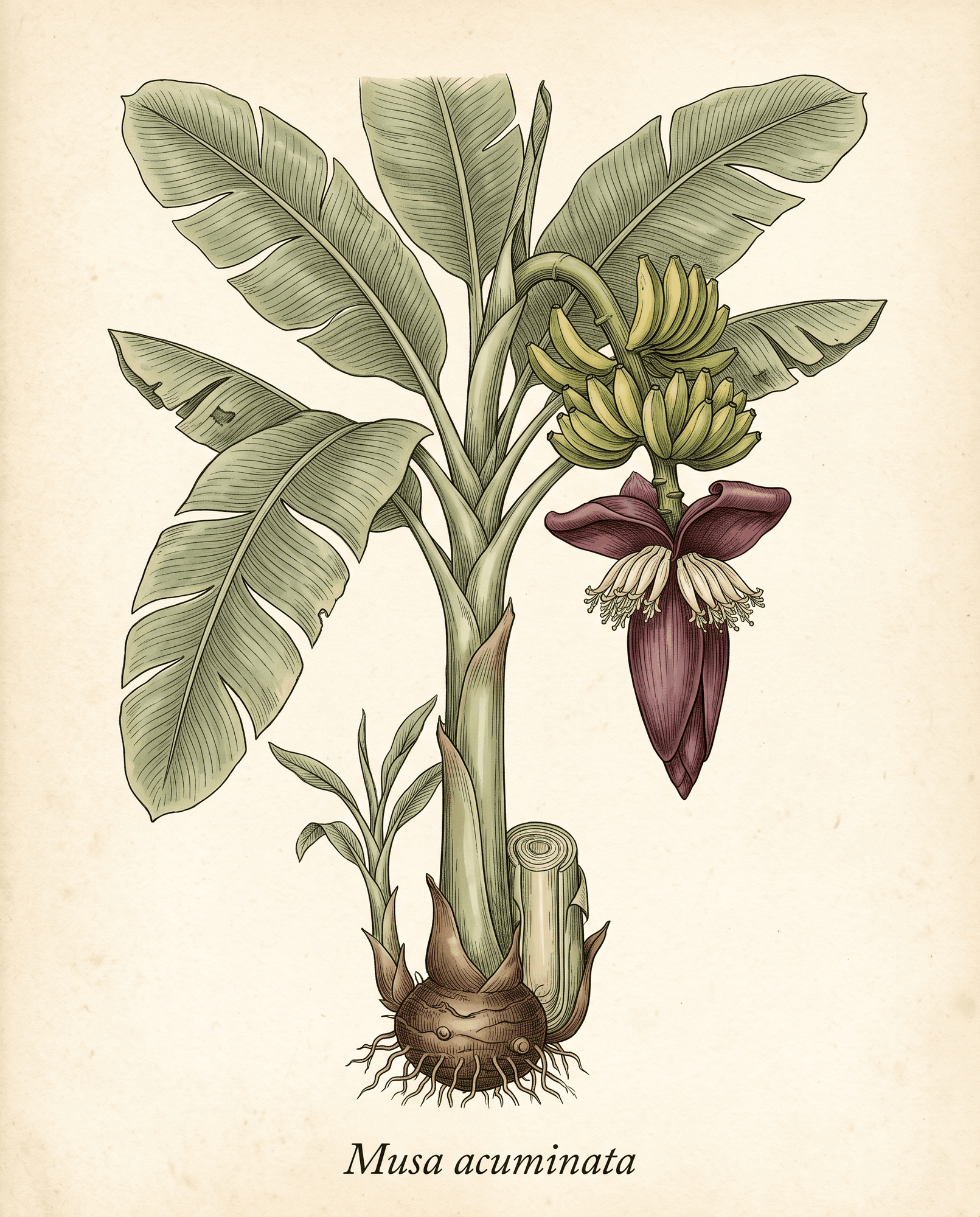
She has fed more people, in more places, for longer than almost any plant — and she has done it without being thought of as medicine at all. The fruit goes in the lunchbox. The peel goes in the bin. But the peel is where the tannins and the carotenoids live, the green fruit is where the stomach medicine lives, and the leaf is the plate on which offerings are laid. She is so ordinary, so present, so easy to come by that we have stopped seeing her. That is its own kind of teaching.
One Plant, Two Tempers
Everything about working with banana comes down to ripeness. Green, she is astringent and binding — the form the Caribbean and West Africa have always reached for when the stomach is raw or the body is weak, boiled and eaten as food that is also medicine. Ripe, she is sweet and loosening, moistening a dry system that has been running on fumes. Same plant, opposite gestures. Knowing which one you’re asking for is the whole practice.
Her Medicine Is Rebuilding
Where other plants clear and move things out, banana coats, fills, and closes over. She is who you reach for when tissue has been worn thin — the stomach after years of hard use, the gut after a long illness, the body after grief has burned through its reserves. Cool, sweet, heavy, moistening. A builder, not a clearer.
A Practice for the Season
For one week, don’t throw away a single peel. Wash them, cut them into strips, dry them until they snap, grind them, and put the powder in a jar. Notice how much you have. Notice what it does to your attention to treat the discarded part as the valuable one, every day, for seven days.
Then read What the Peel Knows, elsewhere in this issue, and you’ll understand what’s in that jar.
A Plant Walk, Wherever You Live
If she grows near you, find a clump rather than a single stem — she is never really alone. Look for three generations at once: the mother carrying fruit, the daughter half her height beside her, the granddaughter just breaking ground. If she doesn’t grow near you, do the walk in the produce aisle with the same attention. Notice what she sells for, how far she traveled, and what it costs for her to be that ordinary.
She fruits once and then she goes. What she leaves behind is already growing beside her.
— The Sage
Go deeper. The full Banana monograph lives in the Materia Medica library — her flower’s medicine for the cycle and postpartum, the pharmacology of the peel, her Ayurvedic and Chinese readings, black soap and the provision grounds, methods and dosages for every part of her, and a tarot spread for entering into relationship with her as an ally. It’s included with Herb-Curious membership, along with the whole library.