Banana
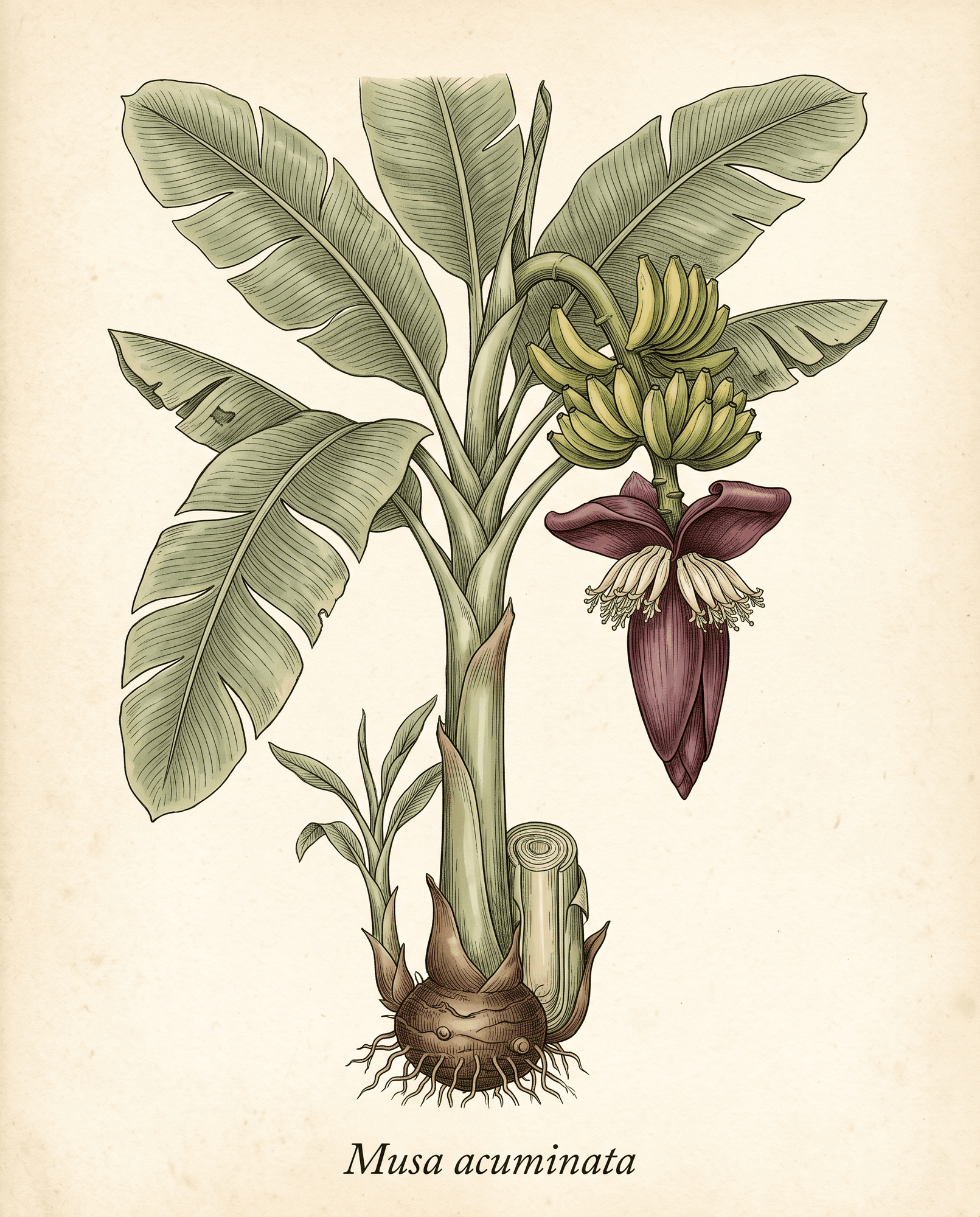
Banana is not a tree. She is the largest herb on earth — a giant, soft-bodied perennial who rises out of an underground corm, builds a column out of nothing but tightly furled leaf sheaths, unfurls leaves wide enough to carry a meal or shelter a head from rain, drops one heart of flowers, sets her fruit, and dies back. And beside her, already, a daughter is coming up. She never fruits twice. She never has to.
She has fed more people, for longer, in more places than almost any plant, and she has done it without being thought of as medicine at all. The fruit goes in the lunchbox. The peel goes in the bin. But the peel is where the tannins and the carotenoids live, the green fruit is where the gastric medicine lives, the leaf is the plate on which offerings are laid, the flower steadies a bleeding cycle, and the sap will close a cut in the field. She is one of those plants who is so ordinary, so present, so easy to come by that we have stopped seeing her. That is its own kind of teaching. (A note on names: the cooking banana is called plantain, and she is a sister to the sweet banana, not a separate plant. She is not the same as the low-growing leaf plantain, Plantago, which is a different family entirely and lives elsewhere in this library.)
The shape of her medicine
Banana’s medicine moves downward and inward. She is cool, sweet, heavy, and moistening — a builder, not a clearer. Where the alteratives open channels and escort things out, she coats, fills, and closes over. She is the plant you reach for when tissue has been stripped, scoured, or worn thin: the stomach lining after years of NSAIDs, the gut after a long illness, the skin after too much sun, the body after grief has burned through its reserves. Her whole gesture is restoration of the surface that protects.
She holds two opposite tempers in one body, and the difference is ripeness. Green, she is astringent and binding. Ripe, she is sweet and loosening. Working with her well means knowing which one you are asking for.
Her gastroprotective action is the most specific medicine she carries, and it lives in the green fruit. The flavonoid leucocyanidin thickens the layer of mucus that stands between the stomach’s own acid and the stomach’s own wall, and pectin strengthens the phospholipid film laid over that mucosa. This is not acid suppression. It is the rebuilding of the barrier itself — which is why she has held her place in folk practice for gastritis, reflux, and peptic ulcer, and why she has been shown to protect against the erosions that aspirin and other anti-inflammatory drugs leave behind.
As a demulcent and emollient, that same principle runs through the rest of her. Inside, her pectin and starch gel and soothe. Outside, her pulp, her sap, and her leaf cool and cover — the leaf laid over a burn, the mashed fruit on cracked heels, the peel against a slow-healing patch of skin.
Her prebiotic action is the green fruit again, and it is one of the more elegant things she does. Resistant starch passes through the small intestine untouched and arrives in the colon as food for the bacteria living there, who ferment it into short-chain fatty acids that feed the colonocytes directly. She is not just soothing the gut lining; she is nourishing the organisms that build it. Cooking destroys this, which is why green banana flour and lightly-prepared green fruit carry a medicine that the fried plantain on the plate beside them does not.
As an astringent, she tightens and draws tissue back in on itself — the tannins densest in the green fruit and in plantain peel. This is the action behind her use in diarrhea and dysentery, behind the flower’s steadying of a heavy cycle, and behind the peel powder’s work on loose, oily, congested skin.
As a laxative, she is the same plant turned around. Ripe, her starches have converted to sugar, her fiber has softened, and she moistens and moves the bowel rather than binding it. In Chinese dietary medicine this is her signature: she lubricates a dry intestine and relieves the constipation of heat and dryness rather than the constipation of cold and stagnation.
Her hypotensive action comes through mineral weight rather than through any drug-like mechanism. She is one of the most potassium-dense foods most people will ever eat, and potassium is how the body escorts excess sodium out. The pseudostem carries this further, adding a real lithotriptic action — the fresh juice of the inner core has long been used to discourage and dissolve urinary stones, and it reduces the oxalate load that lets those stones form.
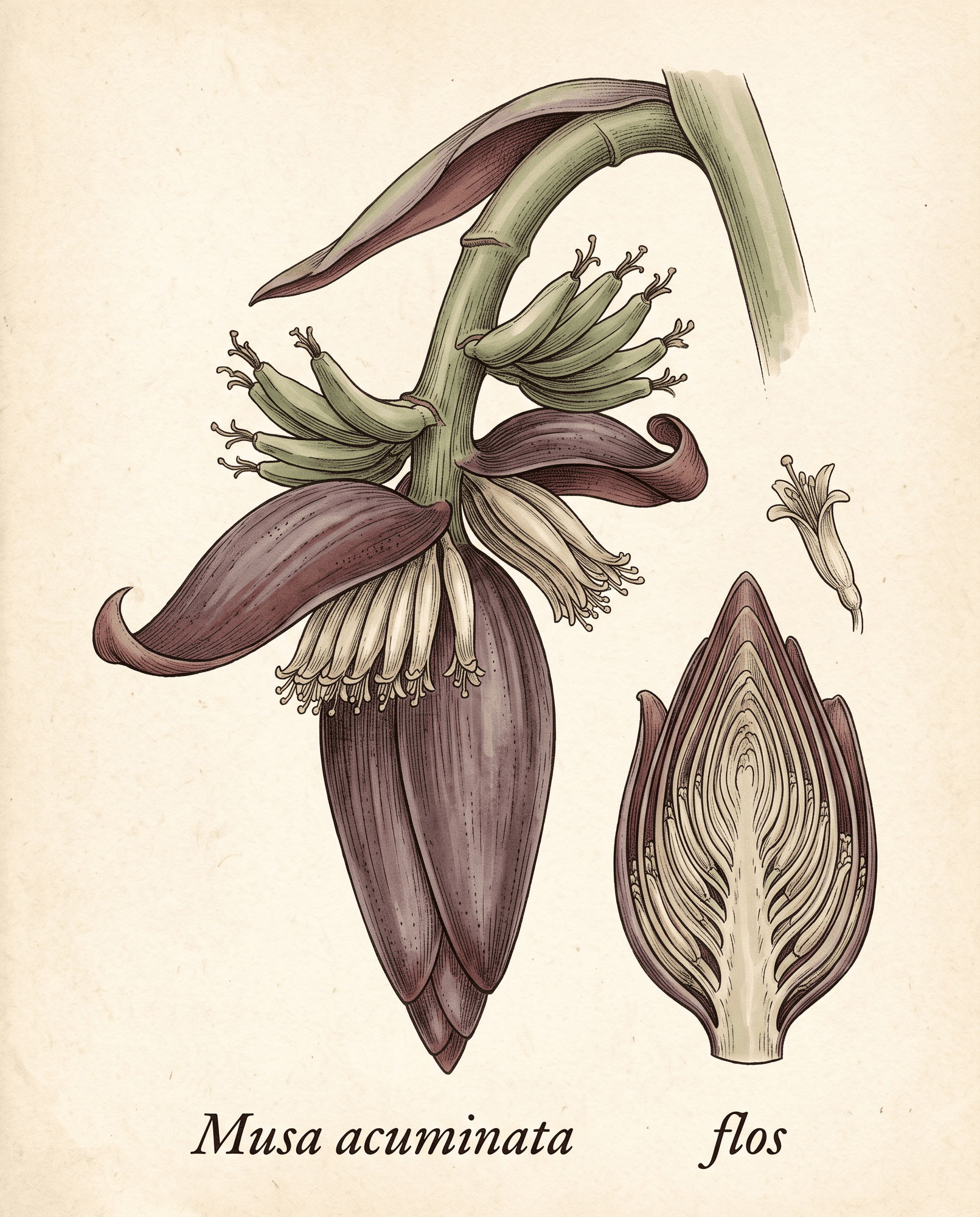
The flower deserves her own line. Astringent, cooling, iron-rich, and bitter at the edges, the heart is worked with for heavy bleeding, for painful cycles, for postpartum recovery, and as a galactagogue — the food given to a nursing mother to bring the milk in.
Taken together, her actions form a single gesture: she rebuilds what protects. Skin, mucosa, gut wall, blood, milk, the mineral floor of the body. She is medicine for the depleted, not the congested.
What lives inside her
Whose medicine she carries
Earth (corm)
Jupiter
Cancer
The Sun
Ten of Pentacles
Oshun
Oshun is the sweetness that feeds and the sweetness that heals — honey, gold, the fresh water, the beauty a person tends in the mirror not as vanity but as the practice of knowing they are worth tending. Banana is hers before she is anyone else’s, and the fruit is the evidence: yellow, soft, generous, ripening into the exact color of her cloth, set on her altar because she belongs there. Not a rare offering, either — common, everywhere, sold on every corner, which is Oshun’s own teaching about how abundance actually works. A single sucker at a doorway becomes a clump, and the clump feeds a household for years without being asked twice.
Her place here runs through three doors at once. The heart is fertility and womb medicine — worked for a heavy or painful cycle, for postpartum recovery, for bringing in the milk, and ewe ọ̀gẹ̀dẹ̀ goes into the bath of a woman asking to conceive. The peel is the beauty work — tannin, lutein, and the ash at the base of West African black soap, the discarded part that turns out to be what makes skin soft, bright, and cared for. And beneath both, she builds: coating a raw stomach, filling a depleted body, putting iron back after bleeding, laying a mineral floor under a heart running on nothing. Oshun’s sweetness is not indulgence. It is the nutrient a body cannot rebuild without.
The hands she has passed through
Banana’s story begins in the highlands of New Guinea, in the Kuk swamp, where people were deliberately planting and propagating Musa roughly seven thousand years ago — one of the earliest domestications anywhere in the world, and one accomplished entirely through the cutting and replanting of suckers rather than seed. From there she moved with people, not with wind or birds. Every banana in the world is a passenger. Austronesian voyagers carried her west and east as a canoe plant, one of the few crops worth the weight in a boat because a single sucker could start a grove. She appears in Sri Lanka six thousand years ago, in South Asia and Uganda in the millennia after that, and phytoliths at Nkang in Cameroon put her on the African continent by around 500 BCE — meaning West and Central African peoples have been growing, breeding, and thinking with plantain for well over two thousand years.
In West and Central Africa, she became a staple that reshaped the forest zone. Plantain-based cultivation supported dense settlement where grains would not grow, and she entered the material culture as thoroughly as she entered the diet. Her skin, sun-dried and burned in clay pots, yields an ash that is leached to draw out its potash — the alkali that makes soap possible. This is the foundation of ose dudu in Yoruba and alata samina in Twi: the black soap traditions of Ghana, Nigeria, Benin, and the wider coast, where the skins are not a byproduct of the process but the chemistry at the center of it. Her leaf, meanwhile, became the surface on which food is cooked, wrapped, served, and offered. In Yoruba practice she is ọ̀gẹ̀dẹ̀, the plantain àgbàgbà, and ewe ọ̀gẹ̀dẹ̀ appears in workings for fertility, for childbirth blessing, and for calling sweetness into a relationship.
She crossed the Atlantic in the same century and often the same ships as sugarcane, arriving in the Canaries and then the Caribbean in the early 1500s. Colonial planters wanted her for a hard reason: plantain fed the enslaved cheaply, grew fast, and did not require the labor that could be extracted for cash crops instead. But the provision grounds — the marginal plots where enslaved people were made to grow their own food, and where, in the hours after forced labor, they grew what they chose — became something the planters did not intend. Plantain, yam, okra, callaloo, pepper, and medicine grew there together. Those grounds were sites of survival and of quiet sovereignty: land where a person’s own hands fed their own family, and where plant knowledge carried from West and Central Africa was kept alive, tested against new soil, and passed down. Plantain is one of the plants that made that possible, and she carries the memory of it.
Across the Caribbean and the Black Atlantic, her uses multiplied. Green banana boiled and eaten for the stomach and for weakness. The leaf passed over flame until supple and laid over a burn, a boil, or an inflamed patch of skin, or used in steaming for fever and inflammation. Fufu, mofongo, tostones, matoke, boiled green banana with saltfish — food that is also medicine, in the way that the deepest kitchen traditions never separated the two. The peel rubbed on a wart, a bite, a sore.
In India and South Asia, where she has grown for at least three thousand years, she is kadali, rambha, mocha — names that speak of beauty, of quivering in the wind, of the sap that exudes. Ayurveda works every part: fruit for depletion and for building tissue, flower for heavy bleeding and gynecological complaints, pseudostem juice for urinary stones, leaf as the plate itself. The banana leaf as a plate is not a rustic novelty; it is a whole grammar of hospitality and purity. The plant is planted at wedding gates and temple entrances as a sign of fertility, prosperity, and auspicious beginning, and her association with generational continuity is old and unbroken.
In Chinese medicine, she is xiang jiao, documented as sweet and cold, entering Lung and Spleen, clearing heat, moistening the intestines, and relieving the thirst of fever. The peel is treated as its own medicine, xiang jiao pi — sweet, astringent, cold — decocted for dysentery, itching, and to bring down blood pressure.
In Brazilian Candomblé and Umbanda, the bananeira is understood as radiated by Xangô (Shango); in some regions her fruit and flower stalk are consecrated to Exu (Elegua). Her leaves are not used for baths or amaci — they are the cloths and plates of obligation, the surface on which the sacred is laid. Nearly every wrapped offering in the tradition passes through her: acaçá, abará, aberém, agidi, each one folded into her blade and steamed.
She has been called a fig of paradise, a poor man’s crop, a colonial staple, a dessert, and a weed of the dooryard. She has been all of them. What she has actually been, most of the time, is the thing standing between a household and hunger.
Where she works in the body
Digestive system. This is her heartland, and she works it from both directions. Green, her resistant starch and pectin bind loose stool, slow transit, and rebuild the gut wall from the inside — she has been shown, repeatedly, to shorten the course of persistent diarrhea in children and to reduce the slide into dehydration. Ripe, she does the opposite, lubricating a dry bowel and easing constipation of the heat-and-dryness kind. Underneath both, her prebiotic action feeds the colonic bacteria whose short-chain fatty acids nourish the intestinal lining directly. For post-illness recovery, post-antibiotic repair, and the long work of rebuilding gut terrain, she is one of the simplest and most available medicines there is.
Gastric & duodenal mucosa. Her most specific medicine, and worth naming separately from the gut at large. Leucocyanidin thickens the gastric mucus layer; pectin and phosphatidylcholine reinforce the phospholipid film over the mucosa. The result is a barrier rebuilt rather than an acid suppressed — appropriate for gastritis, reflux with erosion, peptic and duodenal ulcer, and particularly for anyone whose stomach lining is being worn down by long-term NSAID use. Green, dried, and powdered is the traditional form. Cooking, and ripening, both diminish it.
Cardiovascular system. Through potassium and magnesium density she supports blood pressure regulation, fluid balance, and steady cardiac rhythm — potassium being the mineral by which the body clears excess sodium. The pseudostem and the flower carry this too. Her fiber and phytosterols contribute modestly to lipid balance. This is not dramatic medicine; it is the mineral floor under a cardiovascular system, and it matters most when that floor has been eroded by diuretics, sweat, illness, or a diet of processed food.
Urinary system. The fresh juice of the inner pseudostem is the classic preparation — worked with across South Asia to discourage and dissolve calcium oxalate stones, to ease painful and difficult urination, and as a gentle diuretic. Where a stone has already formed, she is supportive rather than curative and belongs alongside proper care. Where the tendency runs in a body, she is a reasonable long practice.
Skin. She works the skin from the outside more than from within. The leaf, warmed until supple, is laid over burns, scalds, and inflamed patches — clean, cool, and non-adherent, one of the oldest field dressings in the tropics. The sap closes small cuts. The mashed ripe pulp softens cracked heels and dry, wind-burned skin. The peel is the concentrated form: tannins that draw tissue back in and regulate sebum, lutein that supports the skin’s work of evening its own tone, phytosterols that support barrier function, and amylase that loosens dead surface cells without abrasion. Plantain peel is the stronger and more astringent of the two — the choice for oily, congested, hyperpigmented skin — while banana peel is gentler and more emollient, better suited to dryness and sensitivity.
Nervous system. Her reputation as a steadying, mood-supporting food is genuine, though not for the reason usually given. The serotonin and dopamine in her flesh do not cross into the brain. What she actually does is clear the road for the body’s own tryptophan, which enters the brain through a transporter it shares with several larger and more abundant amino acids — and in open competition, it loses. This is why a protein-heavy meal, tryptophan and all, does not raise brain serotonin. Carbohydrate changes the odds: her sugars trigger insulin, insulin drives the competing amino acids into muscle, and tryptophan, bound to albumin and largely spared, crosses into a road that has been cleared for it. Her vitamin B6 then works at the far end of the same chain, as the cofactor for the enzyme that converts 5-HTP into serotonin. The sugar opens the door and the B6 finishes the conversion — two ends of one process rather than two entries on a nutrient list — with magnesium supporting the same pathway and steadying the stress response around it. She is not a rich source of tryptophan herself, so she works on what is already circulating: for the anxious, depleted, under-eating body running on adrenaline with no floor under it, that is the right kind of help. Chinese dietary medicine names this, calling her calming to the spirit.
Reproductive system & lactation. The flower carries this work. Astringent, cooling, and iron-rich, the cooked heart or its juice is given for heavy menstrual bleeding and for painful cycles, and postpartum for uterine recovery and to bring in the milk. Her iron content addresses the anemia that follows sustained blood loss, which is part of why the flower and the heavy cycle are so consistently paired across traditions. The ripe fruit is named an aphrodisiac and a builder of reproductive tissue in Ayurveda, on the strength of her sweet, heavy, building nature rather than any stimulating action.
How to take her
Harvest calendar
Preparations
Green banana or plantain flour: Green fruit peeled, sliced, dried at low heat, and ground. 1–2 teaspoons stirred into water, broth, or porridge, once or twice daily. The primary form for gastric and gut work. Do not cook it — heat destroys both the leucocyanidin and the resistant starch.
Boiled green banana as food: Whole green fruit, boiled and eaten alongside a meal. Gentler than the flour, appropriate daily, and the traditional form across the Caribbean and West Africa for the weak stomach and the recovering body.
Ripe fruit: Eaten in the evening for constipation of dryness. Mashed with a little cardamom, ghee, or raw sugar when it needs warming and lightening.
Peel powder: Peels washed, cut into strips no thicker than a quarter inch, dried until brittle at 150–170°F (or in full sun over 1–3 days), ground, and sifted. Stored airtight in the dark, it holds six months to a year. Any residual moisture will clump and eventually mold.
Peel powder, face mask: ½ teaspoon powder with raw honey and a little aloe gel. Ten to fifteen minutes on clean skin, then rinse warm. Once weekly.
Peel powder, in soap: 1–2 teaspoons of sifted powder per 100g of melt-and-pour or cold-process base, worked in thoroughly before setting. Historically appropriate to black soap; plantain is the more grounded choice of the two.
Peel powder, body scrub: 2 tablespoons of the coarser sifted-out fraction with raw cane sugar, a tablespoon of coconut or jojoba oil, and a few drops of vetiver, frankincense, or cedarwood.
Leaf, as dressing: Cut a young, unblemished blade, wash, and pass briefly over flame or steam until it darkens slightly and turns supple. Lay the smooth side against clean burns, scalds, or inflamed skin. Change frequently. Not for deep or infected wounds.
Leaf, as wrapper: Softened the same way, used to wrap food for steaming — and to line the vessel on which offerings are laid.
Flower (heart) as food or juice: Outer bracts removed, the pale inner tiers chopped and soaked in acidulated water to stop browning, then cooked. Eaten two or three times weekly through the bleeding phase of the cycle, or postpartum. The juice is traditionally taken with curd or yogurt.
Pseudostem juice: The tender inner core of a spent stem, juiced fresh and drunk immediately — it oxidizes within minutes. Roughly half a cup, often with a pinch of salt or a squeeze of lime, for urinary stone tendency and stagnant urination.
Sap: Fresh from a cut stem or peel, applied directly to small cuts, insect bites, and warts. It stains permanently — keep it off cloth.
Spiritual & ritual:
- Leaves cut, passed over flame, and used to line the vessel or dress the surface on which offerings are laid
- Fruit set out for ancestors and for the household dead, particularly alongside food that was cooked and eaten by the living that same day
- Ripe fruit laid around the edge of a plate of offering food, sweetness set against heat
- A sucker planted at a gate, a doorway, or a new threshold as a sign of continuity and increase
- Dried peel powder added to cleansing soap for washing before ritual work
When to hold back
Use with caution if:
- You are taking potassium-sparing diuretics, ACE inhibitors, or ARBs. Her potassium density is real and additive; these drugs already retain potassium.
- You have advanced kidney disease or any potassium-restricted diet. Both fruit and peel are potassium-dense. The pseudostem and flower as well.
- You have a latex allergy. Latex-fruit syndrome cross-reactivity with banana is well documented, alongside avocado, kiwi, and chestnut.
- You are managing diabetes. The ripe fruit is high in available sugar; the green fruit is not, and behaves quite differently. Know which one is on the plate.
- You have a cold, damp, congested constitution — chronic phlegm, loose cold stool, weak digestive fire, cold hands and feet. Ripe fruit in quantity will deepen this. Pair with warming spice or choose green.
- You are working with active cough, asthma, or wet respiratory congestion. The sweeter and riper she is, the more she thickens damp. Traditional practice across several lineages agrees on this.
Topical considerations: Sap stains skin and fabric and can irritate sensitive skin — patch test peel preparations before broader use. Wash peels thoroughly before drying, including organic fruit; residue on the skin concentrates in the powder. Do not apply leaf or peel to deep, dirty, or infected wounds.
General notes: Generally very safe as food across the lifespan, including pregnancy and childhood. In Ayurveda, banana with milk is named a classic incompatible combination — different post-digestive actions producing ama — and is traditionally associated with skin trouble and dulled digestion. Whether or not the framework holds for you, the observation that banana-and-dairy sits heavily is worth testing in your own body.
Who walks with her
For gastric and duodenal healing: Marshmallow root, slippery elm, licorice root, calendula, meadowsweet, plantain leaf.
For gut terrain and post-illness recovery: Burdock root, okra, chamomile, ginger, chicory root.
For skin, in preparation: Shea butter, calendula, rose, kaolin clay, oat, chamomile, turmeric.
For black soap and deep cleansing: Shea butter, cocoa pod ash, palm kernel oil, plantain skin ash — the traditional company she keeps.
For heavy bleeding and cycle support (with the flower): Yarrow, shepherd’s purse, red raspberry leaf, nettle.
For lactation and postpartum: Fenugreek, blessed thistle, nettle, oatstraw, moringa.
To warm and lighten her: Ginger, cardamom, cinnamon, black pepper, long pepper.
The through-line in this company is that Banana is the base and the others are the direction. She brings bulk, mineral, mucilage, and coating — the floor to build on — and her allies bring the movement, the warmth, the antimicrobial edge, or the specific tissue affinity she does not carry alone. This is why she pairs so naturally with warming spice: her weight and coolness are exactly what a hot, dry, dispersing herb needs to land on, and the spice is exactly what keeps her from settling into damp. Set her with marshmallow and licorice and you have a demulcent formula that can hold a raw stomach for months. Set her with ginger and you have a food.
How to know her
Plant walk: If you live where she grows, find a clump rather than a single stem — she is never really alone. Look for the three generations at once, which is what growers keep on a healthy mat and name in exactly these terms: the mother carrying fruit or already dying back, the daughter half her height beside her, and the granddaughter, a small sucker just breaking ground. Sit with the arrangement. If you live where she does not grow, do the walk in the produce aisle and the corner store instead, with the same attention: notice what she sells for, how far she traveled, whose hands cut her, and what it costs for her to be that ordinary.
The peel practice: For one week, do not throw away a single peel. Wash them, cut them, dry them, grind them, sift them, and put the powder in a jar. Notice how much you have. Notice what it does to your attention to treat the discarded part as the valuable one, every day, for seven days. This is a small practice and it does more than it looks like it will.
Offering on the leaf: Cut or buy a banana leaf. Pass it over flame until it softens and its smell rises. Lay it on your altar or your table and set food on it — food you cooked, that you also ate. Serve the ancestors from the same pot you served yourself from. Leave it overnight; return the food to the earth in the morning.
Ritual of standing through wind: Bring a banana leaf, whole and unshredded, into the house. Over the following days it will dry, curl, and split along its ribs the way the plant’s own leaves split in storm. Do not throw it out when it starts to tear. Keep it where you will see it. Let it be a companion through a season when things are coming apart at the edges — a reminder that the shredding of the leaf is not the falling of the plant.
Journal prompts
- What in me has been worn thin and needs rebuilding rather than clearing?
- What am I discarding without looking at it — in my body, my kitchen, my lineage?
- What am I building that I will not be standing here to see finished? How does that sit in me?
- Where have I mistaken being ordinary and available for being unimportant?
- What is the difference, in my life right now, between being cleaned out and being fed?
Tarot Spread
A spread for entering into relationship with Banana as a plant ally:
- What in me is asking to be coated, covered, and protected rather than opened?
- What have I thrown away that was the medicine?
- What am I holding — what vessel am I being, for whom?
- What is the fruit I am setting down this season?
- What is already growing beside me that I have not turned to look at?
Keep a piece of dried peel or a banana leaf on the altar with the cards. Ask the questions after a meal rather than before — she answers better to a fed body.
The same plant, multiple lenses
Banana is madhura and kashaya in taste — sweet and astringent — guru and snigdha in quality, heavy and unctuous, with madhura vipaka, a sweet post-digestive effect. Her potency is the point of disagreement: most classical sources name the ripe fruit sheeta virya, cooling, while some texts assign the ripe fruit ushna virya and a sour vipaka, reserving the cooling designation for the unripe. This is not a small disagreement — it is the difference between a fruit that pacifies Pitta and one that provokes it — and the resolution in practice is ripeness and preparation. The greener she is, the more astringent, light, and cooling. The riper she is, the sweeter, heavier, and more Kapha-building. Working with her means reading which plant is in your hand.
She is balya — strengthening — and brimhana — building, nourishing, filling out what has been depleted. This is her essential Ayurvedic character.
Pitta Dosha — Fire & Water
The ripe fruit’s sweet taste, cool potency, and moistening quality make her broadly Pitta-pacifying, and the flower more so. She is called for burning digestive heat, gastritis, hyperacidity, ulcer, and the bleeding disorders grouped as raktapitta — where excess heat has driven blood out of its channels. The flower’s astringency serves heavy menstrual bleeding directly. Where the ripe fruit does aggravate Pitta — and in some constitutions it does — mashing her with raw sugar, cardamom, or rose settles it.
Kapha Dosha — Earth & Water
This is where she asks for restraint. Heavy, sweet, unctuous, and cool is the exact recipe for increasing Kapha, and a Kapha-dominant body eating ripe banana daily will feel it as heaviness, mucus, sluggish digestion, and slow morning fog. She is contraindicated in cough, cold, and asthma for this reason across several traditions at once. If she is needed, take her green and cooked light, or pair the ripe fruit with ginger, black pepper, long pepper, or cinnamon to keep her moving.
Vata Dosha — Air & Ether
Vata is where she is most obviously a gift. Her heaviness, oiliness, sweetness, and building quality directly counter Vata’s dryness, coldness, roughness, and tendency to deplete. For the thin, anxious, dry-skinned, irregularly-digesting, under-eating body she is grounding food — and one of the few things that is both easy to eat and genuinely filling when appetite is gone. Warm her slightly and pair with ghee, cardamom, or cinnamon and she is nearly ideal Vata nourishment.
Taste & Temperature: Sweet, cold (fruit). Sweet and astringent, cold (peel — xiang jiao pi). Channels Entered: Lung, Spleen, and Large Intestine. Functions: Clears heat and generates fluids. Moistens the intestines. Resolves toxicity. Calms the spirit. The peel additionally clears damp-heat and lowers blood pressure.
Clearing Heat & Generating Fluids
Xiang jiao is a cooling, fluid-generating food, called on for the thirst that comes with fever, for dryness in the mouth and throat, and for the residual heat that lingers after an acute illness has broken. Her sweetness is not an empty sweetness — in this framework it builds fluids and Yin rather than just supplying sugar, which is why she is given to the parched and depleted rather than to the merely hungry.
Moistening the Intestines
Her most classical function. She lubricates a dry large intestine and relieves constipation arising from heat or from Yin deficiency — the dry, hard, difficult stool of a body running short on fluids, not the sluggish stool of cold and stagnation. She is also given for hemorrhoidal bleeding, where dryness and heat below have made tissue fragile.
Resolving Toxicity & Clearing Damp-Heat
The peel carries this line more strongly than the fruit. Xiang jiao pi, sweet and astringent and cold, is decocted for dysentery, for itching and damp skin conditions, and to bring down elevated blood pressure. Its astringency lets it clear heat without further loosening tissue that is already loose — an unusual and useful combination.
Calming the Spirit
She is named as calming to the Shen. Cold, sweet, fluid-building foods settle a spirit that has been agitated by heat — the restlessness, the thin sleep, the irritability that comes with a body running hot and dry. This aligns closely with her Western reading as a food for the depleted, over-adrenalized nervous system.
Yin/Yang Balance
Banana is strongly Yin — cold, sweet, moistening, descending, fluid-generating, damp-forming. She is well suited to heat and dryness: Yin deficiency with heat signs, fluid depletion, dry constipation, heat in the Lung with dry cough.
She is not appropriate for cold, damp, or Spleen-Yang deficient patterns, and this is one of the clearer contraindications in the whole materia medica. Loose cold stool, chronic phlegm, wet cough, weak digestion, cold limbs, heavy damp constitutions — she deepens all of it. Where she is still wanted, she is taken cooked rather than raw, in small amount, and always with warming, damp-transforming company: ginger, cinnamon, tangerine peel, cardamom.
For going deeper
- Verger, Pierre Fatumbi. Ewé: The Use of Plants in Yoruba Society. Companhia das Letras. — the standard reference on Yoruba plant knowledge, gathered in relationship rather than extraction.
- Voeks, Robert. Sacred Leaves of Candomblé: African Magic, Medicine, and Religion in Brazil. University of Texas Press.
- Lee, Michele Elizabeth. Working the Roots: Over 400 Years of Traditional African American Healing. Wadastick Publishers.
- Lans, Cheryl. Creole Remedies of Trinidad and Tobago. — documentation of Caribbean bush medicine as practiced, including Musa.
- Carney, Judith A. & Rosomoff, Richard Nicholas. In the Shadow of Slavery: Africa’s Botanical Legacy in the Atlantic World. University of California Press. — essential on provision grounds and the plants carried across.
- Denham, Tim et al., on the Kuk Swamp excavations, and Mbida et al. on the Nkang phytoliths in Cameroon — the archaeobotanical record of banana domestication and its arrival in Africa.
- Bhavaprakasha Nighantu, and Frawley, David & Lad, Vasant. The Yoga of Herbs. Lotus Press. — for kadali in the Ayurvedic materia medica.
- Bensky, Dan, Clavey, Steven & Stöger, Erich. Chinese Herbal Medicine: Materia Medica. Eastland Press; supplemented by Chinese dietary-therapy sources for xiang jiao and xiang jiao pi, which sit more in the food-as-medicine literature than in the classical herbal canon.
- Lewis, D.A. et al., on leucocyanidin and gastric mucosal protection, and the clinical literature on green banana in persistent childhood diarrhea — the modern research most directly confirming the traditional gastric use.
- Conversations with Ghanaian, Nigerian, and Beninese soapmakers about ose dudu and alata samina, and with Caribbean and West African cooks about green banana, plantain, and what the leaf is for. This knowledge is oral, place-based, and held by living people. It is worth going to the source.
The Conversation
Questions, noticings, what this is teaching you — leave them here. This same conversation lives in The Circle.