Sambucus nigra
Elder is the one growing where the ground stays wet: the ditch, the creek bank, the back wall of the churchyard. In early summer she opens wide flat plates of cream flowers. By fall those same plates hang heavy with fruit so dark it reads as black, and that fruit is the medicine this season asks for. When the rain comes back and the colds start moving through the house, the school, and the office, elderberry is who you want on the shelf.
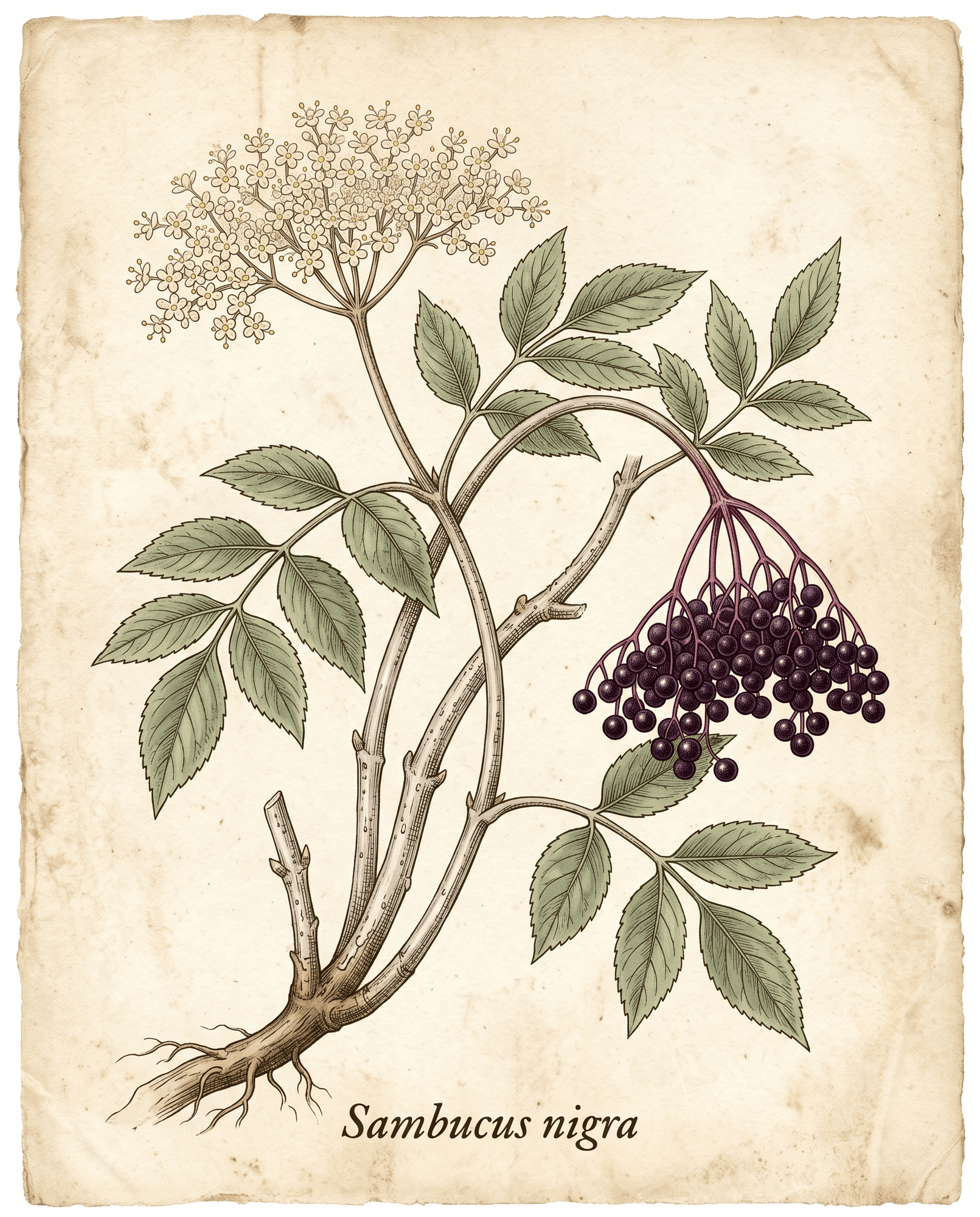
People have leaned on her through the cold months for as long as she has grown beside them. Indigenous nations across this continent dried her berries for winter and gave her flowers to feverish children. Southern kitchens still cook her down with honey and ginger when the weather turns and hand a spoonful to everyone at the table. In Cuba and Mexico she is saúco, steeped for coughs and fevers. The practice is the same nearly everywhere she grows: make her in the fall, and take her all winter.
Flower and Fruit
Elder hands over her medicine twice a year. In early summer she is the flower, gathered and dried, the fever-breaker of the nursery. At the turn toward fall she is the berry, stripped from the stem when the whole cluster has gone dark, then cooked. That last part matters. Raw and green berries, and her leaves, stems, and bark, carry compounds that turn the stomach hard. Ripe, stripped, and cooked, she is among the gentlest medicines there are, gentle enough for the whole family.
Her Medicine Is Protection
Where chicory clears, elderberry stands guard. The dark pigment that stains your hands is the same medicine that meets the viruses of cold and flu season at the door, making it harder for them to take hold, while steadying the body’s own defenses rather than pushing them into overdrive. That steadiness is why she works best as a daily companion. Taken every day through the season, she keeps the body ready. When a cold does get through, she is the first thing to reach for at the first scratch of the throat, and she helps it move through faster and lighter than it would have alone. And if a fever comes, her flower is waiting in the cupboard to help it break.
A Practice for the Season
Make your elderberry syrup now, while the season is turning, and take it every day until spring. The protection is in the rhythm. A spoonful once in a while is a nice gesture; a spoonful every morning is a practice, and it is the daily practice that carries a household through the wet months.
The daily syrup
- 1 cup dried elderberries (or 2 cups fresh, fully ripe, stripped of every stem)
- 3 cups water
- A thumb of fresh ginger, sliced, and a cinnamon stick, if you like
- About 1 cup raw honey
Simmer the berries and spices in the water, uncovered, for 30 to 45 minutes, until the liquid has reduced by about half. Mash the berries against the side of the pot, then strain through a fine sieve or cloth and press out every drop. Let it cool until it is warm rather than hot, then stir in the honey. Bottle, label, and keep it in the refrigerator, where it holds for about two months. Make a fresh batch when the jar runs low.
To watch a batch come together at the stove, see When Summer Feels Like Fall, where I walk through my own recipe for Elderberry Syrup.
Every day: 1 tablespoon each morning for adults, 1 teaspoon for children. Take it at the same time, before the day starts, the way you would lock the door behind you.
At the first sign: When the throat scratches or the body starts to ache, take the same dose three or four times a day until you feel yourself again, then return to once a day.
Through the season: Keep going from now until the days lengthen and the rain lets up. Notice, when spring comes, how the winter went.
Honey is not for babies under one year old, so make a batch sweetened another way for the littlest ones, or ask your herbalist about the flower instead.
A Plant Walk, Wherever You Live
Go to the wet places: the creek, the drainage ditch, the edge of the woods, the far corner of an old cemetery. Here in the Pacific Northwest, blue elderberry lines the roadsides and forest openings, and by now the birds have taken most of her fruit. Look instead for what she leaves standing: arching gray canes with bumpy, corky bark, leaves set in opposite pairs along the stem, and the bare, branching skeletons of the fruit clusters still held up at the tips. Snap a dead twig and look for the soft white pith inside. That is the hollow she is named for. Red elder grows here too, with cone-shaped clusters of scarlet berries, and she is her own plant with her own cautions, so leave her berries be. Mark where the blue elder grows, and come back next August to gather your own. Until then, find dried berries at the apothecary, and notice how far the medicine has traveled from the creek bank.
She gathers everything summer gave her into a dark berry and hands it over just as the cold arrives. Take her every day, and let her keep the door through the dark months.
— The Sage
Go deeper. The full Elder monograph lives in the Materia Medica library — her energetics and the hot-and-cool teaching of the flower, the Elder Mother and the graveyard lore, her lineages among Indigenous nations, Southern kitchens, and the saúco of Cuba and Mexico, her Ayurvedic and Chinese readings, methods and dosages for flower and berry, and a tarot spread for entering into relationship with her as an ally. It’s included with Herb-Curious membership, along with the whole library.