Cayenne
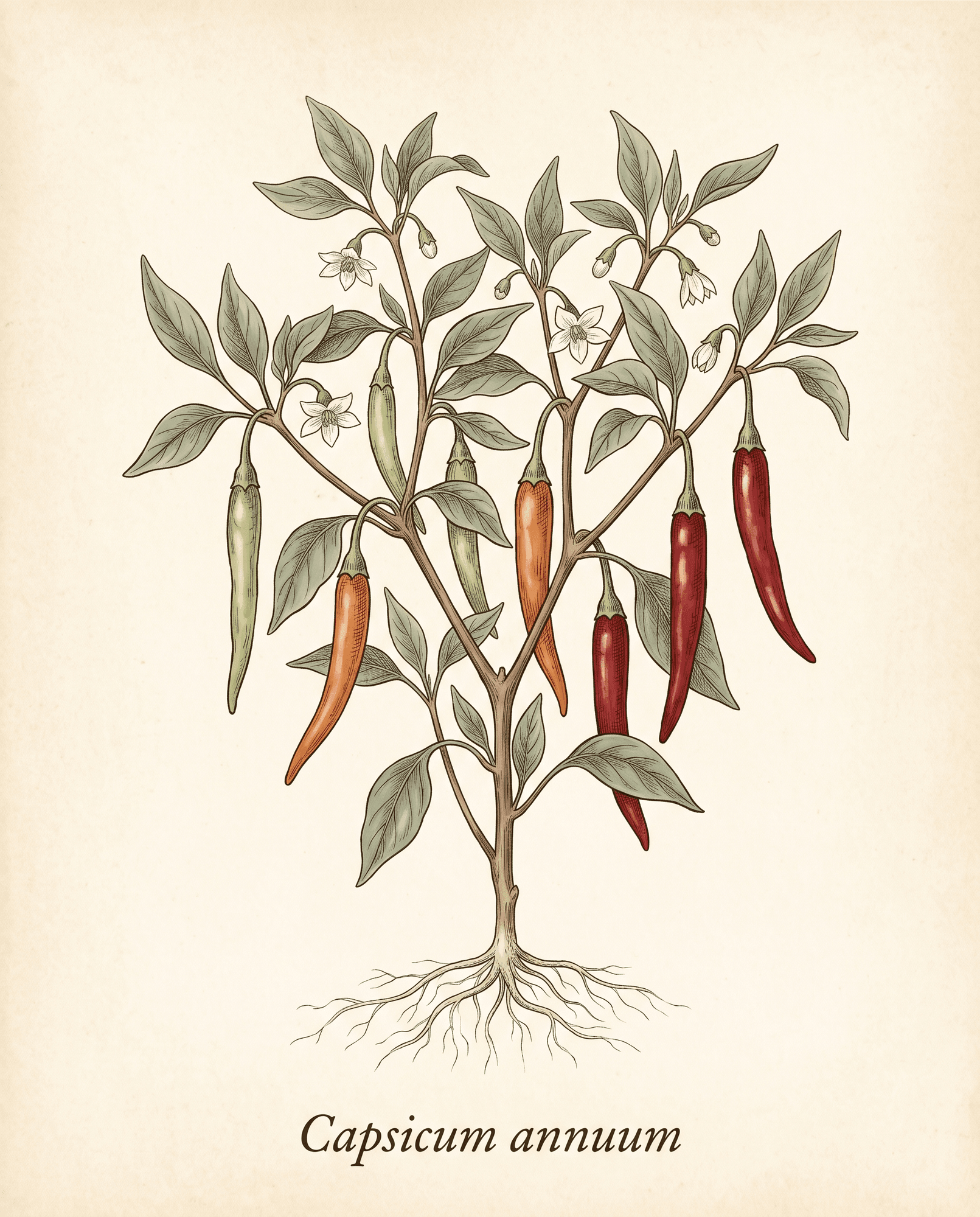
Cayenne is the fire that moves. She does not sit still in the body the way a warming root does, radiating heat from one place — she runs. Taken into the mouth she is already traveling: the tongue, the throat, the belly, and then out through the whole vascular tree to the far cold edges of the hands and feet. She is the purest of the stimulants, the herb the old herbalists reached for when the blood had grown slow and the vital force had banked too low to carry the rest of the medicine where it needed to go. Every part of her says the same thing — the red of her ripe fruit, the burn that floods and then fades, the way she opens the pores and brings the sweat: she is here to get things moving that have stopped.
This is bold medicine, and it has never been quiet or hidden. She has crossed every ocean, seasoned every diaspora, and become so woven into the world’s cooking that most people have forgotten she began as a small bird-sown berry in the warm lowlands of the Americas. She is the pepper in the pot of greens, the heat in the hot sauce, the powder pressed into a wound to stop the bleeding, the pinch stirred into warm water and pressed to the lips of a person whose heart is failing. She carries other herbs on her back — a diffusive, the ones that spread a formula through the whole body — and she carries courage in the same gesture. Where things have grown cold, slow, stuck, or afraid, she goes first.
The shape of her medicine
Cayenne’s medicine moves outward and everywhere at once. She is diffusive, not focal — she does not concentrate her heat in one organ but pushes it centrifugally, from the core out to the surface and the periphery. Her heat is not the deep, banked, slow warmth of a root like ginger or ashwagandha; it is fast, bright, and dispersing, the heat that floods and then opens. She is decidedly hot and dry, and everything she does follows from that fire in motion.
She is a stimulant first, and in the old Western tradition she was called the purest of them — an herb that quickens and excites the body’s own functional activity without depressing it afterward the way alcohol or narcotics do. As a circulatory stimulant she is unmatched for the periphery: the cold hands and feet, the sluggish capillary beds, the person who cannot get warm no matter how many layers they wear. She drives blood into the small vessels at the edges and equalizes the circulation, spreading it out from where it has pooled to where it has failed to reach.
As a diffusive, her real genius shows: she is the herb that carries other herbs. Added in small amounts to a formula, she spreads its action through the whole body, opening the vessels so the other medicines can travel. She does not do the specific work of the tonic or the nervine she rides with — she gets it there faster and farther.
Her cardiac tonic action made her legendary. She strengthens the pulse without speeding it, feeds the heart directly through the blood, and the traditional herbalists trusted her as an emergency medicine for the failing or arresting heart — a pinch in warm water at the first sign of trouble. This is heart medicine in the most literal sense: fuel and force delivered straight to the muscle that never rests.
Her hemostatic action seems to contradict all this movement, and yet it follows from it. Poured into a wound, cayenne equalizes the blood pressure from the crown to the feet, taking the concentrated pressure off the site of bleeding so the body can clot on its own. She stops bleeding not by constricting but by redistributing — by spreading the force out so no single place is overwhelmed.
As a diaphoretic she opens the pores and brings the sweat, which is why she belongs in the beginning stages of a cold with chills, when the body needs to warm from within and break a fever by moving through it rather than suppressing it. As a carminative and gentle antispasmodic she warms the digestive fire, moves stagnant gut, relieves the cramping of cold in the belly, and — against every intuition about a “hot” food — actually protects the stomach lining by stimulating its protective mucus and its blood supply.
Topically she is a rubefacient and a remarkable analgesic. Rubbed into skin she draws blood to the surface, warming stiff joints and cold muscles. Applied over time, her capsaicin exhausts the nerve’s supply of the chemical that carries pain, so the ache quiets — which is why she lives in liniments for arthritis, neuralgia, and the pain that will not let go.
Together her actions are a single gesture: fire that moves. She is for the body that has grown cold, slow, stuck, or afraid to circulate its own force.
What lives inside her
Whose medicine she carries
Sun
Scorpio
The Sun
Ace of Wands
Shango
Shango is fire with a purpose — not the wildfire that consumes, but the disciplined lightning of the warrior-king, the drummer, the one whose heat is vitality and whose vitality is courage. His is the fire of the blood and the heart, the generative force that drives a body forward and will not be told to sit down. Cayenne belongs to him because she carries exactly this fire: not diffuse warmth but directed heat, the kind that strengthens the pulse, feeds the heart, and pushes the blood out to every cold and forgotten edge of the body.
She is his medicine in the most literal chamber of the self. When the heart falters, when the vital force has banked so low that the whole system runs cold and slow, she goes straight to the muscle and gives it fuel and drive. This is the work of a force that refuses collapse — that meets the failing moment with heat rather than surrender. Shango does not rule the slow and patient terrain-shifting of the alteratives; he rules the strike, the surge, the sudden return of power to a body that had begun to lose it. Cayenne answers to that. She is the herb of ignition.
And she carries his courage in the same gesture she carries his heat. To work with cayenne is to take on the willingness to move first, to go where the blood has grown cold and afraid to travel, to add force and speed to whatever is already underway. She protects by advancing. She repels harm by refusing stagnation. In her the heat of the heart and the courage of the warrior are the same fire — and that is Shango’s own teaching, that the strength to keep going and the strength to stand and fight are drawn from one burning source.
The hands she has passed through
Cayenne’s story begins in the warm lowlands of the Americas, where she is one of the oldest cultivated plants on the continent. Archaeological remains place chili peppers in Mesoamerican caves at least six to seven thousand years ago — carbonized fragments recovered beneath layers older than domesticated maize and beans, evidence that Indigenous peoples were the first pepper breeders in the world, selecting over centuries for heat, size, and color. For the Maya, the Aztec, the Inca, and the many nations of the Amazon and the Caribbean, the pepper was never only food. She flavored and preserved in a world without refrigeration, but she was also medicine and ceremony: the Maya worked with peppers for coughs, asthma, and sore throats; the Aztec used chiles against toothache and believed the pepper carried strength and vitality; peppers were sometimes eaten in fasting and offered to the sacred. The word for her comes from Nahuatl — chīlli — and the name cayenne itself comes from the city of Cayenne in the Guianas, a colonial label laid over a much older plant.
When Europeans reached the Americas, they carried her out into the world with astonishing speed, and it is the Portuguese route that matters most to her deeper story. Portuguese traders moved chili peppers along the same coasts and routes as the transatlantic trade in enslaved people, and the pepper was taken up across West and Central Africa so completely and so quickly — by peoples already devoted to the heat of melegueta, the grains of paradise — that within a century many believed the chili had always been African. This is how she came to be called Guinea pepper and African bird pepper. And this is the turn in her story that matters: the pepper that had become central to West African cooking was carried back across the Atlantic on the slave ships themselves. Provisioning records show chili and other African-adapted foods loaded as staples for the Middle Passage, and enslaved Africans grew peppers in the kitchen gardens and foraged edges they were permitted to tend after the day’s forced labor was done. In the New Orleans Voodoo tradition, hot pepper held a place of commanding spiritual authority - used in gris-gris, floor washes, and ritual preparations attributed to practitioners like Marie Laveau. Whether the source pepper was cayenne (Capsicum annuum) or the West African ‘Guinea pepper’ (Aframomum melegueta), both carried the same ritual heat: protective, purifying, and fierce.
So cayenne arrives in the American South already carrying a doubled memory — native to these hemispheres, but returning as an African crop, seasoned into the foodways of a people surviving captivity. She belongs to the tradition of the mess of greens and the pot of beans, the heat stirred into stews and preserved as pepper sauce, the flavor that made lean and imposed rations into something nourishing and one’s own. In the kitchen gardens of the enslaved and their descendants, pepper was food, medicine, and a small sovereignty — a plant one grew and used on one’s own terms, on ground the master did not fully control. Colonial Williamsburg still grows African bird pepper in its Sankofa Heritage Garden, a working memory of the plots the enslaved tended for themselves.
Her modern medicinal life in the West was shaped by lineages that made her a household herb. Root doctors and conjure healers across the antebellum South held their own sophisticated cayenne tradition - fever medicine, circulatory stimulant, protective herb - a parallel pharmacopoeia carried in practice and passed person to person, generations before Samuel Thomson formalized pepper’s use for a white American audience. In the early 19th century, Thomson — founder of the popular Thomsonian movement, who taught ordinary people to doctor themselves — placed cayenne at the center of his system. Believing that cold was the root of disease, he made her his great stimulant, the herb to raise and hold the “vital heat” of the body. A century later, the herbalist Dr. John Christopher carried her forward, teaching cayenne as a first-aid specific for the heart, for shock, for bleeding, and for the failing pulse — a teaspoon in warm water to bring a person out of a heart attack, cayenne poured into a wound to stop hemorrhage by equalizing the blood pressure. Whether or not every dramatic account holds up to clinical scrutiny, this is the lineage most modern home herbalists inherit when they keep cayenne in the first-aid kit, and it is why she is trusted for emergencies of the blood.
Across all of it, she keeps the same character: a warming, moving, protective fire. She has been food and medicine and offering, native crop and returning diaspora, kitchen staple and emergency remedy. She has never once been subtle, and she has never needed to be.
Where she works in the body
Cardiovascular system. This is cayenne’s heartland. She stimulates the whole circulation, strengthening the force of the pulse without raising its rate, and drives blood into the peripheral vessels — the reliable remedy for cold hands and feet, poor peripheral circulation, and the person who runs cold. Traditionally she is a cardiac tonic and an emergency herb for the failing heart, feeding the muscle directly through the blood. Modern work points toward her role in supporting healthy cholesterol and blood pressure and in the integrity of the vascular walls. Her hemostatic action — stopping bleeding by equalizing pressure through the whole system rather than by constriction — is part of the same cardiovascular medicine.
Digestive system. Against every intuition about a “hot” food, cayenne is protective and tonifying to the gut. She stimulates the digestive fire, wakes appetite, moves stagnant digestion, and relieves the cramping and gas of cold conditions in the belly. Remarkably, she stimulates the stomach’s protective mucus and its own blood supply, which is why the tradition and the research both connect her with the prevention and healing of certain ulcers rather than their cause. She is warming carminative medicine — best for cold, sluggish, gassy digestion, and to be used with care where there is already heat.
Musculoskeletal system. Applied topically she is a rubefacient and a deep analgesic. Rubbed into stiff joints and cold, aching muscles she draws blood to the surface and brings warmth and movement. Used consistently in a liniment or salve, her capsaicin depletes the nerve’s supply of the chemical that carries pain, quieting the ache of arthritis, back pain, and old injuries. This is her most evidence-supported action and her most familiar one in the modern apothecary.
Respiratory system. As a warming, diffusive stimulant and diaphoretic she belongs at the very beginning of a cold with chills — the moment the body needs to warm from within, open the pores, and break a fever by moving through it. She thins and moves mucus, opens the sinuses (anyone who has bitten into a pepper knows the flooding and the clearing), and helps expel congestion from a cold, damp, stuck respiratory picture.
Integumentary system. Through the skin she works in two directions. Topically as a rubefacient she brings blood to the surface and warms; her capsaicin liniments ease surface pain. And by opening the pores and bringing the diaphoretic sweat, she uses the skin as a channel of release, moving heat and stagnation out through the body’s largest surface. Handle her with respect — the same fire that heals on intact skin will burn broken skin and the eyes.
Nervous system. Cayenne’s relationship with the nerves is the mechanism beneath much of her pain medicine. Capsaicin first excites the sensory nerve and then exhausts it — depleting substance P, the neuropeptide that carries pain, so that with repeated exposure the nerve simply stops reporting the ache. This underlies her long use for neuralgia, shingles pain, diabetic nerve pain, and the chronic pain that outlives its cause. She quiets pain not by numbing but by using up the signal.
How to take her
Harvest calendar
Preparations
Powder, internal: Start very small — a pinch (1/16 to 1/8 teaspoon) of dried powder stirred into warm water, honey, or a little juice, up to a few times daily. Cayenne is potent; the dose is small and built up slowly as tolerance allows.
Warm infusion (cayenne tea): A pinch of powder in a cup of hot water, sometimes with lemon and honey. The warmth is traditional and deliberate — the old herbalists held that warm cayenne water works faster than cold or than capsules, opening and dispersing more quickly. This is the classic form for chills, circulation, and the emergency heart and bleeding uses of the folk tradition.
Tincture: 1:10 in high-proof alcohol is common. Typical dose is small — a few drops to a quarter-teaspoon in water. A few drops of cayenne tincture is a frequent diffusive addition to other formulas.
Capsules: Widely used for those who cannot take the heat by mouth; often standardized by heat units. Take with food to reduce stomach discomfort.
Diffusive addition to formula: A small pinch of powder or a few drops of tincture added to another herbal preparation to spread its action through the body. This is one of her most characteristic uses — she is rarely the whole formula, often the spark that moves it.
Infused oil / liniment (topical): Powder infused into oil (olive or sesame) over several weeks, or a prepared capsaicin liniment, rubbed into stiff joints, cold muscles, and areas of chronic pain. Always patch-test. Never near the eyes, mucous membranes, or broken skin, and wash hands thoroughly after — or wear gloves.
Food: Her oldest and safest medicine. Cooked into greens, beans, stews, and sauces; made into pepper sauce and hot sauce; a daily pinch for those who run cold. Food is where she has fed and warmed people for thousands of years.
Spiritual & ritual:
- A pinch added to workings that need force, speed, and ignition — to move a stalled situation or add heat to an intention
- Kept for protection and to repel harm, sprinkled at thresholds or worked into protective preparations
- Stirred into warm water and taken for courage before a hard undertaking, the way she is taken for the cold and failing heart
- Placed on altars dedicated to Shango, or offered alongside other fire and warrior medicines
When to hold back
Use with caution if:
- You run hot, or have a Pitta-predominant or inflammatory constitution. Cayenne adds fire; in an already-hot body she aggravates.
- You have active reflux (GERD), gastritis, peptic ulcers, or IBS. Though cayenne can be protective to the gut in cold, sluggish conditions, in active heat and inflammation of the digestive tract she can worsen burning, urgency, and irritation. Start extremely small if at all.
- You have hemorrhoids or anal fissures — the heat can aggravate on the way out.
- You are taking blood-thinning medication (warfarin and others). Cayenne can affect bleeding and platelet activity.
- You are taking blood-pressure or blood-sugar–lowering medication. Her effects may be additive.
- You are pregnant or breastfeeding — culinary amounts are generally considered fine, but medicinal doses should be approached with professional guidance.
Topical considerations: Keep her away from the eyes, mucous membranes, and broken or irritated skin — she will burn intensely there. Always patch-test first, wear gloves or wash hands thoroughly after handling, and remove promptly if the skin becomes more than comfortably warm. Milk or oil, not water, best removes the burn.
General notes: The heat is real feedback — let it guide the dose. Begin with the smallest amount and build slowly. As food she is remarkably safe and has nourished people across the world for millennia; as concentrated medicine she asks for respect and a light hand.
Who walks with her
For circulation and the heart: Hawthorn, ginger, garlic, prickly ash, motherwort.
For warming the digestion: Ginger, black pepper, fennel, cinnamon, cardamom.
For topical pain and liniments: Ginger, prickly ash, arnica (external only), St. John’s wort oil, wintergreen.
For colds and the onset of chills: Ginger, yarrow, elderflower, garlic, thyme.
As the diffusive in a formula: Almost any tonic or nervine she is asked to carry — a small pinch to spread the medicine through the body.
Cayenne’s gift to a plant community is movement. She is rarely the whole medicine and almost never the largest part of a formula; she is the spark that carries the others. With hawthorn she becomes complete heart medicine — hawthorn feeds and steadies the muscle while cayenne drives and warms the circulation that serves it. With ginger she doubles the warming, ginger holding the deep and steady heat while cayenne flashes it out to the periphery. In a liniment she opens the tissue so the other pain herbs can reach it. She is a companion who makes everyone around her faster and warmer — and like any strong personality, she works best in small proportion, lending her fire without overwhelming the formula.
How to know her
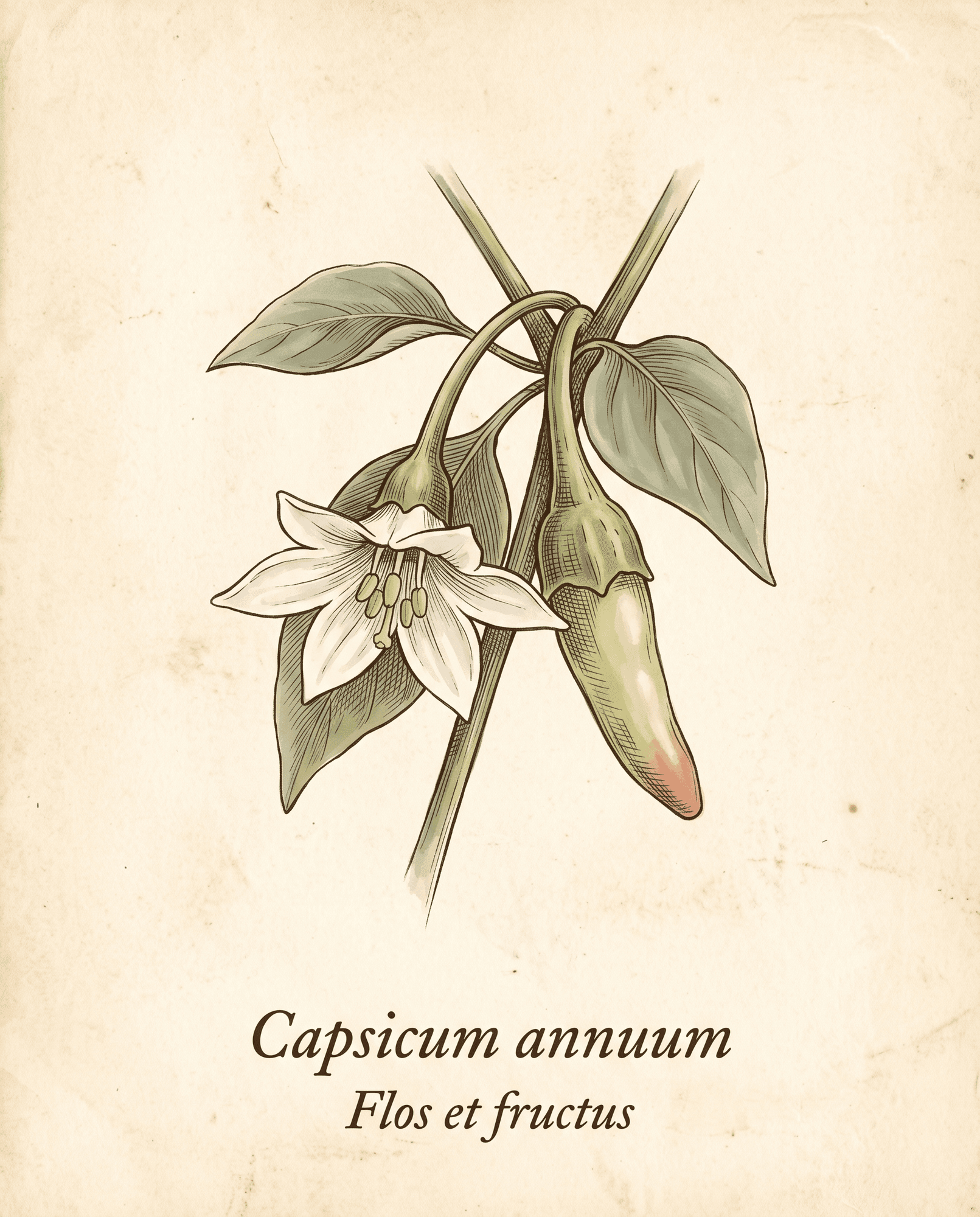
Plant walk: If you can, visit cayenne in a hot garden at the height of summer, when her long fruits are turning from green to red on the plant. Notice how modest the flower is — a small white star — and how the heat is not there at the beginning but builds slowly as the fruit ripens in the sun. Sit with the plant that gives the most warming medicine in the garden and see how quietly she begins.
Kitchen practice: Cayenne’s oldest ritual is the pot. Cook her into a mess of greens, a pot of beans, a stew — the ancestral medicine of turning heat and a humble ingredient into nourishment and warmth. As you add her, notice this is the same gesture your people have made for generations: a pinch of fire to make what is plain into what sustains.
Ritual of ignition: When something in your life has stalled — a project, a decision, a body grown too still — make a small cup of warm cayenne water. Hold it, feel its heat before you drink, and name what you are asking to move. Take it slowly. Let the warmth spreading out to your hands and feet be the felt sense of the stuck thing beginning to travel again.
Ritual of protection: Keep a small vessel of cayenne at a threshold, or work a pinch into a protective preparation. She repels by refusing stagnation — the same fire that moves the blood turns back what would settle where it is not wanted.
Journal prompts
- Where in my life has the fire banked too low — where have I grown cold, slow, or afraid to move?
- What am I holding so tightly that the pressure needs to be equalized, spread out, released?
- Where do I need to go first — to move before the others, to carry something forward?
- What is the difference, in my body, between warmth that comforts and heat that moves?
- What plain and humble thing in my life could be made nourishing with a little fire?
Tarot Spread
A spread for entering into relationship with Cayenne as a plant ally:
- Where in me has the circulation of vital force grown cold or slow?
- What is she asking me to move that has been stuck too long?
- Where do I need her courage — to go first, to advance rather than wait?
- What am I holding under too much pressure, that needs to be spread out and released?
- What does she want me to know about the fire I carry?
Keep a dried cayenne pepper or a vial of the tincture on your altar with the cards. Sit with the heat of the question before you turn each one.
The same plant, multiple lenses
In Ayurveda cayenne is known among the fiery peppers — sometimes called Marichaphalam or Raktamaricha, “the red pepper.” Her energetics are triple-fire: pungent in taste (katu rasa), heating in potency (ushna virya), and pungent again in post-digestive effect (katu vipaka). There is nothing cooling or mellow in her anywhere in the arc of digestion. She is one of the great kindlers of agni, the digestive fire, and a burner of ama, the undigested residue that clogs the channels.
Pitta Dosha — Fire & Water
This is where cayenne must be handled with the most care. She increases Pitta — she is pure heat, and in a Pitta-predominant person or during a Pitta-aggravated season she can drive inflammation, acid, skin heat, irritability, and burning digestion. For hot constitutions and inflammatory conditions she is generally to be avoided or used only in the smallest culinary trace. When the fire is already high, more fire is not medicine.
Kapha Dosha — Earth & Water
Kapha is cayenne’s natural home. Kapha’s cold, heavy, damp, sluggish, mucus-laden nature is exactly what her triple-pungent fire disperses. She stokes a slow metabolism, cuts through congestion and phlegm, clears the cold and damp that settle into Kapha tissues, and moves the heaviness that Kapha holds. For Kapha-dominant constitutions and cold, damp, stagnant conditions she is well-matched medicine — used, as always, with a light hand.
Vata Dosha — Air & Ether
Cayenne’s warmth reduces Vata’s cold, and this is genuine benefit — she brings heat to the cold hands and feet and the poor circulation of a Vata imbalance. But her dryness is a caution, because Vata is already dry, and her intensity can be too stimulating and scattering for Vata’s sensitive, easily-depleted nature. For Vata she is best held by moistening, grounding companions — sesame oil, ginger in a warm and unctuous base — so her heat comforts without further drying or dispersing an already airy constitution.
In TCM cayenne is known as La Jiao and is classified squarely among the warming, Yang-supporting foods and herbs.
Taste & Temperature: Pungent (acrid), hot. Channels Entered: Heart, Spleen, and Stomach (some sources add Lung). Functions: Tonifies and warms Yang. Dissipates Cold. Promotes the circulation of Qi and Blood. Warms the Middle and awakens the digestion. Expels Wind-Cold-Damp.
Warming Yang & Dispelling Cold
La Jiao’s core action is to warm the body and tonify Yang, especially the warmth of the Middle Jiao — the digestive center. She dissipates Cold stagnation: the cold abdominal pain, the diarrhea and vomiting that come from Cold in the digestion, the deep chill of frostbite and Cold lodged in the channels. Where the body has grown cold and the Yang fire has weakened, she rekindles it.
Moving Qi and Blood
Pungent and hot, La Jiao is expansive and dispersing — she stimulates the circulation of both Qi and Blood, opening the channels and clearing obstruction. She moves energy outward to the periphery and downward, which is the traditional understanding beneath her use for poor circulation and Cold, stuck conditions. This is the same diffusive, moving quality the Western tradition names.
Awakening the Middle & Digestion
She warms the Spleen and Stomach, stimulates the appetite, and promotes digestion — classic warming-carminative work for a cold, weak, sluggish digestive center. She is found in warming liniments (Cold-Damp Painful Obstruction, Bi syndrome) for the same reason she lives in Western pain oils: her heat opens the channels and moves what Cold has stopped.
Yin/Yang Balance
Cayenne is strongly Yang — warming, moving, dispersing, ascending and outward. She is medicine for Cold and Yang-deficient patterns: the cold body, the weak digestive fire, the stagnant Cold-Damp circulation. She is expressly not for Yin-deficient patterns with heat — the person with a red tongue, night sweats, flushing, or a dry burning constitution — nor for anyone with signs of internal Heat, cough from Heat, or eye disease, where her fire only makes the imbalance worse. In TCM as everywhere, she is fire, and fire is only medicine where there is Cold to meet.
For going deeper
- Wood, Matthew. The Earthwise Herbal, Volume II: A Complete Guide to New World Medicinal Plants. North Atlantic Books. (Capsicum as a New World plant and diffusive stimulant.)
- Christopher, John R. School of Natural Healing and Herbal Home Health Care. Christopher Publications. — for the foundational American folk teaching on cayenne for the heart, shock, and bleeding.
- Bensky, Dan, Clavey, Steven, & Stöger, Erich. Chinese Herbal Medicine: Materia Medica. Eastland Press. (For the warming, Yang-tonifying classification; see La Jiao.)
- Frawley, David & Lad, Vasant. The Yoga of Herbs: An Ayurvedic Guide to Herbal Medicine. Lotus Press.
- Andrews, Jean. Peppers: The Domesticated Capsicums. University of Texas Press. — for the deep history of Capsicum domestication and its global spread.
- Twitty, Michael W. The Cooking Gene. Amistad/HarperCollins. — on African American foodways, the pepper, and the memory carried in the kitchen garden.
- Colonial Williamsburg’s Sankofa Heritage Garden — a living reference for the plants the enslaved tended for themselves, including African bird pepper.
- Conversations with elders in African American, African, and Caribbean food traditions on pepper, pepper sauce, and the pot of greens. These are oral and place-based, and worth seeking out where you live.
The Conversation
Questions, noticings, what this is teaching you — leave them here. This same conversation lives in The Circle.