Garlic
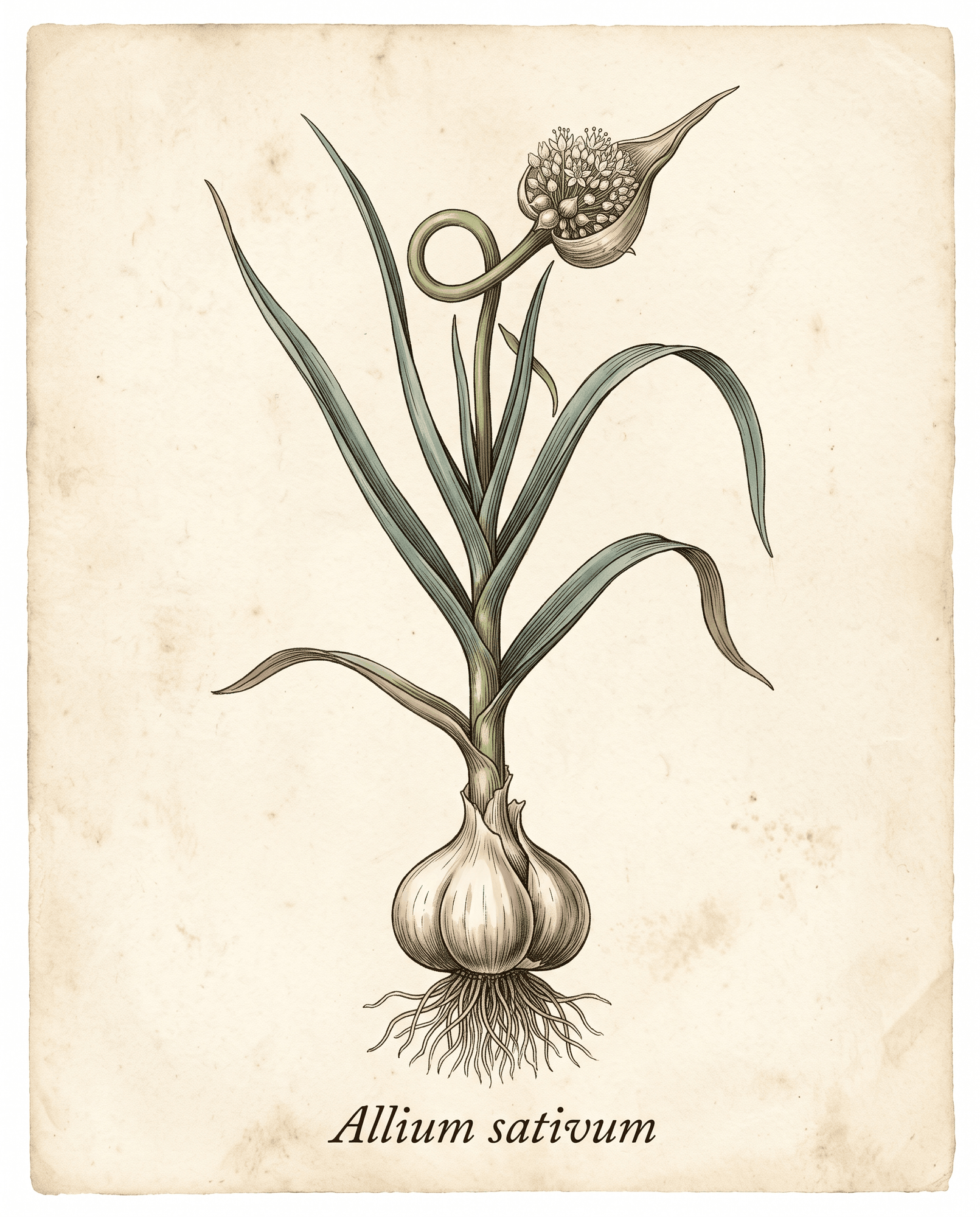
Garlic is the guardian at the gate. She has stood at the thresholds of human dwellings for as long as we have had thresholds — braided over the doorway, tucked under the pillow, buried at the crossroads, worn against the skin — and everywhere she has stood, she has done the same work: she keeps out what would do harm. What the old stories cast as vampires and the evil eye, the body knows as infection, contagion, and the slow corrosion of the blood. She is medicine for the boundary itself, the living edge where the body meets the world and decides what may cross.
This is fierce medicine, and unashamed of it. She is hot and moving where other herbs are cooling and building. She does not nourish the blood so much as defend it — thinning it where it has grown thick, driving it where it has grown slow, clearing the terrain of what should not be there.
Her defense is not a metaphor. Look at how she is built: a head divided into sealed compartments, each clove wrapped in its own papery skin, and every one of them capable of becoming a whole new plant on its own. If something gets into one chamber, the rest survive and the line continues — the same logic as a village that does not keep all its grain in one storehouse. That is protection and multiplication living in the same body. And when something does breach her, she answers chemically: the instant her tissue is torn, she converts what she has been holding in reserve into allicin, and allicin kills what is eating her. She keeps her weapon sheathed until the moment of attack.
What makes her medicine is that we receive the very defense she built for herself. Chew a clove and you trigger the same reaction the burrowing insect triggers; the compound she made to kill what was consuming her goes to work on what is consuming you. Her enemies and ours turn out to be the same kind of creature — the pest in the soil and the microbe in the blood — and she does not distinguish between them. This is her whole medicine in a single gesture. She has no separate gift for us. She simply defends herself, and we are permitted to stand inside that defense.
The shape of her medicine
Garlic’s medicine moves outward and through. She is hot, pungent, and dispersing — the taste alone opens the pores, quickens the pulse, and sends heat to the surface. Where a cooling herb draws stagnation down toward the exits, garlic drives it out through movement and sweat, breaking up what has settled and refusing it a place to rest. She is a plant of circulation in the fullest sense: she will not let things sit.
Her antimicrobial action is the oldest and most thoroughly documented of her gifts, and it is broad. She meets bacteria, viruses, molds, yeasts, fungi, and parasites down to the intestinal worms — the crushing of the clove releases allicin, and allicin and its sulfur descendants disrupt the machinery of the organisms they touch. This is why she has been the poor person’s medicine across every culture that grew her: a food that is also a defense, always at hand, needing no prescription. She is at her strongest here raw and freshly crushed; heat and time soften this particular edge even as they preserve others.
Her circulatory and blood-moving action is among her deepest gifts. She is a mild but real anticoagulant — her sulfur compounds inhibit the formation of thromboxane, the signal that tells platelets to clump, so the blood flows more freely and clots less readily. At the same time she works on the vessel and the pressure within it: her S-allyl cysteine supports nitric oxide, the body’s own signal for the vessel walls to soften and widen, and modulates the enzyme cascade that otherwise tightens them. The result is blood that moves more easily through vessels that hold it more gently — the twin gestures of hypotensive and blood-moving medicine working as one.
Her hypolipidemic thread runs alongside. Over the long term, taken as food and medicine rather than as a quick fix, she helps shift the balance of blood lipids and slows the oxidative damage that hardens the arteries. This is patient cardiovascular work — not a dramatic intervention but a steady tending of the terrain the blood runs through.
As a diaphoretic and expectorant, she turns her heat toward the lungs and the surface. In the first cold grip of a wind-cold illness she opens the pores, breaks a sweat, and pushes the invader back out through the skin; in a wet, stuck cough she thins and moves the congestion so it can be expelled. Her immunomodulant action underwrites all of this — she does not only kill what invades, she strengthens the body’s own capacity to meet it.
Her hypoglycemic and antioxidant actions round out the picture of a plant that works, quietly and cumulatively, on the whole metabolic terrain. Together her actions form a single gesture: driving out and guarding against. She is for the body that needs to move what has stalled and defend what is vulnerable.
What lives inside her
Whose medicine she carries
Earth (bulb)
Scorpio
Strength
The Chariot
Ogun
Ogun is iron. He is the warrior and the blacksmith, the one who carries the blade and clears the road, the force that meets obstruction with labor and will not be turned aside. Garlic is his in the blood most of all — for the blood is where iron lives in the body, and garlic is the herb that tends the blood as a warrior tends a weapon: keeping it moving, keeping it clean, keeping its edge. She thins what has thickened, drives what has slowed, and defends the whole moving river of it against what would foul it. Her heat is his forge-heat. Her refusal to let things settle is his refusal to let a road stay blocked.
There is iron, too, in how she is grown and gathered. She is broken to be used — the clove must be crushed before her medicine will rise, the way iron must be struck before it will take a shape. Ogun’s medicine is never passive; it asks for the labor of breaking and the willingness to be changed by force. Garlic carries that in her body. She does not offer her strength to anyone who will not first break her open.
And she is a fighter’s plant in the plainest sense. Roman soldiers ate her before battle; workers who raised the great stone monuments were fed her for strength; every army that ever marched carried her for endurance and defense. Ogun walks with everyone who labors and everyone who fights, and garlic is the food he feeds them — the strength that comes not from comfort but from heat, iron, and the refusal to fall.
Elegua
Elegua stands at the threshold. He is the one who opens and closes the road, who guards the doorway and the crossroads, who must be greeted first because nothing passes into the compound without passing him. Garlic is his fellow gatekeeper. Across the whole world and across thousands of years, she has been hung at the door, buried at the crossing, worn at the throat — placed at exactly the points Elegua governs, to do exactly his work: to decide what may enter and to turn back what may not.
This is her protective medicine in its oldest form. The evil eye, the malevolent spirit, the harm sent on purpose — these are the threats the braid over the doorway was meant to meet, and they are not so different from the threats the body meets at its own borders. Garlic guards both gates at once: the door of the house and the door of the body. Where Elegua opens the way for good fortune and closes it against harm, garlic is the plant left at his post, standing watch through the night.
Babalu Aye
Babalu Aye governs contagion — the epidemic, the fever, the infection that passes from body to body, the diseases that move through a people and mark the ones they touch. His is the medicine of the guarded and the vulnerable, of quarantine and immunity, of the body under siege by what it cannot see. Garlic belongs to him wherever infection is the enemy. Her broad antimicrobial reach — against the bacterium, the virus, the fungus, the parasite — is protection at exactly the register he rules.
She was the plague medicine of the poor. When the great sicknesses moved through and there was nothing else, there was garlic — worn, eaten, pressed to the skin, hung in the sickroom — and often enough it was not superstition but the real antimicrobial edge of the plant doing quiet work. Babalu Aye walks with the sick and the exposed, and garlic walks with him: the humble defense placed between a vulnerable body and the contagion at its door. She strengthens the boundary he is always tending — the gate of the immune system, the last wall between the body and what wants in.
The hands she has passed through
Garlic is among the oldest cultivated plants on earth, grown for some five thousand years, and everywhere she has been grown she has carried the same double life: food and defense, medicine and amulet, the thing you eat and the thing you hang at the door. She appears in Egyptian hieroglyphics and in cuneiform, in ancient Chinese, Greek, and Indian writings, in the Bible, the Talmud, and the Quran, and in the Yoruba traditions of West Africa. Few plants are attested across so many separate literatures. Wherever people were writing things down, garlic was already there.
In ancient Egypt, she was fed to the laborers who raised the great stone works, prized for the strength and endurance she gave. She was valuable enough to serve at times as currency, and valuable enough to strike over: the two worker revolts recorded in Egyptian hieroglyphics were both set off by garlic supplies running short after the Nile flooded. These are the earliest known documented worker revolts… recorded forever in hieroglyphics. Clay models of garlic bulbs were placed in tombs, and she was invoked in oath-taking — a plant serious enough to swear upon. She was, from the beginning, associated with vigor, protection, and the passage into whatever comes next.
The ancient Greeks left her at the crossroads as an offering to Hecate, goddess of the boundary between worlds, and wore her as a charm against the evil eye — sometimes in a small amulet of coal, salt, and garlic worn to keep a hostile gaze from landing. Roman soldiers ate her for strength and courage before battle, and Roman writers recorded her as a plant of Mars, the war-god — the same martial signature that runs through her medicine still.
Across the Mediterranean, the Balkans, and much of Europe, the braid of garlic hung over the door became one of the most enduring protective charms in the world. She warded the home against malevolent spirits, against the evil eye, against — in the later folklore that Hollywood made famous — the vampire, the undead thing that comes in the night to drink the blood of the living. It is worth sitting with that image: that the plant folk memory chose as the guardian against a blood-thief is the very plant that, in the body, guards and cleans the blood itself. The story knew something the microscope later confirmed.
There are darker and stranger threads in her lore. An Islamic tradition holds that garlic sprang up where Satan’s left foot fell as he left the garden, onion where his right foot fell — a story that marks her as powerful and a little dangerous, a plant of the threshold between good and ill. A Buddhist medical text held that the first garlic grew where a demon’s blood spilled to earth. Again and again the folk imagination ties her to blood, to boundaries, and to the forces that must be kept at bay.
Her pungency has always cut both ways. The same fierceness that made her medicine made her socially suspect, and across many cultures she was held unfit for the refined, the devoted, or the self-controlled. The priesthood of ancient Egypt abstained from her. In China, monks, widows, and adolescents were forbidden her on the grounds that she inflames the passions — a prohibition that reads as superstition until you have watched what she does to a hot temperament. The nobility and upper classes of Europe avoided her as coarse, and it was that European attitude, not the plant, that colonists carried to America.
So in the United States garlic became a marked food — the food of the commoner, and then the food of the immigrant. She was what Italians cooked with, what Caribbean kitchens ran on, what Asian food smelled of. To eat her openly was to be identifiably not of the ruling class, and the disdain aimed at the plant was rarely only about the plant. It was not until around the 1940s that she began to be rehabilitated in the American mainstream, spoken of publicly for her nutritive and medicinal value. The published histories rarely explain why the shift came when it did. The plainest explanation is that the country was becoming more integrated, and the foodways of the people who had always cooked with her were becoming everyone’s. Garlic did not change. The American table did.
She traveled everywhere, because she is easy to carry and easy to grow, and she was taken up everywhere she went. Across African, Caribbean, and African American folk medicine, she became a staple of both the kitchen and the healing tradition — eaten daily for the heart and the blood, pressed into service against colds and fevers and infections, worn or placed for protection against harm sent by others. In the hoodoo and rootwork traditions of the American South she is a plant of protection and cleansing, used to guard a home and drive out what should not be there. Everywhere the diaspora carried its foodways, garlic came too, holding its double role as flavor and defense.
The Eclectic physicians of nineteenth-century America used her for respiratory infections and to support the circulation, and she was carried through both World Wars as a wound antiseptic when other medicines ran short — “Russian penicillin,” the soldiers called her. Today she sits in nearly every kitchen and nearly every herbalist’s practice, still doing the oldest work: feeding the body, moving the blood, and standing at the gate.
Where she works in the body
Cardiovascular system. This is garlic’s heartland. She works on all three of the blood’s moving parts at once: she thins the blood itself, inhibiting the platelet aggregation that leads to clotting; she softens and widens the vessel, supporting the nitric oxide that relaxes arterial walls and modulating the enzyme cascade that would tighten them; and she tends the terrain over time, shifting blood lipids and slowing the oxidative hardening of the arteries. The result is a plant that lowers blood pressure, improves circulation, and reduces the long slow risk of atherosclerosis — not through one dramatic action but through steady, cumulative, food-level work. She is for the body whose blood has grown thick, sluggish, or pressured.
Immune system. Garlic is one of the great immune allies, and she works two ways. She meets pathogens directly — her sulfur compounds are broadly antimicrobial against bacteria, viruses, fungi, and parasites — and she strengthens the body’s own defensive capacity, modulating immune function so the body meets threats more competently. This is the medicine of the guarded gate: both the guard who turns the invader away and the strengthening of the wall itself. She is foundational for the body that catches everything, that cannot shake an infection, that needs its borders reinforced.
Part of how she supports that response is heat. Garlic warms and tonifies, and she helps the body raise and hold a fever — which is not a malfunction but the body’s own antimicrobial heat, working on the same principle by which we cook meat to make it safe. The reflex to suppress every fever works against the very response the body is mounting. The judgment call is the state of the person rather than the number: a fever that leaves someone lethargic or hard to rouse needs to come down, and once it has, the body may need help mounting it again to finish the fight. Garlic is one of the plants that helps it rise.
Worth teaching alongside her is the myth of the universally weak immune system. Most people are not immunocompromised — moving through a world dense with microbes and remaining upright is itself proof of a functioning defense. Some people do live with conditions that genuinely weaken immunity. Others have the opposite problem: allergy is an immune system overreacting, spending its attention on pollen and peanuts while real threats slip past. But for most people, a run of catching everything reflects circumstance rather than defect — poor sleep, poor food, unrelieved stress, a body trying to defend itself with its hands tied behind its back.
She has also been shown to stimulate the immune cells involved in recognizing and clearing abnormal cells. This is the accurate and limited version of a claim that gets badly overstated: garlic is not a cancer cure, but she helps the body to mount its own self defense. Abnormal cells arise in all of us continually and are ordinarily identified and cleared; disease begins where that surveillance fails.
Respiratory system. Her heat and her antimicrobial reach make her a strong ally for the lungs and airways. In the first cold stage of a wind-cold illness she is diaphoretic — she opens the pores and breaks a sweat to drive the invader back out. In a wet, congested cough she is expectorant, thinning and moving the phlegm so it can be cleared. For chronic and recurrent respiratory infection she brings her antimicrobial edge to bear directly on the tissue.
The lungs are also her favored road out. Whatever enters the body must eventually leave it, and garlic prefers to leave through the breath — which is precisely why garlic breath is so persistent, and why it is often stronger the morning after than the evening of. She has been working her way out through the lungs all night. The traditional demonstration of this is done at the foot: rub a cut clove on the sole, and in time she can be tasted on the breath. She will cross the whole body to reach the lungs, and she cleans as she travels. For the respiratory system this is a gift rather than an accident — the medicine arrives at that tissue by preference, no matter where it went in.
Digestive system. Garlic warms and stimulates digestion, and she is famously antimicrobial in the gut — traditionally reached for against intestinal parasites and dysentery, and increasingly understood as a prebiotic that feeds beneficial gut flora through her inulin content. Her warmth suits a cold, sluggish, or damp digestion. The caution is the mirror image: raw and in quantity she can irritate an already hot or inflamed gut, and she is hard on an empty or refluxing stomach.
Metabolic system. Through her effect on blood lipids, her mild blood-sugar-lowering action, and her broad antioxidant activity, garlic supports the deep metabolic terrain — the slow-moving background conditions of lipids, glucose, and oxidative stress out of which so much cardiovascular disease grows. This is long-game medicine, the kind that works as a daily food across years rather than as an acute intervention.
How to take her
Harvest calendar
Preparations
Fresh raw clove: The strongest antimicrobial form. Crush or chop and let rest 10 minutes before eating — this allows alliin and alliinase to meet and form allicin before the clove is swallowed or cooked. One to several cloves daily. Take with food to buffer the stomach.
In food: The foundational daily medicine, and the best way to take her. Added at the end of cooking preserves more of the volatile compounds than long cooking does. This is the form that carries the cardiovascular and metabolic benefits over the long term, and the form most bodies tolerate easily. Cook what you already like and use more of her than you think you need — sauteed with mushrooms over rice and beans, roasted alongside brussels sprouts until she turns sweet, in shrimp with chili and lime.
Matching the preparation to the destination: Where you need her to arrive should shape how you take her. For the mouth itself — sores, inflamed gums, sore throat — a tincture or glycerite applied topically puts her directly on the tissue. For the stomach and upper intestine, a tea delivers her where she is wanted. For the lower intestine, a gel capsule carries her through the upper tract intact, so that by the time it dissolves she is where the trouble is. Same plant, three different roads.
Fire cider, pickles, and dressings: She takes readily to vinegar. Fire cider (garlic with horseradish, ginger, onion, and hot pepper in vinegar) is a classic winter preparation; pickled cloves are milder and easy to eat daily; a raw clove crushed into a vinaigrette is medicine hiding in a salad.
Honey-fermented garlic: Whole peeled cloves submerged in raw honey, left to ferment for several weeks. The honey draws out and holds her medicine in a form that is gentler on the stomach and easy to take by the spoonful through cold season.
Garlic-infused oil and salve (fresh use only): Cloves infused briefly in warm oil for topical use on the chest, or for the ears in the folk tradition. Thickened with beeswax into a salve, the oil and wax buffer her heat so she can be applied to skin without burning it — the safer way to use her topically. Note the safety point below — oil-infused raw garlic is not shelf-stable and must be refrigerated and used within a few days.
Oxymel: Garlic (often with other pungent and aromatic herbs) infused in honey and vinegar — a traditional preparation for the respiratory and circulatory systems, and an easy daily tonic through winter.
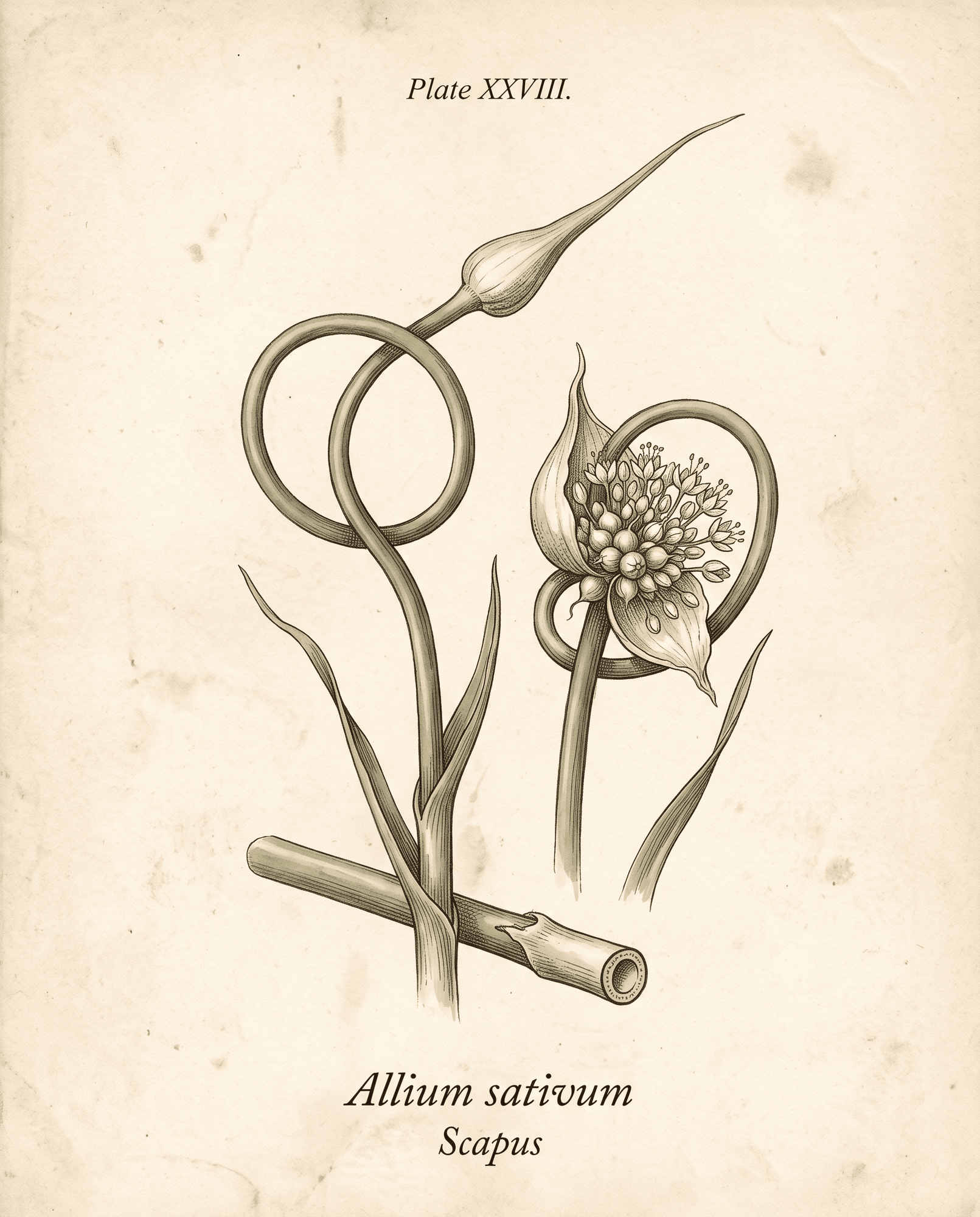
Scapes: The curled green flowering stems, cut in early summer, are milder and can be eaten as food — a gentler seasonal garlic for those who find the clove too fierce.
Spiritual & ritual:
- Braided and hung over the doorway to guard the home
- Cloves buried at the boundary of a property or placed at the crossroads for protection
- Worn on the body for warding when walking into difficult or hostile situations
- Placed on altars dedicated to Ogun, Elegua, or Babalu Aye for protection and strength
- Rubbed on the threshold or burned with other cleansing herbs to drive out what should not be in a space
When to hold back
Use with caution if:
- You take anticoagulant or antiplatelet medication (warfarin, aspirin, clopidogrel, and others). Garlic’s blood-moving action is additive and can increase bleeding risk. Her power to thin the blood is real, which is exactly why it must be respected.
- You are approaching surgery. Stop medicinal doses of garlic one to two weeks before any surgical procedure because of the bleeding risk.
- You take blood-pressure or blood-sugar-lowering medication. Her effects are additive; monitor for readings that drop too low.
- You have a hot, inflamed, or ulcerated digestive tract — reflux, gastritis, ulcers, IBD in flare. Raw garlic especially can aggravate an already hot gut.
- You are breastfeeding and the infant is unsettled by it — garlic passes into breast milk and changes its flavor, which some infants dislike (though it has also long been used to support milk supply).
Topical considerations: A raw crushed clove left in prolonged contact with the skin can cause a chemical burn. Do not leave raw garlic taped to the skin, and dilute well in any topical preparation. If you must apply her directly in an emergency, keep it brief and take pain seriously as the signal to stop — an oil infusion or salve is the better vehicle in nearly every case.
General notes: Very safe as food across the lifespan. In Ayurvedic terms she is heating and strongly aggravating to Pitta — the hot, inflammatory constitution — and should be used sparingly or with cooling companions by those who run hot. Large raw doses can cause digestive upset, heartburn, and body odor. She is a specific and a food, best worked with steadily rather than in heroic single doses.
She also heats more than the tissue. The old prohibitions that named her a plant which inflames the passions are worth taking at face value: in someone already hot-tempered or easily inflamed, she can raise the temperature of the emotions along with the body. Knowing your own constitution matters more with garlic than with almost any other plant in the kitchen.
Who walks with her
For the blood and the heart: Hibiscus, hawthorn, ginger, turmeric. Hibiscus cools and softens the vessel where garlic heats and moves the blood within it — the two together hold a warming/cooling axis across the whole cardiovascular system. Hawthorn tends the heart’s own structure and rhythm while garlic tends the blood it pumps.
For infection and immunity: Thyme, ginger, elderberry, echinacea, honey. Thyme and garlic together are a potent respiratory antimicrobial pair; ginger adds warmth and circulation; elderberry and echinacea bring their own immune support to the defense.
For circulation and warmth: Ginger, cayenne, rosemary, cinnamon. The warming, blood-moving herbs are a family, and garlic sits comfortably among them for cold, stagnant, sluggish patterns.
For the digestion and the gut terrain: Ginger, fennel, thyme. These temper garlic’s fierceness and add their own carminative warmth for a cold, damp, or parasite-burdened gut.
These allies share garlic’s willingness to move and to guard. The warming circulatory herbs amplify her heat; the antimicrobial herbs join her at the gate; cooling, structuring heart herbs balance her fire. Garlic is a strong personality in any formula — she leads easily and can overwhelm — so her best company is either herbs that match her intensity or herbs that consciously soften and direct it.
How to know her
Plant walk: If you grow her, visit the bed in early summer when the scapes have curled. Cut one and smell the broken end — the whole medicine of the plant is in that green pungency, rising the instant she is wounded. Sit with what it means that she gives nothing until she is broken, and that the breaking is not damage but release.
Ritual of protection at the threshold: Braid or tie garlic and hang it over the door of your home, at the point where inside meets outside. As you place her, name what you are asking her to keep out and what you are asking her to keep safe. Leave her at her post. Replace her when the season turns.
Ritual of cleansing a space: When a room or a home feels heavy with what should not be there, crush a clove and carry its scent through the space, or add garlic to a wash for the floors and the threshold. Move from the back of the house toward the front door, asking what does not belong to leave the way it came.
Ritual before hard work: Before walking into something difficult — a confrontation, a labor, a fight you did not choose — take a little garlic as food and ask her for her iron. She is the strength that Ogun feeds to everyone who has to do the hard thing anyway.
Journal prompts
- Where in my life am I being asked to guard a boundary — and am I guarding it, or leaving the gate open?
- What in me only releases its medicine when I am broken open? What have I been unwilling to let be broken?
- Where is my blood — my vitality, my anger, my life-force — thick and stalled, and what would it mean to let it move?
- What am I keeping out that I should let in? What am I letting in that I should keep out?
- What strength do I carry that comes not from comfort but from heat and iron?
Tarot Spread
A spread for entering into relationship with Garlic as a plant ally:
- What gate am I standing at right now?
- What is she teaching me about protecting it?
- What in me needs to be broken open to release its medicine?
- What is she asking me to drive out?
- What strength is she offering me for the work ahead?
Keep a clove or a braid of garlic on your altar with the cards. Sit with the pungency of her until the answers sharpen.
The same plant, multiple lenses
Garlic — Lashuna or Rasona — holds an unusual place in Ayurveda. She is described as possessing five of the six tastes (all but sour), and as heavy, unctuous, penetrating, and mobile in quality, with a hot potency (ushna virya) and a pungent post-digestive effect (katu vipaka). She is also named a rasayana — a rejuvenative — and specifically a heart tonic (hridya). This is a plant of considerable power in the tradition, treated with both respect and caution.
Pitta Dosha — Fire & Water
This is where garlic must be handled with care. Her intense heat strongly aggravates Pitta — the fiery, inflammatory constitution. For those who run hot, who are prone to inflammation, acid, irritability, and heat in the blood, raw garlic in quantity will worsen the pattern. When a Pitta-dominant person needs her cardiovascular or antimicrobial medicine, she is best used cooked, in small amounts, and buffered with cooling companions.
Kapha Dosha — Earth & Water
Garlic is excellent medicine for Kapha imbalance. Kapha is cold, heavy, damp, and stagnant — exactly the terrain garlic’s hot, penetrating, mobile nature is built to move. For the Kapha patterns of sluggish circulation, high cholesterol, damp congestion in the lungs, slow digestion, and metabolic heaviness, she is deeply appropriate. Her pungency cuts the damp; her heat moves the cold; her mobility breaks the stagnation.
Vata Dosha — Air & Ether
Garlic is one of the rare pungent herbs that also pacifies Vata, and this is what makes her unusual. Most pungent, heating herbs aggravate Vata’s dryness and coldness, but garlic’s unctuous, heavy, grounding quality — her oiliness — offsets that, so the classical texts name her Vata-pacifying. For the cold, dry, depleted, anxious Vata constitution she can be genuinely nourishing and grounding, especially cooked in oil or ghee, which amplifies her unctuous side. It is chiefly Pitta, not Vata, that she troubles.
In TCM, garlic is known as da suan, and she is a warming, dispersing, yang-natured herb.
Taste & Temperature: Acrid (pungent), warm. Channels Entered: Spleen, Stomach, Lung, and Large Intestine. Functions: Warms and moves; resolves toxicity and reduces swelling; kills parasites; warms the Spleen and Stomach; disperses cold and supports the Lung’s defensive function.
Resolving Toxicity & Reducing Swelling
Da suan is used both internally and externally to clear toxic accumulation — applied to abscesses, boils, and swellings, and taken for toxic and infectious conditions. Her broad antimicrobial action is understood here as the clearing of toxicity, and she is often paired with cold, bitter herbs when the toxicity is hot, so her warm dispersal and their cold drainage work together.
Killing Parasites
She is a classical herb for intestinal parasites — hookworm, pinworm, and others — used internally and, in tradition, externally. This is one of her oldest and most reliable applications in the tradition.
Warming the Middle & Dispersing Cold
As a warm, pungent substance entering the Spleen and Stomach, da suan warms a digestion that has been invaded by cold — the cold-type abdominal pain that eases with warmth, the poor appetite, the watery diarrhea. She is one of the kitchen herbs classically eaten in cold weather and with cold or raw foods precisely to warm the middle burner.
Supporting Lung Defense
Entering the Lung channel with her warm, dispersing nature, she helps open the pores and support the body’s surface defenses (wei qi) against wind-cold invasion — the reason she has been eaten through winter across so many traditions to prevent seasonal illness.
Yin/Yang Balance
Garlic is strongly Yang in nature — warming, moving, dispersing, and dry. She is medicine for cold, damp, stagnant, and excess-toxic patterns, and she is not appropriate for Yin-deficient or heat patterns — the person with signs of internal heat, red eyes, dry mouth, night sweats, or a red tongue with little coat. For such patterns she adds fire to fire. As with the Ayurvedic reading, the caution is consistent across traditions: garlic is heat, and heat is wrong medicine for a body already too hot.
For going deeper
- Wood, Matthew. The Earthwise Herbal: A Complete Guide to Old World Medicinal Plants. North Atlantic Books.
- Bensky, Dan, Clavey, Steven, & Stöger, Erich. Chinese Herbal Medicine: Materia Medica (3rd edition). Eastland Press. (See entry on da suan.)
- Frawley, David & Lad, Vasant. The Yoga of Herbs: An Ayurvedic Guide to Herbal Medicine. Lotus Press.
- Fulder, Stephen. The Garlic Book: Nature’s Powerful Healer. Avery.
- Felter, Harvey Wickes & Lloyd, John Uri. King’s American Dispensatory (1898) — for Eclectic-era clinical use, available through Henriette’s Herbal.
- Chevallier, Andrew. Encyclopedia of Herbal Medicine. DK.
- Oral traditions of hoodoo and rootwork on garlic as a plant of protection and cleansing — place-based and lineage-held, worth seeking from practitioners where you are.
The Conversation
Questions, noticings, what this is teaching you — leave them here. This same conversation lives in The Circle.