Lemon
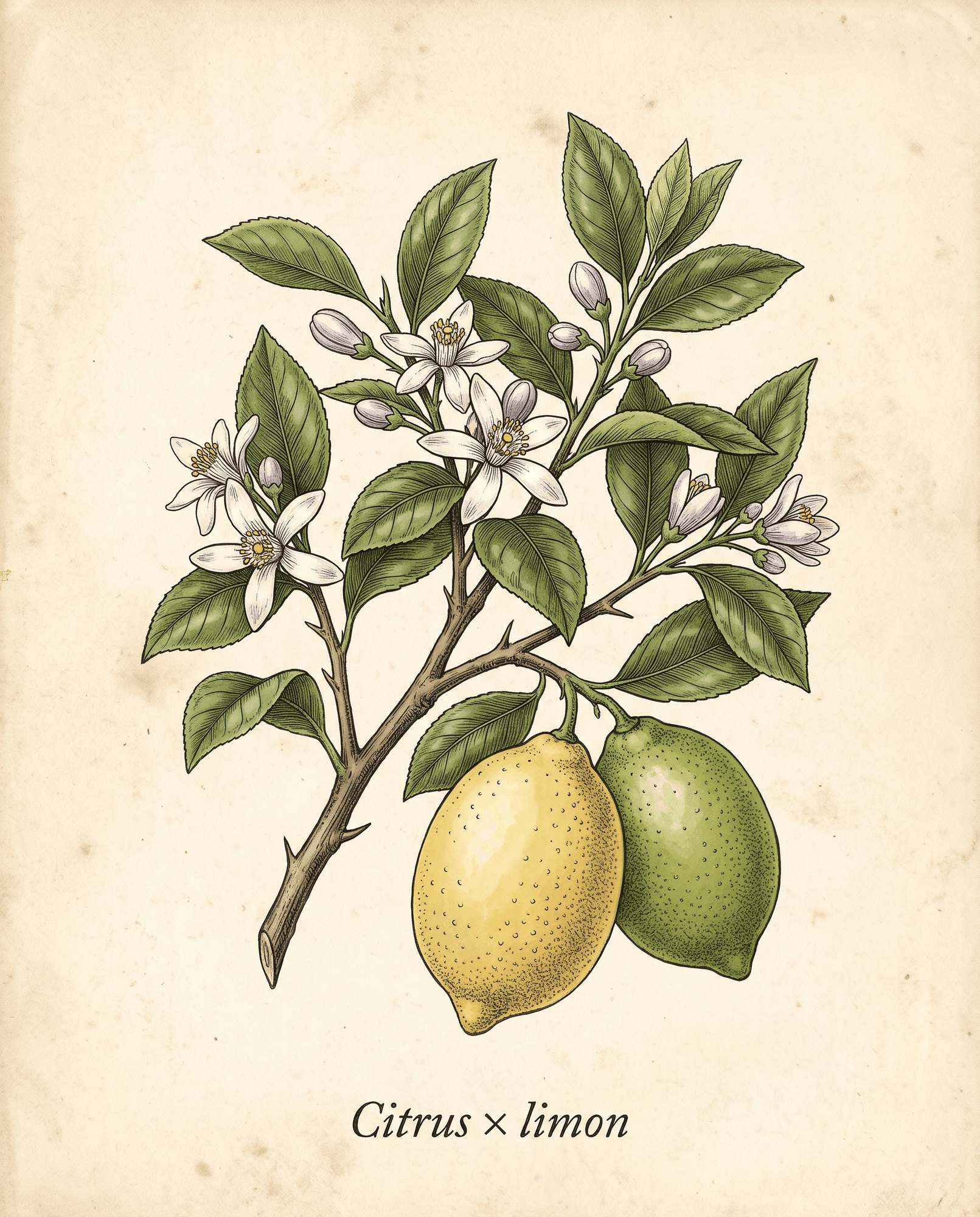
Lemon is the clearing that comes without a fight. She is bright, sour, and sharp enough to make the whole mouth wake, and yet her medicine is a cool one: she settles fever, quiets nausea, slakes a thirst that water alone cannot reach, and cuts through what has grown thick and stuck, whether that is mucus in the throat, grease on the stove, or heaviness in a room after a hard conversation. She does her work by making things clean, not by making them hurt.
She has no wild home. She was born in the gardens of the Himalayan foothills, a child of the citron and the sour orange, and she has traveled ever since in human hands — across the Indian Ocean, through Persia and Arabia, into Egyptian kitchens and Andalusian orchards, onto the ships that crossed the Atlantic, and into every Caribbean yard and Southern kitchen where a squeeze of sour still means medicine. She is so common now that she is easy to overlook. She is in the glass of warm water at dawn, the cup of honey and hot lemon for a sore throat, the wash bucket on the floor. She has always been there, doing quiet and essential work.
The shape of her medicine
Lemon moves downward and inward. The sour taste gathers and draws in, closing what has gone loose and settling what has risen. She cools heat that has climbed to the head and the stomach, the flushed face of fever, the burning thirst of summer, and the queasy rising of nausea. She dries damp, cutting through catarrh, sluggish digestion, and the thick, heavy feeling that comes after rich food.
The traditions do not fully agree on her temperature, and the disagreement teaches something. Her juice is cooling to the body in Chinese dietary practice, in Arabic humoral medicine, and across Caribbean hot-and-cold medicine. Ayurveda mostly reads her as heating in potency, because the sour taste kindles digestive fire. Some classical readings call her the exception: sour in taste but cool in effect. Both are true in practice. She sparks the digestive fire at the start of a meal, then leaves the body cooler and clearer than she found it. Her peel is a different matter. The oils of the rind are warming and aromatic, and the physicians who wrote about her long ago noted that juice pressed with the peel is less cold than juice from a peeled fruit.
As a febrifuge, she helps the body through fever without fighting it. Lemon water, lemon baths, and hot lemon with honey have been given in fevers across the world. They cool, keep the body drinking, and replace what is lost.
As an anti-emetic, she settles the rising stomach. Her scent alone can quiet nausea, and a slice held to the nose or a sip of diluted juice is one of the oldest remedies for travel sickness and the queasy mornings of early pregnancy.
As an anti-lithic, she is one of the few kitchen remedies with the urologist’s attention. Her juice is richer in citric acid than any other citrus. Once absorbed it leaves through the kidneys as citrate, which binds calcium and keeps it from crystallizing into stones.
Her antimicrobial action lives in two places: the low pH of the juice, which few microbes tolerate, and the citral and limonene in the oil of the rind. This is why she has long been the wash for cutting boards, the rinse for a sore throat, and the cleaner for wounds when nothing else was at hand.
As an antioxidant, she carries vitamin C in the juice and a richer store of flavonoids in the white pith most people throw away. Hesperidin, eriocitrin, and diosmin protect tissue and strengthen the small vessels.
As an anti-catarrhal, she thins and cuts mucus. Hot lemon and honey loosens a congested throat and chest. In the Chinese reading she transforms phlegm and quiets cough.
Her astringent quality is the sour pucker, a tightening of tissue that has gone lax. It shows most clearly in the gums: spongy, bleeding gums were the first sign of scurvy, and her juice firms them again.
As an aromatic and carminative, the oil of her rind relaxes the gut, moves gas, and lifts the mood with its bright scent. As a bitter, the pith and peel stimulate digestion by reflex from the tongue. The old pharmacies kept tincture of lemon peel to strengthen bitter stomach formulas.
As a sialogogue, she makes the mouth water at the thought of her. Saliva is the first step of digestion, and as a stomatic she carries that waking-up all the way into the stomach: appetite returns, heaviness lifts, and food begins to move.
And she is nutritive in the oldest sense: a source of the vitamin the body cannot make for itself, whose absence once killed more sailors than battle did.
Together her actions make one gesture: making clean. She cuts through, cools down, and leaves things clear.
What lives inside her
Whose medicine she carries
Air (scent and peel oil)
The Star
Ace of Swords
Obatala
Obatala wears white. He is the cool head, the clear mind, the one who settles disputes and keeps peace, the shaper of the human body and the keeper of the ori, the head where a person’s destiny sits. His medicine is coolness, purity, patience, and clarity. He does not tolerate filth, and he does not answer heat with more heat. He is the cloth laid over a fever and the calm voice that brings a quarrel to an end.
Lemon carries this medicine. Before she is ever sour, she is white: a waxy, fragrant blossom, a pale inner flesh, a pith the color of cloth. In the body she cools what has climbed to the head — the fever, the flush, the pounding headache of summer heat, the nausea that rises toward the mouth. She clears the mind the way she clears a room: a slice of her in a bowl of water, a wash across the threshold, a few drops on the hands, and the air feels sharper and quieter at once.
Her cleansing is Obatala’s kind of cleansing. She does not scour or tear down. She cuts through what clings — residue, grease, old energy, ties that have soured — and leaves what is underneath intact and clean. In the floor wash, in the spiritual bath, in the limpia, she is the clarifier, the one that makes a place or a person fit again to receive what is good.
There is an edge in her, and that edge belongs to her medicine too. Obatala is gentle, not soft; his peace has a spine. Lemon’s sourness is the same: a clear, honest no that does not need to raise its voice. Working with her in his name is a practice of keeping the head cool, the hands clean, and the boundaries clear without hardening the heart.
The hands she has passed through
Lemon’s story begins in the foothills of the eastern Himalayas, where the ancestors of all citrus first grew: northeast India, northern Myanmar, and southwest China. She is not a wild plant. Genetic work has shown she is a cross between the citron and the sour orange, and the sour orange is itself a cross of pomelo and mandarin. She was made in cultivation, in the gardens of the people of that region, long before anyone wrote her down. In India she became nimbu and nimbuka in the kitchen and the medicine chest, valued as an appetizer, a digestive, and a key ingredient in pickles. A string of lemon and green chilies still hangs over doorways and shop fronts there, said in folk tradition to keep away Alakshmi, the bringer of misfortune, who cannot abide the sour and the hot.
Her name traveled west with her. Sanskrit nimbuka became Persian līmūn, Arabic laymūn, then Italian limone, Old French limon, and the English lemon. It was Arab and Persian agriculturalists who carried her across the medieval world. She appears in a tenth-century Arabic treatise on farming, grew as an ornamental in early Islamic gardens, and spread through the Arab world and the Mediterranean between roughly 1000 and 1150, reaching Egypt, North Africa, Sicily, and Andalusia.
In twelfth-century Egypt, Ibn Jumayʿ, a Jewish physician at the court of Saladin, wrote an entire treatise on the benefits of the lemon. He described her juice as cold and dry. He explained that Egyptians preferred lemon to vinegar because she was gentler on their stomachs and intestines. He also recorded recipes: a simple lemon drink sweetened with sugar, a lemon stew called laymūniyya for people of hot temperament, and salted lemons, a cousin of the preserved lemons still made in North African kitchens. His recipes were translated into Latin, circulated in Europe for centuries, and still turn up in recipe books.
In China, lemon came into the materia medica late. She is first recorded in the eighteenth-century Bencao Gangmu Shiyi, which notes that pickled lemon brings the qi down and harmonizes the stomach. Because she eased the nausea of early pregnancy and was believed to steady the pregnancy itself, she earned the name yi mu guo, “the fruit good for mothers.”
Lemon crossed the Atlantic in 1493, when Columbus carried seeds to Hispaniola, and Spanish colonization spread her through the Caribbean and the Americas. In the Caribbean, lemon and lime share a vocabulary and a medicine chest; in many islands “lime” covers both, and the fruit that does lemon’s work in a household is often a lime. Lime leaves and fever grass boiled with honey and ginger for a child’s cold, lime squeezed into bush tea, and citrus rubbed on the skin or added to a bath for fever all belong to the same family of practice. Among the Maroon communities of Jamaica, remedies passed down include lemon juice drunk in water for colds and fevers, gargled with honey or salt for sore throats, and lemon baths for a fever that will not break.
In the American South, lemon became one of the standard cleansing and uncrossing materials of hoodoo. Lemon floor washes and lemon baths remove crossed conditions and stagnant energy, clear a house after illness or conflict, and prepare a space or a person for new work. In Mexican and Mexican American curanderismo, lemon appears alongside the egg in the limpia, the spiritual and physical cleansing used for mal de ojo, the evil eye. Across the Mediterranean, a lemon stuck with pins was a tool of folk image magic, and a lemon left in a room was said to absorb what was ill-wishing.
Her most famous moment in Western medicine came at sea. On long voyages, scurvy, the disease of vitamin C deficiency that rots gums, opens old wounds, and fills the limbs with bruises, killed sailors by the thousands. Sailors and physicians had known for generations that citrus helped, but in 1747 the Scottish naval surgeon James Lind compared remedies side by side aboard HMS Salisbury, and the sailors given oranges and lemons recovered far faster than the rest. It is often called one of the first controlled clinical trials. The Royal Navy did not act on it for nearly fifty years. In 1795 it finally made a daily ration of lemon juice compulsory, and scurvy all but disappeared from the fleet. A lemon tree now sits on the crest of the Royal Navy’s Institute of Naval Medicine.
She has been a fruit for kings and a fruit for sailors, an offering, an ink, a wash, a pickle, and a cure. Through all of it she has remained what she was in the first gardens: the sour that makes things clean.
Where she works in the body
Digestive system. This is where her medicine starts. The sour taste triggers saliva and gastric secretions before she reaches the stomach, and the warm water and lemon taken at dawn is a cup that wakes the whole digestive tract for the day. She settles nausea — from motion, from pregnancy, from overindulgence — and eases the heavy, greasy feeling after rich food. The oils of the rind are carminative, and the bitter peel and pith strengthen a weak appetite. Her pectin is gentle on the gut. For digestion that is sluggish, damp, or nauseated she is a daily ally. For digestion that is already hot, raw, and acid-burned she can be too much (see Contraindications).
Urinary system. Lemon juice holds more citric acid than any other citrus, and the body excretes it as citrate, which binds calcium in the urine and keeps it from crystallizing. For people who form calcium stones and run low in urinary citrate, a daily lemon drink — the juice of a few lemons diluted across the day’s water — is a practice taken seriously by urologists as well as herbalists. She also keeps people drinking, and plenty of fluid is the foundation of all stone prevention.
Immune system. Vitamin C is used heavily by the immune system, and lemon has been the first remedy reached for at the start of a cold in kitchens across the world: hot water, lemon, honey, often ginger. Her antimicrobial acids and oils, her cooling of fever, and her steady supply of fluid make her a companion through infections rather than a cure for them. She supports the body while it does its own work.
Respiratory system. She cuts and thins mucus, eases a sore throat, and helps loosen congestion in the chest. A gargle of warm water, lemon, and salt or honey cleans and soothes a raw throat. Hot lemon steam opens the sinuses. In the Chinese reading, she moistens a dry, irritated throat by generating fluids, even as she transforms phlegm.
Cardiovascular system. Her gift here lives mostly in the white pith and the peel. Hesperidin, eriocitrin, and diosmin support the integrity of capillaries and veins, and vitamin C is essential to the collagen that builds every vessel wall. The bleeding gums and spontaneous bruising of scurvy were, at root, vessels coming apart. Eating the whole fruit, or adding the pith and peel to preparations, gives the vessels the most of her.
How to take her
Harvest calendar
Preparations
Morning lemon water: The juice of half a lemon in 8–12 oz of warm (not boiling) water, taken on waking before food. A gentle daily digestive and hydration practice. Drink it promptly and rinse the mouth with plain water afterward to protect the teeth.
Hot lemon and honey: The juice of half to one lemon in a cup of hot water, with raw honey stirred in once the water has cooled to drinkable. Fresh grated ginger is a classic addition. Take 2–4 cups a day at the first sign of a cold or sore throat.
Lemonade for stones: About 4 oz of fresh lemon juice (roughly 3–4 lemons) diluted into 2 liters of water and sipped throughout the day. Sweeten lightly or not at all. A steady practice for people prone to calcium stones.
Gargle: The juice of half a lemon in a half cup of warm water, with a pinch of salt or a spoonful of honey. Gargle several times a day for a sore throat.
Peel infusion: 1 teaspoon dried lemon peel (yellow rind only) per cup of just-boiled water, covered, steeped 10 minutes. A bitter-aromatic tea before meals for weak appetite and gas.
Tincture, peel: Fresh 1:2 in 95% alcohol, using the thinly shaved yellow rind only, or dry 1:5 in 60% alcohol. Typical dose 1–2 mL before meals, or a few drops to brighten and strengthen bitter digestive formulas.
Leaf and blossom tea: A small handful of fresh lemon leaves or a few blossoms steeped in hot water for 5–10 minutes. Softer and more floral than the fruit, calming to the nerves and the stomach.
Oleo saccharum / lemon syrup: Rub peeled yellow rind into sugar and let it sit until the oils draw out into a fragrant syrup, then add juice. A way to keep her through the year, and an old base for cough syrups and cordials.
Salted / preserved lemons: Quarter lemons, pack with salt, and cover with juice. Ready in about a month. A digestive condiment in the line of Ibn Jumayʿ’s salted lemons and the preserved lemons of North African kitchens.
Bath: Slice two or three lemons into a warm bath, or add a strong infusion of lemon leaves. Cooling in fever and summer heat, and cleansing to the spirit.
Topical: Diluted juice dabbed on oily skin as an astringent, or on insect bites. Always at night or on skin that will stay covered, never before sun exposure.
Essential oil: Diffused for clarity and mood, or diluted to 1% or less in a carrier oil. Cold-pressed lemon oil is phototoxic on the skin, so keep it off sun-exposed areas for at least 12 hours after use.
Spiritual & ritual:
- Floor wash of lemon juice or slices in water, worked from the back of the house toward the front door, to clear a home after illness, conflict, or a hard season
- Cleansing bath of sliced lemon, with or without hyssop or basil, to uncross and refresh
- A cut lemon or a bowl of lemon water left in a room to draw in heaviness, then discarded outside the home
- White blossoms or a whole lemon on a white cloth for offerings of peace, clarity, and a cool head
- Lemon water to cleanse ritual tools, altars, and the hands before spiritual work
When to hold back
Use with caution if:
- You have reflux, gastritis, or an active ulcer. Her acidity can aggravate a stomach lining that is already inflamed. Diluting her, taking her with food, or using the peel instead of the juice is often better tolerated, and some people need to set her aside while they heal.
- You are prone to canker sores or a raw, sensitive mouth. Acid stings broken tissue.
- You have fragile tooth enamel. Frequent sipping of undiluted or strong lemon water erodes enamel over time. Dilute well, drink promptly rather than sipping all day, rinse with plain water afterward, and wait before brushing.
- You have a known citrus allergy. Rare, but real.
Topical considerations:
- Phytophotodermatitis. Lemon juice or peel oil left on skin that then meets strong sunlight can cause burns, blisters, and dark patches that last for months. Keep her off skin that will be in the sun.
- Undiluted essential oil is irritating to skin and mucous membranes. Always dilute.
- Juice stings broken skin and should not be used on open wounds unless nothing else is available.
General notes: Lemon is one of the safest medicines there is, eaten daily by much of the world across the lifespan, including in pregnancy. Ripe fruit, peel, leaf, and blossom are all gentle. Most problems come from too much juice too strong too often, or from juice and oil on skin in the sun.
Who walks with her
For colds and sore throat: Ginger, honey, elderberry, thyme, sage, garlic.
For fever and summer heat: Lemongrass (fever grass), hibiscus, lemon balm, peppermint, elderflower.
For nausea and digestion: Ginger, fennel, spearmint, cardamom, orange peel.
For kidney health and stone prevention: Nettle leaf, corn silk, marshmallow root, plenty of water.
For vessel strength: Hawthorn, rose hips, bilberry, buckwheat.
For spiritual cleansing: Hyssop, basil, rue, rosemary, white flowers, salt.
Lemon is a catalyst more often than a centerpiece. She brightens and sharpens what she is mixed with, and she draws out the best in warmer, sweeter allies. Ginger brings the heat she lacks and the movement she encourages. Honey softens her edge and protects the throat she is cleansing. With fever grass and hibiscus she makes the classic cooling drinks of hot countries, and with hyssop and basil she makes the classic cleansing baths. Alone she is sharp. In good company she is bright.
How to know her
Plant walk: Find a lemon tree, in a yard, an orchard, or a pot by a sunny window. Look for her flowers, her small green fruit, and her ripe yellow fruit all on one branch. Notice the thorns among the glossy leaves. Crush a leaf and breathe. Ask her what is ripening in you, what is still green, and what is only just beginning to bloom.
Seasonal practice: In the depth of winter, when lemons are at their best and colds are making the rounds, keep a bowl of them on the table. Start each morning with warm lemon water. Notice how the sour wakes you up, and what your body asks for as the season turns.
Ritual of clearing: After an illness, an argument, or a long hard season, slice three lemons into a bucket of cool water. Starting at the back of the home, wipe down the floors, sills, and door handles, moving toward the front door. Speak what you are clearing as you go. Pour the remaining water out past the threshold, away from the house, and leave the door open for a few minutes to let fresh air in.
Ritual of the cool head: When your thoughts are hot, crowded, or running ahead of you, sit with a bowl of cool water and a cut lemon on a white cloth. Squeeze a little juice into the water. Dip your fingers and touch your crown, your brow, and the back of your neck. Breathe in her scent. Let the heat drain down and out. Stay until your mind is quiet enough to hear the next right step.
Journal prompts
- What in my life has gone sour, and is it asking to be cut away or to be preserved?
- Where am I meeting heat with more heat?
- What would it mean to clean something without scrubbing it raw?
- Where do I need a clear, honest no that does not need to be loud?
- What in me is in flower, what is still green, and what is ready to be picked?
Tarot Spread
A spread for entering into relationship with Lemon as a plant ally:
- What has gone sour that I am still holding?
- What is Lemon offering to cut away?
- What will remain when it is clean?
- Where do I need to keep a cool head?
- What is she ripening in me now?
Lay the cards on a white cloth beside a whole lemon. When you have finished reading, cut the lemon and breathe in her scent before you close.
The same plant, multiple lenses
In Ayurveda, lemon is nimbuka or jambira. Her taste (rasa) is sour, and she is light (laghu) and sharp (tikshna). Most texts give her a heating potency (ushna virya) and a sour post-digestive effect (amla vipaka). Some classical readings name her the exception among sour fruits, cool in potency with a sweet post-digestive effect. That split mirrors what practitioners see in the body: she kindles agni at the start, then leaves the system clearer and less burdened. She is deepana and pachana — appetite-kindling and digestion-promoting — and is used to clear ama, the sticky residue of incomplete digestion.
Pitta Dosha — Fire & Water
Pitta is where lemon needs care. Her sour taste can aggravate an already fiery stomach, with acid reflux, burning, ulceration, and irritability. Yet she is also the summer drink of hot countries, and many Pitta types do well with her when she is well diluted, lightly sweetened, and taken cool rather than hot. Lime is often preferred to lemon for Pitta. Watch the stomach and the temper. If either grows hotter, step back.
Kapha Dosha — Earth & Water
Kapha is lemon’s clearest ally. Kapha’s heaviness, congestion, sluggish digestion, and damp mucus are exactly what her sharp, light, sour nature cuts through. Warm lemon water first thing in the morning, with or without a little ginger or raw honey, is a classic Kapha-balancing practice. Avoid pairing her with heavy sweets or iced drinks, which work against her for this dosha.
Vata Dosha — Air & Ether
Vata generally benefits from lemon’s sour taste, which grounds, moistens through stimulating secretions, and kindles a weak, irregular appetite. Taken warm, with food, or with a little salt and oil — as in pickles and dressings — she steadies Vata digestion. Her drying quality can tip toward excess if she is taken in large amounts or on an empty stomach for a very dry, anxious constitution, so pair her with warmth and moisture.
In Chinese medicine, lemon is ning meng, a relatively late arrival to the materia medica, first recorded in the eighteenth century and long known in southern China as yi mu guo, “the fruit good for mothers.”
Taste & Temperature: Sour and slightly sweet; cool to slightly cold (fruit). The peel is warmer and more aromatic. Channels Entered: Lung, Stomach, and Liver. Functions: Generates fluids and relieves summer heat. Harmonizes the Stomach and calms the fetus. Transforms phlegm and stops cough. Moves qi.
Generating Fluids & Relieving Summer Heat
Ning meng is a classical remedy for summer-heat injury and heat that has damaged the fluids: intense thirst, a dry mouth and throat, irritability, and the depleted, overheated feeling of a hot day or a febrile illness. Her sour taste, joined with a little sweetness, creates fluids in the body; she quenches thirst more deeply than water alone. Lemon water and lemon tea are dietary therapy for exactly this pattern.
Harmonizing the Stomach & Calming the Fetus
She settles rebellious Stomach qi: nausea, vomiting, belching, and poor appetite, especially when heat is involved. This is the root of her name yi mu guo. She was eaten, often pickled or salted, to quiet the nausea of early pregnancy and was understood to help steady a restless pregnancy. She is also used for food stagnation and the heavy, bloated stomach after overeating.
Transforming Phlegm & Stopping Cough
For cough with phlegm and a dry, irritated throat, she both moistens the Lung by generating fluids and helps resolve phlegm. Lemon with honey, lemon steeped with rock sugar, and salted lemon in hot water are traditional remedies for a lingering cough or a sore throat.
Moving Qi
Her aromatic peel moves stagnant qi in the middle and the chest, easing distention, gas, and the tight, stuck feeling of mild Liver-Stomach disharmony. In this she resembles her cousins, citron and tangerine peel, though she is lighter and less often used for this function.
Yin/Yang Balance
Lemon’s juice is Yin in nature: cooling, fluid-generating, and gathering inward. She suits patterns of heat, dryness of the fluids, rising Stomach qi, and summer-heat. She is less appropriate for cold, deficient digestion — loose stools, cold hands and belly, a pale tongue — on her own, and for these patterns she is best taken warm and paired with warming allies like fresh ginger. Her warm, aromatic peel balances the cool juice, which is one reason the whole fruit is often used rather than the juice alone.
For going deeper
- Ibn Jumayʿ, Hibatallāh. Treatise on the Lemon (12th century). Selections in English translation by Alasdair Watson, available through the Posen Library of Jewish Culture and Civilization.
- Lind, James. A Treatise of the Scurvy (1753). Available in facsimile through many medical history libraries.
- Bensky, Dan, Clavey, Steven, & Stöger, Erich. Chinese Herbal Medicine: Materia Medica (3rd edition). Eastland Press. See the citrus family entries for context on citron and tangerine peel.
- Frawley, David & Lad, Vasant. The Yoga of Herbs: An Ayurvedic Guide to Herbal Medicine. Lotus Press.
- Felter, Harvey Wickes & Lloyd, John Uri. King’s American Dispensatory (1898), entries on lemon juice and lemon peel. Available through Henriette’s Herbal.
- Szopa, Agnieszka et al. “Citrus limon (Lemon) Phenomenon — A Review of the Chemistry, Pharmacological Properties, Applications in the Modern Pharmaceutical, Food, and Cosmetics Industries, and Biotechnological Studies.” Plants 9(1), 2020.
- Yronwode, catherine. Hoodoo Herb and Root Magic. Lucky Mojo Curio Company. For lemon in African American cleansing and uncrossing work.
- Laguerre, Michel. Afro-Caribbean Folk Medicine. Bergin & Garvey. For hot-and-cold medicine and citrus across the islands.
- Conversations with elders in Caribbean, Southern, and Latin American households about lemon and lime remedies, floor washes, and baths. These live mostly in oral tradition and are worth seeking out where you live.
The Conversation
Questions, noticings, what this is teaching you — leave them here. This same conversation lives in The Circle.