Mimosa
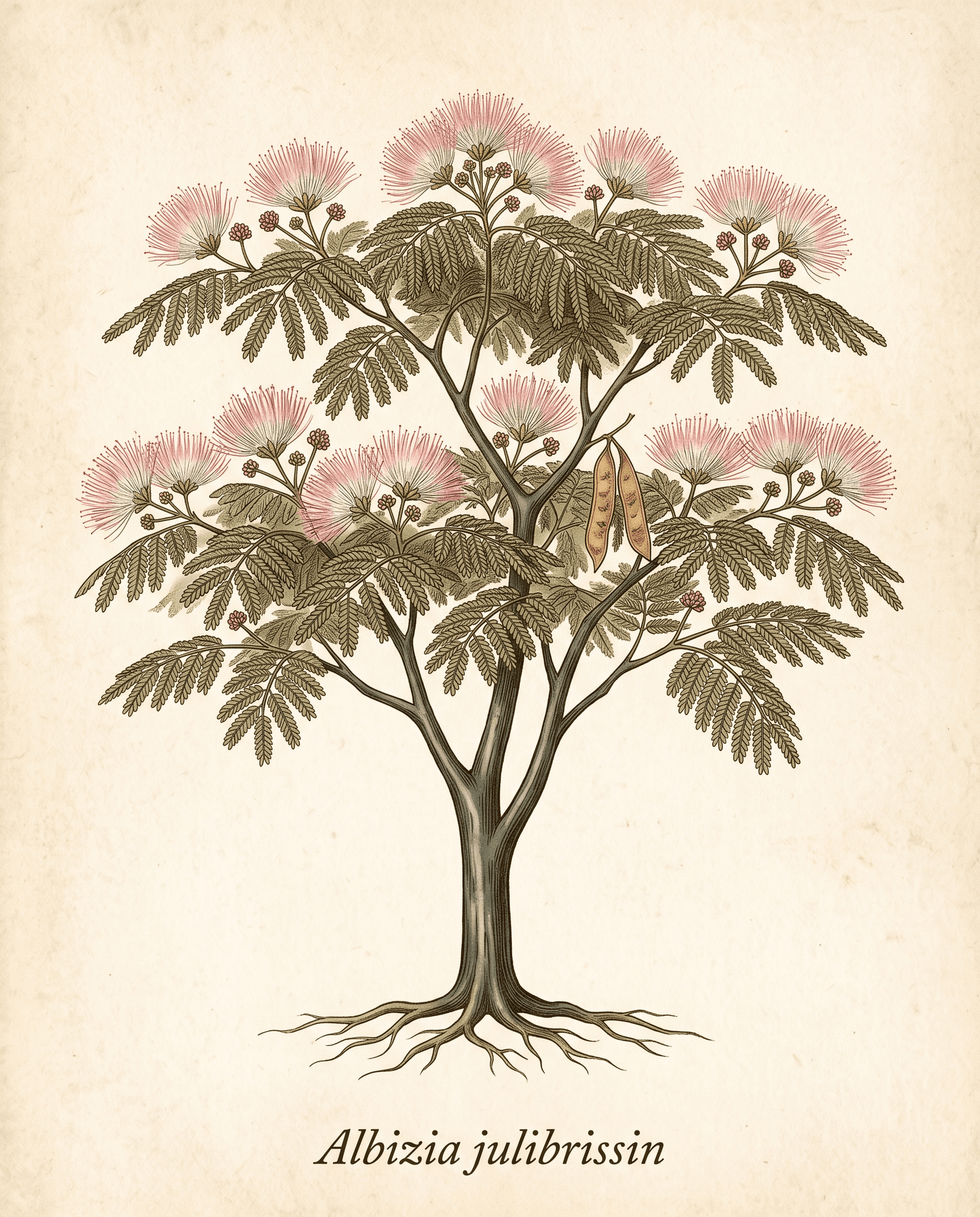
There is a tree along nearly every Southern roadside whose flowers look like something that escaped from a dream — no petals at all, just a starburst of fine silk threads, pink at the tip, white at the base, opening in the heat of June. Most people who pass her know her as a nuisance. She is on the invasive lists. She seeds into the fencerows, she comes back from the stump, she is cut down constantly and constantly returns. She is also, in the tradition that has known her longest, the single most explicit grief medicine in the materia medica.
Her Chinese name is hé huān — collective happiness. Not private happiness. Not cheerfulness. The happiness that exists between people, which is the exact thing that grief takes from us. She is prescribed for the person who cannot sleep because of sorrow, who has gone irritable and flat and unreachable, whose chest feels full of something that will not move. And here is the part that tells you who she really is: the same bark that is given for that grief is the bark that is laid on broken bones and blackened bruises. She does not distinguish between the two kinds of break. She never has.
The shape of her medicine
Mimosa is sweet, and that sweetness is the whole beginning of her medicine. In a materia medica full of bitter heart herbs — motherwort’s bite, yarrow’s sharpness, the bitter roots that drain and clear — she arrives with something almost nothing else in the cabinet offers: she is pleasant. She does not correct the grieving person. She feeds them. The sweet taste builds and restores, and for a body that has stopped being able to receive anything, that is not a small thing. It is the entire intervention.
She is neutral in temperature — neither cooling a heat nor warming a cold — which is part of why she is so gentle and so widely tolerated. What she moves is not temperature. It is constraint.
Her medicine divides cleanly into two, and the tree gives you both.
The bark is the deeper, heavier, more anchoring of the two. She is sweet with a bitter edge, and her direction is downward and inward — she settles. As a nervine and anxiolytic she takes the person whose spirit is unmoored, hovering, unable to land, and she brings them back into the body. The Chinese language for it is exact: the bark anchors the shen. Not sedates. Anchors. This is medicine for the one who has gone somewhere else since the loss and cannot find the way back.
The bark is also blood-invigorating and vulnerary, and this is where she stops being a nervine and becomes something stranger and more interesting. She moves stagnant blood. She reduces swelling. She has been used for two thousand years on fractures, contusions, sprains, and abscesses — laid over the broken place while the body knits itself back. She is a trauma herb in the oldest and most literal sense of that word.
Hold those two facts next to each other, because they are the plant: she treats the broken bone and the broken heart with the same bark, by the same mechanism, and the tradition never thought that was a metaphor. Something is stuck where circulation should be. Something has hardened around an injury. The tissue has closed and cannot open. Whether the injury was a fall or a funeral, the pattern is the same, and so is the medicine.
The flower is lighter and moves the other way — upward, outward, opening. Sweet, neutral, faintly aromatic, full of linalool. Where the bark anchors, the flower lifts. She is for the grief that has flattened into greyness, the sleep that will not come, the person who is not agitated but simply gone — no appetite, no interest, no color. The flower is also gently carminative, easing the knot under the breastbone and the epigastric ache that grief so often parks in the stomach, because unexpressed feeling stagnates in the belly as readily as in the chest.
Her anti-inflammatory and mild analgesic threads run through both parts, quieting the low chronic burn that follows any injury, in any tissue.
Taken together, the two halves of her are a single instruction: move what has hardened, and then let something sweet back in.
What lives inside her
Whose medicine she carries
Air (the spirit that will not rest, the folding leaf, sleep)
Moon
Cancer
Five of Cups
Two of Cups
Oshun
Oshun holds the sweet waters, the honey, the beauty, the capacity for pleasure. She is not frivolous — anyone who has been taught otherwise has been taught wrong. Oshun’s medicine is the insistence that sweetness is necessary, that a life without pleasure is not a life that has been protected but a life that has been diminished, and that the return of joy after devastation is one of the most serious things a person can do.
Mimosa is hers completely. She is the tree of silk and honey-colored evenings, the one whose flowers are all beauty and no utility, who was carried across the world purely because people could not stand to be without the sight of her. And her medicine is the exact thing Oshun governs: the restoration of the capacity to receive sweetness. Grief closes that capacity. It is one of the first things to go and one of the last to come back. Food loses its taste, music does not land, touch does not reach. The person is not in pain anymore, exactly. They are simply shut.
Mimosa opens what has shut. Not by force — she has no force in her — but by feeding it. This is Oshun’s method precisely: honey, not argument.
Oya (The Storm That Must Move)
But sweetness cannot come back into a body that is still full of what it has not moved, and this is where Oya stands.
The bark’s blood-moving action is Oya’s. What has stagnated must be dispersed before anything can be rebuilt — the resentment that has hardened around a loss, the anger that grief always carries and that we are so rarely permitted to name, the bruise on the inside that never came up to the surface. Oya is the wind that clears the field. She does not comfort. She moves, and the moving is the mercy.
Notice the order, because the order is the teaching. Oya first, then Oshun. The storm, and then the honey. Anyone who has tried to sweeten a grief that had not yet been allowed to move knows exactly why that sequence cannot be reversed.
The hands she has passed through
Mimosa’s names are a map of everything people have noticed about her.
In Persia, where she has grown for millennia, she is shabkhosb — night sleeper — because at dusk every leaflet on every leaf folds down along its rib and the whole tree closes itself. Her Latin epithet, julibrissin, is a European mangling of the Persian gul-i abrisham: silk flower. In Japan she is nemunoki, the sleeping tree. And in China, where her medicine was formalized, she is hé huān — shut happy, or collective happiness — a name that reaches for both the leaves folding closed at nightfall and a happy couple lying down together. The tree that sleeps, the tree that is a marriage, and the tree that heals grief are one tree, and every language that met her arrived at the same cluster of meanings without consulting the others.
In the Chinese materia medica she has been used continuously for at least two thousand years. The bark, hé huān pí, sits in the category of herbs that nourish the Heart and calm the spirit, and she is used for constrained emotion — the anger, resentment, and sorrow that have nowhere to go and so have lodged in the chest as fullness and distension. She is given for insomnia from grief, for irritability, for low mood, for palpitations. In the same breath, and out of the same bark box, she is given for fractures, bruising, swelling, sores, and abscesses. The flower, hé huān huā, works the same territory more lightly, and reaches further into the belly.
She was brought from Constantinople to Florence in 1749 by the Italian nobleman Filippo degli Albizzi, who gave the genus his name. From Europe she was carried to America around 1785 by the French botanist André Michaux, who planted her in his nursery outside Charleston, South Carolina, and sent seed north to William Bartram in Philadelphia. Thomas Jefferson had thirty-two of her seeds sown at Monticello in 1809. By 1807 she was for sale.
Sit with the geography for a moment. The tree whose name means collective happiness, whose medicine is for grief that will not move and hearts that have closed, entered this country through the port city of the slave trade and was planted, as an ornament, at Monticello. She then did what she does: she escaped the garden. She spread across the entire South, through the fencerows and the cut-over lots and the roadsides of the counties where the grief she treats was being manufactured on an industrial scale. Two hundred years later she is on every invasive list in the region, cut down as a nuisance, growing anyway.
None of that is why she works. But it is worth knowing whose land she is standing on, and what she has been standing over.
In modern Western herbalism she arrived late and by way of the Chinese literature, largely through practitioners who found her indispensable for grief, trauma, and the depression that follows loss — the herb reached for when someone has been hollowed out by something that happened to them rather than by something wrong with them. That framing has stuck, because it is accurate.
Where she works in the body
Nervous system. She is a nervine of an unusual kind: relaxing without heaviness, mood-lifting without stimulation. Her territory is specifically the nervous system that has been injured rather than merely overworked — grief, bereavement, trauma, the aftermath of a shock. She eases the insomnia of sorrow, the 3 a.m. waking, the flat greyness, the irritability that surprises the person having it. She is safe for long courses, which matters enormously here, because the nervous system does not recover from a death in a fortnight.
Cardiovascular system. The bark invigorates the blood and disperses what has stagnated, and the Chinese tradition places her in the Heart channel for reasons that are not only symbolic. The grieving heart is a heart with altered circulation and altered rhythm — the chest fullness, the palpitations, the physical ache behind the sternum are not imagined. She moves the blood that grief has slowed and eases the constriction that comes with it. She is not a cardiotonic; she does not build the heart’s strength. She unbinds it.
Musculoskeletal system. This is the one people skip, and it is the key to her. She is a classical trauma herb — bark applied to fractures, contusions, sprains, and swelling, taken internally to move the stagnant blood beneath a bruise and speed the knitting of bone. Her saponins are anti-inflammatory and her whole action is the dispersal of what has pooled and hardened around an injury. The bark that mends the bone is the bark that mends the heart. Teach her without this and you have taught half a plant.
Digestive system. Chiefly the flower’s territory. Grief and unexpressed anger park themselves under the breastbone — the knot, the epigastric ache, the appetite that has gone. She eases that constraint gently and helps the belly open again, which is often the first physical sign that a person is coming back.
Skin. External use, from the older record: bark washes and poultices for sores, boils, swellings, and abscesses. The same dispersing action, applied where the body has walled something off.
How to take her
Harvest calendar
Preparations
Bark decoction. 5–10 g dried bark per day, simmered 20–30 minutes. Mild, slightly sweet, easy to drink. This is the traditional form and the one the entire Chinese record rests on.
Flower infusion. 1–2 teaspoons dried flowers per cup of just-boiled water, covered, steeped 5–10 minutes, up to three cups daily. Delicate. Do not boil her or leave her uncovered — the volatiles that do the lifting are the first thing to leave.
Tincture, bark. 1:5 in 40–50% alcohol. 2–4 mL up to three times daily. The most practical form for sustained grief work.
Tincture, flower. 1:5 in 40–50%. Lighter dose, 1–3 mL. Often combined with the bark rather than used alone.
Bark and flower together. This is how I would give her for grief, and it is worth saying plainly: the two halves are one medicine. The bark moves and anchors; the flower lifts. Use only the bark and you settle a person who then has nowhere pleasant to land. Use only the flower and you lift a person who is still carrying the stone.
Topical. Strong bark decoction as a wash or compress over bruises, sprains, swellings, and sores. Powdered bark in a poultice for the same.
In formula. She is gentle enough to hold the center of a formula and mild enough to need company for anything acute. See the allies below.
Spiritual & ritual:
- Flowers gathered at full bloom and dried for altar work with Oshun — honey, silk, and the return of sweetness
- Bark carried or placed on the altar in work concerning a rupture between people, a reconciliation, or a grief the household is holding together
- Flowers floated in a bath for the person who has stopped being able to feel pleasure
- Sat with at dusk, watching the leaves fold — a practice for anyone who has forgotten how to close the day
- Given as tea in the house of the bereaved, which is where she has always belonged
When to hold back
Use with caution if:
- You are pregnant or nursing. She invigorates the blood and is traditionally contraindicated throughout.
- You take sedatives or sleep medication. Her effects are additive.
- You take pharmaceutical antidepressants. She is well tolerated by most, but she is working the same territory; coordinate rather than stack blindly.
Never used:
- The seed pods and seeds contain a neurotoxin and are documented as poisonous to livestock and dogs. They are not part of the materia medica. Bark and flower only. If you are wildcrafting her, know this before you hand anything to anyone.
Identification:
- She is Albizia julibrissin, and “mimosa” is three unrelated plants. She is not Mimosa pudica, the sensitive plant, and she is emphatically not Mimosa tenuiflora (jurema), which is a wholly different medicine with a wholly different profile. Apprentices ordering “mimosa bark” online will be offered all three. Buy by Latin name.
General notes: She is among the gentlest herbs in this arc and tolerates long, steady use — which is appropriate, because grief does. Large doses of bark can cause mild digestive upset. Wildcraft from prunings and from the trees already being cut; there is no shortage of her.
Who walks with her
For the grief that has hardened into bracing: Motherwort, rose.
For the grief that has flattened into absence: Rose, tulsi, damiana, lemon balm.
For the hollowed-out, depleted heart: Hawthorn, rose, milky oats.
For sleeplessness after loss: Skullcap, passionflower, linden.
For the trauma that is in the tissue as well as the spirit: Arnica externally, comfrey for the knitting, mimosa bark bridging both.
For the long haul of bereavement: Milky oats and mimosa together, taken for months rather than weeks.
The formula question with mimosa is always the same, and it is a diagnostic question before it is an herbal one: which grief is in front of you? The braced heart and the collapsed heart look nothing alike and want opposite medicines. Motherwort — bitter, cool, drying, armed — is for the one who has gone rigid, whose grief has become a clenched jaw and a racing chest and a boundary made of glass. Mimosa — sweet, neutral, opening — is for the one who has gone soft in the wrong way, who is sleepless and flat and has stopped reaching for anything. They are near-opposites, and they are both correct, and knowing which is in the room is most of the work.
And note what neither of them is: a builder. Mimosa moves and lifts; motherwort moves and steadies. Neither one rebuilds. The grieving body is very often depleted underneath everything else, and so hawthorn and rose belong beneath both of them as ground, with milky oats when the nervous system has been running on nothing for months. Movers on top of a foundation. Never movers alone.
How to know her
Plant walk: Find her in June, when she is impossible to miss, and then find the stump of one that was cut. Both are the lesson. Sit under the living one long enough for the light to change. Ask what it means that the medicine for grief in this country grows mostly where nobody planted it, and is mostly considered a problem.
The folding: Go to her at dusk and stay. Watch the leaves close — it takes longer than you expect, and you cannot catch the moment it happens. When she has finished, ask yourself what you have not let yourself close. Not release. Close. There is a difference, and the tree knows it.
Ritual of the sweetening: For someone who has been in grief long enough that they have stopped expecting to feel good again. Make a strong tea of the bark, let it cool, and stir in raw honey until it is unmistakably sweet — sweeter than you think is proper. Sit down with it somewhere beautiful. Drink it slowly. Do not make it mean anything. The point is only this: your body is capable of receiving something pleasant, and today it will. That is the whole ritual. It is smaller than the grief and it is not trying to be bigger.
Ritual of reconciliation: Where something has broken between people and both parties want it mended. Each takes tea from the same pot of bark and flower. Nothing is required to be said. She is the tree of collective happiness, and she has been given for this longer than any of us have been alive.
Journal prompts
- Where in me has something hardened around an injury, and how long has it been there?
- What have I lost the ability to enjoy — and when did I stop noticing that I had?
- What grief in me is still waiting to be allowed to move before it can be comforted?
- Who is the “collective” in my collective happiness — and are they still reachable?
- What am I refusing to close, because closing feels like betraying what I lost?
Tarot Spread
A spread for entering into relationship with Mimosa as a plant ally:
- What in me has stopped moving?
- What am I holding that hardened long before I noticed?
- What sweetness am I no longer letting in?
- What is she offering to mend that I have not asked her to touch?
- What would it take for me to close the day?
Keep a few of her flowers in a shallow bowl of water beside the cards. They will not last the night, and that is part of it.
The same plant, multiple lenses
A note before the reading, because the confusion here is common and consequential. Albizia julibrissin is not the Ayurvedic shirisha. Shirisha is her cousin, Albizia lebbeck, a genuinely classical Ayurvedic herb — and one used for an almost entirely different purpose, chiefly as a vishaghna, an antitoxic and anti-allergic remedy for the respiratory tract and the skin. If you go looking for julibrissin in the Ayurvedic literature you will find lebbeck wearing her name, and you will come away with the wrong plant and the wrong indications. She has no classical seat in Ayurveda. What follows is a reading by quality, not a citation.
By her qualities she is sweet (madhura), neutral in virya, light, and gently unctuous — building without heaviness, calming without cold.
Vata Dosha — Air & Ether
This is her clearest alignment. The Vata grief-picture is exact: the unmoored spirit, the mind that will not land, the insomnia, the anxiety that has no object, the appetite gone, the person who has become thin and dry and untethered by loss. Her sweetness builds. Her anchoring settles. She is one of the few nervines that calms Vata without also depleting or chilling. For the grieving Vata, she is close to ideal, and she is safe for the long courses that Vata’s grief requires.
Pitta Dosha — Fire & Water
She serves Pitta well in a particular register: the irritability, resentment, and smoldering anger that grief so reliably carries and that Pitta constitutions turn outward or inward as heat. Her neutral temperature means she does not cool that fire directly — she disperses the constraint the fire is trapped behind, which is often the better move, since Pitta’s anger is usually a heat with nowhere to go rather than a heat that is simply excessive. Pair her with cooling companions if the heat is genuinely high.
Kapha Dosha — Earth & Water
The most careful reading. Kapha grief is heavy, damp, immobile — the person who has gone to bed and stayed. Her sweetness could, in principle, feed that heaviness. But her action is moving, and the flower especially is light, aromatic, and lifting rather than building. In practice she is useful for Kapha’s grief provided you lead with the flower and keep the bark modest, and provided she has warming, moving companions alongside her. This is a plant where the two parts genuinely matter, and Kapha is where you will feel the difference.
She is hé huān — collective happiness — and this tradition has held her longest and understands her best. She appears in two forms, and the tradition is careful to distinguish them.
Taste & Temperature: Sweet, neutral. (Bark: sweet with a slightly bitter edge.) Channels Entered: Heart, Liver. (Some texts add Lung and Spleen.) Functions: Calms and anchors the shen, relieves constraint. Invigorates Blood, disperses stasis, reduces swelling. Nourishes the Heart. The flower additionally moves constrained Qi in the middle burner.
Calming the Shen & Relieving Constraint
Her central function and the one she is named for. She is placed among the herbs that nourish the Heart and calm the spirit, and her specific indication is emotional constraint — the unexpressed anger, resentment, grief, and frustration that have obstructed the flow of Qi and now sit in the chest as fullness, distension, and a heaviness that has no physical cause. The presenting signs are low mood, irritability, poor sleep, palpitations, forgetfulness, and a spirit that will not settle.
The word the tradition uses for the bark’s action is anchoring. This is a distinction worth teaching hard: she does not knock the shen out, she brings it back down and ties it to the body. The person who has been floating above their own life since the funeral is the person this bark is for.
Invigorating Blood & Reducing Swelling
The function that most Western teaching leaves out, and the one that makes her comprehensible. She moves Blood stasis and disperses swelling: fractures, contusions, sprains, abscesses, sores, and lung abscess. The bark is applied externally and taken internally for physical trauma.
The tradition places both functions in the same herb because it understands them as the same action. Injury — of the bone or of the spirit — creates stasis. Something that should be circulating stops. The tissue hardens around the wound. Mimosa disperses that stagnation, and it does not much matter to her whether the thing that struck was a falling beam or a death in the family.
The Flower’s Own Register
Hé huān huā shares the shen-calming function but works more in Qi than in Blood, and reaches further into the middle burner — the epigastric knot, the constrained belly, the ache under the breastbone. She is lighter, more aromatic, more lifting, and better suited to the grief that has become dullness rather than agitation.
Yin/Yang Balance
She is remarkably balanced — neutral, sweet, harmonizing. She neither tonifies strongly nor drains, neither warms nor cools. This is why she can be given for long stretches and to fragile people, and why she appears in so many formulas as a supporting rather than a chief herb.
But note what that balance means clinically: she is a regulator, not a builder. She restores flow. She does not create substance. Where the Heart Blood or the Qi is genuinely depleted — and in long bereavement it very often is — she must be paired with herbs that build, or you will move a person who has nothing left to move. Movement without substance is just exhaustion with better circulation.
For going deeper
- Bensky, Dan, Clavey, Steven, & Stöger, Erich. Chinese Herbal Medicine: Materia Medica (3rd edition). Eastland Press. — the entries on he huan pi and he huan hua; the authoritative source for everything in this monograph’s TCM section.
- Holmes, Peter. Jade Remedies and The Energetics of Western Herbs. Snow Lotus Press / Artemis Press. — for the cross-tradition energetic bridge.
- Winston, David & Maimes, Steven. Adaptogens: Herbs for Strength, Stamina, and Stress Relief. Healing Arts Press. — Winston is the practitioner most responsible for albizia’s place in modern Western practice for grief and trauma; his writing and lectures on her are the ones to seek out.
- Huang, B., Wu, Y., Li, C., Tang, Q., & Zhang, Y. (2023). “Molecular basis and mechanism of action of Albizia julibrissin in depression treatment and clinical application of its formulae.” Chinese Herbal Medicines, 15(2). — for the pharmacology of the antidepressant action.
- Michaux, André — the historical record of his Charleston nursery, and the Monticello garden books, for the tree’s arrival in the American South. Read them for what they are.
- Grief workers, funeral directors, and elders in the Black church tradition — the knowledge of what a household in mourning actually needs is not primarily herbal, and it is not written down. It lives in people. Go and sit with them.
The Conversation
Questions, noticings, what this is teaching you — leave them here. This same conversation lives in The Circle.