Pomegranate
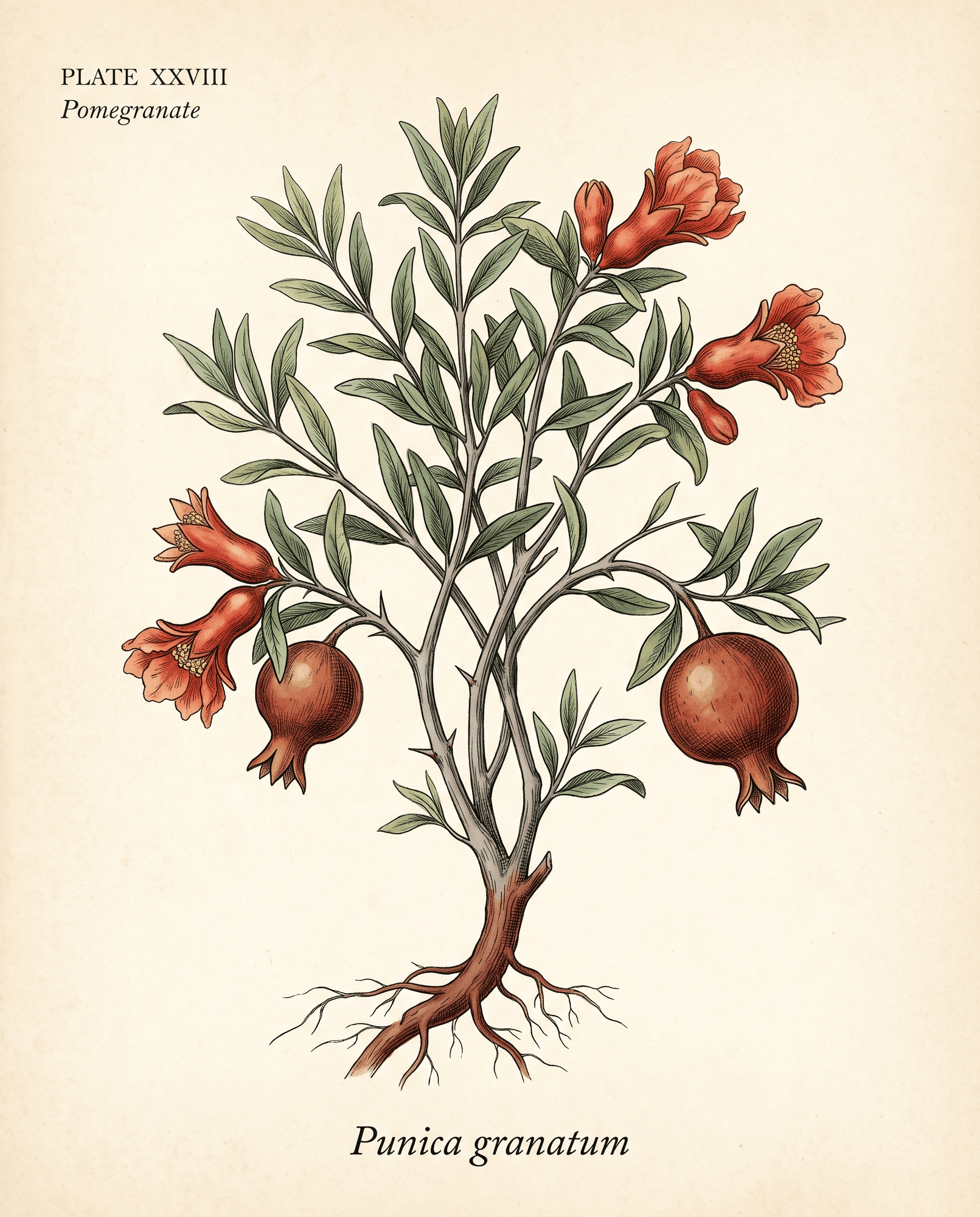
Pomegranate keeps her treasure behind a hard door. The rind is leathery and bitter, the membranes inside are pale and puckering, and nothing about her outside prepares you for what happens when she is broken open: hundreds of seeds, each one wrapped in its own bead of red juice, packed so close they press into facets like cut stone. She has been carried across deserts and seas, buried with kings, carved onto temple columns, embroidered onto the hems of priests, and smashed on the floors of bridal rooms. People have always known she was holding something.
Her medicine lives in that doubleness. The sweet, sour juice cools and feeds — it quenches thirst, settles a hot stomach, steadies the heart, and builds the blood. The rind does the opposite kind of work: it gathers, tightens, and holds, drawing in what is leaking, stopping what will not stop. She is fertility and she is the pause in fertility. She is the fruit of the wedding and the fruit of the grave. She is for anyone learning that abundance and boundaries are not enemies, that the sweetness is safest when something strong is holding it.
The shape of her medicine
Pomegranate’s movement is inward. Her astringency draws tissue together and gathers what has been spilling outward — loose bowels, bleeding gums, heavy discharge, a body that cannot seem to hold its own fluids. Her juice cools heat where it has flared: the burning stomach, the flushed thirst of summer, the hot, reactive tissue of chronic inflammation. Her drying nature answers damp, and her toning nature answers tissue that has gone lax and lost its hold.
The traditions do not agree on her temperature, and the disagreement is instructive. In Ayurveda, the sweet fruit is read as neither hot nor cold, balancing to all three doshas, while the sour fruit runs hot. In Chinese medicine, the dried rind is classed as warm. Western herbalists tend to meet the juice as cooling and the rind as a neutral-to-warm astringent. What these readings share is her sourness and her grip. The fruit leans cool; the rind leans warm. She holds both.
She is astringent first, and her astringency is where the medicine begins. The rind is dense with ellagitannins — punicalagin above all — that bind to proteins on the surface of tissue and draw it tight. This is the pucker you feel when you bite into the pith. In the gut, it firms loose stool and calms a lining that has been pouring out fluid. In the mouth, it tightens spongy gums. On the skin, it closes weeping sores.
Her hemostatic action comes from that same tightening. Chinese medicine uses the rind for bleeding that has settled into a chronic pattern — blood in the stool, bleeding hemorrhoids, heavy uterine bleeding that trickles on past its time. She does not stop bleeding by force. She firms the vessel walls and the tissue around them until they hold.
As an antimicrobial, the rind has been worked with for dysentery and infectious diarrhea for thousands of years, and the tannins carry real activity against a wide range of bacteria and some viruses and fungi. Her anthelmintic reputation is older still. The root and stem bark, with their piperidine alkaloids, were once the great tapeworm remedy of the Old World, and the rind carries a gentler share of that work. The bark’s strength is also its danger, which is why this monograph leaves it in the history books.
Her antioxidant and anti-inflammatory actions are carried in the juice and the rind alike, and they work in a way that has changed how herbalists think about fruit medicine. The large tannin molecules are barely absorbed. Instead, the gut’s own bacteria break them down into smaller compounds, urolithins, which then enter the blood. Much of what pomegranate does for the whole body, she does through the living community in the bowel. Some people’s gut flora make these compounds readily; others make very little. Her medicine is a collaboration, and it asks something of the body receiving it.
As a cardiac tonic and hypotensive, the juice has been honored in Ayurveda as hridya — pleasing and strengthening to the heart. A daily glass can ease blood pressure down modestly over weeks and help protect the lining of the vessels from oxidative wear. This is steady, food-level medicine rather than dramatic action.
She is anti-emetic in the Ayurvedic reading, cooling the stomach and settling nausea and the sourness of acid rising. She is nutritive — vitamin C, potassium, fiber, and a long reputation for building the blood in pallor and fatigue. Her seed oil is a true emollient, rich and softening to dry, depleted skin. And she is an aphrodisiac in the old sense, strengthening reproductive vitality — shukrala in Ayurveda — as she has been read in every culture that ever held her up as the fruit of the marriage bed.
Together, her actions make one gesture: holding what is precious. She nourishes, and then she keeps.
What lives inside her
Whose medicine she carries
Fire (flower, red of the aril)
Earth (rind, seed)
Pluto
Scorpio
The High Priestess
Death
Oshun
Oshun is the keeper of sweetness, and pomegranate is a sweetness you have to work for. Oshun rules the river, the honey, the brass and gold, the ovaries and the womb, the fertility that fills a house with children and the joy that fills a life with reasons to stay. She is the one who knows her own worth. The pomegranate carries all of that. She is the fruit of fertility across nearly every culture that has touched her — so many seeds in one body, so much life held in reserve. She is the fruit of love and marriage, offered to newlyweds for healthy children, broken open in bridal chambers to call in abundance.
But Oshun’s sweetness is never naive, and neither is pomegranate’s. The juice is sweet and sour at once. The seeds are guarded by a bitter membrane and a hard, astringent rind. Oshun’s medicine is the medicine of sweetness with a spine — pleasure that knows its boundaries, generosity that does not bleed itself dry. The rind is the part of her that says no: to the leak, to the drain, to the endless outpouring that leaves nothing for the self. The same fruit that feeds the whole household is the fruit that teaches the household to hold what it has.
In the body, this shows up in her reproductive and blood medicine. She builds the blood with her juice and stops its excess with her rind. She strengthens reproductive vitality and firms tissues that have grown lax. She is honored in Ayurveda as supportive through the menstrual years and into menopause. She is the medicine of the woman whose cycle bleeds too long, whose energy runs out through too many open doors, who needs to be reminded that her sweetness is a treasure and not a public fountain.
Even her form speaks this language. The flower does not drop its calyx when the petals fall. It keeps it, and the calyx rides the fruit all the way to ripeness as a small crown at her tip. She is born crowned. Nothing about her sweetness asks permission.
Oya (Seed and threshold)
Oya owns the gates of the cemetery and the winds that change everything. She escorts the dead to the threshold. She lives in the marketplace where fortunes turn. She is the storm that breaks things open. And pomegranate has been the fruit of the threshold for as long as people have been burying their dead.
In the Greek story, the seeds Persephone eats in the underworld bind her there for part of every year, and so the pomegranate became known as the fruit of the dead — the reason the world goes dark and cold each autumn, and the promise that the daughter will come back. In Egypt, dried pomegranates and their seeds were laid in tombs for the long journey. In Iran, families gather on the longest night of the year to eat pomegranate seeds and see the light return. These are not separate traditions so much as one remembering, held in many hands: the seed is what goes down into the dark and what comes back up.
That is Oya’s work. She does not shield us from endings; she walks us through them. The pomegranate carries her in the seed — the part that crosses over — and in the way the fruit breaks, bursting outward, scattering what it has carried. The French named the grenade after this fruit for exactly that explosive, seed-flinging break. There is wind in her. There is sudden change.
In the diaspora, dark red and purple fruits are among Oya’s offerings, and pomegranates appear in devotional art at her feet. She takes what is dark and sweet. She took in the Ibeji when their mother could not keep them; she knows what it is to hold children who are not her own and to mourn the ones who did not stay. The pomegranate, fruit of fertility and fruit of the grave, holds both sides of that grief without flinching. Work with her seeds when you are crossing a threshold, when you are honoring the dead, when you are learning to let the season turn.
The hands she has passed through
The pomegranate is one of the oldest cultivated fruits in the world, first tended some five thousand years ago in the rocky, sun-struck lands of Persia, in and around what is now Iran. Zoroastrian communities held her as a blessed fruit. They served her at Nowruz and Mehregan, offered her at weddings to wish the couple healthy children, and planted a pomegranate tree at each fire temple so its leaves could be used in ceremony. On Yalda Night, the winter solstice, Iranian families still gather to eat her seeds and celebrate light returning after the longest dark. Persian kings carried her image as a sign of life and power: a relief at Persepolis shows Darius the Great holding a pomegranate flower, and Xerxes is said to have fielded soldiers whose spears ended in pomegranates of gold and silver.
From Persia she moved outward along the trade routes — east into India and China, west into Mesopotamia, the Levant, and Egypt. Egyptians painted her on tomb walls, fermented her juice into wine, and buried her with the dead. Dried pomegranate seeds went into the tomb of Tutankhamun, and a large dried fruit was found in the tomb of Djehuty, an official in Queen Hatshepsut’s court. The Ebers Papyrus, one of the oldest surviving medical texts in the world, includes her among its remedies, and by the classical period the root bark was known across the region as a remedy for worms.
The Phoenicians carried her across the Mediterranean — the genus name Punica remembers them — and offered her to their goddess Astarte. In Hebrew tradition she adorned the hem of the high priest’s robe and the capitals of Solomon’s Temple, and later lore held that each fruit contained 613 seeds, one for every commandment of the Torah. She is eaten at Rosh Hashanah in the hope of a year as full of merit as she is of seeds. The Qur’an places her among the fruits of paradise, and one story holds that every pomegranate carries a single seed descended from paradise itself — which is why no seed should be wasted.
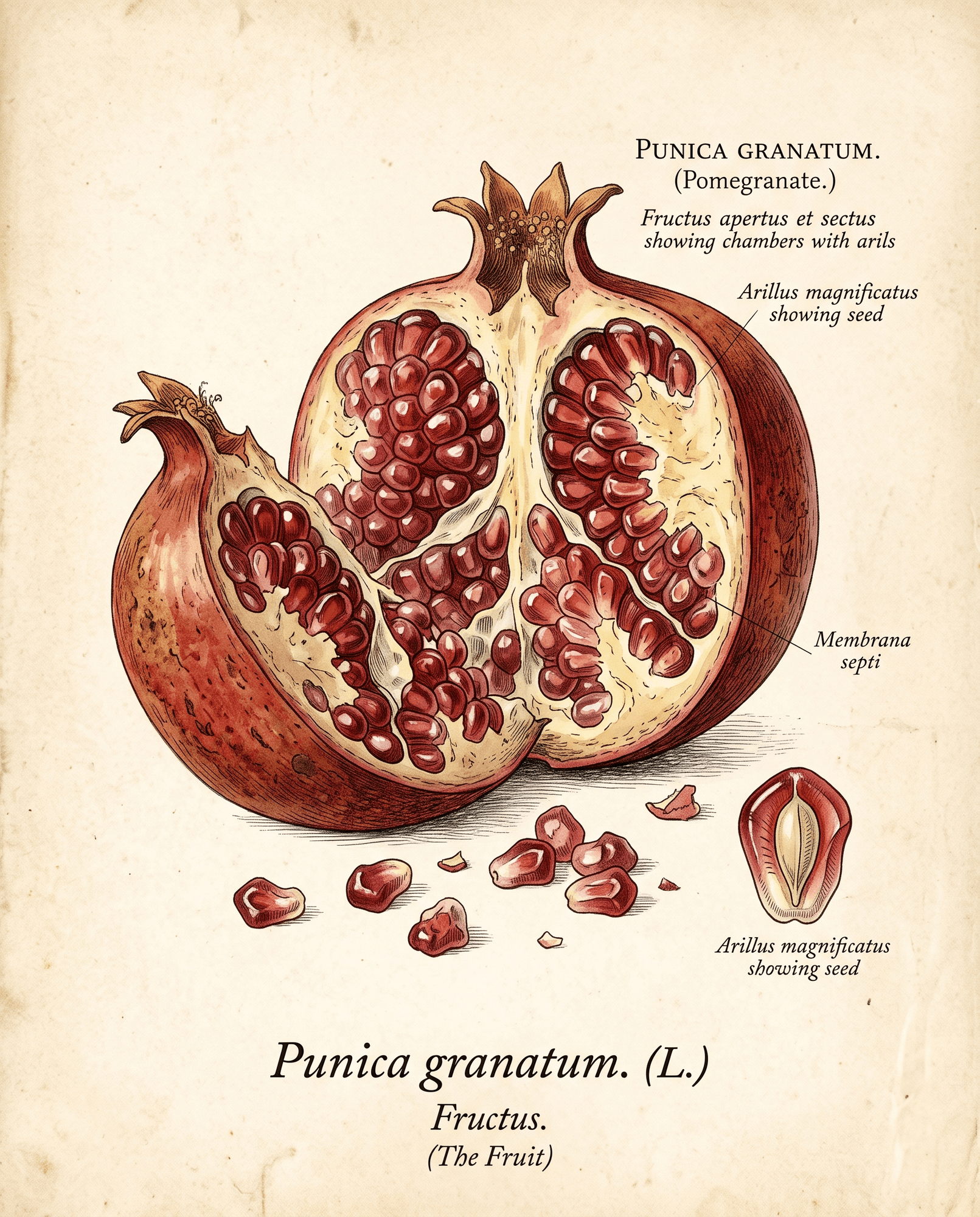
In the Greek world she belonged to Persephone and to the underworld, to Aphrodite and to marriage, and to the story of the seasons. Greek physicians used her as medicine as well as myth. Dioscorides recorded the seeds and rind among the plant remedies used to prevent pregnancy, likely applied as a pessary rather than eaten. Fertility and its pause lived in the same fruit.
When the Moors of North Africa brought their gardens and their medicine into al-Andalus, the pomegranate came with them and flourished. The city of Granada carries her on its arms, and early English speakers called her the “apple of Granada.” In Ayurveda, where she is known as dadima, she has been worked with for centuries for digestion, thirst, nausea, the heart, and the blood, and she appears in hundreds of classical formulations. In Chinese medicine, the dried rind, shi liu pi, entered the materia medica as an herb that stabilizes and binds.
Spanish ships carried her across the Atlantic, and she took root in the dry lands of Mexico and the American Southwest. In the Afro-Atlantic world, where Yoruba traditions met the Catholic calendar in Cuba and Brazil, she found her way onto the altars of the Orishas. Devotional images from those traditions show pomegranates scattered at the feet of Oya, Ogun, and Shango, and her dark red fruit belongs to the sweet, dark offerings laid before Oya.
The Eclectic and British herbalists of the 19th and early 20th centuries used the rind and flower as astringents for diarrhea, dysentery, sore throat, and bleeding gums, and the root bark for tapeworm — until safer remedies replaced it. In the last few decades she has become one of the most studied fruits in the world, and the research has returned, in its own language, to what the old healers already knew: that she is heart medicine, gut medicine, and a keeper of the blood.
She has been a crown, a grenade, a garnet, a wedding gift, a grave good, a commandment, and a promise that the light will come back. She is all of them still.
Where she works in the body
Digestive system. This is where her rind does its oldest work. For chronic loose stool, lingering diarrhea after illness, dysentery, and the kind of bowel that has lost its ability to hold, the astringent rind firms the tissue and slows the outpouring. Chinese medicine reaches for her when diarrhea has gone on long enough to weaken the body, when the rectum begins to prolapse, when parasites are part of the picture. The juice works higher up: Ayurveda honors her for a burning, acidic stomach, for nausea and the sensation of rising bile, for lost appetite and lost taste. Her mouth medicine belongs here too. The rind, powdered or decocted, is a traditional tooth powder and gargle for spongy, bleeding gums, mouth ulcers, and sore throat. And because so much of her whole-body medicine is made by gut bacteria from her tannins, a healthy digestive community is part of how she works everywhere else.
Cardiovascular system. Her juice is gentle, daily heart medicine. Taken regularly, it modestly lowers blood pressure and helps protect the lining of the arteries from the slow oxidative wear that leads to stiffening and plaque. Ayurveda counts her among the fruits that please and strengthen the heart and pairs her with arjuna and ashwagandha for that purpose. She is also blood medicine in the older sense — building the blood in pallor, fatigue, and anemia, where her vitamin C helps the body take up iron — and her rind firms vessels where bleeding has become chronic. She nourishes and she holds.
Reproductive system. The fruit of fertility carries real reproductive medicine. Ayurveda reads her as strengthening to reproductive tissue in all bodies and uses her through the menstrual years and into menopause, often alongside shatavari. Chinese medicine uses the rind where the reproductive system is leaking: heavy or prolonged uterine bleeding, chronic vaginal discharge, and seminal loss. Her seed has long been read as estrogenic, though what the seed actually carries remains debated. And she carries the opposite teaching too — the historical use of her seeds and rind to prevent conception — which is exactly why her concentrated preparations are set aside in pregnancy.
Skin. The cold-pressed seed oil is one of the richest oils the plant world offers dry, mature, and weathered skin. Its punicic acid softens and calms, and it absorbs well enough to use on the face. The rind, as a wash or powder, is an astringent for weeping sores, oozing rashes, and tissue that will not close. Ayurveda applies the fresh juice, sometimes blended with aloe, to hot rashes and insect bites. Seed oil to nourish, rind to tighten, juice to cool: three preparations for three states of the same organ.
Immune system. The rind is a broad antimicrobial. Its tannins act against a wide range of bacteria — including drug-resistant strains of Staphylococcus aureus in laboratory study — as well as the herpes simplex virus and several fungi. Traditionally this is the ground of her dysentery medicine, her gargles for infected throats, and her washes for infected skin. Her anti-inflammatory compounds, working through the gut and the blood, help quiet the chronic, low-grade fire that sits underneath so many long illnesses.
How to take her
Harvest calendar
Preparations
Fresh fruit: Eat the arils freely in season. The whole aril, seed and all, brings fiber along with the juice. This is the gentlest and most complete way to take her medicine.
Juice: Fresh or pure, unsweetened juice. In Ayurvedic practice, 20–50 mL, diluted with water, once or twice daily between meals rather than with them. As daily heart medicine, a small glass of 4–8 oz (120–240 mL) is a common food-level amount. Mixed with a little jaggery or honey, it is a classic drink for excessive thirst in hot weather.
Rind decoction: 3–9 g of dried rind per day (roughly 1–2 teaspoons, chopped, per cup of water), simmered 15–20 minutes. Take in short courses of several days for chronic diarrhea or as a gargle for sore throat and bleeding gums. Strongly astringent; not for long-term daily use.
Rind powder: Finely powdered dried rind as a tooth powder for gums, stirred into warm water as a mouth rinse, or dusted onto weeping sores and small wounds.
Rind tincture: 1:5 dried rind in 30–40% alcohol. Typical dose 1–2 mL, two to three times daily, for short courses in digestive and astringent formulas.
Flower infusion: 1 teaspoon of dried flowers per cup of just-boiled water, steeped 10 minutes. A gentler astringent tea for loose stool and a gargle for the throat.
Seed oil: Cold-pressed, used neat as a facial oil or at 5–20% in serums, balms, and body oils for dry, mature, or inflamed skin. Store cool and dark; it oxidizes quickly.
Food: Pomegranate molasses — the juice slowly boiled down to a dark, tart syrup — belongs to Persian, Levantine, and Turkish kitchens and carries a concentrated share of her medicine into daily meals. Arils scattered over greens, grains, and stews bring color and cooling to heavy food.
Root and stem bark: Historically decocted for tapeworm. Not a home preparation. See contraindications.
Spiritual & ritual:
- A halved fruit offered with honey on an altar for fertility, love, and abundance
- Seeds eaten on the longest night of the year, or at a threshold of the year, to welcome light and blessing
- Dark red fruit, often in nines, offered to honor the dead and the one who guards their gate
- Dried rind burned in small amounts or carried in a pouch to hold the household together
- A fruit broken open at a wedding, a new home, or a new venture — the more seeds scatter, the more blessing
When to hold back
Use with caution if:
- You are taking warfarin or other blood thinners. Pomegranate juice has been reported both to raise INR sharply and, when stopped, to let it fall. Keep intake consistent and tell whoever monitors your levels.
- You are taking statins, sildenafil, calcium channel blockers, or other drugs broken down by CYP3A4 or CYP2C9. Juice may slow the gut’s breakdown of these drugs; case reports include muscle breakdown with rosuvastatin and prolonged erection with sildenafil.
- You are taking blood pressure medication. Her gentle blood pressure–lowering effect can add to theirs.
- You have acute diarrhea or dysentery in its first days. Chinese medicine cautions against using the rind early, when the body is still clearing what made it sick — binding too soon can hold the pathogen in.
- You are constipated or dry. The rind’s astringency will make it worse.
- You are pregnant. Avoid concentrated rind, flower, seed, and bark preparations, given their long history as contraceptives and the alkaloids in the bark. The fruit as food is fine.
- You have a known pomegranate allergy. It is uncommon but real, usually showing up as itching of the mouth and throat.
Topical considerations: The rind’s tannins are drying and can stain skin and cloth. Patch test the seed oil before broad use, especially on reactive skin.
General notes: The root and stem bark contain pelletierine alkaloids. Overdose can cause dilated pupils, severe headache, exhaustion, and respiratory paralysis. This part of the plant belongs to trained practitioners only and is not recommended for home use. The dried rind is also classed as slightly toxic in Chinese medicine and is kept to short courses; when using it for parasites, avoid fats and oils, which increase absorption of the alkaloids. The fruit and juice are food, safe across the lifespan in ordinary amounts.
Who walks with her
For the gut and chronic loose stool: Blackberry root, raspberry leaf, cinnamon, nutmeg, dried ginger, haritaki (chebulic myrobalan).
For the heart and vessels: Hawthorn, hibiscus, rose, garlic, arjuna.
For the blood: Nettle, yellow dock, hibiscus, beet.
For reproductive vitality and the menstrual years: Shatavari, raspberry leaf, rose, motherwort.
For the mouth and throat: Sage, myrrh, calendula, clove.
For dry and mature skin: Rosehip seed oil, calendula, rose.
These allies each answer one side of her doubleness. For cold, lingering diarrhea, cinnamon, nutmeg, and dried ginger warm the gut her rind is tightening, so she binds without chilling — the same pairing Chinese medicine uses with dried ginger. Blackberry root and raspberry leaf are her fellow astringents, gentler and slower. With hawthorn and hibiscus she becomes a full heart formula — hawthorn to tone the muscle, hibiscus to cool and ease pressure, pomegranate to protect the vessels and build the blood. With rose she is doubled in sweetness and in the heart, and with shatavari her reproductive medicine gains moisture and softness to balance her drying grip. She works best in company that keeps her from holding too tightly.
How to know her
Plant walk: Find a pomegranate tree if you can — in a Mediterranean-style garden, a nursery greenhouse, a friend’s yard in a warm climate. If you cannot, sit with a whole fruit. Hold her weight in your hand. Notice the hardness of the skin, the crown at her tip, the places where the rind has begun to crack. Before you open her, ask what she is holding for you. Then open her slowly and notice what you feel when the seeds come into view.
Seasonal practice — the longest night: On the winter solstice, gather the people you love and share a pomegranate. Let each person take seeds with their fingers and name one thing they want to carry into the returning light. Eat the seeds slowly. Sit up late together. Let the dark be long and full.
Ritual of descent and return: At the autumn equinox, when the light begins to leave, take six seeds from a pomegranate. With each one, name something you are carrying down into the dark season — a grief, a question, a creative work not yet ready to be seen, a part of yourself that needs rest. Eat them. Know that what goes into the dark with you is not lost. At the spring equinox, plant a seed or break open another fruit, and name what has come back with you.
Offering for sweetness and abundance: Halve a ripe pomegranate. Drizzle the open face with honey and taste it first yourself. Set it on your altar or carry it to moving water with a small offering of coins, and speak what you are calling in — love, children, creative abundance, the return of your own joy. Leave it for five days, then return it to the earth.
Ritual of holding: When you are pouring yourself out in too many directions, dry a strip of pomegranate rind and keep it in a small cloth pouch near your bed or on your body. Each time you touch it, remember that you are allowed to keep something for yourself.
Journal prompts
- What treasure am I holding behind a hard door, and who have I let in to see it?
- Where is my sweetness being drained without being honored?
- What am I carrying into the dark season, and what do I trust will come back with me?
- Where in my life do I need to say no so that I can keep saying yes?
- What would it feel like to let myself be broken open, and scattered, and still be whole?
Tarot Spread
A spread for entering into relationship with Pomegranate as a plant ally:
- What is Pomegranate holding for me that I have not yet opened?
- Where is my sweetness leaking away?
- What boundary is she asking me to set?
- What seed am I carrying into the dark?
- What will return with me when the light comes back?
Keep a whole pomegranate or a strip of dried rind on your altar with the cards. Break the fruit open when the reading is done, and eat a few seeds while you sit with what you’ve drawn.
The same plant, multiple lenses
In Ayurveda, pomegranate is dadima, and the classical texts describe three kinds: sweet, sour, and sweet-sour. The sweet fruit is sweet, astringent, and sour in taste, light and slightly unctuous in quality, neither heating nor cooling in potency, and sweet after digestion. She is one of the rare fruits praised as tridoshic — balancing to all three doshas. The sour variety is a different medicine: heating, sour after digestion, and aggravating to Pitta. Which pomegranate you hold matters.
Pitta Dosha — Fire & Water
The sweet pomegranate is one of Ayurveda’s great Pitta fruits. She cools burning acidity, nausea, hot thirst, bleeding conditions, inflamed skin, and the irritable heat of summer. Her sweet and astringent tastes both calm Pitta, and her sweet post-digestive effect keeps her cooling all the way through. She is a classic summer drink, diluted and sweetened, for anyone who runs hot. The sour pomegranate, by contrast, will inflame Pitta — for fiery constitutions, choose the sweetest fruit you can find.
Kapha Dosha — Earth & Water
Her lightness and astringency make her appropriate for Kapha. She helps kindle a sluggish appetite, dry excess moisture, and firm loose, heavy digestion without the heaviness of most sweet fruits. The rind is especially useful for Kapha patterns of chronic loose stool and discharge. For Kapha, eat the arils rather than drinking large amounts of juice, and let her astringency lead.
Vata Dosha — Air & Ether
Pomegranate is gentle on Vata when she is sweet and ripe. Her sweet taste and sweet post-digestive effect nourish, her slight unctuousness keeps her from being too drying, and she settles nausea and restores taste and appetite. Her rind, however, is strongly drying and can aggravate Vata’s constipation and dryness if taken for long. For Vata, favor the ripe fruit and juice, take the rind only in short courses, and pair her with warming, moistening allies like ginger, shatavari, or ghee.
In Chinese medicine, the dried rind of the pomegranate is shi liu pi, classed among the herbs that stabilize and bind.
Taste & Temperature: Sour and astringent, warm. Slightly toxic. Channels Entered: Large Intestine and Stomach; some sources add Kidney. Functions: Binds the intestines and stops diarrhea. Kills parasites. Stops bleeding. Stabilizes the Kidney and stops discharge.
Binding the Intestines and Stopping Diarrhea
This is shi liu pi’s central function. She is used for chronic, watery diarrhea and long-standing dysentery, especially when the pattern has gone on so long that the body is weakened and the rectum begins to prolapse. Her sour, astringent nature holds the intestines closed. For deficiency-cold patterns she is paired with warming herbs like dried ginger; for lingering damp-heat dysentery, she is combined with bitter, heat-clearing herbs so she can bind without trapping heat. She is not used in the early stage of acute diarrhea, when the body is still expelling a pathogen.
Killing Parasites
She is a classical remedy for intestinal worms — roundworm and tapeworm — and the abdominal pain they cause, as well as for amoebic dysentery. For this purpose, the root bark was traditionally even stronger, and fats and oils are avoided during treatment because they increase absorption of the herb’s toxic alkaloids.
Stopping Bleeding
Through her astringency, shi liu pi stops chronic bleeding — blood in the stool, bleeding hemorrhoids, and uterine bleeding that is heavy or will not stop. She can be decocted alone or combined with other hemostatic herbs.
Stabilizing the Kidney and Stopping Discharge
She is used where the Kidney’s holding function has weakened: seminal emission, premature ejaculation, chronic vaginal discharge, and blood in the urine. Here her sourness helps the body retain its essence rather than letting it slip away.
Yin/Yang Balance
Shi liu pi is a binding, retaining herb that gathers inward. She is most appropriate for chronic patterns of leakage and loss — long-term diarrhea, discharge, bleeding, and seminal loss — where the body’s ability to hold has weakened. She is not appropriate for acute excess conditions, especially the early stage of an infection, or for any pattern where the body needs to expel rather than retain. Her slight toxicity keeps her to short courses. The fruit itself, sweet and sour, is gentler — a food that nourishes fluids and eases thirst — while the rind carries the binding medicine.
For going deeper
- Stone, Damien. Pomegranate: A Global History. Reaktion Books. — for the fruit’s journey across cultures, religions, and kitchens.
- Seeram, Navindra P., Schulman, Risa N., & Heber, David (eds.). Pomegranates: Ancient Roots to Modern Medicine. CRC Press. — for the history and the modern pharmacology in one volume.
- Riddle, John M. Eve’s Herbs: A History of Contraception and Abortion in the West. Harvard University Press. — for pomegranate’s long role in fertility control.
- Bensky, Dan, Clavey, Steven, & Stöger, Erich. Chinese Herbal Medicine: Materia Medica (3rd edition). Eastland Press. (See entry on shi liu pi.)
- Frawley, David & Lad, Vasant. The Yoga of Herbs: An Ayurvedic Guide to Herbal Medicine. Lotus Press.
- Grieve, Maud. A Modern Herbal. — for the British and Eclectic-era uses of rind, flower, and root bark.
- Felter, Harvey Wickes & Lloyd, John Uri. King’s American Dispensatory (1898) — see Granatum, available through Henriette’s Herbal.
- Lebo, Kate. The Book of Difficult Fruit. Farrar, Straus and Giroux. — a Pacific Northwest writer’s essay on pomegranate, myth, and fertility.
- Cabrera, Lydia. El Monte. — the foundational record of Afro-Cuban plant knowledge and its place in the religion of the Orishas.
- Conversations with elders in Iranian, Armenian, Levantine, North African, and Afro-Cuban households, where pomegranate lives at the table, at the altar, and at the solstice. Much of her knowledge is held in kitchens and ceremonies rather than books, and is worth seeking out where you live.
The Conversation
Questions, noticings, what this is teaching you — leave them here. This same conversation lives in The Circle.