Devil's Claw
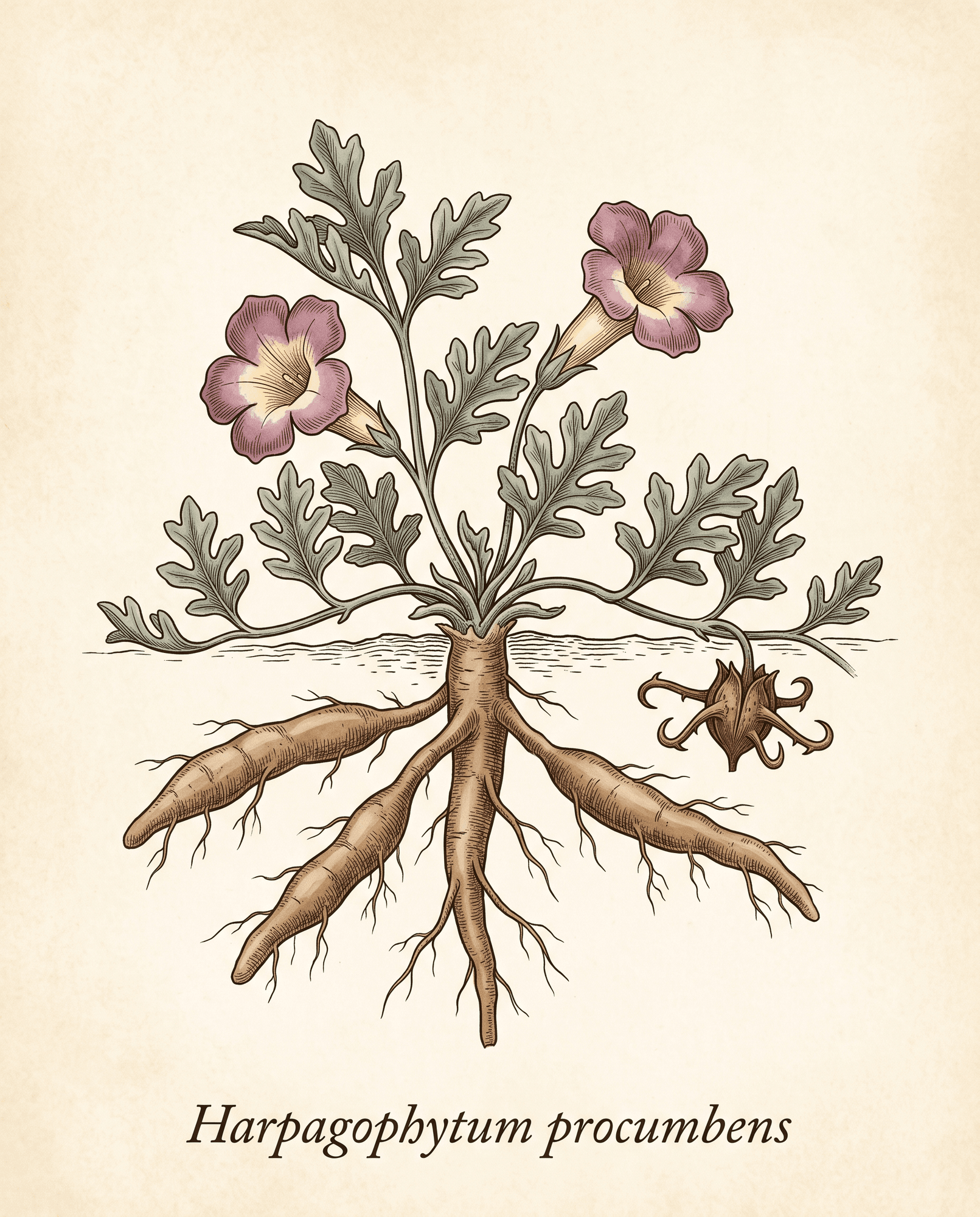
Devil’s claw lies flat against the Kalahari sand, her annual stems trailing as far as two meters out from a central crown, hollow-branched and furred with glandular hairs that weep a slow sticky sap. Her leaves are gray-green and irregularly lobed, the color coming from a fine covering of whitish mucilage cells. Her flowers are trumpets in dark velvety red and purple shading to pink, pale to yellowish-white down in the throat. Nothing about her above ground announces itself. Below ground she is a waterworks: a succulent taproot driving down through sand that holds no moisture, and thick secondary tubers branching off it horizontally, each a hand’s length and thick as a wrist, each a reservoir against a drought that will certainly come. This is a plant that survives by storing what it cannot count on receiving again.
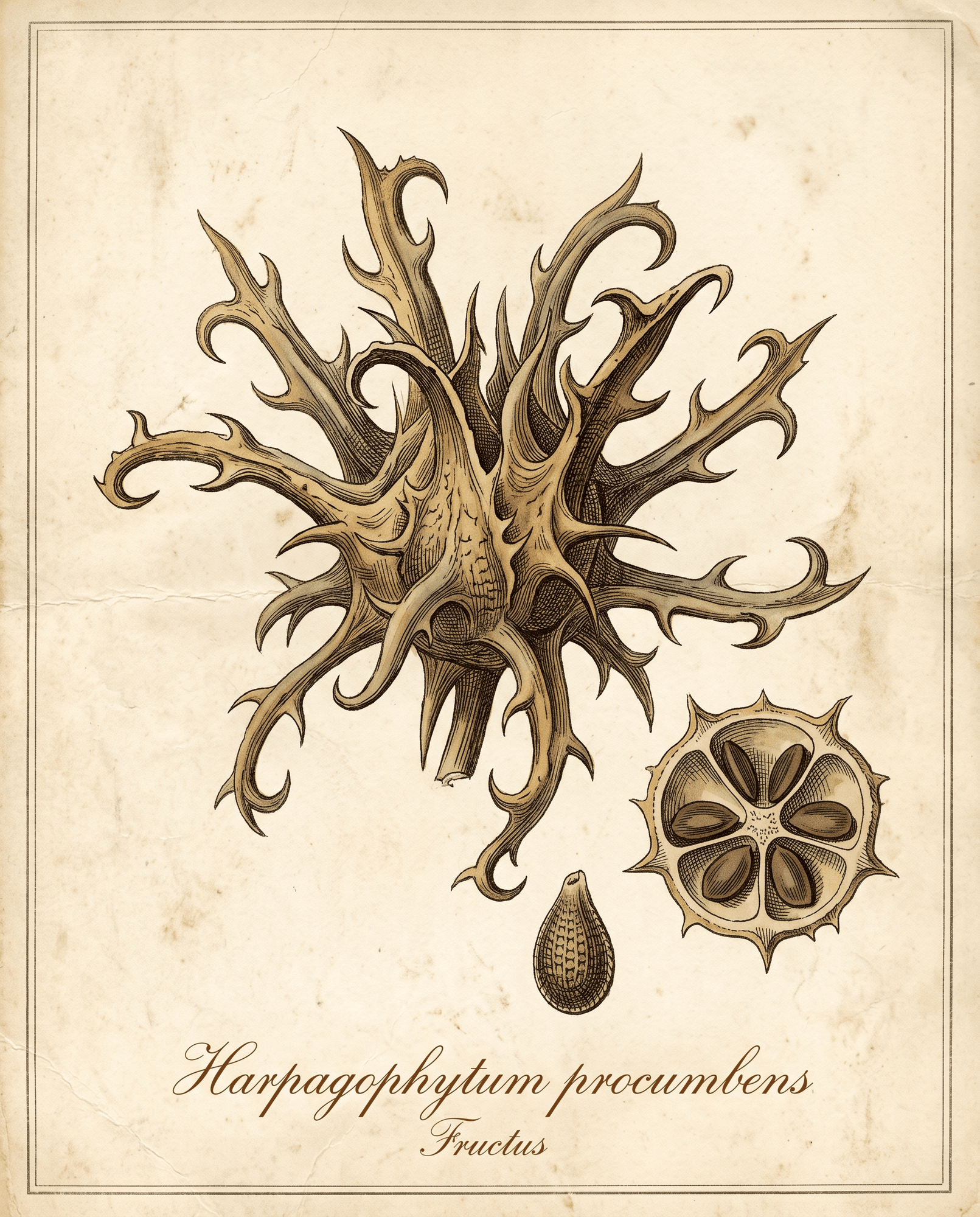
The hooks are what everyone remembers. Her fruit hardens into a woody capsule armed with long curved grapples that catch in hoof and hide and drag her seed across the desert, releasing it slowly, four seeds to a chamber, over a long season. It is these hooks that earned her the names Europe gave her — devil’s claw, duiwelsklou, teufelskralle, garra-do-diabo, grapple plant, wood spider. Her own people named her differently. To the Tswana she is sengaparile. To the San she is //x’aatataba. To the Herero, otjihangatene. Those names carry no devil in them. They belong to communities who have dug her tubers for centuries and know her as the medicine for the aching joint, the fever that will not break, the belly that has stopped working, and the long illness that wears a body down. She was named for what she catches by people passing through, and named for what she heals by the people who stayed.
The shape of her medicine
Devil’s claw moves downward and inward. She is bitter — unmistakably bitter, the kind that arrives at the back of the tongue and stays — with pungency behind the bitter and an astringency that draws tissue closed. Her medicine follows that bitterness down into the gut, the liver, and the deep tissues where chronic heat has taken up residence. Her nature is cool and drying. She meets the body that is inflamed, swollen, hot in the joints, sluggish in digestion, and worn down slowly by a condition that has been present for years. She is not fast medicine. Four to eight weeks is the usual span before her work becomes plain, and that pace belongs to what she is.
Her anti-inflammatory, analgesic, and antiarthritic actions run together and are the ones the world knows her for. The iridoid glycosides — harpagoside chief among them, sitting at between half a percent and three percent of the secondary tuber — dampen the signaling that keeps inflammation lit: cyclooxygenase-2, the nuclear factor governing inflammatory gene expression, and the cytokines that carry the alarm from tissue to tissue. She works the same territory as the pharmaceutical anti-inflammatories without the gastric erosion they cause, though her bitterness brings a gastric caution of its own. Her joint work lands in the cartilage and synovium that have been grinding for decades. She is a plant for the knee that has carried too much weight for too long, the back that has bent over other people’s work, the hands that swelled and stopped opening properly. Her reach extends past the inflamed joint into pain itself, including the burning electrical pain of damaged nerve rather than damaged tissue, which places her in lumbago, neuralgia, and diabetic neuropathy alike.
As a bitter tonic she opens the whole digestive tract from the top. Bitterness on the tongue triggers salivation, gastric acid, bile flow, and peristalsis before food has arrived, and this is her oldest recorded use in Europe — dried tuber sold to restore appetite and settle heartburn. Her cholagogue action moves bile from the gallbladder, which is the road cholesterol and fat-soluble waste leave by, and her laxative action follows the same descent. Here her astringency does something unusual. In her own tradition small doses treat diarrhea and larger doses purge; the drawing, tightening quality dominates at low dose while the bitter purgative push takes over at high. The bowel action is not a fixed direction but a quantity. She restores transit toward normal from whichever side it has failed, and taken too strong or too often she overshoots into loose stool, which the Herero recognized and taught around.
Her detoxifying and alterative threads follow from the liver and the bowel both. She shifts deep terrain slowly, and her effect is cumulative. You notice her months in, when the joint has quieted and the digestion has steadied and you cannot point to the day it changed. Traditional practice speaks of her as a purifier of blood, and her use for what were called blood diseases belongs to this same long, patient register.
Her antibacterial, antifungal, antiviral, antimicrobial, and antimalarial activities sit in the triterpenes and the quinone unique to her genus, and they are the pharmacological echo of a traditional use running far wider than pain. As a febrifuge she is trusted across her whole range for fever of any kind, and she serves as a tonic through the long infectious illnesses — tuberculosis among them, and the venereal diseases, syphilis and gonorrhea, for which she has been given orally to women and men alike. Her vulnerary action belongs to the same family: powdered tuber worked into animal fat has dressed wounds and healed burns across her range for as long as anyone has recorded, and her decoction goes to boils, sores, ulcerated tissue, and bleeding gums.
Her antioxidant action underlies most of the rest, quieting the oxidative churn that accompanies chronic inflammation, and it is through this door that her anticancer activity has been investigated — harpagoside interfering with the pathways governing cell proliferation and survival. That work is laboratory rather than clinical, and it should be held as promise. Her anti-cholesterolemic action rests in the phytosterols, which compete with dietary cholesterol at the gut wall.
Her diuretic and hypotensive actions place her in kidney and blood pressure work, and both appear in traditional use — hypertension directly, and the urinary infections she is given for. These two also explain the cardiac caution that follows her: she carries antiarrhythmic activity of her own, and that matters for anyone on rhythm medication. Her sedative quality is mild and mostly serves her pain work, taking the edge off a body braced against hurting. Her uterocontractant action is the mechanism behind her use in easing childbirth and in postpartum pain, and it is also why she has no place in pregnancy.
Her anti-diabetic action is the thread that runs deepest and gets discussed least. Tswana practitioners use her for type-2 diabetes, and the experimental work supports the tradition — aqueous extract of her secondary tubers lowering blood glucose dose-dependently in both healthy and diabetic animals. That work was done by injection rather than by mouth, which leaves open the question of what a tea or a tincture accomplishes. Her traditional use for the pancreas itself, and for pancreatitis, sits beside this.
And then there is appetite, where she becomes strange. She has been used in her own range as an appetite stimulant, which is what a bitter should do. She has also been shown to blunt food intake, acting on the ghrelin receptor — the single hunger signal the body sends up from the stomach — without fully switching it on. Tradition and laboratory point in opposite directions, and the resolution is the same as her bowel action: she does not push appetite one way. She regulates it, meeting a body whose hunger signaling has gone wrong and returning it toward sense in whichever direction that requires. Her anti-epileptic activity belongs to this same picture of a plant that steadies signaling which has begun firing without reference to need, as does the neuroprotective work behind her reputation for memory.
What lives inside her
Whose medicine she carries
Earth (tuber)
Water (held in reserve against drought)
Saturn
Scorpio
Temperance
Strength
Ogun
The hook is Ogun’s. Her fruit is a grappling iron — that is what her genus name says, a hook-plant — and it catches, holds, and does not release without tearing. Ogun is the one who understands what it is to be an implement with an edge, and what it is to be caught by one. Her thorn, her iron, her fire, her bluntness: all his.
The harvest is his too. She is deep in packed Kalahari sand, and getting her out means a digging tool, a bent back, and hours in the heat, with the discipline of taking only the secondary tubers and leaving the taproot whole so she returns next season. That is labor performed with restraint, which is Ogun at his most difficult. He is the one who can clear any road by force and must decide, each time, how much force to use.
And that decision is why the temptation medicine lives in his house. Ogun’s own story is a story about appetite outrunning the one who holds it — the rage that did not stop when it should have, the withdrawal into the forest afterward, the long reckoning with what he was capable of. His authority over restraint is not the authority of someone who never wanted. It belongs to someone who went too far, understood the cost, and built a discipline on the other side. Devil’s claw meets appetite at that same place. She is the plant for the thing that has a hold — the pull toward sugar, the reaching for what is not needed, the hand that moves before the head has finished deciding. What she loosens is not desire, which is information and should not be amputated. She loosens the hook, so that wanting can arrive and be felt and not automatically be obeyed.
In the body she meets his people where they are worn. Ogun’s domain is work — the lifting, the standing, the repetitive strain, the joint that failed because it was used the way a tool is used. She goes to that joint, and she has been going to it for generations for people whose bodies were the only implement they were given. And in the spirit she does his protective work: strengthening resolve, steadying courage under pressure, clearing unwanted influence off a person, guarding the edges of someone who has been worked on from outside. She is a plant of iron in both registers.
Babalu Aye (Chronic Disease, The Long Illness)
Babalu Aye governs what does not heal quickly. The arthritis, the ulcerated skin, the long fever, the chronic degenerative condition, the diabetes that reshapes a life across decades, the venereal disease carried in shame, the tuberculosis that settles in a chest and stays — these are his, and so is the body that carries them. He walks with a limp. He knows from the inside what it costs to move through a day in a body that hurts, and his medicine is never offered from above.
Devil’s claw’s traditional range covers nearly the whole of his territory, and what she does there is slow work. She is the tonic taken through the long illness, the alterative that shifts terrain over months, the medicine for the joint that will not be cured and can be made livable. Saturn’s discipline and Babalu Aye’s patience are the same discipline seen from two angles.
But she carries his other teaching too, the harder one. Babalu Aye’s people are the ones set outside the gate — the sick, the quarantined, the ones a village decided it could not afford to keep close. Devil’s claw was given the devil’s name by people who did not know her, on the strength of a thorn that scratched them. She is dug out of the Kalahari by ten to fifteen thousand of the poorest people in southern Africa and shipped to Europe, where she has accounted for the majority of rheumatism prescriptions written in Germany. The medicine travels and the money mostly does not. She has been named for a devil, harvested toward the edge of extinction by hands that stay poor, and she goes on healing regardless. That refusal to withhold medicine from a world that has not been fair to her is his own signature.
Christ in the Desert
Karen Rose teaches devil’s claw as the temptation herb, and works her across forty days and forty nights — the span Christ spent fasting in the wilderness.
The story turns on hunger. Christ goes into the wilderness, and he fasts, and afterward he is hungry — and it is then, not before, that the tempter arrives. The first offer is bread from stones. That offer has no force at all for someone who has eaten; hunger is what makes it persuasive. The offers that follow move outward from bread into power and dominion and the whole world seen from a height. Appetite does not stay in the belly. It travels to wherever there is something to want.
And every offer is refused. Not because the hunger was not real — he was starving, and the bread was on the table. He said no anyway, and the no held.
That is the working. Most of us are not going into any wilderness. We are living in the opposite of one: sugar in every aisle and every cupboard, the offer standing there all day at arm’s length, and the want answered before it has even been looked at. For some it is sugar. For others it is the bet, the drink, the habit that has learned exactly when to ask.
Her work is in that hunger — the bitter on the tongue, the signal sent up from the stomach, the wanting that arrives before it is examined. She does not remove the offer. Nothing removes the offer; the tempter comes out to the wilderness too. What she does is loosen the grip enough that an offer can be weighed instead of answered — enough that a person can stand in the middle of all of it and find that the no is available to them.
Then the forty days ended, and he came out. A course of her has a beginning and a finish, and the finish is not a lapse in resolve — it is the shape of the working. Whatever loosens across forty days is meant to be carried out and lived with in an ordinary week, among ordinary food, with the pull weaker and the choosing still yours.
The hands she has passed through
Devil’s claw belongs first to the San of the Kalahari, who have dug her tubers for centuries and likely for millennia, and to the Nama, the Tswana, the Herero, the Topnaar, and the Khoisan and Bantu-speaking peoples across her range. Khoisan practice takes her for childbirth, loss of appetite, and as a purgative, and for menstrual problems, indigestion, inflammation, fever, and syphilis, working her as a bitter tonic through all of it.
In San practice around Molapo, no distinction is drawn between the primary tuber and the secondary ones; either or both are used, fresh or dried, chewed straight or drawn into hot and cold infusions. She is a fever medicine for all fevers, and a tonic through the long infectious illnesses, tuberculosis included. She is used for body aches, particularly muscle and joint, and for the pains of the elderly. Small doses are given for diarrhea and larger doses as a laxative for constipation. She is taken orally for any venereal disease, and historically for the intermittent abdominal pain of peptic ulceration — a use no longer followed, since modern practice contraindicates her there. For infertility, her decoction is taken together with the roots of Ziziphus mucronata.
Herero practice, recorded by Von Koenen, gives a cold infusion: the tuber cut small, covered with cold water, left to steep, and two tablespoons taken daily for cough, diarrhea, constipation, syphilis and gonorrhea in both women and men. The same account carries its own warning — taken too often, or made too strong, the tea purges. Among the Topnaar of Namibia, a decoction of the tubers or chewing them plain addresses stomach pain and the pains that follow birth.
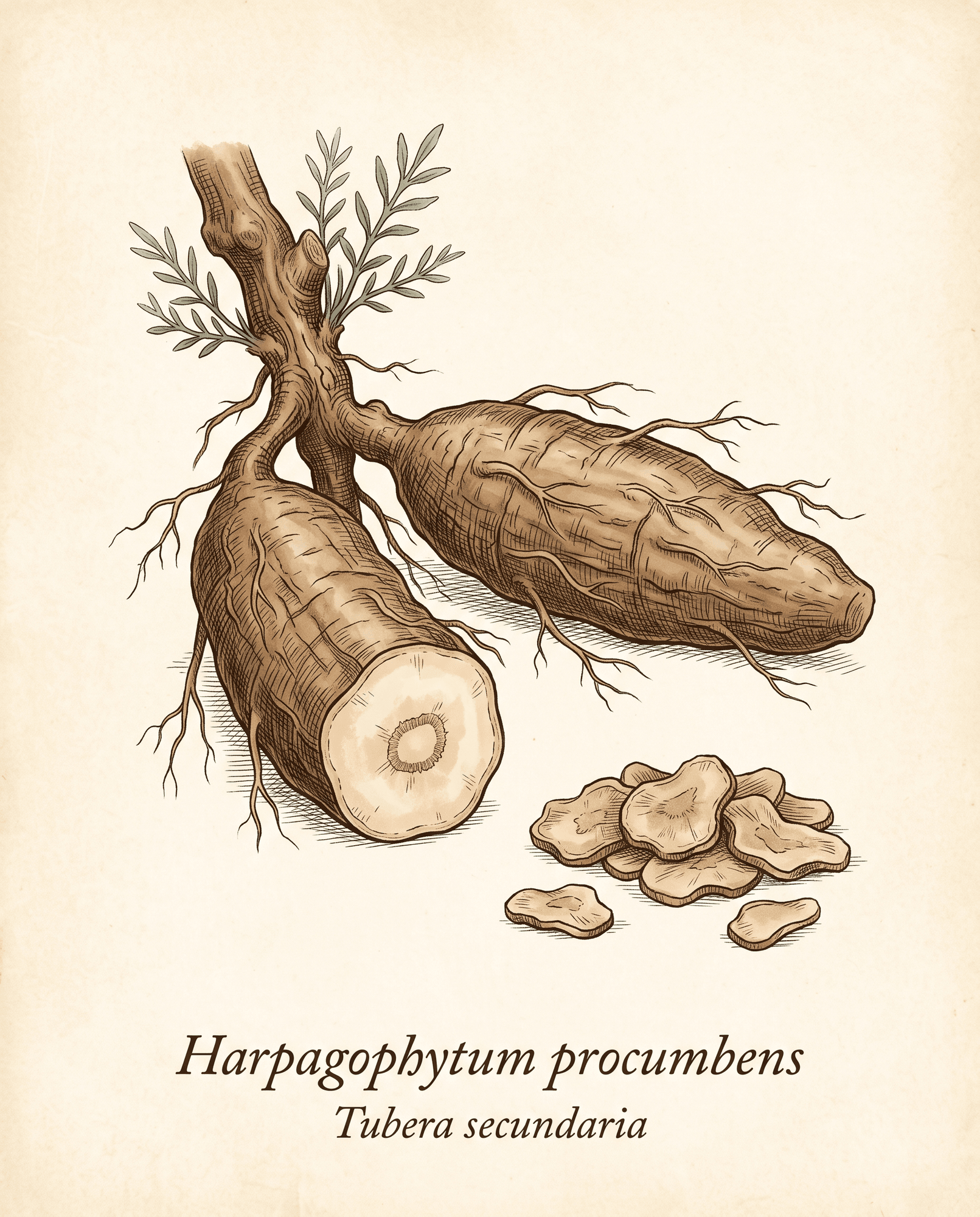
Across the wider region she appears for indigestion and dyspepsia, blood diseases and blood purification, urinary tract infection, sprains, boils, ulcers, sores, bleeding gums, gout, lumbago and lower back pain, asthma, hypertension, high cholesterol, diabetes, and diseases of the liver, gallbladder, kidney, and pancreas. Powdered and worked into animal fat or petroleum jelly, she becomes an ointment for wounds and burns. She is applied to the skin as readily as she is taken by mouth.
She has ceremonial use as well. In a cleansing practice documented in her range, her secondary tubers are mixed with the roots of asparagus and laid over cuts in the skin — the plant working on an opening in the body and an opening in the spirit as one act.
She is also food and material. The young fruit can be cooked as a vegetable before the hooks harden, the dried seeds peeled and eaten, and the black fiber of the claw worked into basketry. She was never only a pharmacy.
Her passage into Europe ran through the German colonial administration of Namibia, and it ran through two men. In 1904 a German farmer, G.H. Mehnert, was taught by San and Nama people how to use her as medicine, and carried that knowledge back. Then the pharmacist Otto Heinrich Volk, who lived in Namibia during the Second World War, came to know her there and began pharmaceutical research on her in the late 1930s, extending it through a series of studies in the 1960s that brought her to the attention of German medicine and opened the door she walked through into the Western pharmaceutical trade. Germany remains by far her largest importer and market, and the reason is not botanical. It is that Namibia was a German colony.
Demand climbed steeply from the 1960s. By 2001 she accounted for roughly three quarters of the rheumatism prescriptions written in Germany, a market worth some thirty million euros. In 2002, the peak export year, more than a thousand tonnes of dried tuber left southern Africa, representing millions of plants; Namibia alone has shipped two thousand tonnes in a single year, which may have meant as many as fifty million plants pulled from the ground.
The route from a San hunter’s knowledge to a German pharmacy shelf ran through commerce and colonial administration, and the people at the beginning of it are still at the beginning of it. She was declared a protected species in Namibia in 1977, and she is protected in every African country where she grows. A proposal to list her under the international endangered species convention was raised in 2000 and opposed — not by industry alone but on the grounds that restricting the trade would cut the income of thousands of harvesters who are among the most marginalized people in the region. She remains unregulated internationally and protected nationally, held in a bind where careless buying and refusing to buy are both harmful, and the only good answer is buying well.
Europe kept the arthritis and the back pain. Of everything above, those two crossed the ocean and became her whole identity in the pharmacy trade. The fever medicine, the blood purifier, the diabetes medicine, the wound ointment, the appetite regulator, the medicine laid over an opened body — those stayed home. Her narrowing was a market decision.
In the diaspora she has arrived recently and taken hold quickly. Black herbalists working in the ancestral traditions have opened her back out past the European framing. Karen Rose, the Guyanese master herbalist who founded Sacred Vibes Apothecary in Brooklyn and has trained hundreds of herbalists in spiritual herbalism, teaches her as the temptation herb and works her across forty days and forty nights.
Whether an older southern African practice of a forty-day course exists has not been established in the written record, and the teaching belongs to her as its author — a correspondence built by a living teacher working in the ancestral traditions, and one that should carry her name. It also reaches something the pharmacology only gestures at. When researchers finally tested her against appetite, they noted that her use as an appetite modulator was known but that the evidence was anecdotal and no clear study had been done. The teaching was ahead of the literature.
Where she works in the body
Musculoskeletal system. Where she is best documented and most trusted. She addresses osteoarthritis, chronic low back pain and lumbago, rheumatic joint pain, the immune-driven arthritides including rheumatoid and psoriatic disease, tendonitis, bursitis, gout, sprains, and the general muscular ache of a body used hard. Her action works on the inflammation itself and not on the perception of pain, which is why she takes weeks to show her work and why the benefit holds while she is being taken. She suits the joint degenerating slowly and the pain that has become a fact of daily life.
Digestive system. Her bitterness is the engine. She stimulates gastric secretion, bile flow, and peristalsis, and her oldest European application was sluggish digestion, poor appetite, dyspepsia, and heartburn after a heavy meal. Her bowel action reverses with quantity — small amounts astringing and settling diarrhea, larger amounts purging — which makes her a regulator of transit and a plant to dose with attention.
Hepatic system. She is choleretic and cholagogue, encouraging the liver to make bile and the gallbladder to release it, and traditional use across her range names liver and gallbladder disease directly. Her phenolic acids are hepatoprotective. Bile is how cholesterol and fat-soluble waste leave, so her alterative and cholesterol work both depend on this gate being open. Her activity in the liver is also why she may interfere with drugs metabolized there.
Nervous system. Her analgesia reaches past inflamed tissue into pain itself, including neuropathic pain — the burning, shooting, electrical pain that follows a damaged nerve. This puts her in neuralgia, lumbago, and diabetic neuropathy, where the two halves of her medicine meet in one condition. Her anti-epileptic activity belongs here, alongside a mild sedative quality that eases a body braced against hurting, and the neuroprotective research underlying her reputation for memory.
Endocrine and metabolic system. Her blood sugar work is traditional among Tswana practitioners and supported experimentally, and her effect on the ghrelin receptor places her in the regulation of hunger signaling. Together these make her a plant of metabolic relationship rather than metabolic force. Her traditional use for the pancreas and for pancreatitis sits alongside this, as does her phytosterol contribution to cholesterol balance — metabolic disorder rarely arrives alone.
Immune system. Her role in fever across southern Africa is old and broad, and her antimicrobial, antifungal, antiviral, and antimalarial activities give that use a mechanism. She has served as a tonic through long infectious illness, which is a different job from acute antimicrobial work — sustaining a body through a siege rather than winning a skirmish. Her use in the immune-driven arthritides connects her fever work and her joint work in one action.
Integumentary system. Powdered and infused into animal fat or petroleum jelly she becomes a wound and burn ointment, and her decoction serves as a wash for boils, sores, and ulcerated skin, or as a rinse for bleeding gums. Her anti-inflammatory, antimicrobial, and vulnerary actions all land here, and topical use avoids the gastric caution entirely, which keeps her available to people who cannot take her by mouth. The cleansing ceremony that lays her tuber over cuts belongs to this territory in both registers at once.
Respiratory system. Traditional use names cough and asthma, given in the Herero cold infusion and elsewhere. This is the thinnest documented part of her range and rests on ethnobotany rather than trials, though the mechanism is plausible — anti-inflammatory and mildly antispasmodic action reaching airway tissue that is inflamed and reactive.
Urinary system. She is diuretic, and traditional use names urinary tract infection and kidney disease. Her antimicrobial activity and her flushing action work together here, which is the ordinary logic of urinary herbs. Kidney inflammation appears in her record repeatedly.
Reproductive system. She is uterocontractant, which accounts for her use in easing childbirth and in postpartum pain, and for menstrual trouble and cramping. She appears in fertility work in San practice, paired with Ziziphus mucronata. The same action rules her out through pregnancy entirely.
Cardiovascular system. She is hypotensive and carries antiarrhythmic activity, and hypertension and high cholesterol both appear in traditional use. This is the least-explored corner of her medicine. Because she works on the heart’s rhythm directly, anyone taking rhythm medication needs to know she does too.
How to take her
Harvest calendar
Preparations
She works well as a simple. Many plants need company to be useful; she carries a formula on her own, and a single-herb preparation of her is a reasonable place to start.
Tea or infusion: 1–2 teaspoons dried tuber steeped in a cup of hot water 10–15 minutes, up to three times daily.
Decoction: Around 1.5 g daily of dried secondary tuber, simmered. She is dense woody material and wants real heat and time. Expect intense bitterness and do not sweeten it if the bitter action is what you are after.
Cold infusion: The Herero method — tuber cut small, covered with cold water, steeped several hours or overnight, two tablespoons daily. Gentler on a sensitive stomach than a strong decoction, and the traditional vehicle for her cough, bowel, and venereal work.
Tincture: 1:5 in 25% ethanol, 30–60 drops two to three times daily, diluted in water or juice. Her iridoid glycosides are water-soluble, so a low-proof menstruum serves her; sustained acidic menstruums risk hydrolyzing them.
Elixir (1:1): 0.1–0.25 mL orally three times daily.
Capsule or tablet, extract: 500–1000 mg daily, taken with food to reduce stomach upset.
Crude tuber, for joint work: Clinical trials have used up to 9 g daily, or 1–3 g of extract, or standardized extract delivering 50–100 mg harpagoside.
Topical: Powdered tuber infused into animal fat, petroleum jelly, or a plant oil base for wound and burn ointment. Salve or liniment for arthritic joints, sprains, and soft tissue pain. Strong decoction as a wash for boils, sores, and ulcerated skin, or as a mouth rinse for bleeding gums.
On dose direction: Her bowel action reverses with quantity. Small doses settle loose stool; larger doses move it. Start low and let the body report back, particularly with anyone whose digestion is already unreliable.
On duration: Joint and inflammatory work asks four to eight weeks before it can be fairly judged, and appetite work reports a similar lag — nothing at all for the first stretch, then a change noticed rather than felt arriving. But she is not a long-term plant. Three to four months is the outer limit, and a course with a defined end suits her better than open-ended use.
Spiritual & ritual:
- A forty-day course taken deliberately, with a start and an end, for loosening a compulsion — not a supplement kept in the cabinet
- Tuber mixed with asparagus root and laid over a cut, in the old cleansing practice, for an opening that is more than physical
- Carried or kept at the threshold for protection, and to turn back influence that has been aimed at you
- A tuber placed on the altar when the question is what has me hooked
- The hooked fruit kept where it can be handled, as an object lesson in catching and being caught
- Taken before a gathering where the pull will be strong, once the forty days have laid the ground
- Bitter drunk without sweetening as an offering of willingness
When to hold back
Do not use if:
- You have an active gastric or duodenal ulcer, gastritis, or significant reflux. She stimulates acid secretion. Her own tradition once used her for the abdominal pain of peptic ulceration; modern practice does not, and modern practice governs here.
- You have gallstones or bile duct obstruction. Her cholagogue action could aggravate an obstruction.
- You are pregnant or breastfeeding. She is uterocontractant, notwithstanding her traditional use at the moment of birth itself.
- The person is a child.
Use with caution if:
- You take antiarrhythmic, chronotropic, or inotropic cardiac medications. She carries her own cardiac activity; avoid the combination.
- You take medications metabolized in the liver. Her hepatic activity may alter how they are processed.
- You take anticoagulant or antiplatelet drugs. Work with a prescriber on timing and dose before adding her.
- You take glucose-lowering medication — metformin, sulfonylureas, insulin. Her blood sugar effects may be additive.
- You take antihypertensives. Her hypotensive action may be additive.
Duration: Not for long-term use. Three to four months maximum, then a break.
Allergy and family: She belongs to the Pedaliaceae — the sesame family — and sesame is a significant allergen, so consider cross-reactivity in anyone with a known sesame allergy. A caution against her for people sensitive to daisies, ragweed, or calendula circulates widely, but those are Asteraceae and unrelated to her; the botany does not support it. Documented hypersensitivity reactions to her include rash, hives, and facial swelling, and these can occur without any family relationship.
Reported adverse effects: Uncommon and mild where they occur — nausea, stomach upset, diarrhea, vomiting, abdominal pain, headache, and vertigo. Loose stool most often means the dose was too high rather than that she is wrong for the person.
Topical considerations: Well tolerated. Patch test on broken, burned, or ulcerated skin before broad application.
Species and sourcing: Two species are traded, H. procumbens and H. zeyheri, each with subspecies of its own. They are used interchangeably in commerce although their chemistry differs and equivalence has never been demonstrated; H. zeyheri is reportedly not permitted for sale in the United States, and DNA barcode work on commercial supplements has found substitution to be a live problem. Ask what you are buying and buy from someone who can answer. Source her carefully. The World Health Organization has described her as effectively extinct in the wild under current harvesting practices. She is wild-harvested, protected in every country where she grows, and dug by harvesters among the poorest people in her range. Look for secondary tubers only, FairWild certification where you can get it, Namibian permitted supply chains, and traceability. Certification is generally only achievable by exporting companies rather than by harvesters themselves, so even fair trade here runs through a middleman — buy as well as you can and know that is what you are doing.
Who walks with her
For joint pain and inflammation: Turmeric, ginger, cayenne, willow bark, meadowsweet, frankincense, nettle leaf.
For the temptation and appetite work: Gentian, dandelion root, orange peel, wormwood in small measure, gymnema.
For blood sugar: Cinnamon bark, fenugreek, dandelion root, hibiscus, tulsi, bitter melon.
For fever and infection: Elder, yarrow, boneset, garlic, echinacea.
For the gut, when her bitterness needs holding: Marshmallow root, slippery elm, licorice, fennel, chamomile.
For the liver and gallbladder: Dandelion root, burdock, milk thistle, artichoke leaf.
For wounds and burns, topically: Calendula, plantain, comfrey, honey.
She stands alone better than most, so the question with her is usually not what she needs but what she is being asked to join. Her closest working relationship in the diaspora is with the warming anti-inflammatories — turmeric, ginger, cayenne, garlic — where she supplies the cool bitter descent and they supply the circulatory push, so the medicine reaches the joint instead of only quieting the signal. Karen Rose’s anti-inflammatory tonic pairs her with exactly this company. With the bitters she is doubled rather than complemented; gentian and dandelion take the same action wider across the palate and deeper into the liver. And when her bitterness is more than a gut can hold, the demulcents are not a compromise but a requirement — marshmallow and licorice let her stay in a formula she would otherwise have to leave.
How to know her
Sitting with the hook: Hold one of her fruits, if you can get one, or a photograph of it if you cannot. Feel how the hooks are shaped — curved back, designed to catch on the way out rather than the way in. Ask the question she asks: what has me hooked. Not what is wrong with me. What has hold of me, and what is it getting from the arrangement.
The forty days: Begin on a day you have chosen rather than a day that happened. Take her twice daily, bitter and unsweetened, before meals. Expect nothing for the first two weeks; most people abandon a bitter in week one because it feels inert, and the arrival is later than patience usually stretches. Mark the days somewhere you will see them. On the fortieth day, stop, and take stock of what changed without your effort and what still requires it. The course ending is part of the medicine — she is an ally called upon, not a crutch carried.
Cleansing the opening: From the old practice. When there is a cut, a wound, or a place where the body has been opened, her tuber is mixed with asparagus root and laid over it. Work it as it was given: attend to the physical opening and the spiritual one as one act, and do not hurry the covering.
Turning back what was sent: For the sense of having been worked on from outside — the influence you cannot name, the heaviness that arrived with someone else. Keep her at the threshold, or carry a piece of tuber on you. Her hooks catch what is coming toward you before it reaches your skin. This is iron medicine and it is not gentle; use it when gentleness has already been tried.
Ritual of the desert: Go somewhere dry and unshaded, in the heat if you can bear it. Sit long enough to be uncomfortable. Consider what she does in that condition — stores water underground against a rain that may not come, and asks nothing of the surface. Ask what you have been storing, and whether you have been storing anything at all.
Offering the bitter: Make a cup of her decoction and drink it without honey, without sweetening, without hurry. Let the bitterness be the whole experience. This is a small practice with an old logic — the willingness to take something unpleasant on purpose, in exchange for nothing immediate.
Journal prompts
- What has me hooked, and what is it giving me that I have not admitted wanting?
- Can I feel a desire all the way through without acting on it?
- Where in my body am I paying for work that was never mine to carry?
- What am I storing against drought, and what have I refused to store?
- Where have I called something a devil because it caught me, without asking what I was walking past?
- What in me has been narrowed to one use by people who found the rest inconvenient?
- What has been aimed at me that I have been absorbing instead of turning back?
- What would forty days of anything look like, in my actual life?
Tarot Spread
A spread for entering into relationship with Devil’s Claw as a plant ally:
- What has me hooked?
- What does the hook give me — the part I do not say out loud?
- Where in my body is this arrangement being paid for?
- What does she loosen, if I let her?
- What remains mine to choose, even after the loosening?
Keep a piece of her tuber or a hooked fruit on the altar with the cards. This is a spread that goes badly if hurried; leave the cards out overnight if the answers do not settle.
The same plant, multiple lenses
Devil’s claw has no classical entry in the Ayurvedic materia medica. She is a southern African plant and her lineage runs through the Kalahari, not the Indian subcontinent. What follows is her medicine read through Ayurvedic logic rather than transmitted within it, offered as a way of placing her alongside plants the tradition does name.
By that logic her rasa is tikta — bitter, dominant and unmistakable — with katu pungency behind it and kashaya astringency drawing underneath. Her virya is shita, cooling. Her vipaka is katu, in keeping with her drying, downward-clearing action. She is langhana — reducing, lightening, depleting.
Pitta Dosha — Fire & Water
Her strongest alignment. Bitter and cooling is the classical answer to excess Pitta, and the conditions she treats read as a list of Pitta in the tissues: hot swollen joints, inflammatory skin, fever, burning digestive heat, the irritability of a body running hot for years. She drains that heat downward and out instead of suppressing it in place. For a Pitta-dominant person with inflammatory joint disease she is well suited, within her duration limit.
Kapha Dosha — Earth & Water
She serves Kapha well. Her bitter, pungent, astringent, drying, reducing nature meets Kapha’s heaviness, damp stagnation, sluggish digestion, and the boggy swollen quality of Kapha-type joint trouble. Her metabolic work — blood sugar, cholesterol, appetite regulation — falls squarely where Kapha imbalance shows itself. Bitter and astringent are both great reducers of Kapha, and she carries both without qualification.
Vata Dosha — Air & Ether
Vata is where she needs holding. Cool, dry, light, astringent, and depleting is the Vata aggravation profile almost exactly, and Vata-type joint pain — the cracking, migrating, cold-worsened ache of dryness in the joint rather than heat — is not her pattern. A Vata-dominant person who still needs her must have her buffered: warming and moistening company such as ginger, cardamom, ashwagandha, marshmallow, licorice, and sesame oil, taken with food and never for long unbroken stretches. Her appetite-regulating and purgative capacities deserve particular care here, since Vata depletion sits badly with a suppressed appetite and a loosened bowel.
Devil’s claw does not appear in the Chinese materia medica. She has no pinyin name in the classical texts, no channel assignment handed down, no place in the formula tradition. What follows is her medicine differentiated by TCM pattern logic — the way a practitioner might place an unfamiliar plant by watching what it does — rather than a classification received from the lineage. Where the placement is inference, it is inference.
Taste & Temperature: Bitter, pungent, astringent, cool to cold. Channels Entered: Liver, Stomach, Spleen, Large Intestine, and the sinews and joints. Functions: Clears Heat and drains Fire from the sinews. Dispels Wind-Damp obstruction. Moves Liver Qi and awakens the Stomach. Drains Damp-Heat downward. Clears Heat and resolves toxicity.
Clearing Heat & Draining Fire from the Sinews
Her joint work reads as Heat lodged in the sinews and channels — the hot, swollen, red, painful joint that worsens with warmth and improves with cold. She drains that Fire downward. This differentiates her sharply from the warming acrid herbs used for cold-type joint pain, and misapplying her to a cold pattern will do nothing useful and may deepen the cold.
Dispelling Wind-Damp Obstruction
Chronic degenerative joint disease sits in TCM as Wind-Damp-Heat bi syndrome — painful obstruction, with the Wind accounting for pain that moves, the Damp for swelling and heaviness, the Heat for redness and warmth. She addresses the Heat and Damp aspects directly and the obstruction through her moving, descending action. In long-standing cases where the pattern has reached the Kidneys and the bones themselves, she wants tonifying company she does not supply.
Moving Liver Qi & Awakening the Stomach
Her bitterness works on Liver Qi stagnation and on Stomach Qi that has stopped descending — the poor appetite, the reflux, the fullness after eating, the irritability that builds through a day. Her appetite regulation reads well in this frame, where the aim is never to increase or decrease appetite but to restore the Stomach’s ability to receive and the Spleen’s to transform. Her acid-stimulating caution reads here as Stomach Yin deficiency with Fire, where more Heat is the last thing wanted.
Draining Damp-Heat Downward
Her diuretic and purgative actions read as clearing Damp-Heat through the lower gates — the urinary infection, the kidney inflammation, the venereal disease, the constipation of Heat drying the bowel. That her bowel action reverses at low dose fits this frame too: her astringency dominates at small quantity, meeting Spleen Qi that has failed to hold.
Clearing Heat & Resolving Toxicity
Her fever work and her topical use for boils, sores, burns, ulcerated skin, and bleeding gums fall into this classical category — Heat-toxin manifesting on the surface. Her wide antimicrobial activity is the pharmacological reading of the same thing.
Yin/Yang Balance
She is Yin in nature and a clearer of excess Yang — cool, bitter, descending, draining. She belongs to conditions of excess Heat and Damp and to bodies running hot. She is wrong for cold deficient patterns: pale tongue, weak digestion, loose stool from cold, cold extremities, joint pain that eases with warmth. She drains rather than tonifies, and in a depleted person she needs holding inside a formula that builds while she clears.
For going deeper
- Mncwangi, N., Chen, W., Vermaak, I., Viljoen, A.M., & Gericke, N. “Devil’s Claw — A review of the ethnobotany, phytochemistry and biological activity of Harpagophytum procumbens.” Journal of Ethnopharmacology 143, no. 3 (2012): 755–771. The most thorough ethnobotanical account, built partly on focus groups with Botswana communities — Tswana use for type-2 diabetes, the dose-dependent bowel action, the venereal and peptic-ulcer uses, the fertility pairing with Ziziphus, and the Herero cold infusion via Von Koenen.
- Gxaba, N. & Manganyi, M.C. “The Fight against Infection and Pain: Devil’s Claw (Harpagophytum procumbens) a Rich Source of Anti-Inflammatory Activity: 2011–2022.” Molecules 27, no. 11 (2022): 3637. Carries the asthma, pancreatitis, tuberculosis, liver, kidney, syphilis and gonorrhea record, the animal-fat wound ointment, and the asparagus-root cleansing ceremony.
- Diaz-Silveira, G.L., Deutsch, J., & Little, D.P. “DNA Barcode Authentication of Devil’s Claw Herbal Dietary Supplements.” Plants 10, no. 10 (2021): 2005. On species substitution in commercial product, and why asking what you are buying is not paranoia.
- Brendler, Thomas. “From Bush Medicine to Modern Phytopharmaceutical: A Bibliographic Review of Devil’s Claw (Harpagophytum spp.).” Pharmaceuticals 14, no. 8 (2021): 726. Traces the commercialization honestly, including the roles of colonialism and absent regulation.
- SANBI PlantZAfrica entry on Harpagophytum procumbens. South African National Biodiversity Institute — the botanical and ethnobotanical record from within her native range, including her names across Setswana, San, Herero, and Afrikaans, and the widest published list of her traditional indications.
- Food and Agriculture Organization, non-wood forest products country report on devil’s claw in the German trade. For the colonial supply chain and the shape of the export market.
- Rose, Karen M. The Art & Practice of Spiritual Herbalism: Transform, Heal, and Remember with the Power of Plants and Ancestral Medicine. Her framework for working plants as spiritual allies, and the tradition this monograph’s spiritual reading sits within.
- Rose, Karen M. Apprenticeship program, Sacred Vibes Apothecary, Brooklyn. The temptation correspondence and the forty-day working are taught here, not in the published book.
- Mahomed, I.M. & Ojewole, J.A. “Analgesic, antiinflammatory and antidiabetic properties of Harpagophytum procumbens DC (Pedaliaceae) secondary root aqueous extract.” Phytotherapy Research 18, no. 12 (2004): 982–989. The blood sugar work. Note the intraperitoneal route.
- Torres-Fuentes, C., et al. “Devil’s Claw to Suppress Appetite — Ghrelin Receptor Modulation Potential of a Harpagophytum procumbens Root Extract.” PLOS ONE 9, no. 7 (2014): e103118. The appetite work, and an honest acknowledgment that the traditional use preceded the research.
- European Medicines Agency, herbal monograph on Harpagophyti radix. For the European traditional-use record and the full range of extract ratios and menstruums in registered preparation.
- FairWild Foundation, the Sustainably Harvested Devil’s Claw project established in Namibia in 1997, and the Kew Millennium Seed Bank, which holds her seed against the threat of extinction. For sourcing, harvester compensation, and what sustainable harvest requires on the ground.
- The San Council of Namibia and the Ju|'hoansi of the Nyae Nyae Conservancy. Her knowledge originates with these communities, and they remain the authority on her. Anything written about her that does not route back to them is incomplete.
The Conversation
Questions, noticings, what this is teaching you — leave them here. This same conversation lives in The Circle.